Inspiration
In India, a Thalassemia patient dies every hour due to delayed blood transfusions.
We read about a 23-year-old Thalassemia warrior who contracted HIV after a transfusion, because the hospital didn’t perform basic safety tests.
Another child in Jaipur’s JK Lon Hospital missed transfusions for two weeks because the blood bank ran dry.
During the COVID lockdown, families of 10,000+ Thalassemia patients struggled as blood donations dropped by 75%.
These are not just numbers. These are lives, dreams, children, mothers, brothers.
Previously we built Scarlet Save, an app that uses AI to detect anemia from a non-invasive method using nail and eye images, offering voice-based recovery plans, multilingual support, and doctor alerts.
But then we asked ourselves: what if they never get the blood in time?
Scarlet Save can help after anemia is detected... but what if we could stop the emergency from happening in the first place?
That's when Scarlet Link was born.
A platform that doesn't just react, it predicts, connects, and saves lives.
Inspired by real pain. Built for real impact.
What it does
Scarlet Link is a lifeline for Thalassemia patients combining AI, empathy, and urgent action.
It offers:
- Real-Time Donor Matching : Uses location + donor database (via e‑RaktKosh or simulation) to instantly connect patients to nearby donors
- AI-Powered Donor Prediction : Analyzes past donor behavior to forecast who is most likely to respond, even before a request is made
- Emergency SOS Mode : One tap sends alerts (SMS or app) to the top 5 predicted donors nearby
- Gemini-Based AI Care Assistant : Speaks to patients in their own language, offering reminders, emotional support, and health guidance
- Voice-First Interface for Rural Use : Works even without typing, can guide non-literate users in Tamil, Telugu, Hindi, Bengali, and more
- Doctor & Family Dashboards: To track transfusion history, iron levels, emotional wellbeing, and follow-up care
- ABHA Integration : To ensure safe, secure medical data sharing
How we built it
We’re building Scarlet Link during the hackathon, but our foundation is Scarlet Save, our award-winning app that detects anemia non-invasively and supports patients with multilingual AI.
Scarlet Save helped detect.
Scarlet Link connects and protects.
1. Core Infrastructure
Using Flutter + Firebase for a real-time app that works in low-connectivity zones.
Design rule:
"Can a rural mother use this without help?"
- Voice-first UI
- Offline-ready
- Regional languages
2. Donor Matching & Smart Logic
Finding blood shouldn’t depend on luck.
We’re using a LightGBM-based donor scoring model, hosted via Firebase Cloud Functions, that ranks donors by:
- Last donation date
- Location proximity
- Reliability & past responsiveness
No bulky models just fast, interpretable AI that powers instant matching and SOS fallback, even under pressure.
3. SOS Mode
One tap = life saved.
- Finds top donors instantly
- Sends fallback SMS alerts
- Prioritizes high-likelihood responders
- Consent-first, secure
Inspired by real-world delays that cost lives.
4. Clara 2.0, AI Support
Powered by Gemini, Clara speaks in local languages to:
- Guide recovery
- Track iron overload
- Offer emotional support
Simple. Human. Healing.
5. Doctor & Family Dashboards
- Doctors track vitals via Google Fit
- Families get alerts
- Simulated sync via ABHA/NDHM APIs
Optimized for mobile-first care a lesson from Scarlet Save.
6. Data & Ethics
- End-to-end encryption
- Role-based access
- User-owned data
- NDHM/GDPR-aligned
Scarlet Link isn’t just secure, it’s trustworthy.
Challenges we ran into
- Ensuring privacy for donor/patient data (especially with ABHA linking)
- Simulating real donor data for predictions due to lack of public APIs
- Designing voice-first UX for dialect diversity and low-literacy users
- Balancing urgency (SOS) with emotional sensitivity in design
- Creating fallback flows for offline or patchy connectivity
- Making all this possible in a 48-hour hackathon
Accomplishments that we're proud of
- Built Scarlet Save an award-winning AI app for anemia detection and recovery support.
- Turned real pain points into purpose, leading to Scarlet Link for Thalassemia care.
- Pivoted from detection to donor prediction, emergency response, and post-care.
- Designed for offline use, regional languages, and zero-literacy accessibility.
- Co-created with patients, doctors, and NGOs, tech built with the community, not just for it.
What we learned
- Trust and timing save lives, not just data.
- A voice in your own language feels like a friend when you’re afraid to ask for help.
- AI must serve the underserved, not just cities and the privileged.
- A 5-second delay can cost a life, speed and reliability are non-negotiable.
- If a grandmother in a village can use our app, we’ve done it right.
What's next for Scarlet Link
- Build MVP during the hackathon, donor match, SOS, and AI assistant.
- Pilot with Blood Warriors or a partner NGO.
- Add 8+ Indian languages with voice-first UI.
- Expand to long-term care: iron tracking, Desferal alerts.
- Integrate with e-RaktKosh for real-time blood availability.
- Align with Anemia Mukt Bharat and UNSDG 3.
Final Thought
Scarlet Link is more than an app, it’s a bridge between fear and hope.
Built with :
1. Tech Stack Visualization
A modern, interactive layout showing 6 core technology categories:
- Frontend & Mobile: Next.js 15, Flutter, PWA
- AI/ML Engine: LangChain, Llama 3.1, Vector DB (Qdrant)
- Voice Intelligence: AssemblyAI, ElevenLabs, WebSpeech
- Real-time Architecture: Socket.io, Redis, Apache Kafka
- Edge Computing: Cloudflare Workers, WebAssembly
- Blockchain & Security: IPFS, Smart Contracts, Zero-Knowledge Proofs (ZKPs)
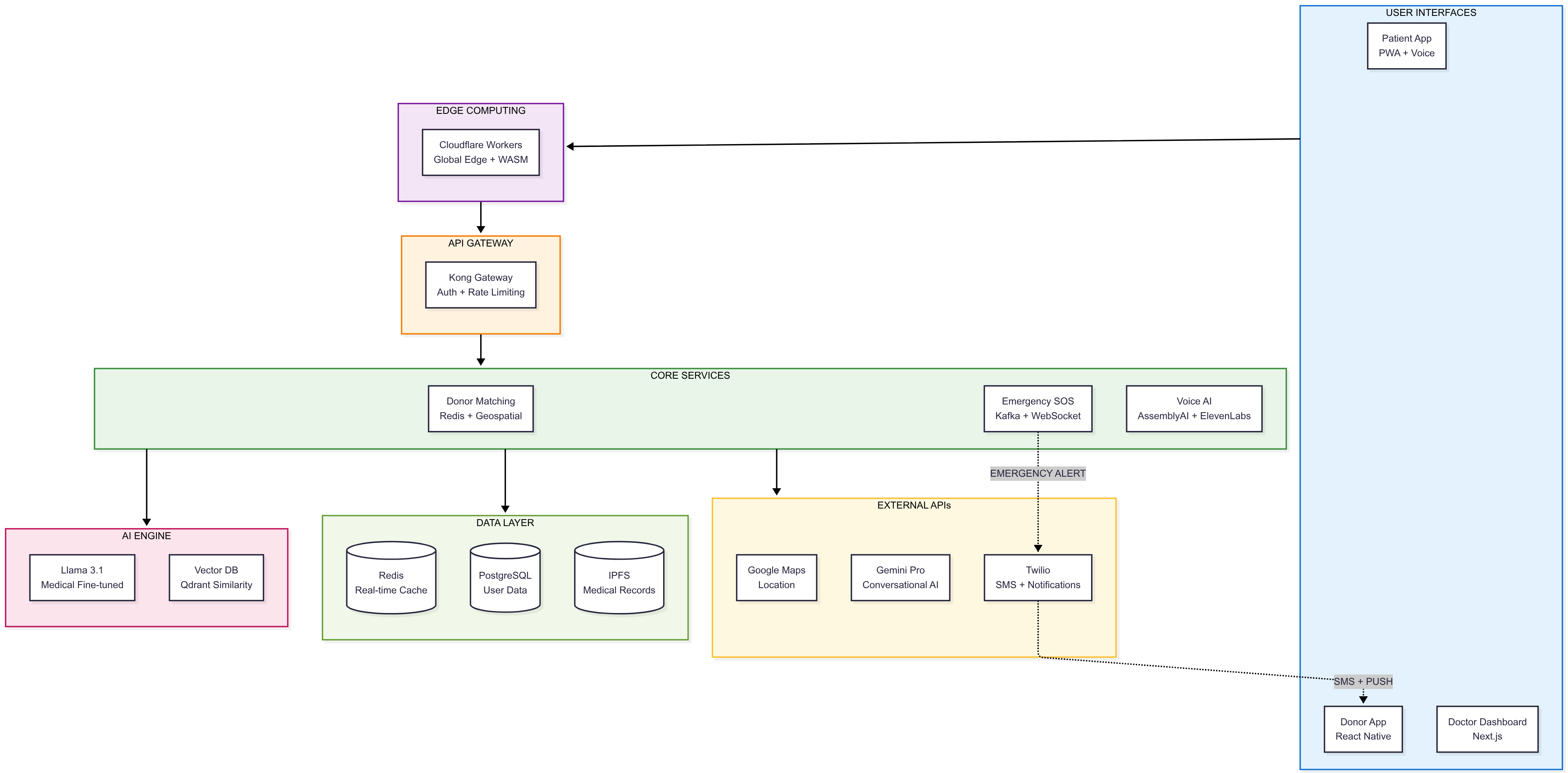
2. Technical Architecture
A detailed system design includes:
- Multi-layer architecture: From user interface to secure data storage
- Real-time event flows: For emergency alerts and donor matching
- AI/ML pipeline: Integrated with voice recognition and donor prediction
- Blockchain layer: For secure handling of medical records and consent
- Edge computing: Ensures low-latency response, even in remote regions
Key Technical Highlights
- Sub-200ms donor matching using edge-deployed ML models
- Offline-capable PWA powered by WebAssembly inference
- Multi-language voice AI, trained with medical terminology
- Event-driven architecture capable of handling thousands of concurrent emergencies
- Zero-knowledge proofs (ZKPs) to protect sensitive health data while maintaining user privacy


Log in or sign up for Devpost to join the conversation.