Inspiration
Shopping for groceries can be time-consuming. Customers often have to search for products manually, compare prices, keep track of their budgets, and wait at checkout. We wanted to explore how AI and digital payments could make everyday shopping smarter, faster, and more convenient. This inspired us to build Scan&Go AI, an AI-powered smart shopping experience where customers can scan product barcodes, explore product information, manage their shopping cart, receive AI-powered shopping assistance, and experience a seamless checkout using PayPal.
What it does
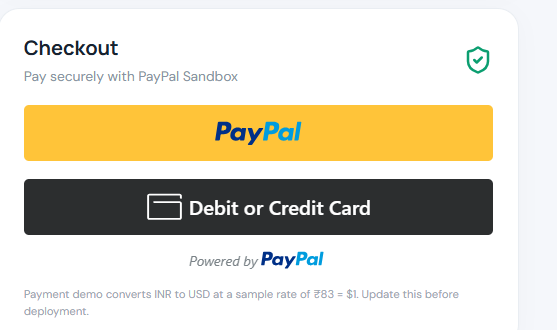
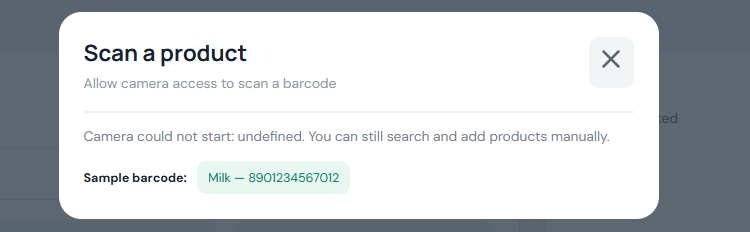
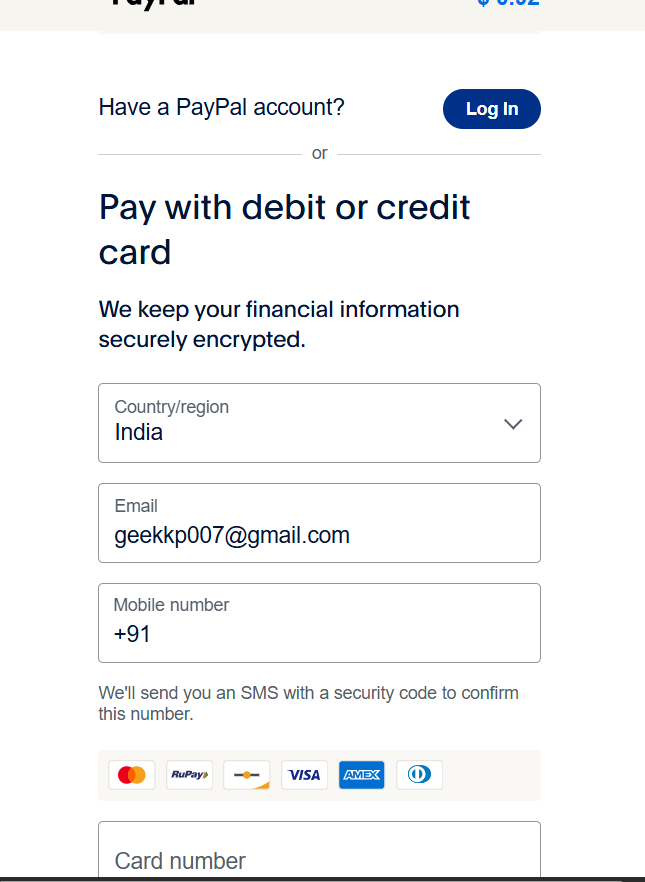
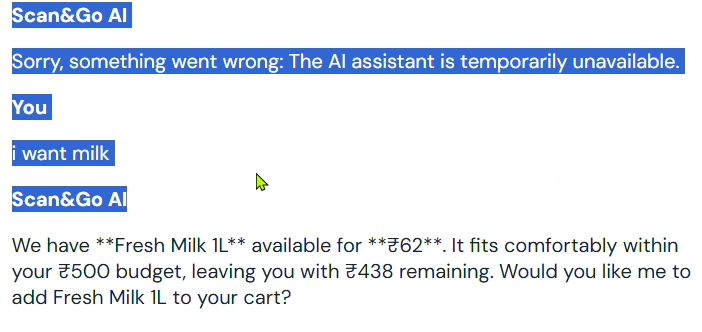
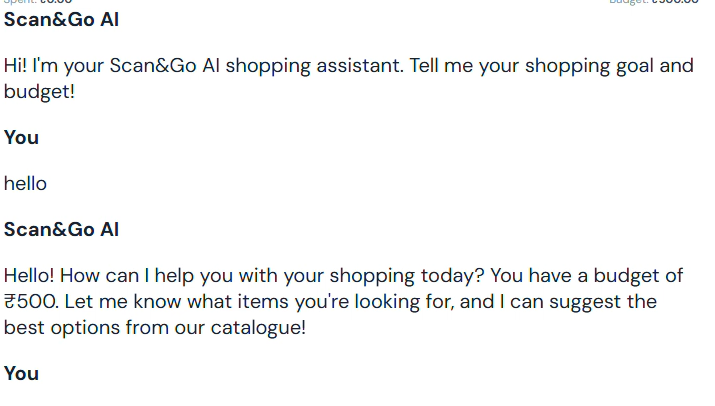
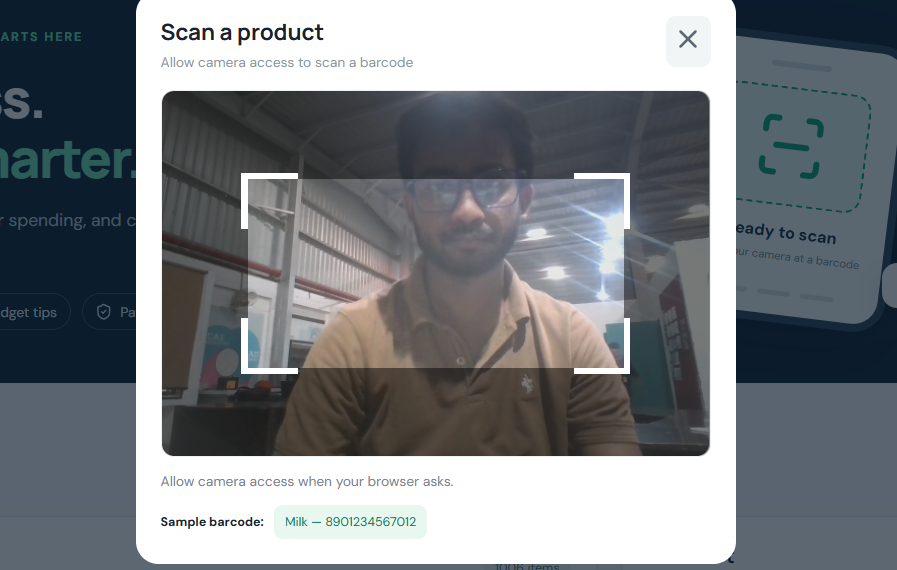
Scan&Go AI is a smart shopping application that aims to make grocery shopping easier, faster, and more convenient. The idea is simple: instead of manually searching for every product, customers can scan a product's barcode and look up its details. They can browse products, add items to their cart, manage quantities, and keep track of their shopping budget. We also built an AI Shopping Agent that helps users with shopping-related questions, product suggestions, and budget planning. For checkout, we integrated PayPal Sandbox so users can experience a digital payment flow without using real money. Our goal is to bring product discovery, AI assistance, and digital payments together in one shopping experience.
How we built it
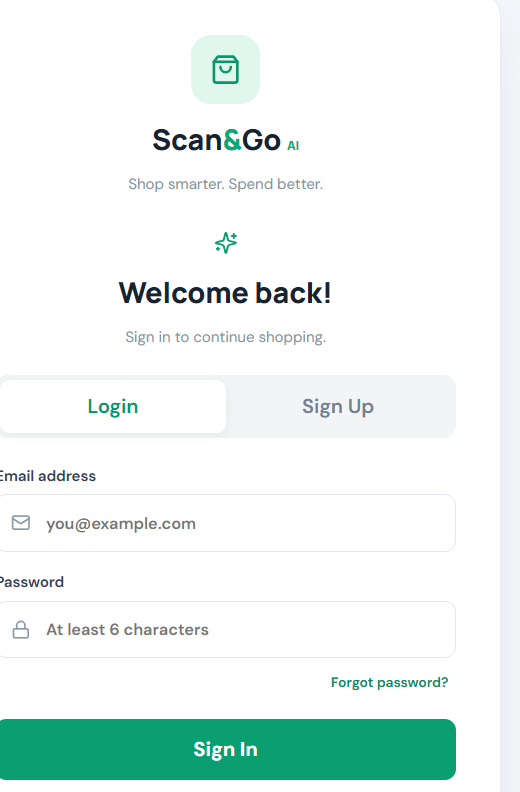
We built Scan&Go AI using React and Vite for the frontend and Node.js with Express.js for the backend. We used a barcode scanning library to read product barcodes through the camera and connected our backend to the Open Food Facts API to retrieve product information. We also added a product dataset containing 1,000 products so users can browse and search through the catalogue. For the AI Shopping Agent, we integrated Google's Gemini AI to make shopping assistance more interactive and useful. One of the most important parts was integrating PayPal Checkout using the PayPal Sandbox API. This allows us to demonstrate the payment process in a safe testing environment. We also used Supabase for user authentication and Resend SMTP for email functionality.
Challenges we ran into
One of our biggest challenges was getting barcode scanning to work reliably with different products and cameras. We had to work with different barcode formats and understand how to retrieve product information after a barcode was detected. Another challenge was product data. Not every barcode is available in the external database, and our imported dataset does not contain barcode numbers for every product. Integrating different services was also challenging. We had to make sure the frontend, backend, AI assistant, database, and PayPal checkout could communicate properly We also paid attention to payment security by ensuring that the backend validates trusted product IDs and prices rather than relying on prices sent directly by the frontend.
Accomplishments that we're proud of
We are proud that we turned our idea into a working full-stack shopping application instead of keeping it as just a concept. Some things we are especially happy with are: Building a shopping dashboard with product browsing and cart management. Integrating an AI-powered Shopping Agent using Gemini. Connecting barcode lookup with an external product database. Integrating PayPal Sandbox for a simulated checkout experience. Bringing authentication, product data, AI, and payments together in one application. Most importantly, we learned how different technologies can work together to solve a real-world problem.
What we learned
While building Scan&Go AI, we learned much more than just writing code. We gained practical experience with React, Express.js, API integration, barcode scanning, Supabase authentication, and PayPal Sandbox. We also learned that integrating AI into an application is not just about connecting a model. It is about making the AI genuinely useful to the person using the product. We understood the importance of handling missing product information, validating prices, managing errors, and keeping payment operations secure. The biggest lesson was that building a real application involves a lot of testing, debugging, and improving things step by step.
What's next for Scan&Go
We don't want Scan&Go AI to remain just a hackathon project. We would like to keep improving it and make it useful for everyday shopping.
Our next goals are to improve barcode recognition, support more products and product databases, add reliable verified pricing, and make AI recommendations more personalized.
We also aim to introduce a Multi-Store Product Comparison feature, allowing customers to compare the same or similar products across different stores from a single platform. Users will be able to check product availability, compare prices, identify the store offering the lowest price, and choose the best shopping option without visiting multiple stores.
We also want to connect multiple retailers and product databases into one platform, making it easier for customers to discover products, find better deals, save money, and make informed shopping decisions.
Our long-term vision is to transform Scan&Go AI into a smart, unified shopping platform that makes grocery shopping faster, more affordable, convenient, and personalized through AI, real-time product information, and digital payments.
Built With
- css3
- express.js
- google-gemini-ai
- html5-qrcode
- javascript
- node.js
- open-food-facts-api
- paypal-sandbox-api
- react
- resend
- rest
- supabase
- vite

