-
-
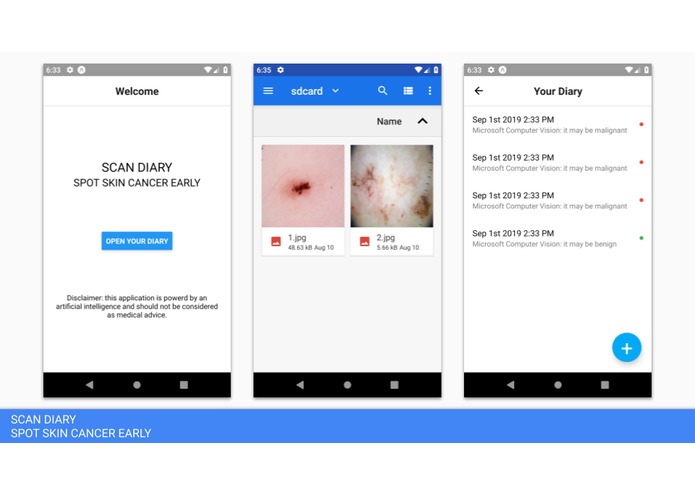
Screenshots of the mobile application
Inspiration
Through my work with startups, I've witnessed massive innovation and access to AI and software in general. Unfortunately, these advancements haven't benefited healthcare in a proportional impact; neither has there been proportional availability of healthcare solutions for the every-day person. Having come across the fact that 99% of skin cancers can be prevented with early detection through self-examination, I was inspired to create an every-day solution that people could use to screen for skin cancer by themselves.
What it does
The Skin Cancer Foundation gives guidelines and paper-based tools to aid in self-examination because skin cancer can be visually screened. However, these tools are not user-friendly and self-examination is not very accurate as we can misjudge what we see without the help of expensive medical advice; the AI-powered product I built addresses these issues.
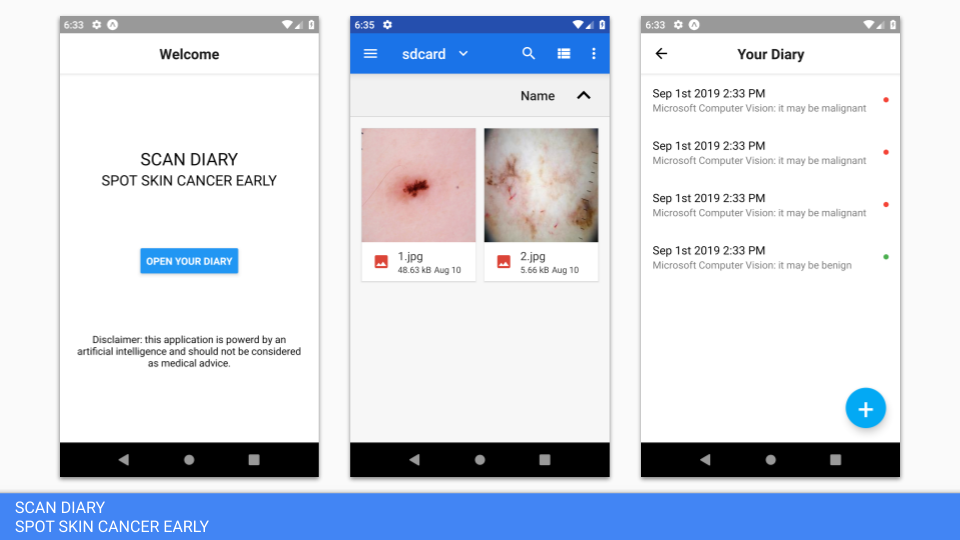
The mobile app is a no-cost, secure, anonymous and user-friendly way for people to access an AI-assisted self-examination; this can greatly improve the accuracy of early detection of skin cancer and save lives. The mobile app is a diary of scans that we can perform on ourselves. Each scan is processed by a Microsoft Azure Custom Vision powered AI which predicts the likelihood of a skin condition being malignant or benign. This diary could also provide a medical expert insight into the progression of a skin condition, aiding in its treatment.
How I built it
I used Microsoft Azure Custom Vision to train an AI model using about two thousand images. I used a stack of Nodejs and Expo to build the server and client solutions respectively. The mobile app is a simple user-experience while the server organizes the data and applies the AI model.
Challenges I ran into
Given that I had access to a limited dataset to train the AI, I tested several algorithms for the machine-learning solution. Ultimately, in the interest of effectiveness and scalability, I opted to go with Microsoft Azure Custom Vision with a multi-label solution for higher precision.
Accomplishments that I'm proud of
I am happy with the solution that I was able to create to address such a critical issue. With better user experience, larger training data and additional input for the AI, I think that the application will serve as a simple and powerful every-day healthcare solution.
What I learned
In addition to the machine-learning algorithms I experimented with, I increased my knowledge and understanding of the Azure stack of cognitive services. Also, given the technological landscape that we are in, I've learnt that there are still many opportunities to apply technology to find effective solutions for imperative issues.
What's next for Scan Diary
Building on this version, my plan is to implement features to notify the users to perform their self-examinations and to guide them through it. I can improve the AI prediction and accuracy by collecting additional input, such as the textural and visual changes of their skin conditions.


Log in or sign up for Devpost to join the conversation.