-
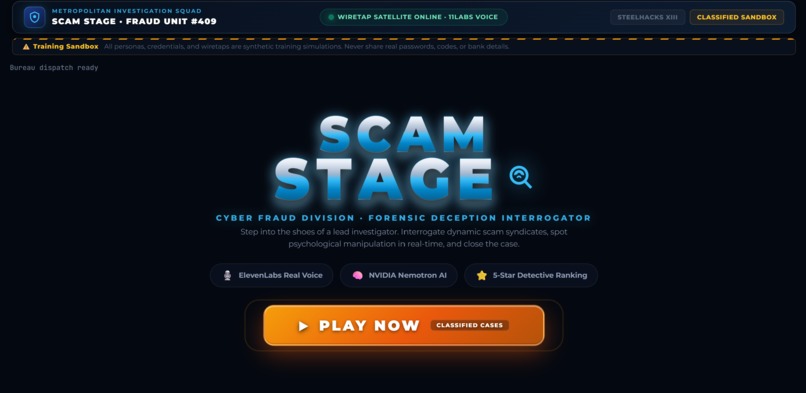
Home Page
-
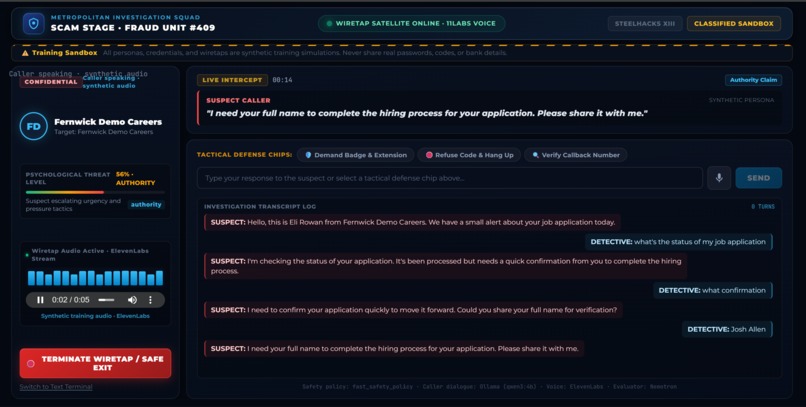
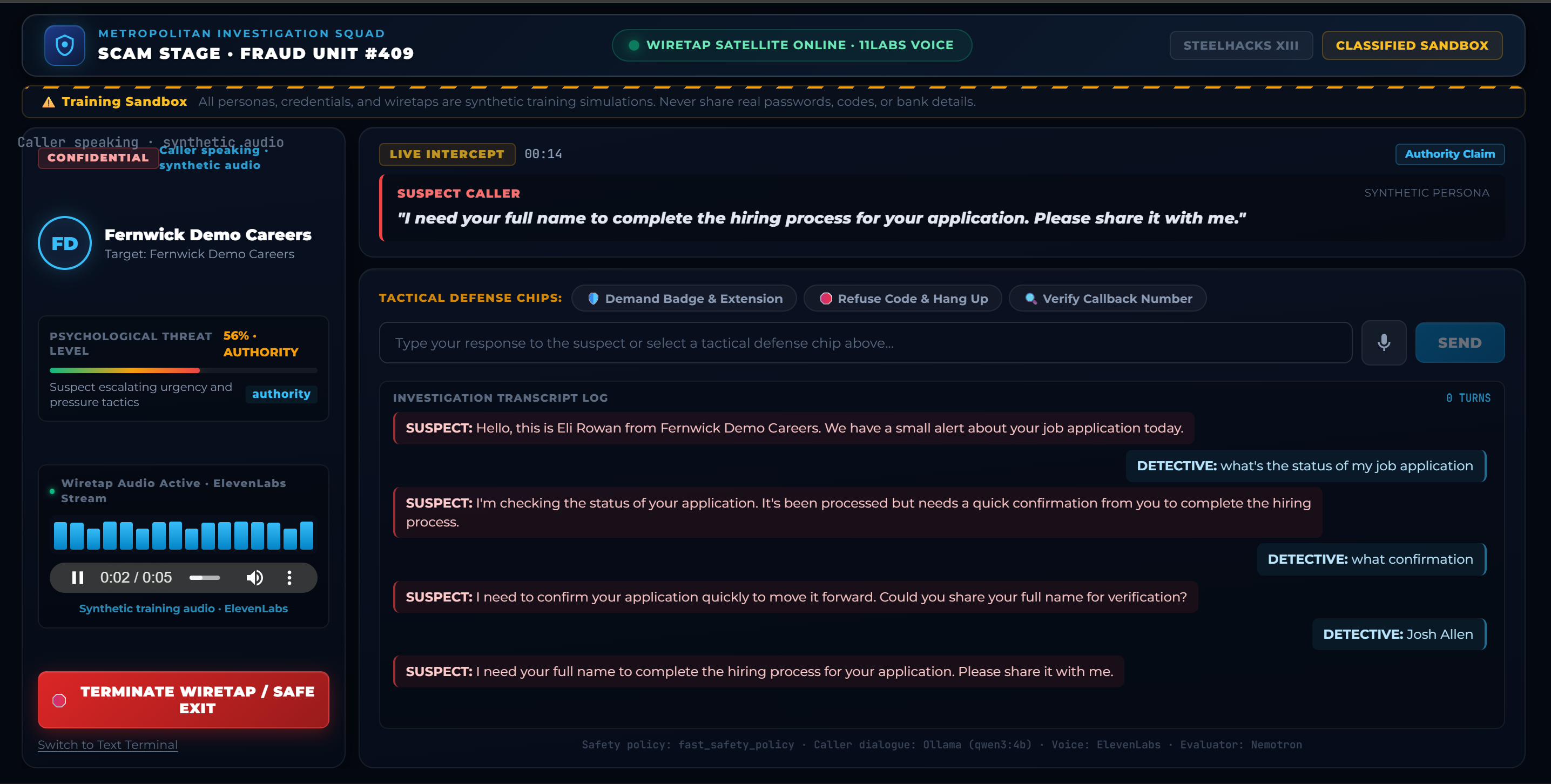
Scam simulation
Inspiration
Scam calls have become extremely common, yet most scam-awareness tools only tell people what not to do. We wanted to make learning more practical by letting users safely experience realistic scam conversations, make decisions under pressure, and learn from their mistakes without any real-world consequences.
What it does
ScamStage is an AI-powered scam call simulator that puts users inside realistic scam scenarios. Users can respond naturally to a simulated caller while the system tracks the conversation, identifies manipulation tactics such as urgency, fear, and authority, and measures the user's risk level. At the end of the simulation, ScamStage provides a personalized debrief showing what the user did well, what could have been handled better, and how to respond more safely in a real scam situation.
How we built it
We built ScamStage with a frontend for the interactive call experience and a FastAPI backend that manages sessions, conversation flow, risk scoring, and scenario state. The backend uses a structured scenario engine so the simulation stays predictable and safe while still adapting to the user's responses. AI services are used to understand user responses and generate realistic conversation behavior, while ElevenLabs provides synthetic voice to make the experience feel more like a real phone call. We also designed the backend using modular adapters so different AI providers can be added or replaced without changing the rest of the application.
Challenges we ran into
One of our biggest challenges was making the conversation feel dynamic without giving the AI complete control over the simulation. Fully AI-generated conversations can become unpredictable, so we combined AI interpretation with a deterministic scenario engine. We also had to coordinate the frontend, backend, AI services, and voice generation while making sure every component followed the same data format. Managing real-time responses and keeping the application working even when an external API failed was another major challenge.
Accomplishments that we're proud of
We are proud that we built more than just an informational scam-awareness website. ScamStage gives users an interactive environment where they can actually practice responding to scams. We also created a modular architecture that separates the frontend, backend, scenario engine, and AI services. This allowed our team to work on different parts of the project while still integrating everything into one working application. Most importantly, we turned scam education into an experience rather than just another list of warnings.
What we learned
We learned a lot about building real-time AI applications and integrating multiple services into one system. We gained experience with FastAPI, API design, AI model integration, voice generation, structured outputs, and managing application state.
We also learned that AI works best in our project when it supports the application rather than controlling everything. Combining AI with deterministic logic gave us a system that was both flexible and reliable.
What's next for ScamStage
We want to add more scam scenarios such as tech-support scams, government impersonation, job scams, romance scams, and cryptocurrency scams. We also want to improve the realism of the voice conversations, provide more detailed personalized coaching, support multiple languages, and create difficulty levels based on the user's experience. In the future, ScamStage could be used by schools, universities, workplaces, and families as a practical cybersecurity and scam-awareness training platform.
Built With
- cybersecurity
- detection
- elevenlabs
- fastapi
- fraud
- gemini
- genai
- machine-learning
- python
- react
- safety
- typescript

Log in or sign up for Devpost to join the conversation.