-
-
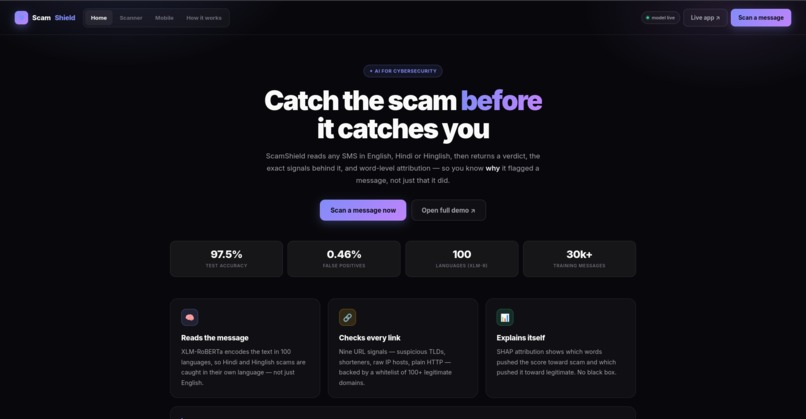
Landing Page
-
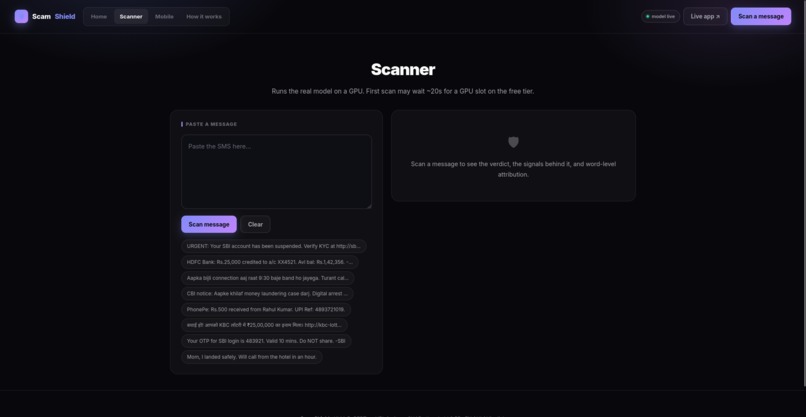
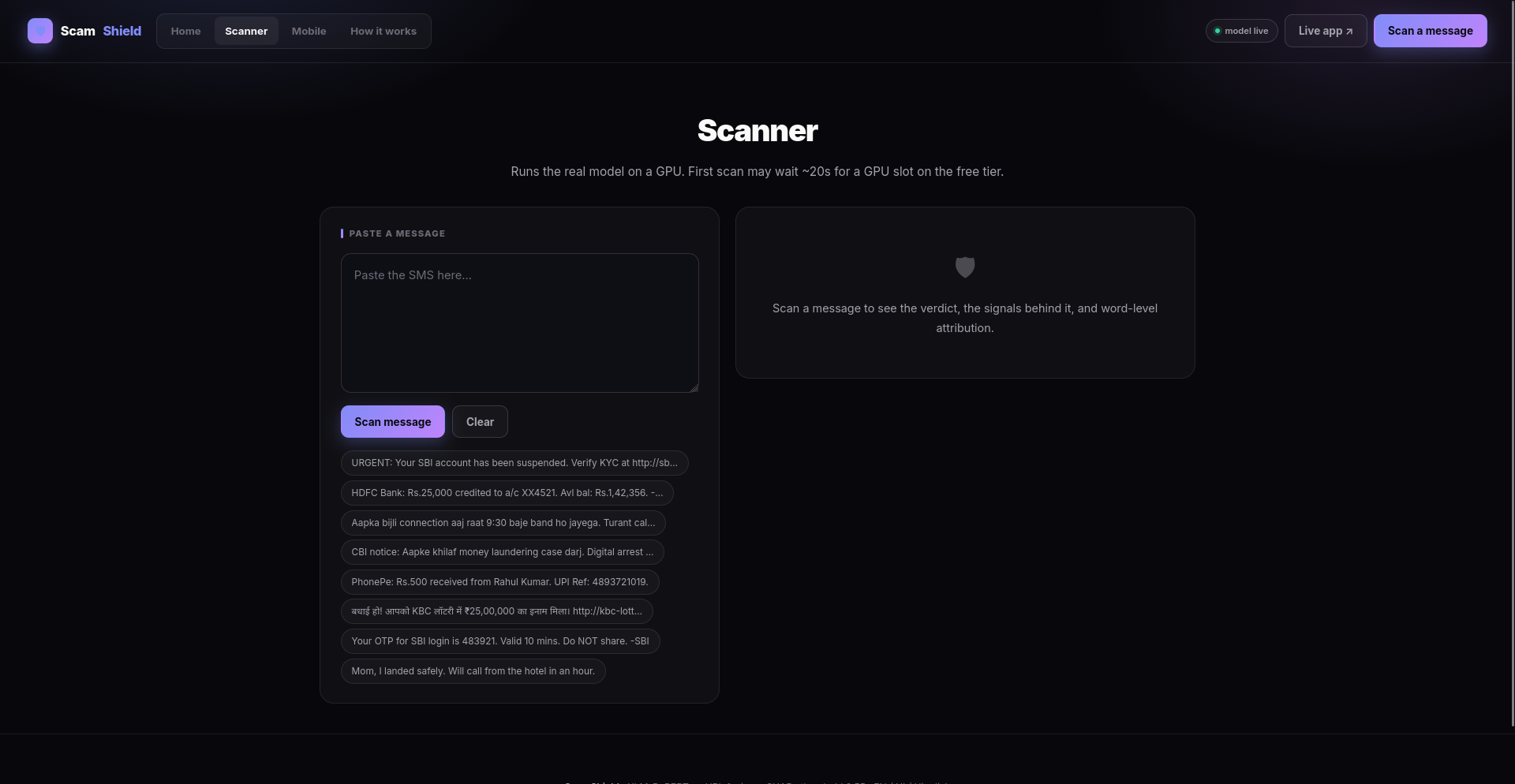
Scanner Page
-
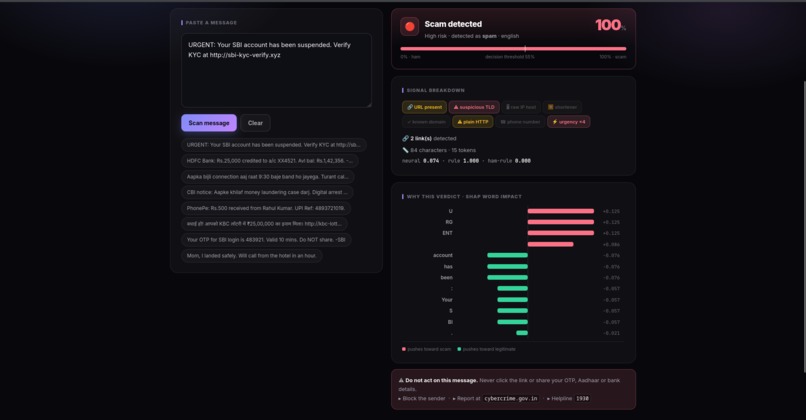
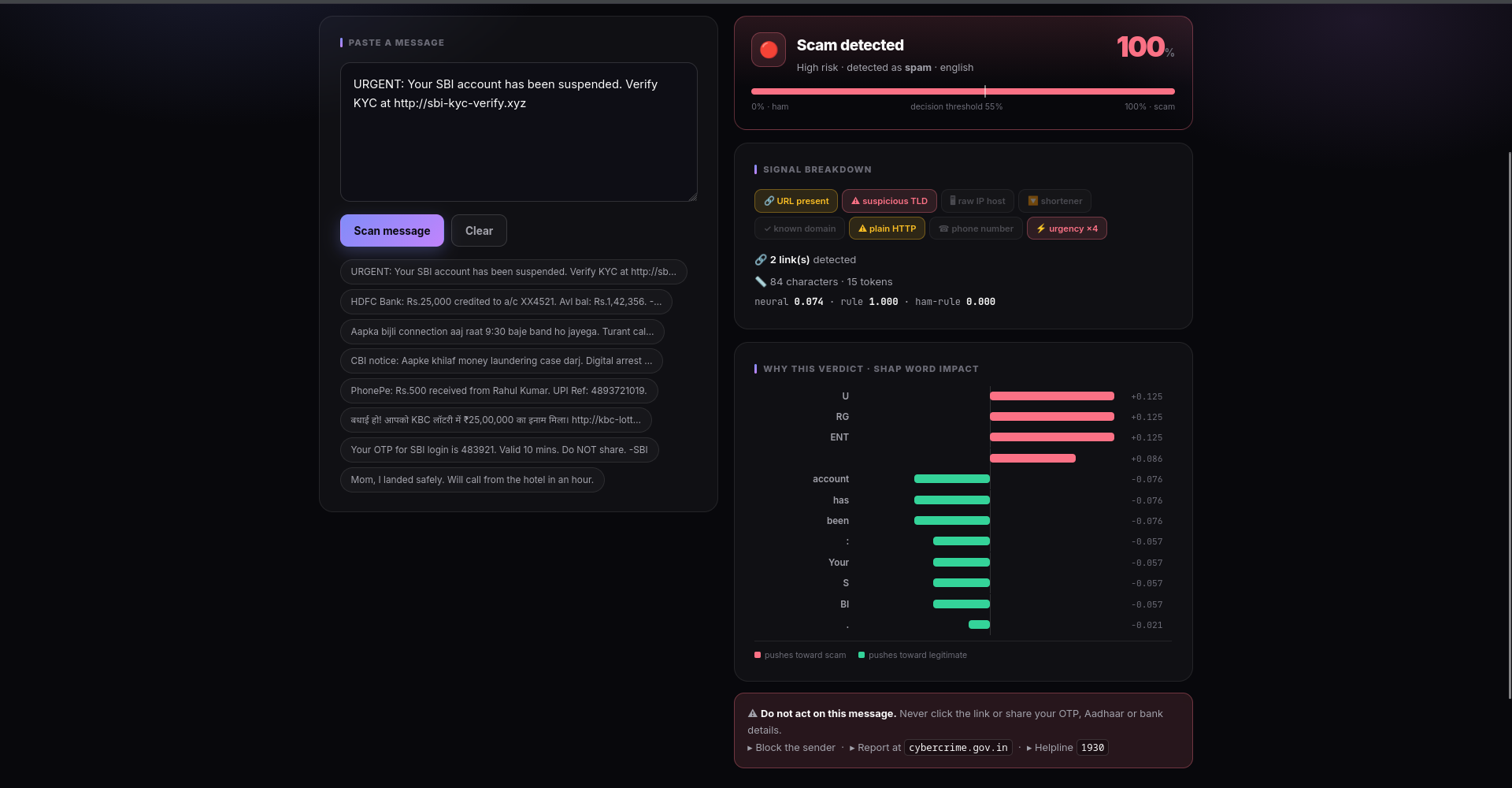
After Scan
-
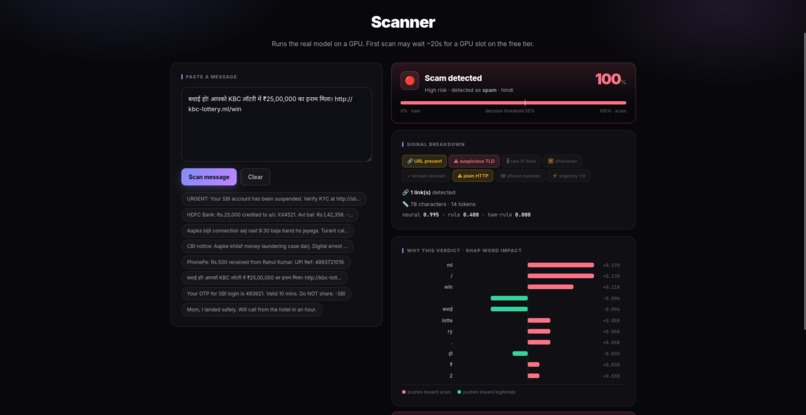
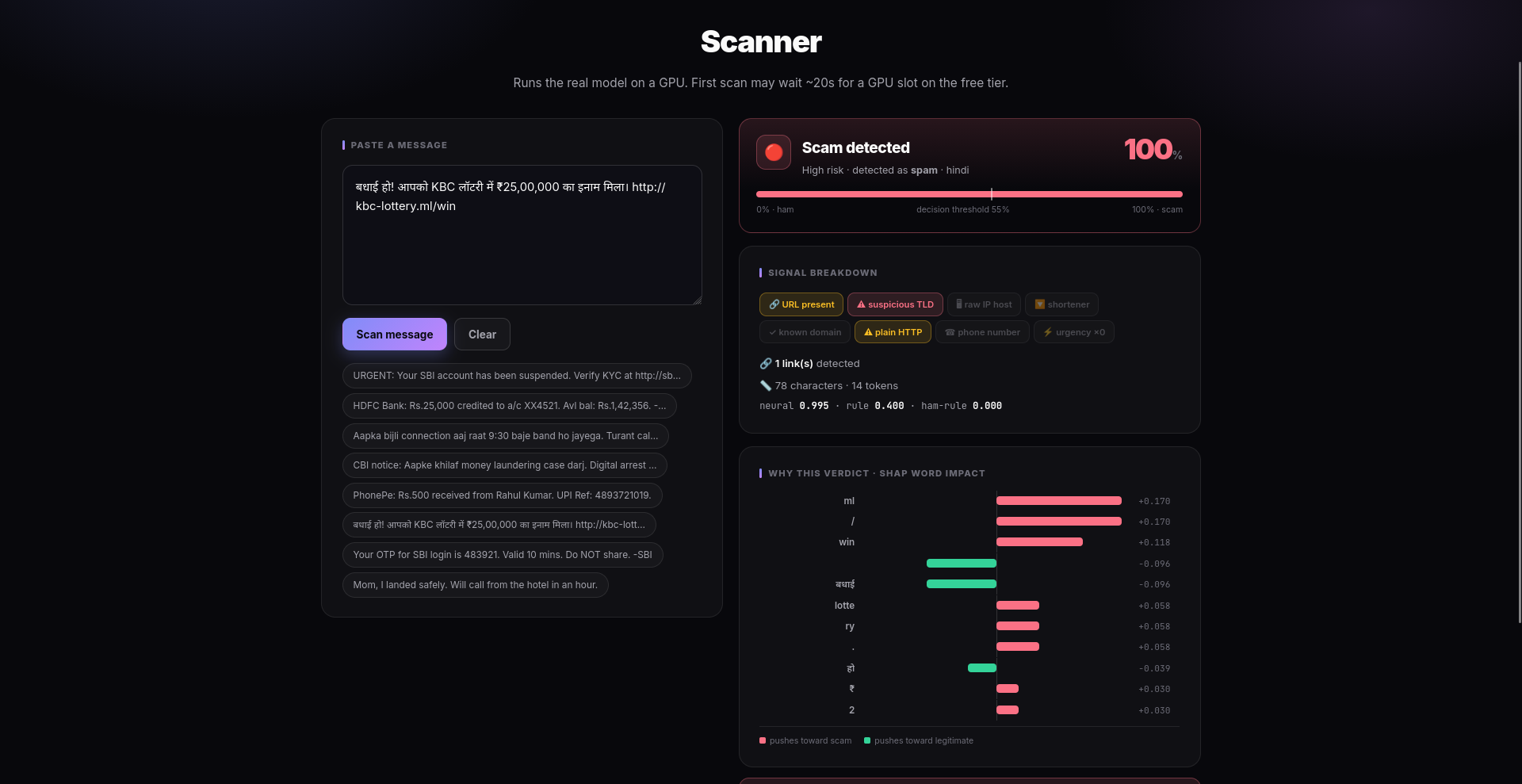
Hindi Message scanning
-
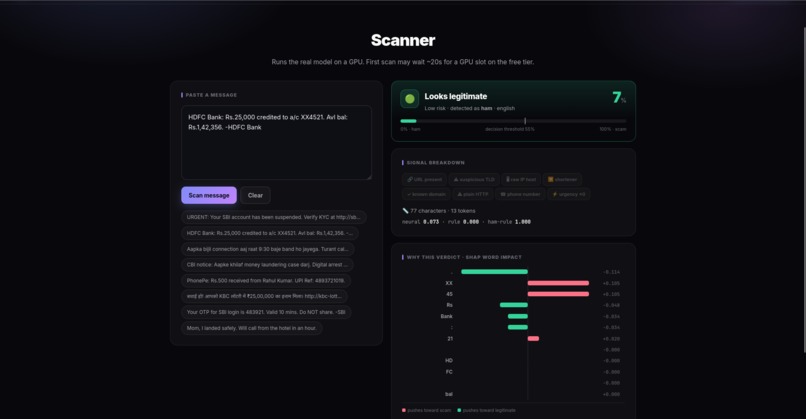
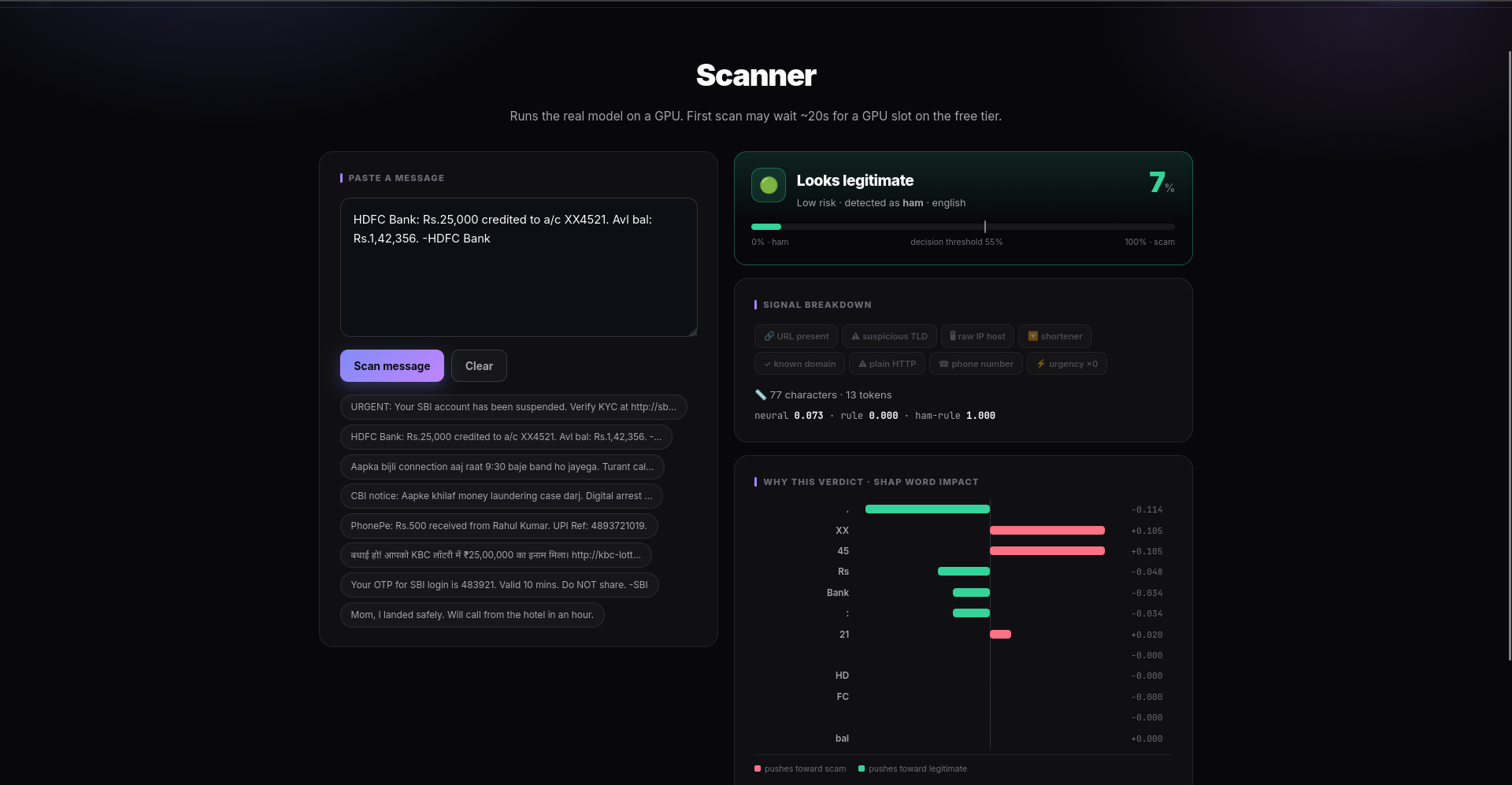
Ham message
-
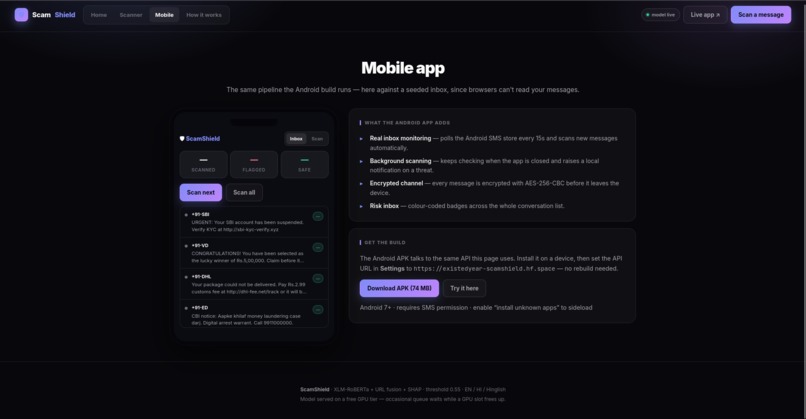
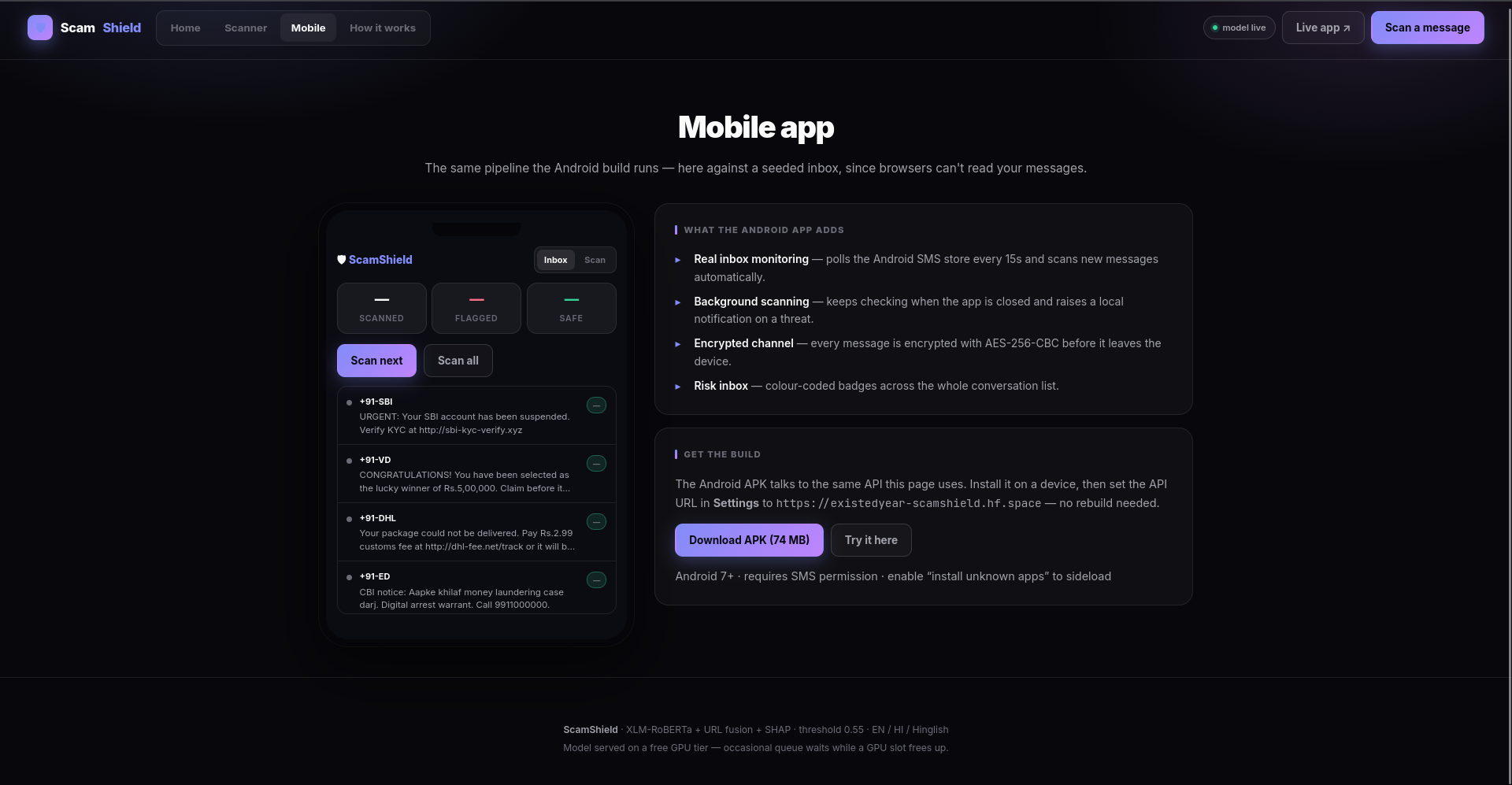
Mobile app menu on web
-
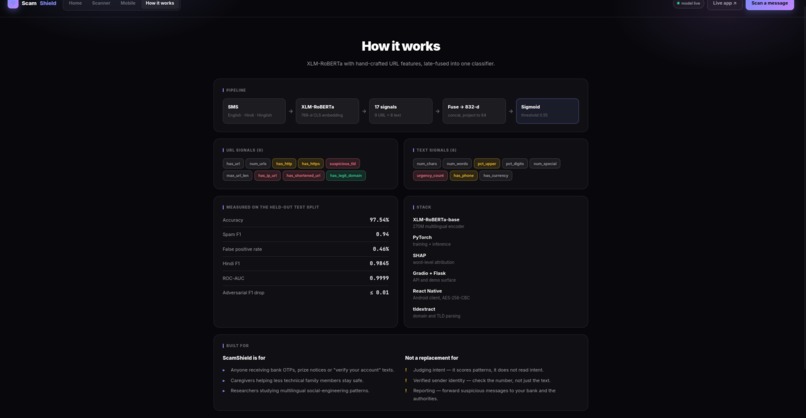
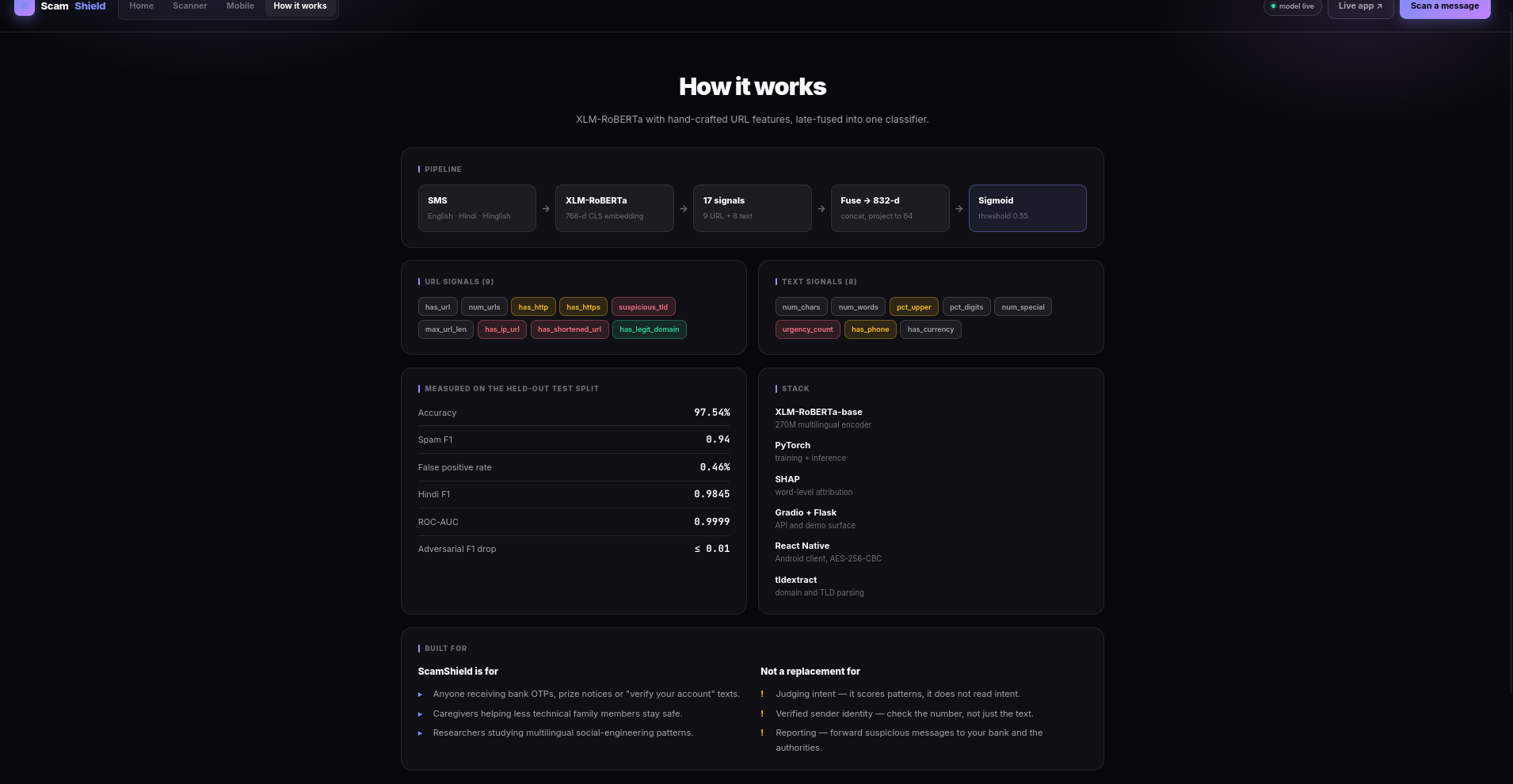
How it works section
🛡️ ScamShield — Multilingual Smishing Detection
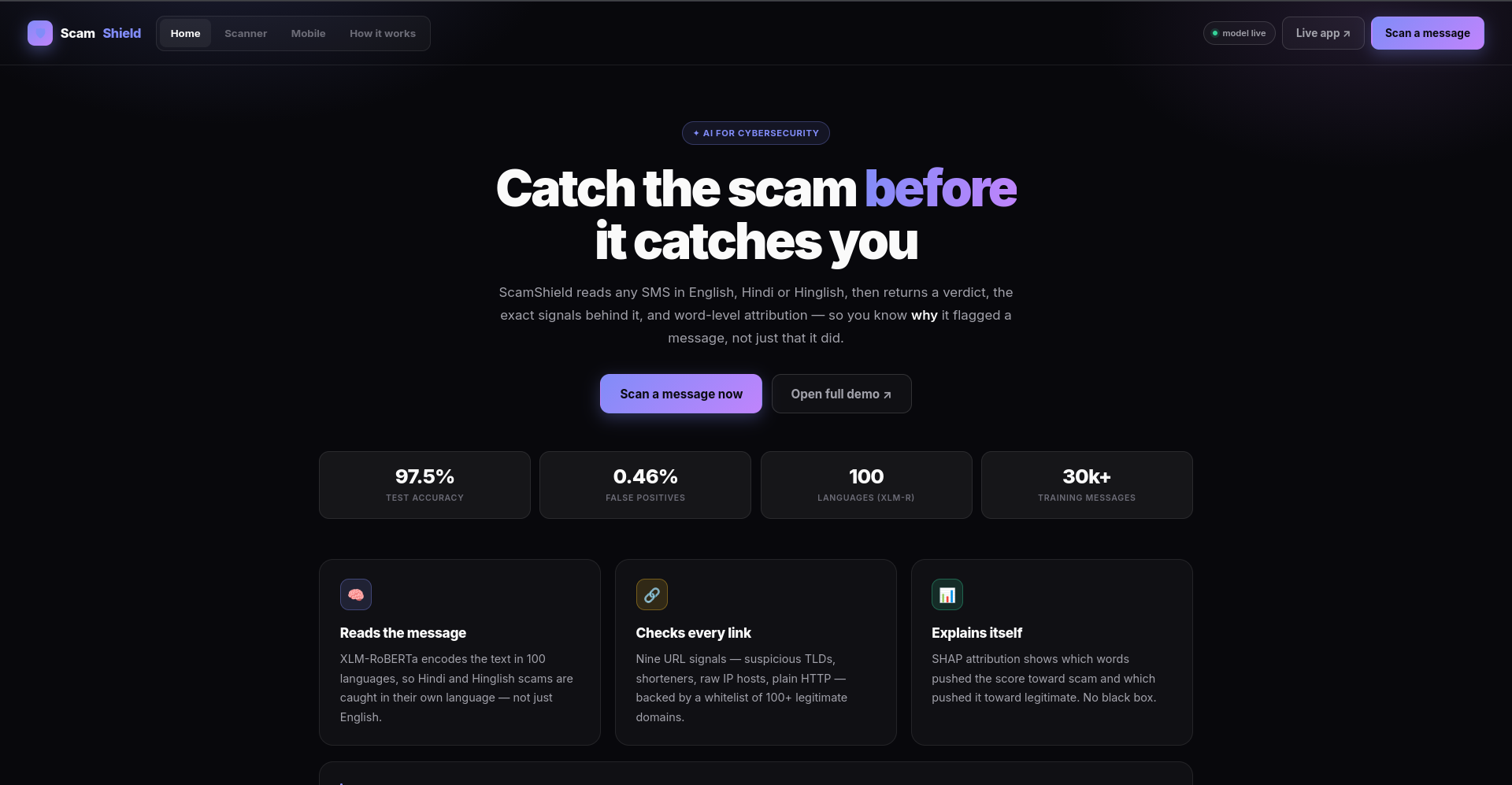
Catch the scam before it catches you. AI smishing defense for English, Hindi, and Hinglish — with word-level evidence for every verdict.
🔗 Live demo: https://scam-shield-flame-delta.vercel.app 🤖 API + full demo: https://existedyear-scamshield.hf.space 📱 Android APK: https://github.com/ExistedYear/ScamShield/raw/main/APKs/app-release.apk 💻 Code: https://github.com/ExistedYear/ScamShield
| Metric | Score |
|---|---|
| 🎯 Test accuracy | 97.54% |
| 📊 Spam F1 | 0.94 |
| 🛡️ False-positive rate | 0.46% |
| 🇮🇳 Hindi F1 | 0.9845 |
| 🥷 Adversarial F1 drop | ≤ 0.01 |
💡 Inspiration
SMS phishing — smishing — is the scam most people meet first and defend against worst. A single text impersonating a bank, a courier, or a government agency can drain an account in minutes, and the messages are getting harder to tell apart from legitimate ones: Indian bank credits, OTPs, and recharge alerts look like spam by every naive heuristic. English-only filters miss the Hindi and Hinglish lures entirely.
We wanted a detector that reads what attackers actually write — and that can prove its verdicts instead of asking for blind trust.
⚙️ What it does
ScamShield takes any SMS in English, Hindi, or Hinglish and returns a calibrated verdict — safe, low, medium, or high risk — with the exact signals behind it:
- 🔗 Nine URL features — suspicious TLDs, shorteners, raw IP hosts, domain whitelist
- 📝 Eight text features — urgency, phone numbers, caps, digits
- 🛡️ Google Safe Browsing reputation with a live API key
- 📊 Word-level SHAP attribution showing which tokens pushed the score each way
It ships three ways: an interactive web demo, a JSON API for automated evaluation, and an Android app with real-time inbox monitoring, background threat notifications, and an AES-256-CBC encrypted channel to the backend.
🔨 How we built it
The core is XLM-RoBERTa-base, fine-tuned on ~30,000 messages from six sources (UCI, Hugging Face and Kaggle corpora, plus hand-crafted Indian transactional SMS to fix the distribution gap), fused late with 17 hand-crafted features:
$$ P(\text{spam} \mid x) = \sigma\big(W \cdot [\text{CLS}{768} \oplus f{64}(x)]\big), \qquad \text{flag iff } P \ge 0.55 $$
The $832 \to 256 \to 64 \to 1$ classifier head runs at a 0.55 decision threshold, chosen specifically to stop flagging legitimate bank SMS. Training ran on Kaggle T4s with label smoothing and early stopping (best val F1 0.9765).
Inference serves from a Hugging Face Space with a Gradio UI and JSON endpoints; the static landing site and the React Native client are thin front ends over that same API. SHAP runs on demand behind the verdict, so the answer lands in ~1.5s while attribution streams in after.
🧗 Challenges we ran into
1. Everything Indian looked like phishing. The model initially flagged nearly every transactional SMS as an attack. We fixed it by adding synthetic legitimate examples and retuning the urgency and currency features.
2. Free-tier GPU quota died after a handful of scans. ZeroGPU gives 5 min/day, and each call re-transfers 1.1 GB of weights onto the GPU. We moved serving to CPU (~1.5s per prediction, unmetered) with GPU as an opt-in flag — the demo literally cannot die on quota anymore.
3. ZeroGPU refuses to boot with zero decorated functions. So a never-called probe function satisfies the runtime check while every real request stays on CPU. One of those bugs you only find at 2 AM.
🏆 Accomplishments that we're proud of
- ✨ 97.54% test accuracy with a 0.46% false-positive rate
- ✨ Hindi F1 of 0.9845 — the hard language, not the easy one
- ✨ Three risk tiers consistent across web UI, seeded mobile inbox, and native app
- ✨ An API automated evaluators can drive with two curl calls
- ✨ A demo architecture that degrades gracefully instead of dying when the GPU runs out
📚 What we learned
Accuracy is the easy part; calibration is the product.
The difference between "spam" and "medium risk, here is why" is what makes a detector usable. Free infrastructure shapes architecture more than any textbook — quota mechanics dictated our CPU serving, caching, and streaming design. And explainability isn't garnish: when a model flags your bank SMS, "here are the three words responsible" is the only response that keeps trust.
🚀 What's next for ScamShield
- 📴 On-device inference via ONNX/TFLite — no message ever leaves the phone
- 🔗 Redirect-chain analysis — follow short links to their landing pages
- 🕰️ WHOIS domain-age as a first-class signal for fresh phishing domains
- 🌏 Tamil, Telugu, and Bengali coverage
- 🔐 Federated learning — the model keeps improving without centralizing anyone's SMS
Built With
- adversarial-robustness
- aes-256
- android
- cybersecurity
- explainable-ai
- fine-tuning
- flask
- google-safe-browsing
- gradio
- hindi
- huggingface
- mobile-app
- multilingual-nlp
- natural-language-processing
- phishing-detection
- pytorch
- react-native
- rest-api
- shap
- smishing
- sms
- transformers
- vercel
- xlm-roberta

Log in or sign up for Devpost to join the conversation.