Live demo: https://scamshield-ng-94k5.onrender.com (free hosting, so the first load can take up to a minute to wake up).
The problem
Scams are part of everyday digital life in Nigeria. The Global Anti-Scam Alliance's State of Scams in Nigeria 2026 report found that 84% of Nigerian adults encountered a scam in the past year, 54% interacted with a scammer, and 22% lost money. Many people have no quick way to check a message in the moment, and scammers rely on fear and urgency.
What it does
You paste a suspicious SMS or WhatsApp message. ScamShield NG gives a risk score (LOW, MEDIUM or HIGH), lists the red flags it found, and explains in plain English or Pidgin why the message is or isn't suspicious and what to do.
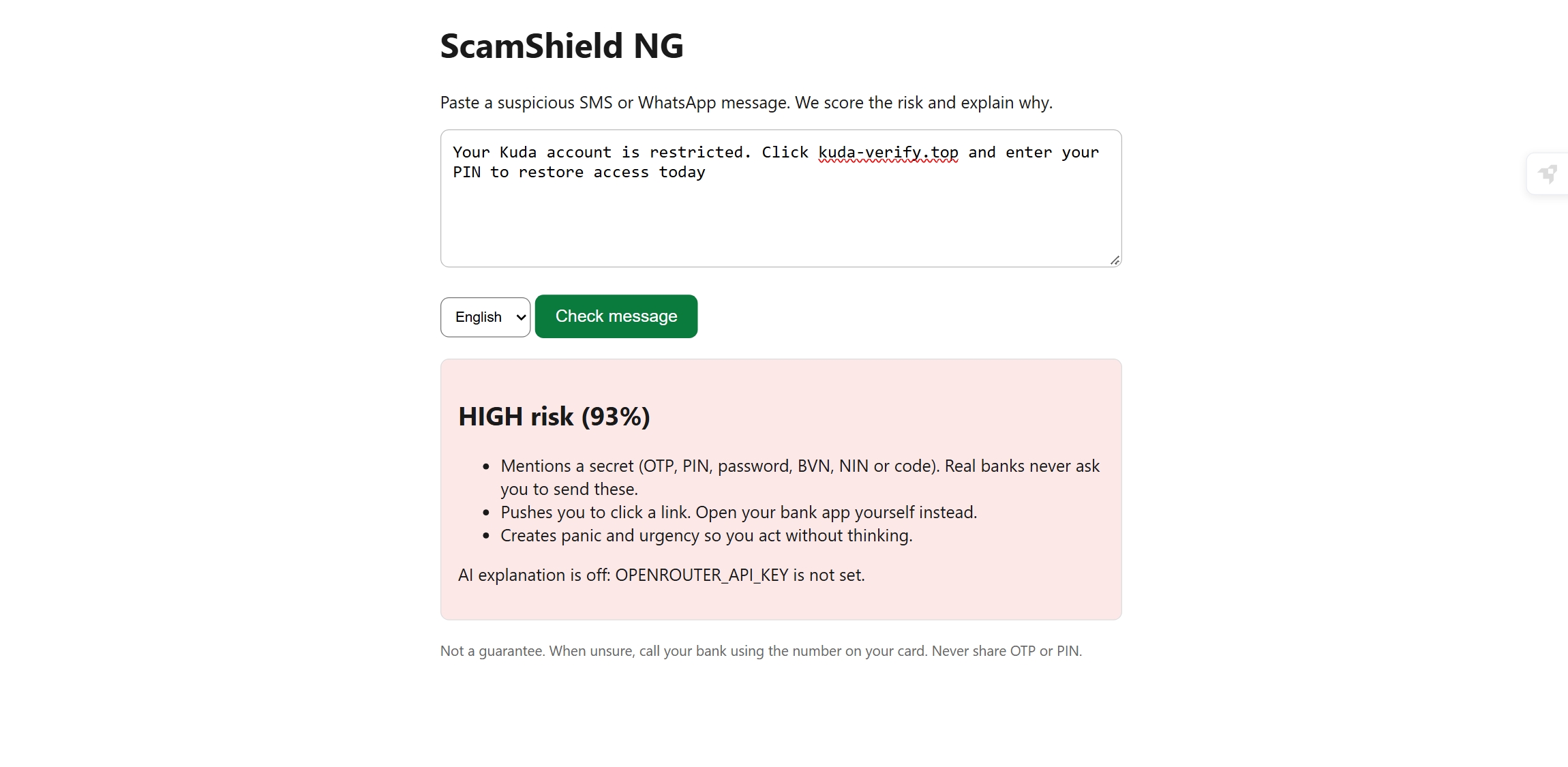
Example input: "Your Kuda account is restricted. Click kuda-verify.top and enter your PIN to restore access today" Output: HIGH risk (93%), with red flags for a PIN request, a link and urgency, plus an AI explanation.
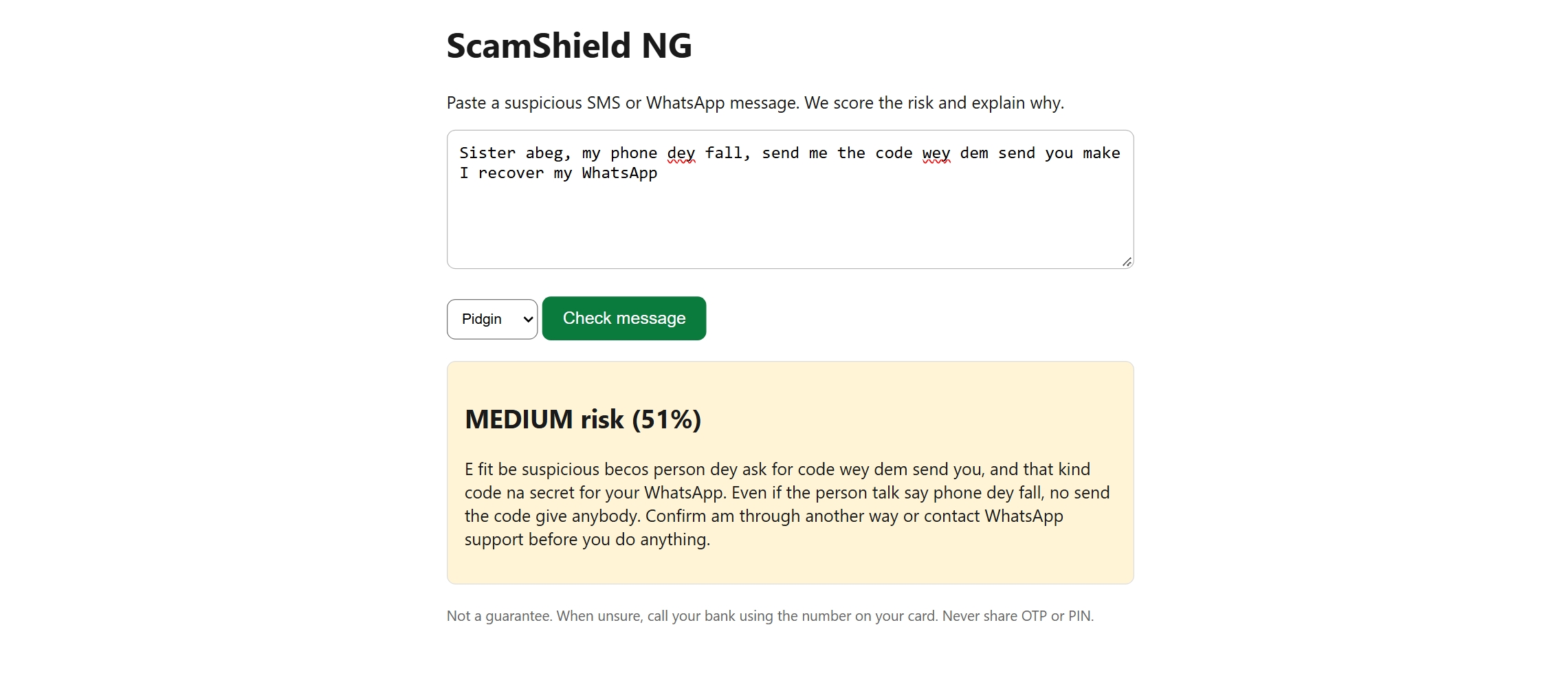
Pidgin example (input: "Sister abeg, my phone dey fall, send me the code wey dem send you make I recover my WhatsApp"). The AI explained: "E fit be suspicious becos person dey ask for code wey dem send you, and that kind code na secret for your WhatsApp. Even if the person talk say phone dey fall, no send the code give anybody. Confirm am through another way or contact WhatsApp support before you do anything."
How AI is used
- A classifier (TF-IDF word and character n-grams with logistic regression, trained with scikit-learn) gives the risk score.
- Rules spot red flags: PIN or OTP requests, links, urgency and upfront fees. A message that warns you not to share a code is not flagged for it.
- A language model through OpenRouter (the free router, so the exact model varies) writes the explanation in English or Pidgin.
Testing and results
- Cross-validation on my 96-message training set gave about 94%, but I don't trust it. The messages were short and written by me with AI help.
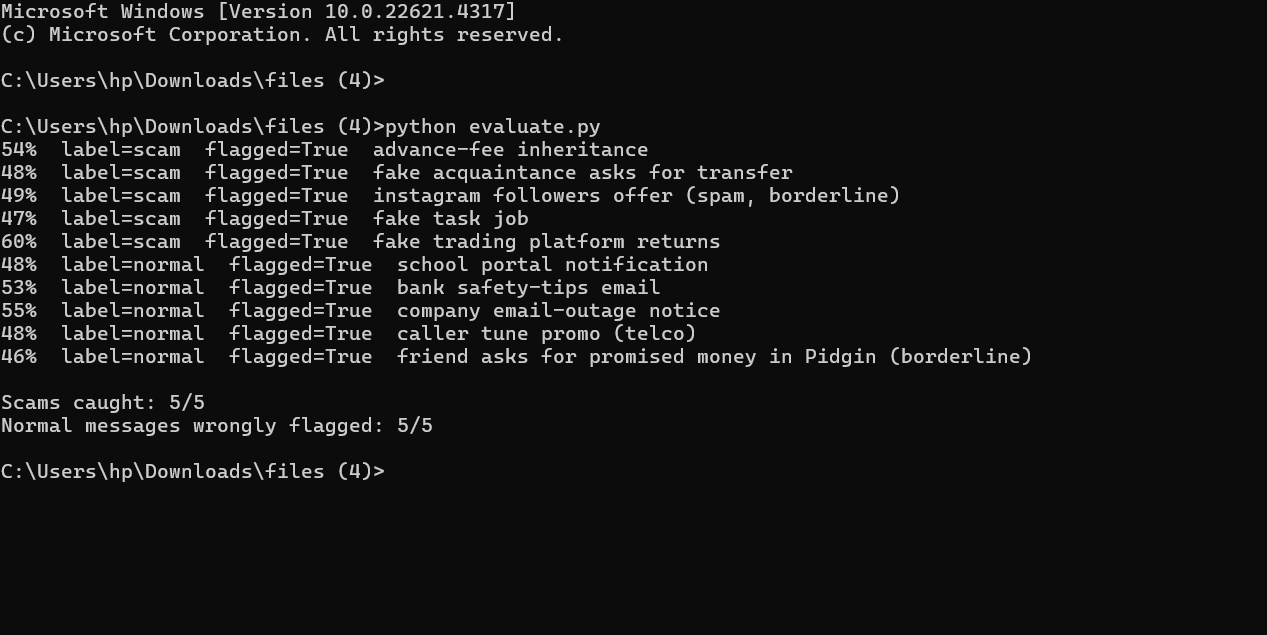
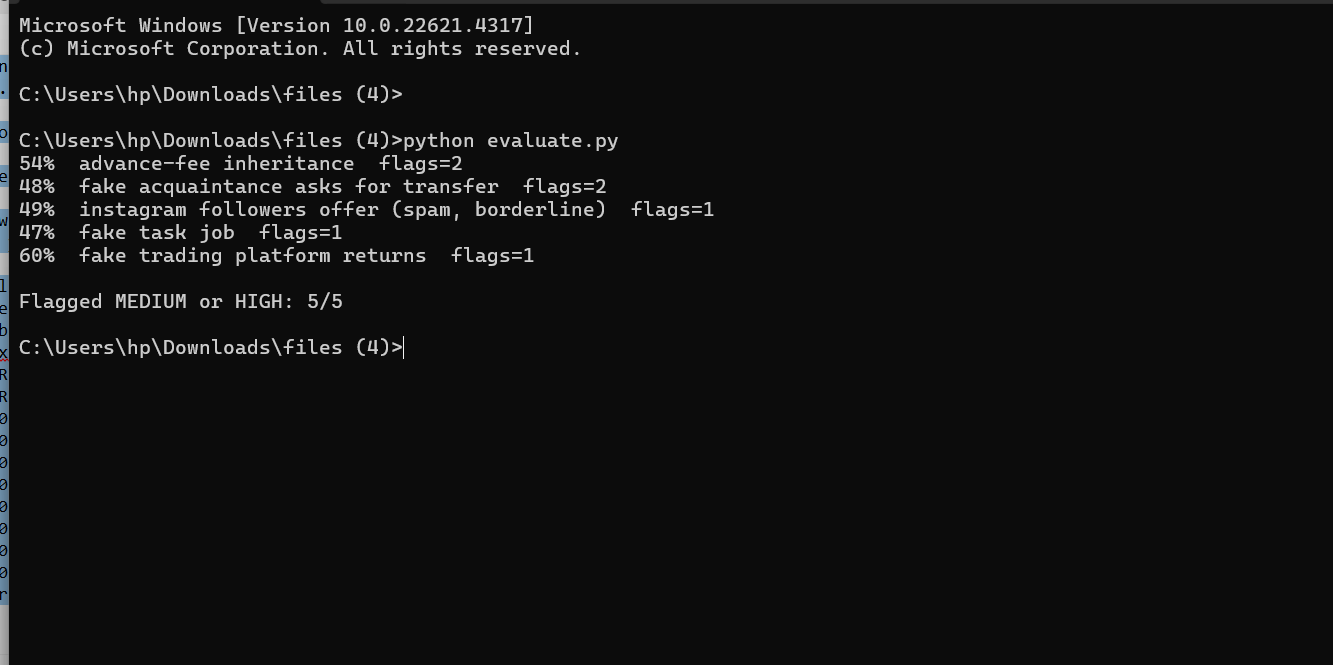
- I then tested on 10 real messages I had received (5 scams, 5 normal), kept out of training. The first version flagged all 10 as risky. After switching to word plus character features, it caught 5 of 5 scams but still wrongly flagged 3 of 5 normal messages.
Limitations
- The training data is tiny, so scores are poorly calibrated. Long real messages, such as bank safety emails, are often wrongly flagged.
- The rules miss scams that avoid the keywords, for example a fake "I sent money by mistake" transfer request.
- The AI explanation sometimes repeats a wrong assumption. In an early test it said a normal OTP notice was asking for the code.
- It is a prototype, not a replacement for calling your bank on the number printed on your card.
Stack, data and AI assistance
- Stack: Python, Flask, scikit-learn, pandas, joblib, HTML/CSS/JavaScript, OpenRouter.
- Data: 96 labelled messages written for this project with AI assistance, plus 10 real messages (names, numbers and links removed) used only for testing. No personal data.
- Pre-existing components: open-source libraries only. Everything else was built during the hackathon.
- AI assistance: the code, dataset, explainer video and narration were built with help from Claude. The narration uses the open-source Kokoro text-to-speech model.
What's next
Collect many more real messages in English and Pidgin, add real normal messages to reduce false alarms, and build a proper held-out test set.
Team
Prince Iliya (solo): idea, testing, real-message collection and direction.
Built With
- flask
- html
- javascript
- openrouter
- python
- scikit-learn