-
-
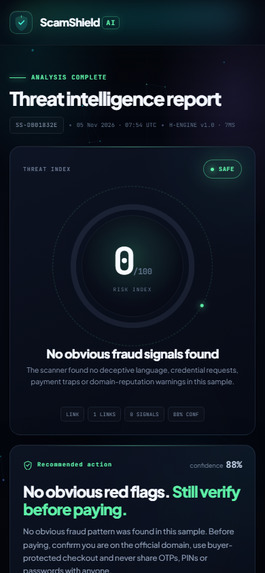
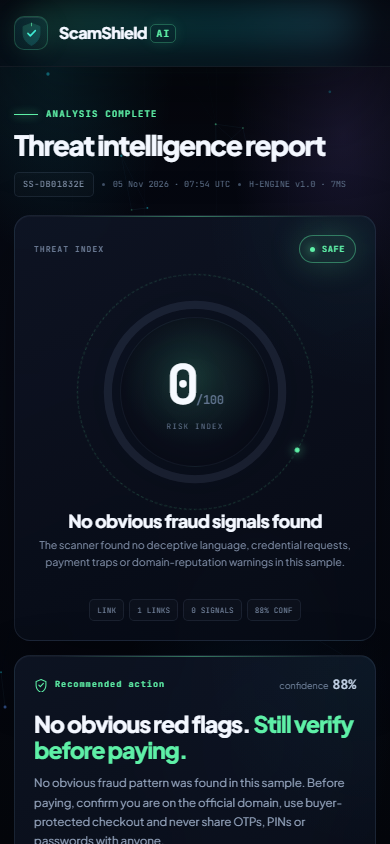
Responsive mobile-first layout for quick on-the-go consumer fraud checks.
-
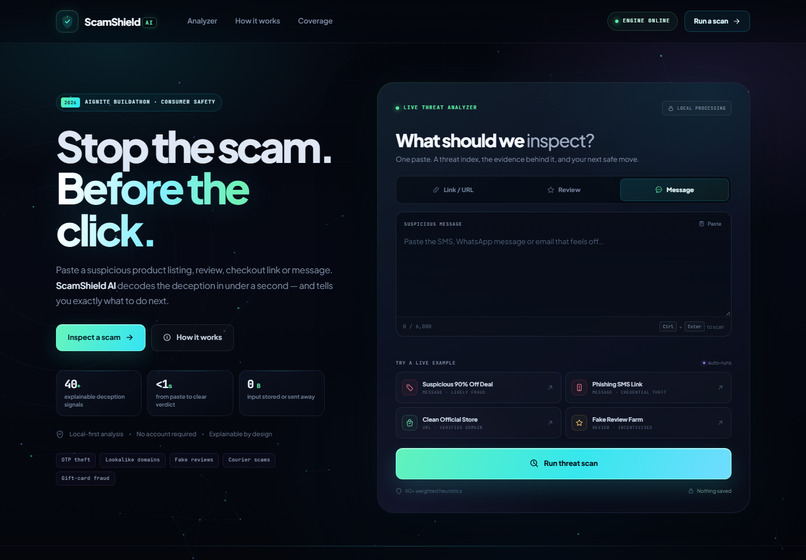
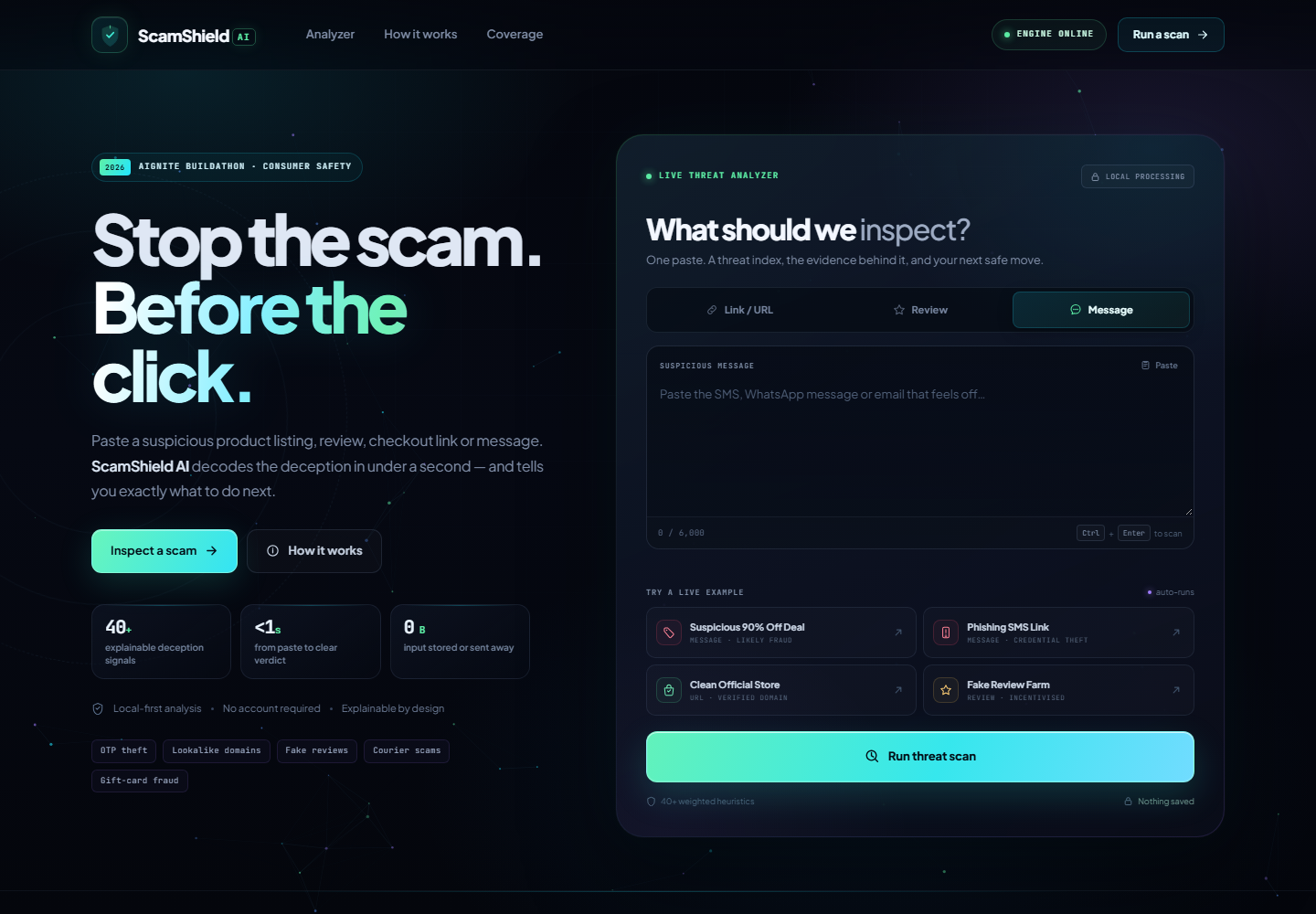
Interactive web console with live particle grid and preset test scenarios.
-
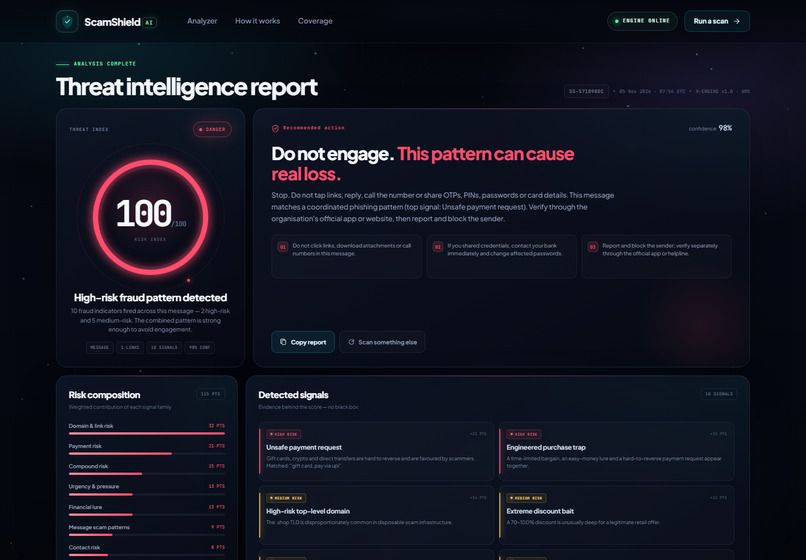
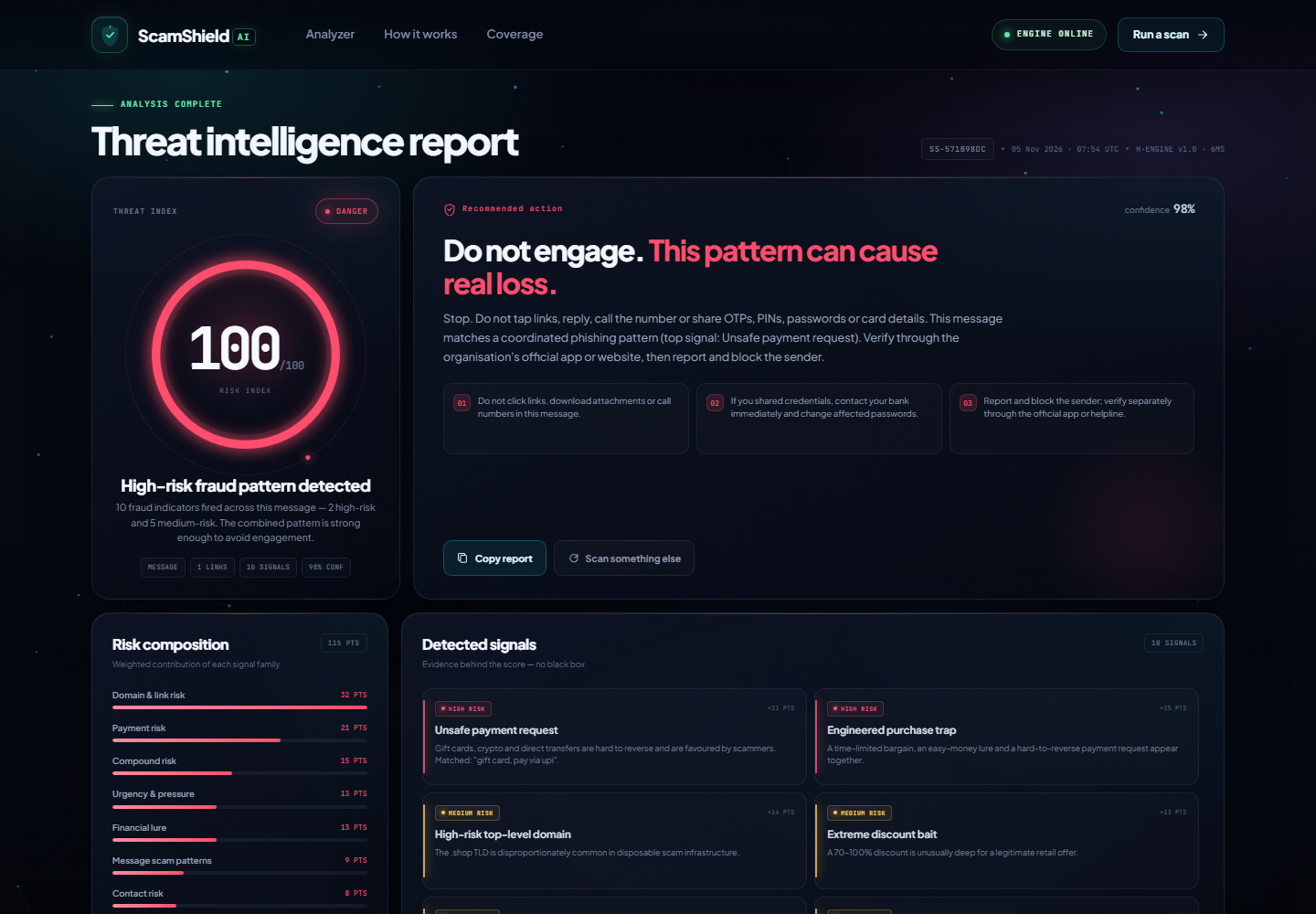
Real-time threat report showing risk score, signal breakdown, and guidance.
Inspiration Scams no longer look like scams. They look like a limited-time marketplace deal, a delivery update, a five-star review, or a checkout page with the right logo. The pressure is designed to make a shopper act before they think.
We wanted to build the pause button.
ScamShield AI was inspired by a simple B2C problem: everyday consumers are asked to make split-second trust decisions with no safety net. They do not need a SOC dashboard or a cybersecurity course. They need a clear answer to three questions:
Does this look dangerous? Why? What should I do right now? What it does The user pastes one suspicious item — a product listing, review, checkout URL, SMS, WhatsApp message or email — and selects the content type. ScamShield AI returns:
A 0–100 threat index. A plain-language SAFE, WARNING or DANGER verdict. A weighted risk breakdown across signal families. Every detected signal with its severity and point contribution. Clear consumer-safety recommendations and three immediate next actions. A shareable, copyable risk report with a report ID and timestamp. Four synthetic presets let judges test the entire experience in one click: Suspicious 90% Off Deal, Phishing SMS Link, Clean Official Store and Fake Review Farm.
How we built it Backend — pure Java, zero dependencies. src/Main.java uses Java's native com.sun.net.httpserver.HttpServer. It serves the static UI, exposes POST /api/analyze, parses JSON with a small in-file parser and runs an explainable heuristic ensemble. Link/domain checks inspect scheme, host shape, punycode, IP literals, shorteners, risky TLDs, sensitive paths, redirects and brand mismatches. Language checks detect urgency, threats, credential requests, payment rails, fake-review patterns, secrecy and off-platform contact. Compound rules raise the score when individually weak signals form one coherent attack.
The API is intentionally transparent: each signal has a title, description, severity, category and point value. Scores are capped at 100. No external AI API, database, API key or build tool is required.
Frontend — one self-contained HTML file. The UI uses inline CSS and vanilla JavaScript with a dark glassmorphism design, a pointer-reactive Canvas particle network, an animated circular threat meter, pulsing status badges, animated risk bars, staggered evidence cards, hover-tilt interactions, clipboard paste, one-click presets and a copyable report. It is responsive, keyboard accessible and respects prefers-reduced-motion.
Delivery — ready to run and deploy. A one-command Windows/Linux launcher, Dockerfile, GitHub Actions compile check, security headers, static-path confinement, request-size limits and a health endpoint make the project easy for judges to run and easy to ship.
Challenges we ran into Making risk scores feel trustworthy. A single keyword is not evidence. We weighted signals, deduplicated them and added compound rules so a lone "limited time" does not accuse a legitimate shop, while urgency + OTP + a hostile domain produces a decisive verdict. Keeping the demo dependency-free. No Maven, no npm, no external AI API. That meant writing our own JSON parser, static server and structured scoring model in one Java file — while still exposing a clean API contract. Designing for clarity under pressure. The report had to be useful in a glance: score first, action second, evidence third. We built the information hierarchy around that sequence. A high-impact interface without a frontend build. All animation, layout and state management live in one HTML file, with a Canvas particle field that stays smooth and degrades gracefully for reduced-motion users. Accomplishments we are proud of A complete end-to-end product — not a mockup — with a real API and real scoring. Explainable evidence behind every verdict, including point contributions. One-click demos covering high-risk, safe and cautionary outcomes. A self-contained, responsive UI that looks and feels like a shipped consumer product. A privacy-first architecture: no content storage, no third-party calls, no accounts. Deployment artifacts included: Dockerfile, CI workflow, run scripts and API docs. What we learned Consumer trust is a UX problem as much as a security problem. The best warning is one a frightened person can understand and act on immediately. Explainability makes risk actionable. "100/100" alone creates anxiety; "brand name used on an unverified domain, credential harvesting language, dangerous destination" creates understanding. Heuristics need humility. ScamShield is a verification aid, not a guarantee, and the product says so openly. What is next for ScamShield AI Optional live domain intelligence: WHOIS age, TLS certificate history and threat feeds. Screenshot and QR-code scanning for messaging apps. A browser extension and share-sheet mobile flow so verification happens where the scam arrives. A multilingual signal pack for Bengali, Hindi and other regional languages. Community reporting and a privacy-preserving signal feedback loop. A lightweight phishing-awareness dashboard for families and small businesses.

