-
-
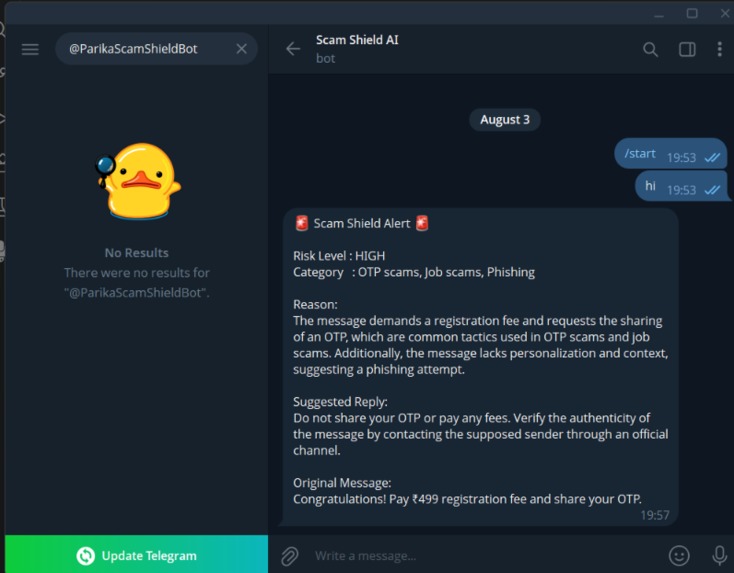
AI RESPONSE ON TELEGRAM
-
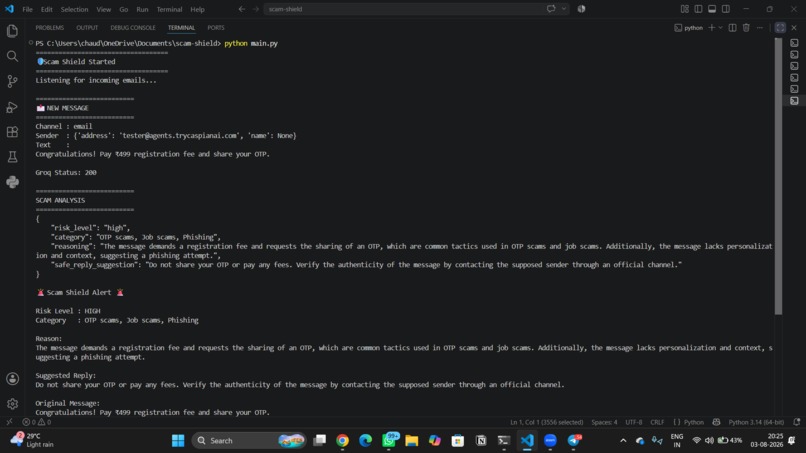
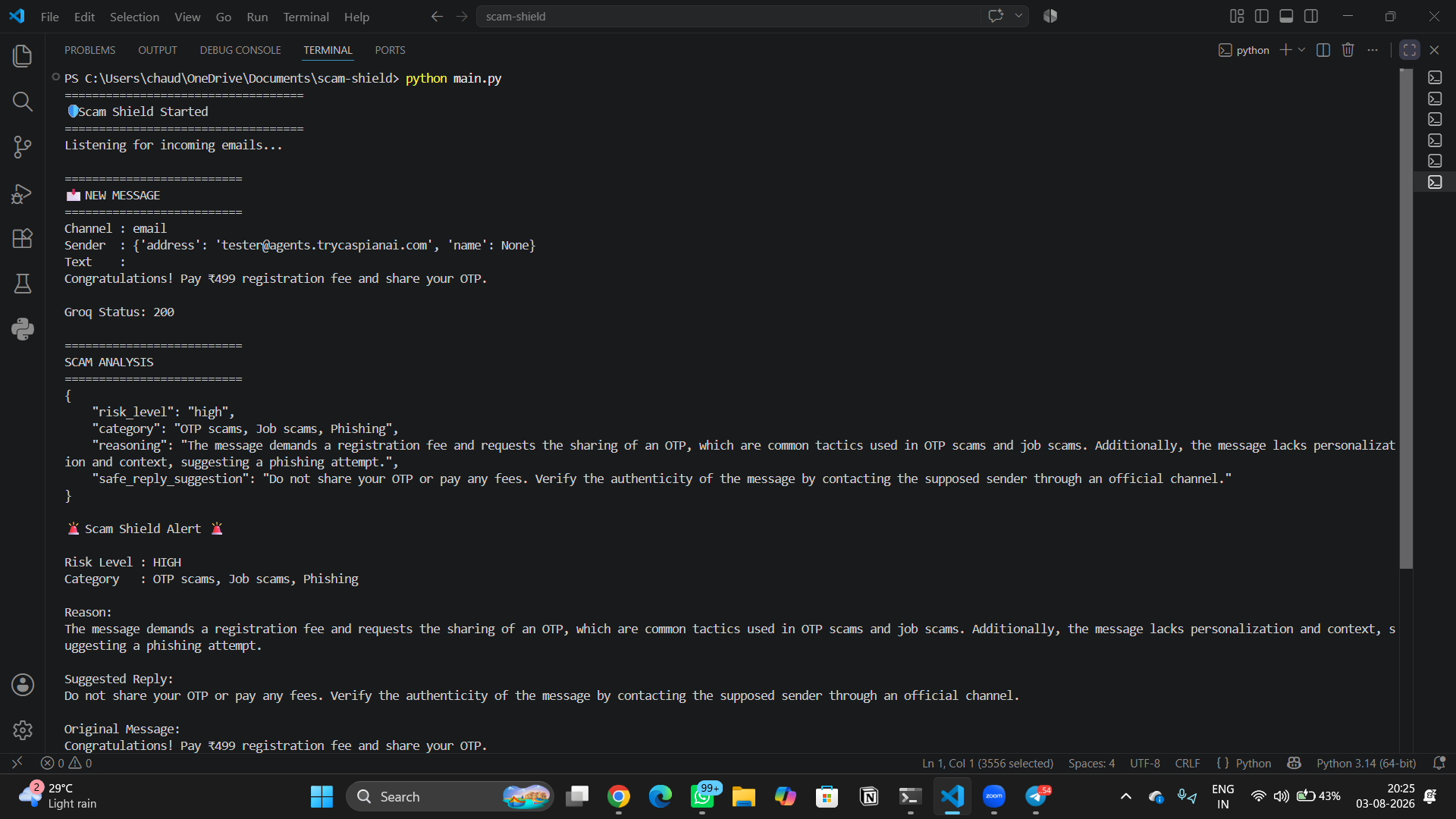
TERMINAL
-
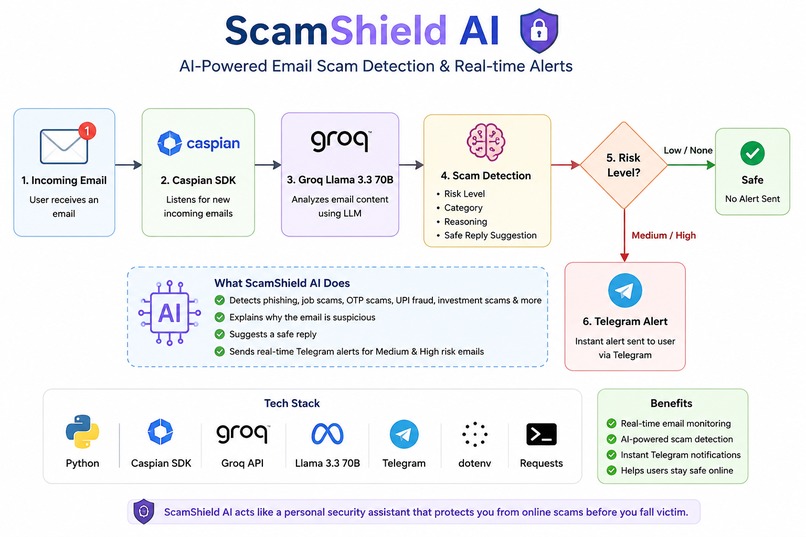
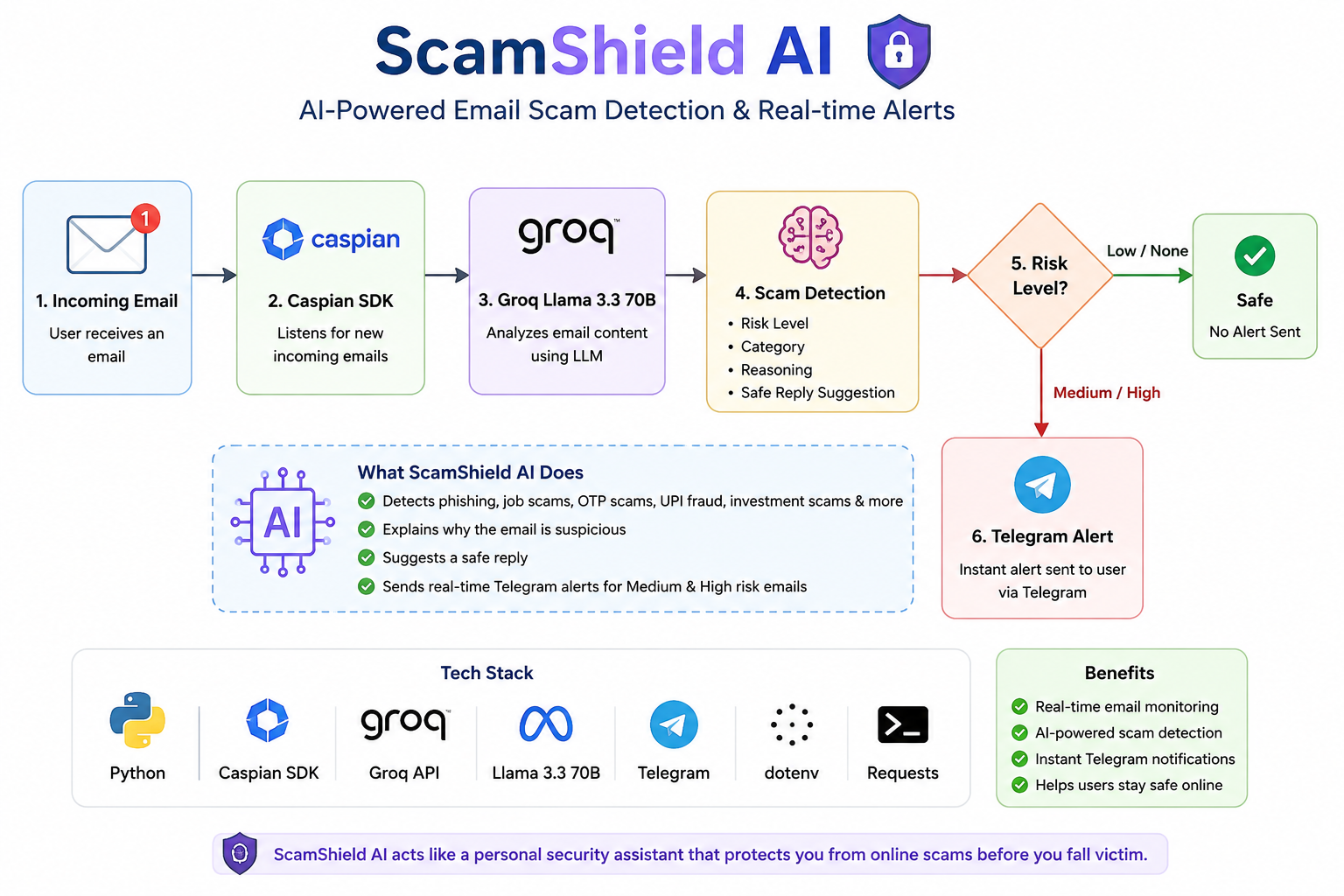
FLOWCHART
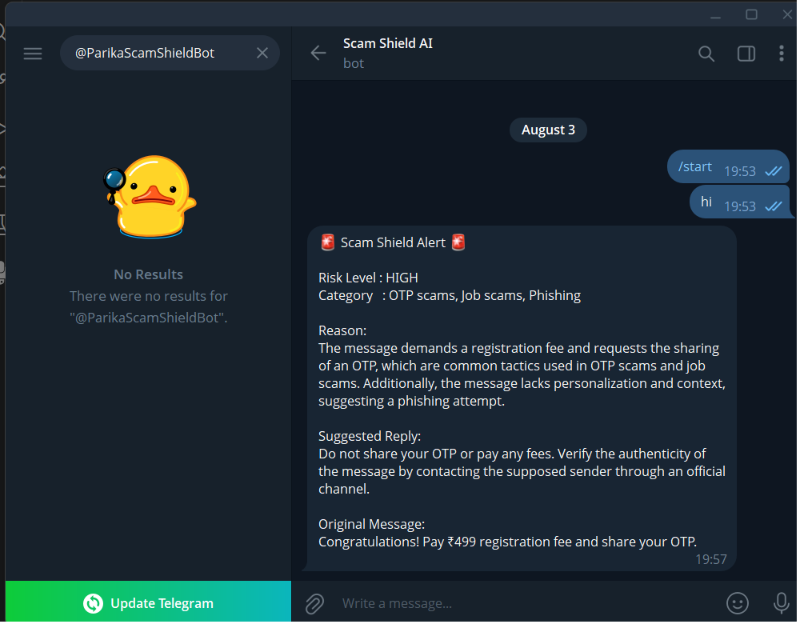
🛡️ ScamShield AI
Inspiration
Online scams are becoming increasingly sophisticated, especially phishing emails, fake job offers, investment frauds, and OTP scams. Many users fall victim because these messages often appear legitimate. We wanted to build an AI-powered assistant that doesn't just filter spam—it understands the content, explains why a message is suspicious, and proactively warns the user before they interact with it.
Our goal was to create an autonomous AI agent that continuously monitors incoming emails, analyzes them using a Large Language Model (LLM), and instantly notifies the user if a high-risk scam is detected.
What it does
ScamShield AI automatically:
- 📧 Listens for incoming emails using Caspian.
- 🧠 Uses Groq's Llama 3.3 70B model to analyze every message.
- 🚨 Detects phishing, fake job offers, OTP scams, UPI/payment fraud, investment scams, impersonation attempts, and other malicious content.
- 💡 Explains why the email is suspicious in simple language.
- ✍️ Suggests a safe response instead of leaving the user unsure.
- 📲 Sends an instant Telegram alert whenever a medium or high-risk scam is detected.
This creates an autonomous security assistant that protects users in real time.
How we built it
Our solution combines multiple technologies into a single AI-powered workflow:
- Caspian SDK continuously listens for incoming emails.
- Each email is passed to Groq's Llama 3.3 70B for intelligent scam analysis.
- The model returns:
- Risk level
- Scam category
- Reasoning
- Safe reply suggestion
- If the risk is Medium or High, the system automatically sends an alert to Telegram.
- The user receives an immediate explanation before interacting with the suspicious message.
Tech Stack
- Python
- Caspian SDK
- Groq API
- Llama 3.3 70B Versatile
- Telegram
- dotenv
- Requests
Challenges we faced
The biggest challenge was integrating multiple services into a seamless event-driven workflow.
Some of the issues we solved included:
- Debugging the Caspian email listener.
- Handling JSON responses reliably from the LLM.
- Understanding the Caspian SDK's messaging API.
- Discovering that Telegram notifications required a conversation ID rather than a direct user ID.
- Connecting real-time email monitoring with AI inference while keeping response times low.
Each challenge helped us better understand event-driven architectures, API integrations, and autonomous AI workflows.
What we learned
Throughout this project we learned:
- Building event-driven AI agents.
- Integrating LLMs into real-world automation.
- Working with external APIs and SDKs.
- Designing reliable AI pipelines.
- Prompt engineering for structured JSON outputs.
- Building autonomous systems instead of traditional chatbots.
Future Improvements
We plan to extend ScamShield AI with:
- 🌐 URL reputation analysis using VirusTotal or Google Safe Browsing.
- 📊 Analytics dashboard for scam trends.
- 📈 Risk score (0–100) instead of categorical labels.
- 🗂️ Scam history database.
- 📱 Support for WhatsApp, Slack, Discord, and SMS.
- 🤖 Personalized AI security recommendations.
- 🔄 Automatic scam reporting to cybersecurity platforms.
Why ScamShield AI?
Instead of simply classifying emails as spam, ScamShield AI explains why a message is dangerous and proactively alerts users before they become victims.
It transforms passive spam detection into an intelligent, autonomous AI security assistant that helps users make safer decisions in real time.

Log in or sign up for Devpost to join the conversation.