-
-
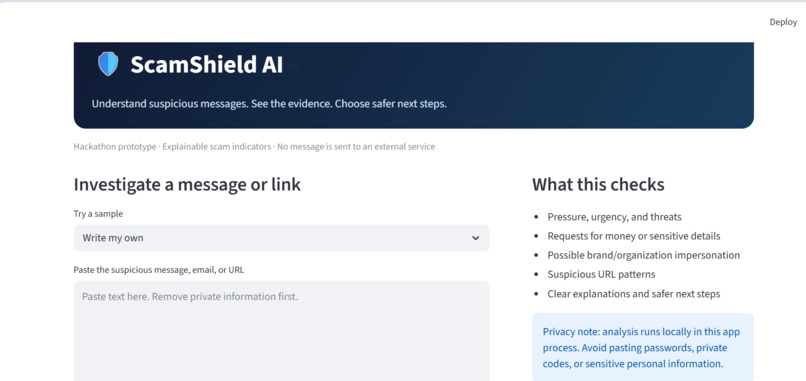
Main page
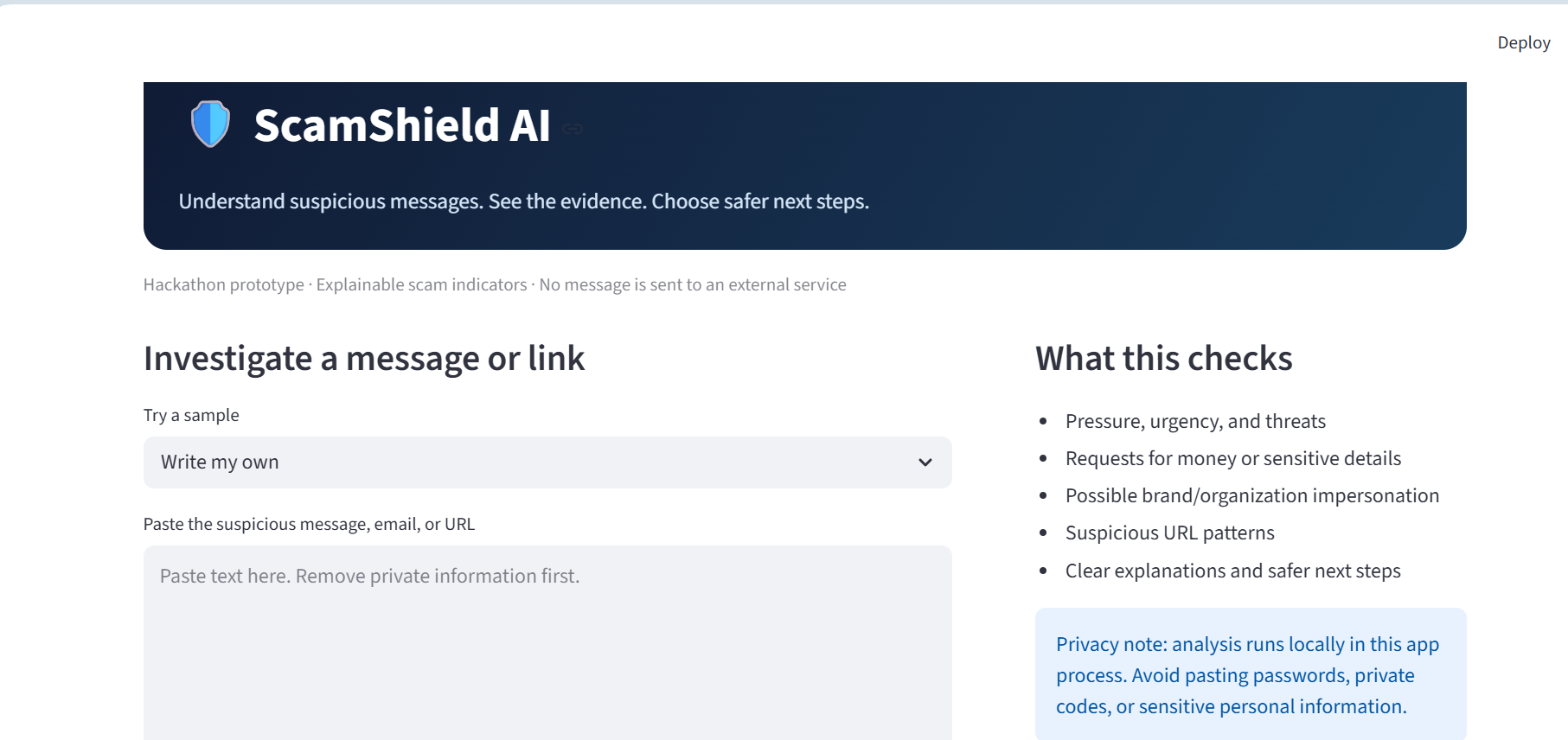
Inspiration
Online scams are becoming increasingly convincing. A fraudulent message may imitate a bank, a delivery service, a company, or even someone the recipient knows. The challenge is not always recognizing that something feels suspicious, but understanding why it may be suspicious and what to do next.
We wanted to explore how AI could make this process easier for people without a cybersecurity background. Instead of giving users a simple “safe” or “scam” label, ScamShield AI aims to help them investigate suspicious interactions, understand warning signs, and make more informed decisions.
What it does
ScamShield AI is an AI-powered scam investigation assistant designed to analyze suspicious messages and URLs, identify potential impersonation indicators, and explain its findings in plain language.
Its goal is to go beyond a basic phishing detector. Rather than presenting a conclusion without context, the application is designed to highlight observable evidence, distinguish potential warning signs from unverified assumptions, and suggest practical next steps.
Depending on the available inputs and enabled analysis components, an investigation can examine message content, URL characteristics, sender information, and screenshots.
The results are intended to help users understand:
- What looks suspicious: potential signs of urgency, credential requests, impersonation, or unusual payment instructions.
- Why it matters: an explanation connecting each finding to the available evidence.
- What remains uncertain: missing information and claims that have not been independently verified.
- What to do next: practical guidance, such as verifying a request through an organization's official website or a previously trusted contact method.
How we built it
We designed ScamShield AI around an evidence-based investigation workflow. The application combines deterministic checks for observable patterns with optional AI-assisted contextual interpretation.
The analysis is separated into components so that message content, URL characteristics, sender information, and other available signals can be examined independently before being brought together into an overall assessment.
A key design decision is to prioritize transparency over unsupported certainty. A suspicious signal is not automatically proof of fraud, and the use of HTTPS or the absence of obvious warning signs does not guarantee that a message is legitimate. The application is intended to communicate these limitations instead of presenting an unverified conclusion as fact.
The project uses Python and a modular architecture, with a web interface designed to make the investigation process accessible to non-technical users.
Challenges we explored
One of the main challenges is distinguishing suspicious patterns from reliable evidence. Urgency, unfamiliar domains, and unusual wording can be useful warning signs, but none of them alone proves that a message is fraudulent.
Another challenge is making AI analysis useful without allowing it to invent evidence or follow malicious instructions embedded in the content being investigated. This requires separating untrusted user-provided content from the instructions governing the analysis, validating structured outputs, and handling uncertainty carefully.
We also considered privacy and security throughout the design. Suspicious links should not be opened automatically, sensitive information should not be requested unnecessarily, and external analysis services must be clearly distinguished from checks performed locally.
What i learned
Building ScamShield AI highlights that useful cybersecurity AI is not simply about producing a prediction. It is also about explaining the evidence, acknowledging uncertainty, and helping people take appropriate action.
We see AI as a tool to support human judgment, not replace it. Our goal is to make digital interactions easier to question, investigate, and verify before users trust a potentially dangerous message.
Future improvements
Potential next steps include integrating verified external threat-intelligence sources, improving screenshot and text extraction, expanding impersonation analysis, and evaluating the system against a carefully curated dataset of legitimate and fraudulent messages.
These improvements would help assess the quality of the analysis more systematically and strengthen the application's usefulness in real-world scenarios.
ScamShield AI Understand the warning signs before you trust the message.
Built With
- detection
- expressions
- python
- regular
- rule-based
- streamlit

Log in or sign up for Devpost to join the conversation.