-
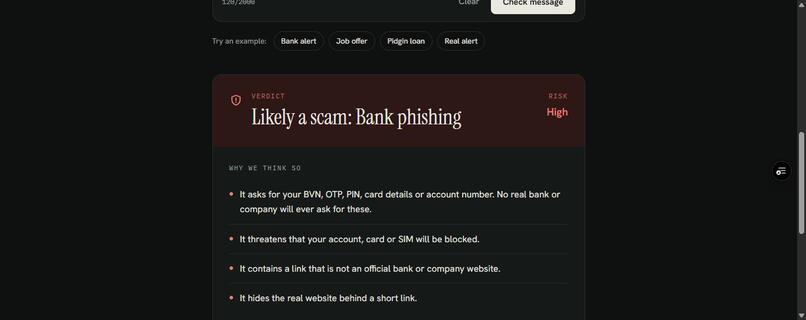
A fake bank alert is flagged as bank phishing, high risk, with plain reasons
-
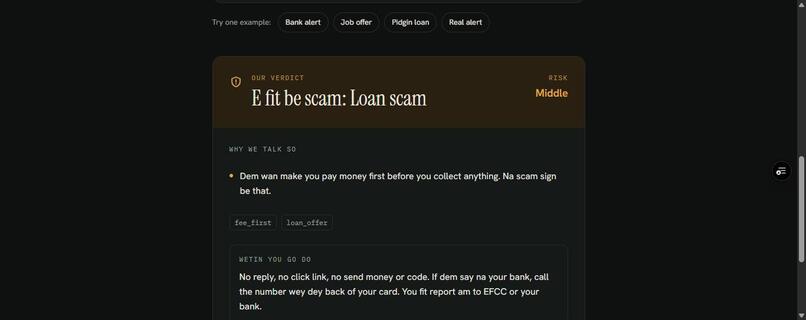
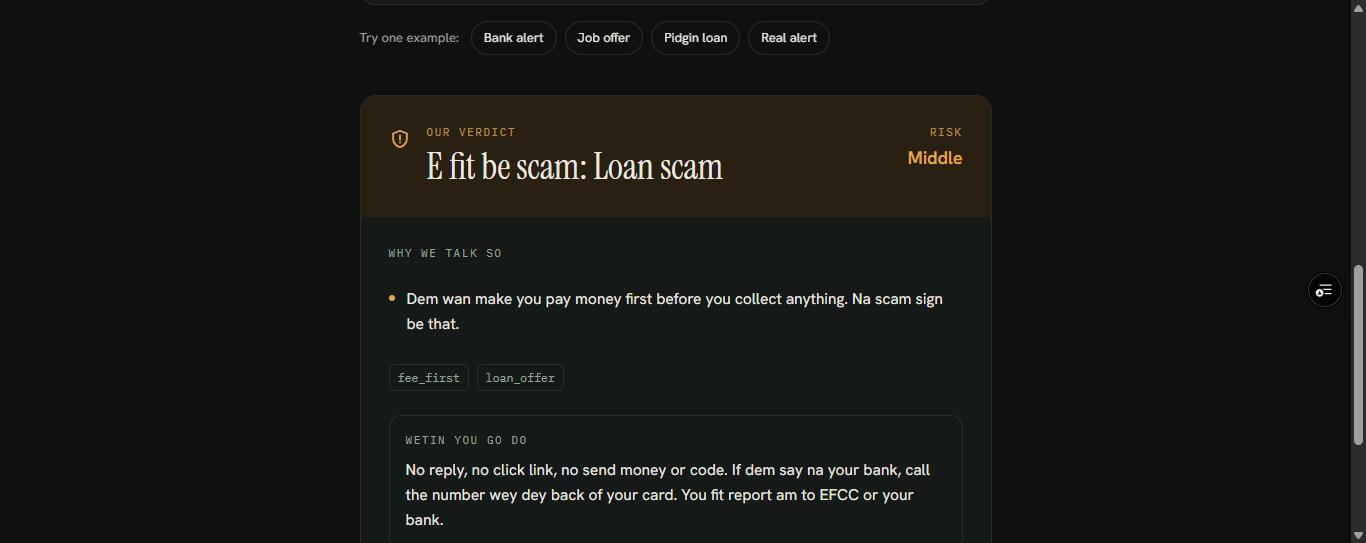
The same check in Nigerian Pidgin: a loan scam asking for a fee first
-
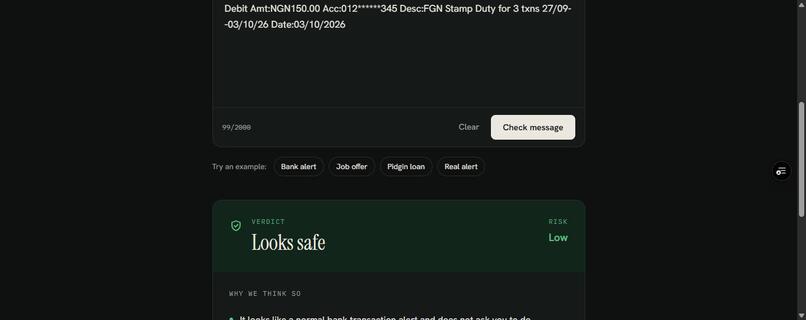
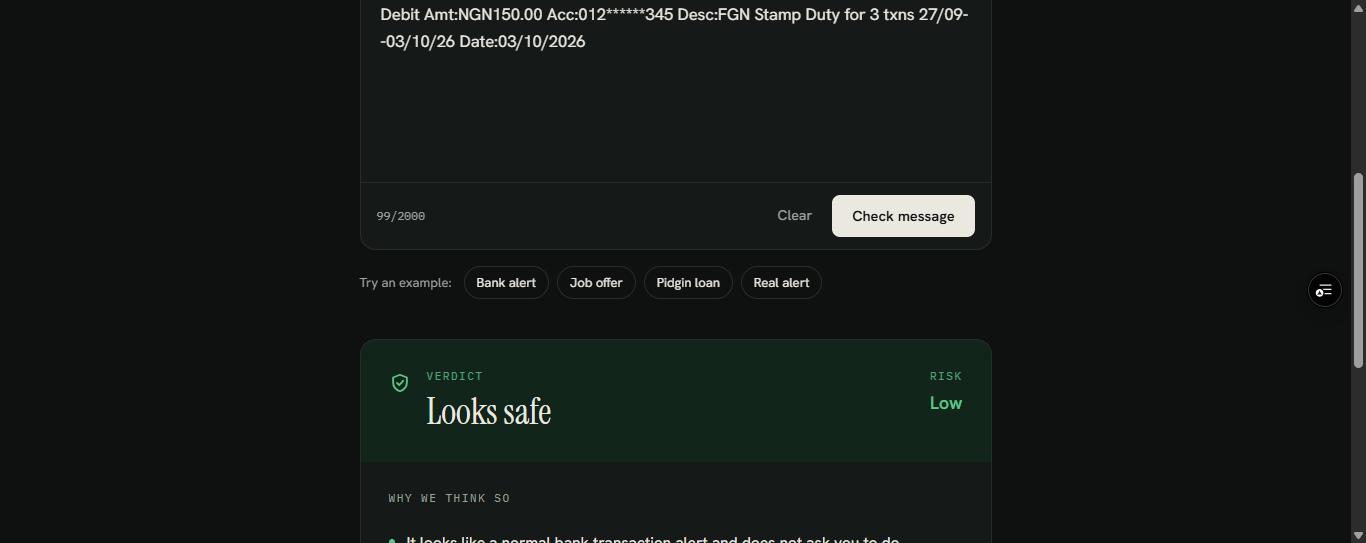
A real bank debit alert is correctly marked safe, low risk
Inspiration
I built ScamShield because I was scammed myself.
When it happened, I had nowhere to turn. I had a message in front of me and a decision to make, and there was no simple tool that could tell me, "this looks like a scam." I couldn't check it. I had to guess, and I guessed wrong. Afterwards I realised how many people in Nigeria are in that same position every day: a fake bank alert asking for a BVN or PIN, a "you've won" prize, an investment offer, a job that needs a "registration fee". The tools that exist are mostly built for Western phishing, and none of them speak to us in a way we actually understand.
So I built the thing I needed that day: a place where you paste the message, in seconds, before you act, and get a clear answer and, just as important, the reason why. I wanted it in English and Nigerian Pidgin, because a warning only helps if the person can understand it. This is not a theory project for me. It comes from a loss I couldn't prevent, and I built it so the next person has the check I didn't have. What it does
What it does
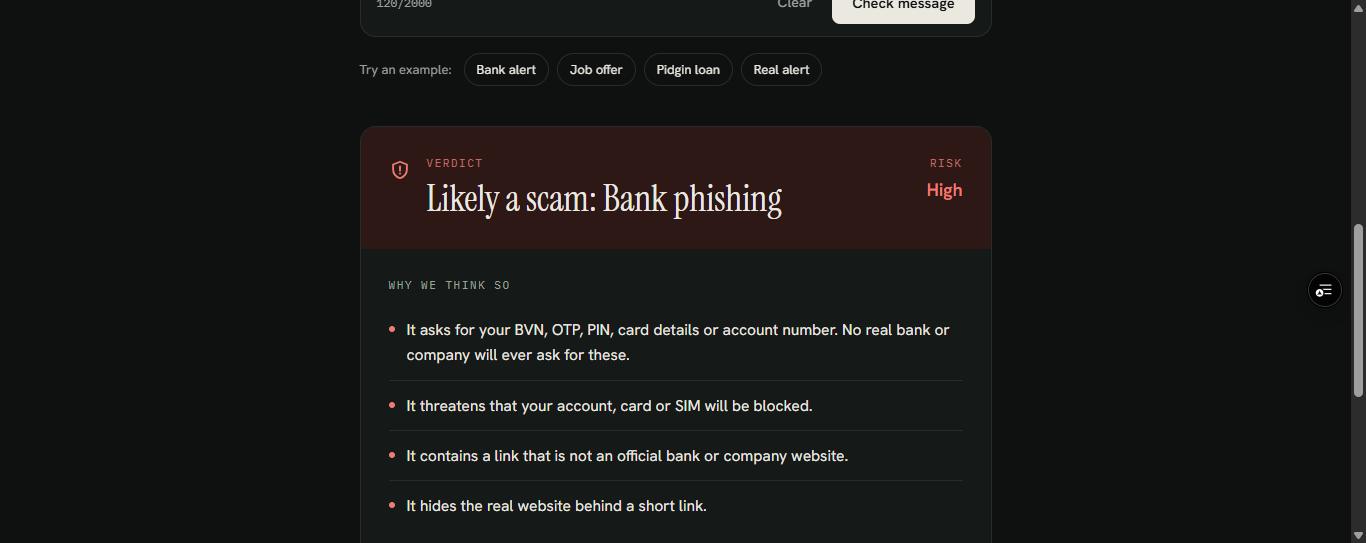
ScamShield lets you paste an SMS or email and returns a scam verdict with a risk level and plain-language reasons (for example: "It asks for your BVN, OTP, PIN, card details or account number. No real bank or company will ever ask for these."). The interface works in English and Nigerian Pidgin, so the explanation reaches people who need it most.
How I built it
- Model: TF-IDF features (word and character n-grams) plus hand-written rule features, fed to a logistic regression (scikit-learn). Rules cover signals such as asking for secrets, payment requests, suspicious or look-alike links and urgency, and each rule doubles as the explanation shown to the user.
- Data: a public SMS spam dataset (UCI), down-sampled so it doesn't drown out the signal, combined with a small set of hand-reviewed Nigerian scam messages that are weighted 15x. We kept a held-out set to check the model.
- API: FastAPI with per-IP rate limiting and locked-down CORS, containerised and deployed on Google Cloud Run. It works without any LLM key (rule-based explanations); an optional OpenAI-compatible LLM can rewrite explanations.
- Frontend: React + Vite + Tailwind on Vercel, with English/Pidgin switching.
Challenges
Public datasets barely contain Nigerian scam patterns, so I had to hand-label local examples (including the chats from when I was scammed) and weight them carefully without overfitting to a tiny set. Making the explanations trustworthy was the other challenge: tying each explanation to a concrete triggered rule keeps it honest instead of a vague "this looks suspicious".
What I learned
Small, well-chosen local data plus transparent rules can beat a bigger generic model for a local problem, and explaining a verdict matters as much as the verdict itself.
What's next
More hand-reviewed local data, more Nigerian languages (Yoruba, Hausa, Igbo), a browser/WhatsApp share-target so you can check a message without leaving the chat, and a proper evaluation on a larger held-out set.
Built With
- docker
- fastapi
- google-cloud-run
- python
- react
- scikit-learn
- tailwindcss
- vercel
- vite

Log in or sign up for Devpost to join the conversation.