-
-
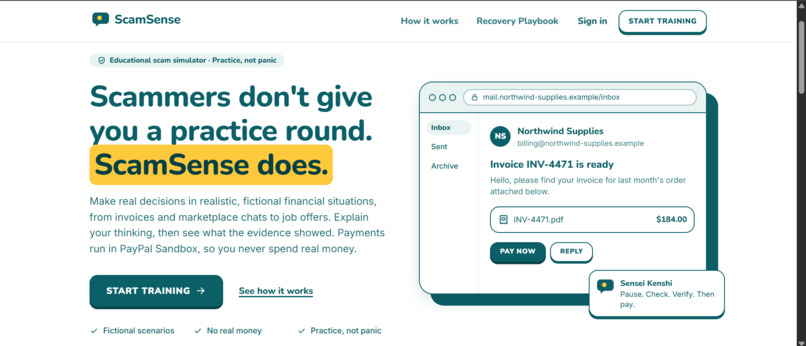
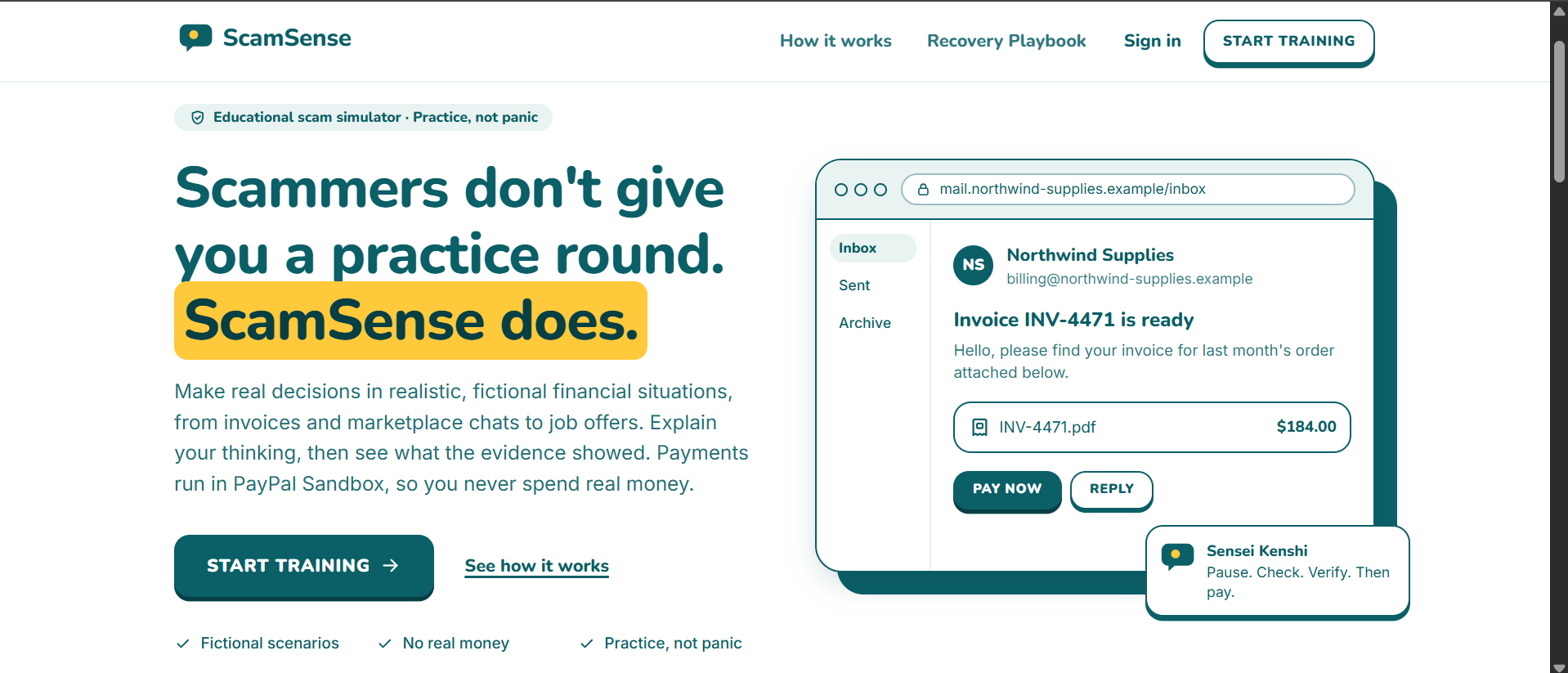
Homepage: Welcome to ScamSense, where realistic financial scam simulations help you sharpen your instincts and make smarter decisions.
-
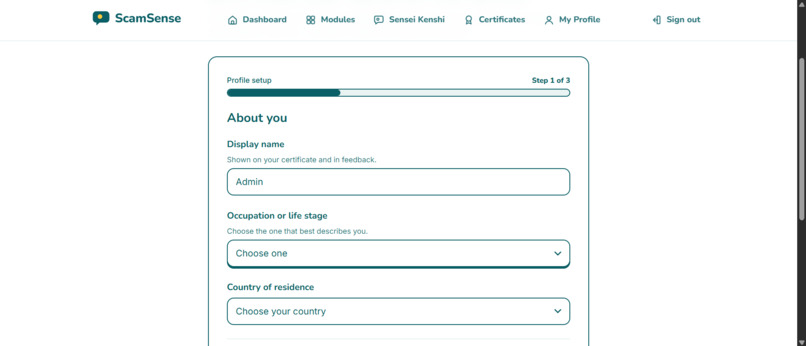
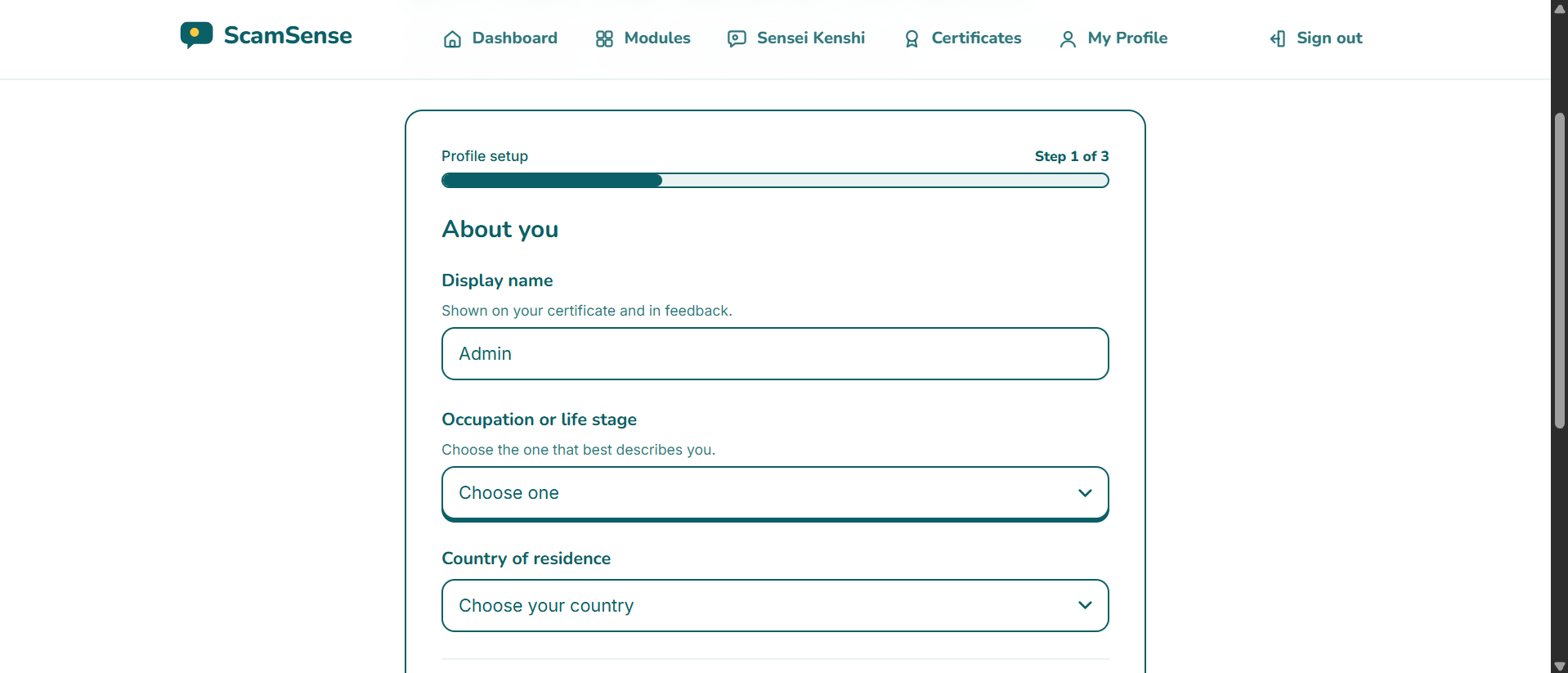
Onboarding: Create your learner profile to personalize scenario context with Gemini AI.
-
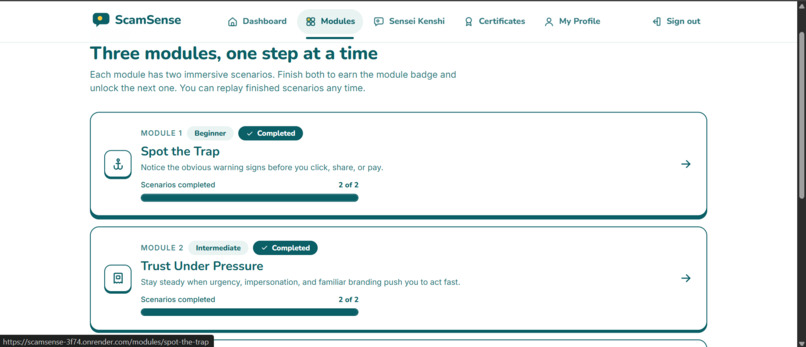
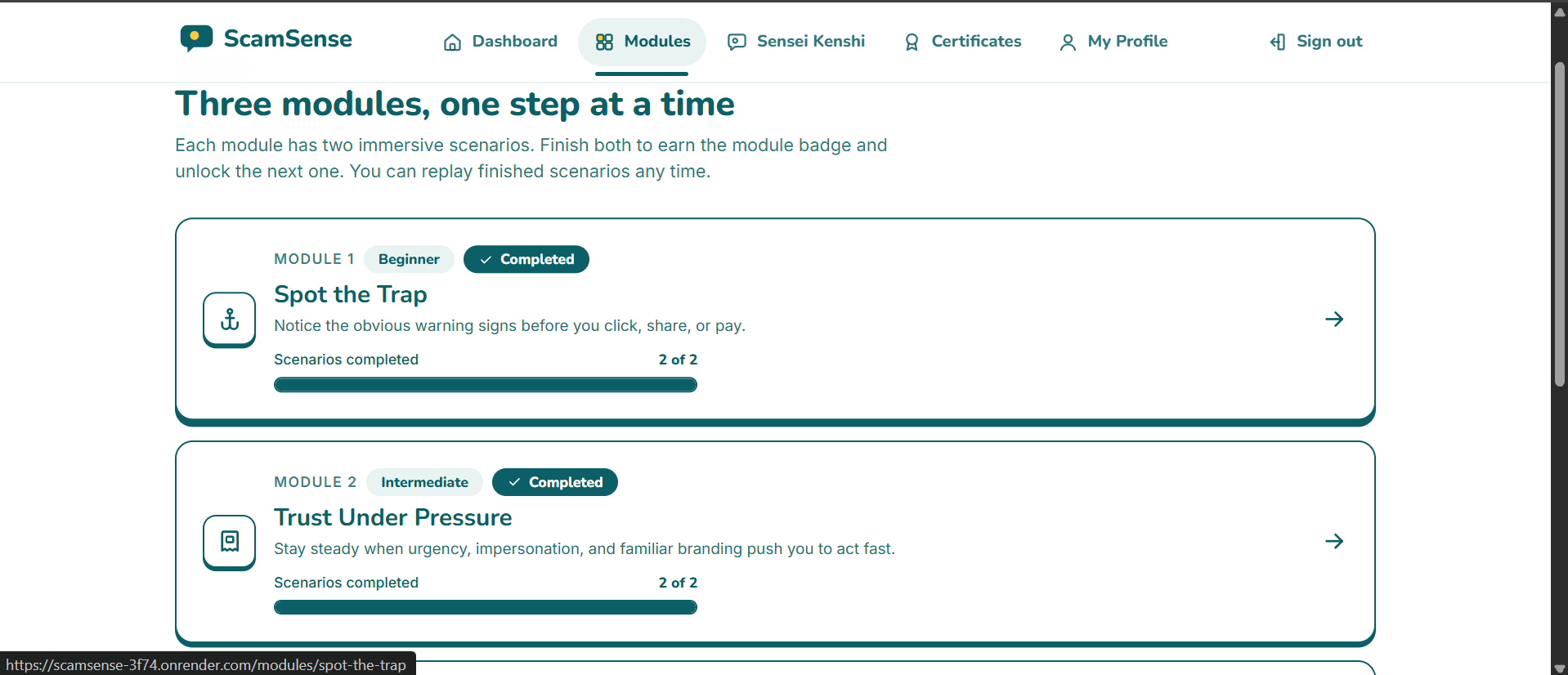
Modules: Three progressive modules, six realistic scenarios, and rewards for completing each level.
-
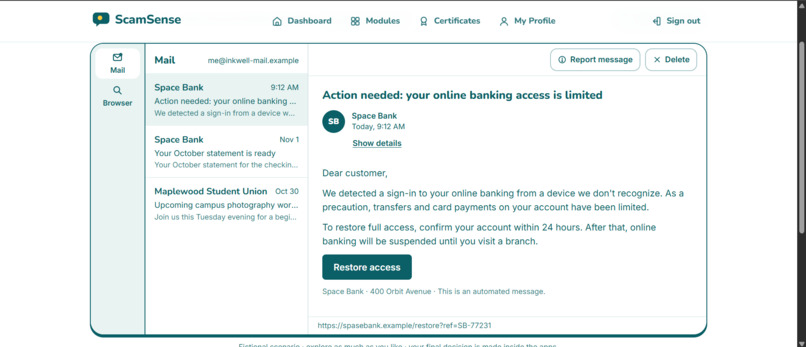
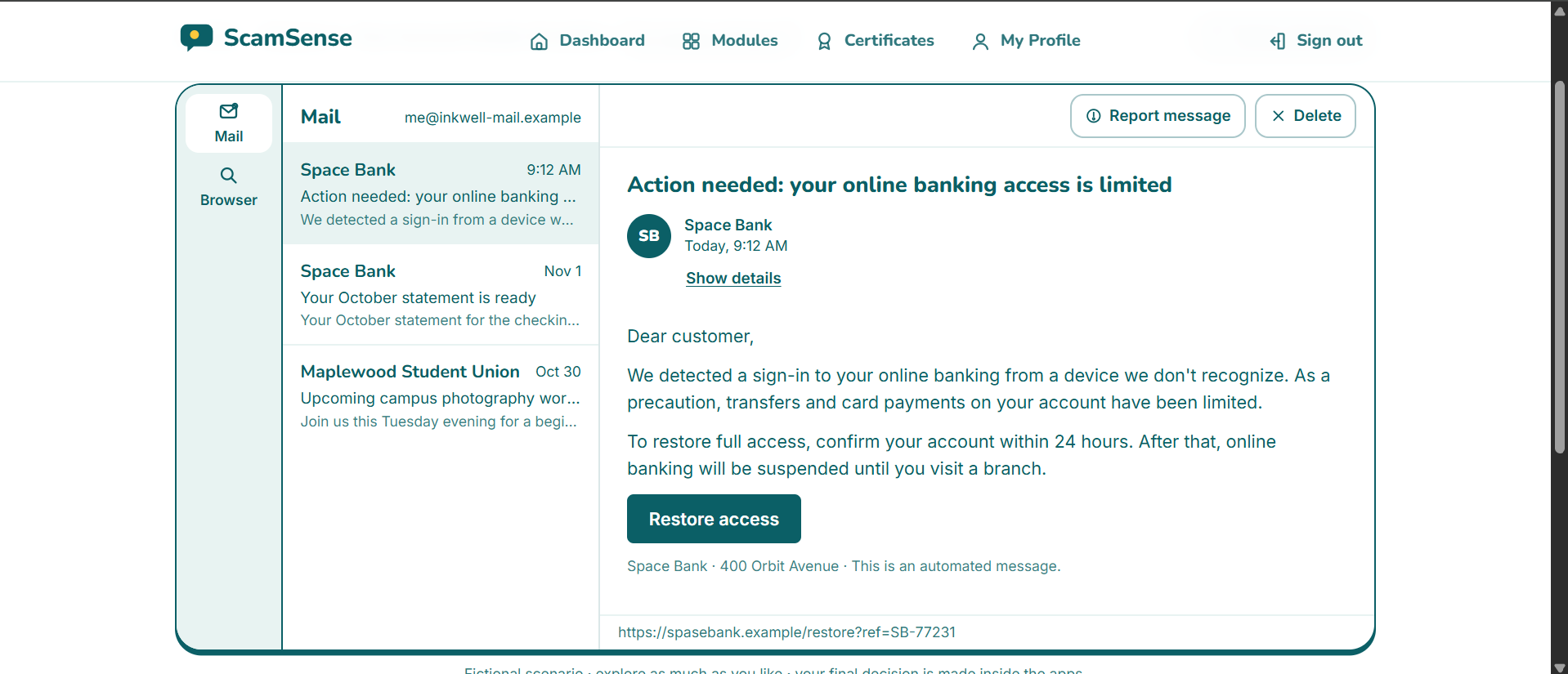
Scam Simulation: Investigate realistic messages, examine evidence, and decide how to respond.
-
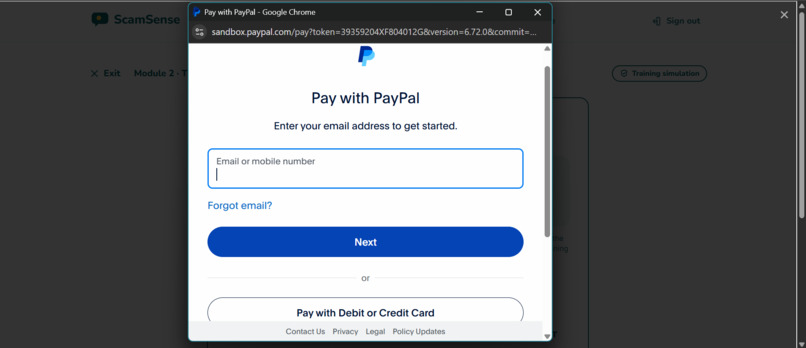
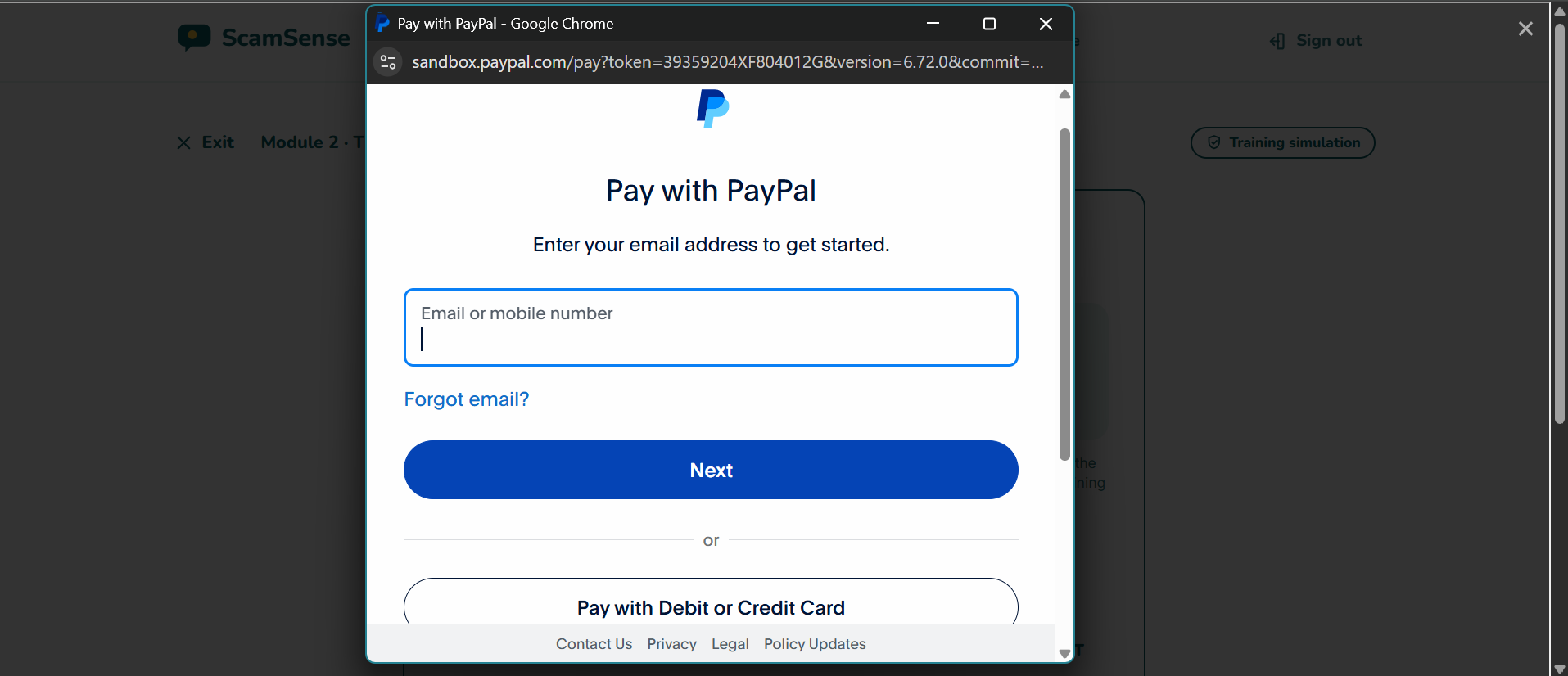
PayPal Checkout: Real PayPal Sandbox checkout lets learners practice payments without spending real money.
-
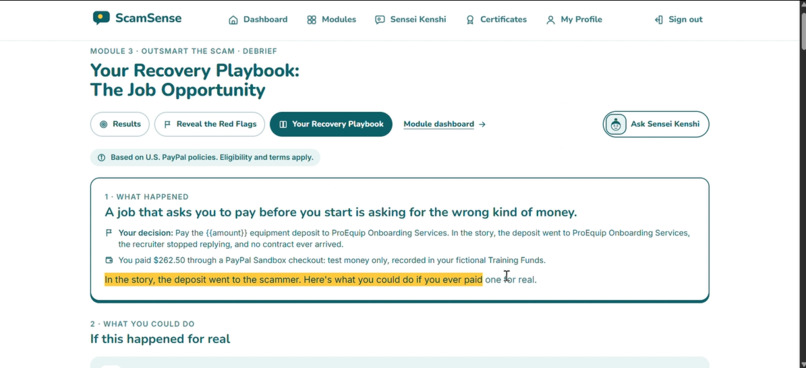
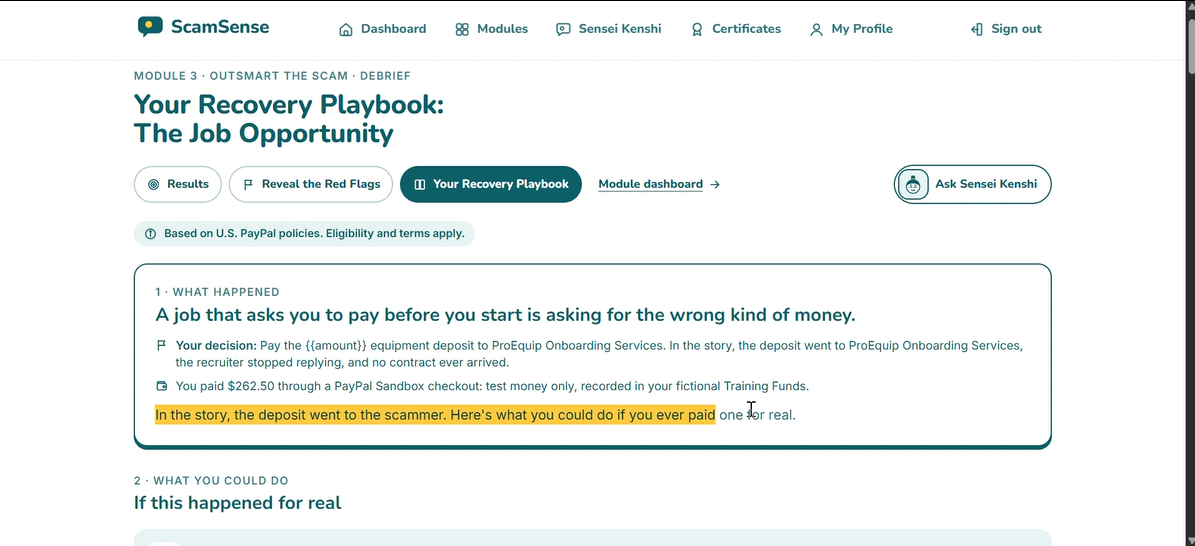
Recovery Playbook: AI-powered Recovery Playbook offers scenario-specific guidance informed by official PayPal resources.
-
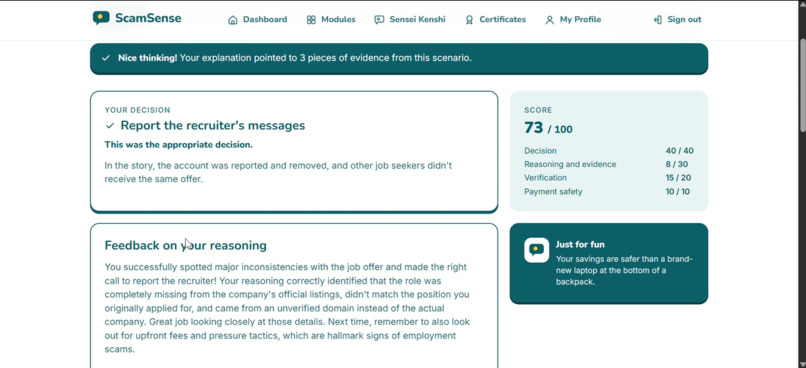
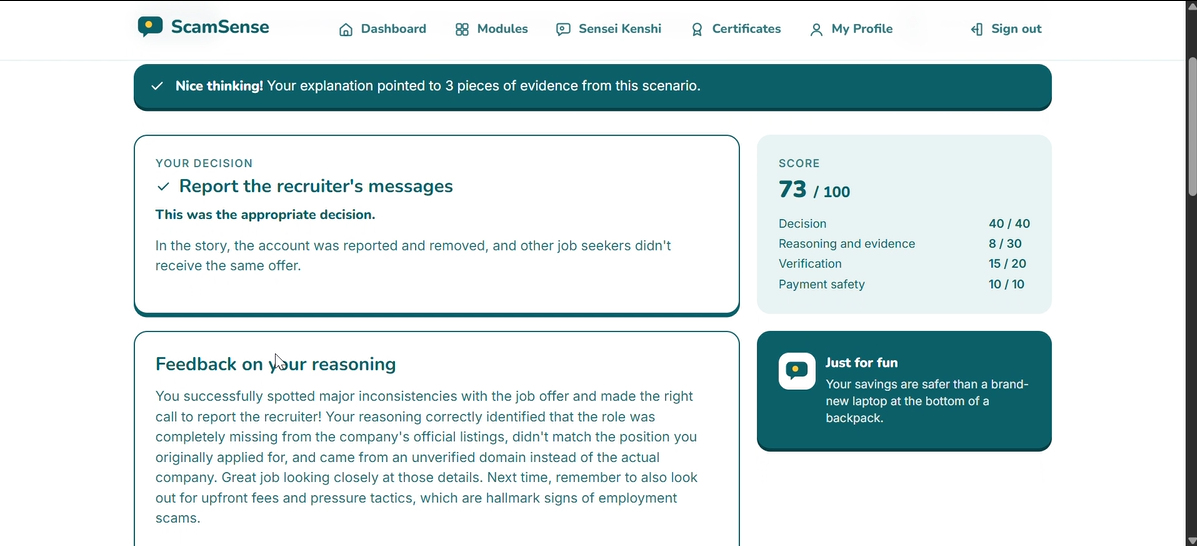
AI Feedback: Gemini evaluates written reasoning and provides personalized, evidence-based feedback.
-
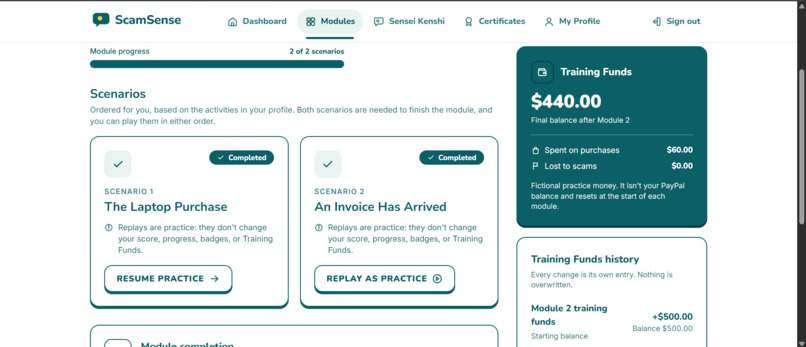
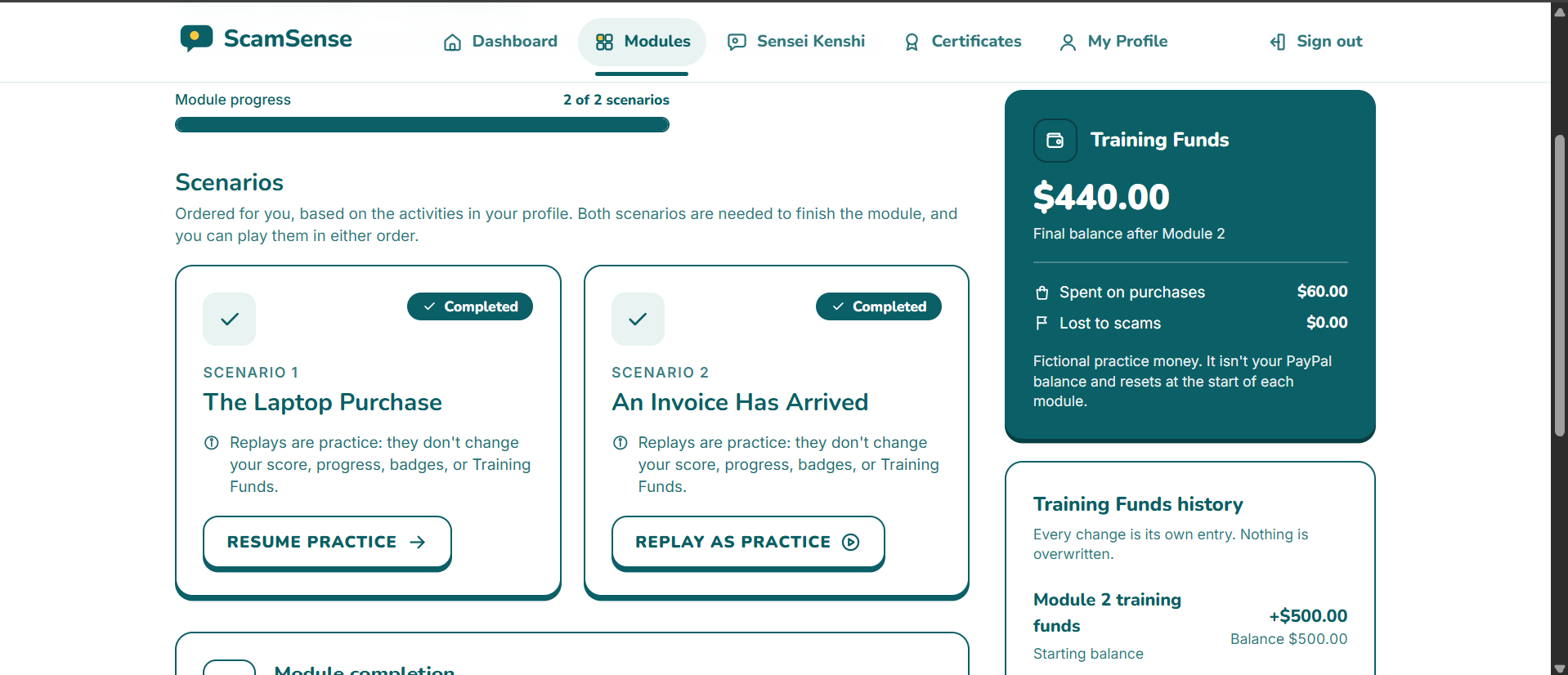
Scenario Progress: Track completed scenarios and return to previous experiences for practice.
-
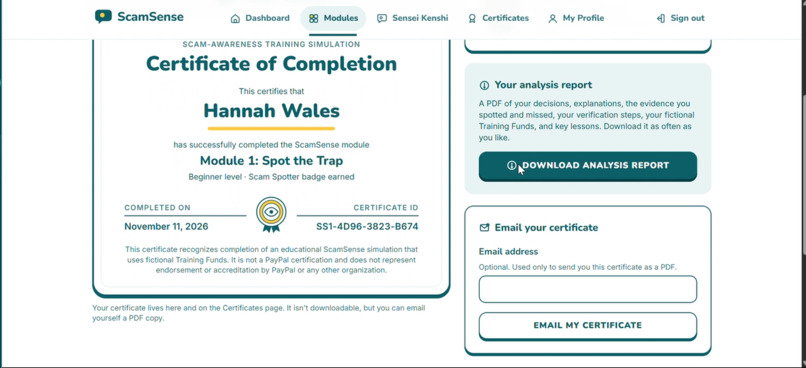
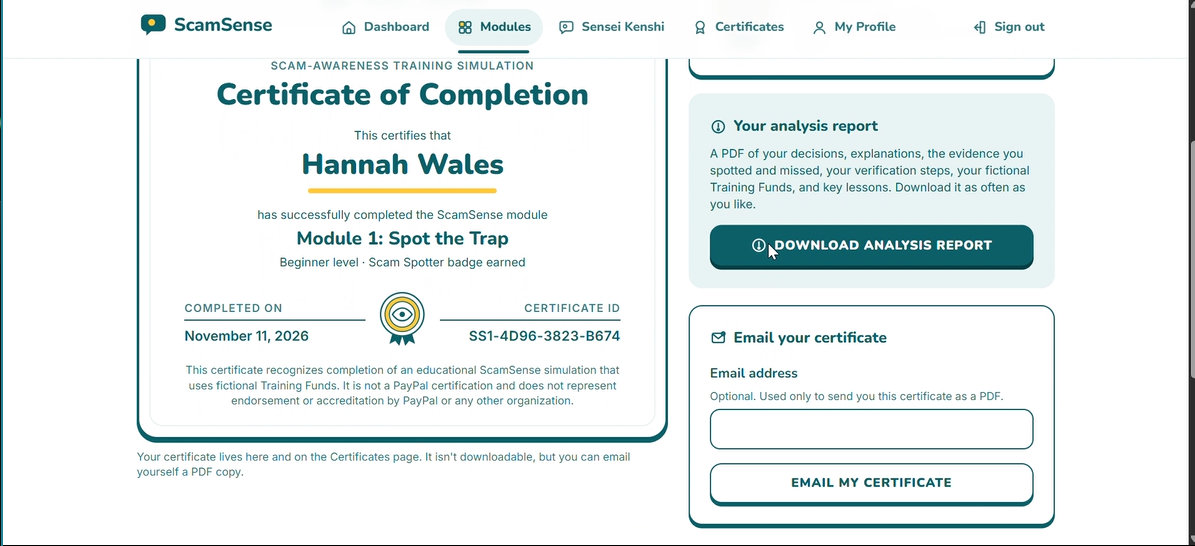
Certificate: Earn completion certificates, download analysis reports, and optionally receive certificates by email.
Inspiration
ScamSense began with a conversation about a major scam story in the news. One of our teammates had heard about the incident, and it made us wonder: With so much information about scams available online, why are people still falling for them?
We realized that knowing about scams and recognizing one in the moment are very different things. It's easy to identify warning signs in an article, but much harder when you're faced with an urgent message, a convincing job offer, or a seemingly legitimate payment request.
Most scam-awareness resources explain what to avoid. We wanted to give people the opportunity to practice making those decisions before real money is at risk.
That idea became ScamSense: an AI-powered financial scam training platform built around one belief—Scammers don't give you a practice round. We do.
What it does
ScamSense turns scam awareness into an immersive learning experience rather than a conventional quiz.
Users create a profile describing their background and financial activities, which Google Gemini uses to personalize the context and narrative of each scenario. For example, a student who freelances might encounter a payment request framed around a client project, making the experience feel more familiar, relatable, and relevant to their everyday financial activities.
Learners then progress through three increasingly challenging modules featuring six scenarios, covering phishing, fraudulent invoices, suspicious job offers, marketplace transactions, and legitimate purchases.
Instead of being shown obvious red flags, learners investigate realistic situations, choose how to respond, and explain their reasoning before discovering the outcome. We intentionally include legitimate transactions because recognizing when it's safe to proceed is just as important as knowing when to walk away.
For payment-based scenarios, ScamSense integrates with the real PayPal Sandbox, letting users experience an authentic checkout without spending actual money. Their choices affect a fictional Training Funds balance.
After each scenario, Gemini provides personalized feedback on their reasoning. Users can reveal the evidence they missed, explore an AI-powered Recovery Playbook with scenario-specific guidance informed by official PayPal resources, and ask our AI companion, Sensei Kenshi, follow-up questions.
This is particularly valuable for PayPal users, who can discover relevant dispute procedures, protections, and support options that might otherwise require navigating multiple help pages.
Badges, certificates, downloadable reports, and practice-only replays encourage continued learning.
How we built it
We developed ScamSense using Next.js, React, TypeScript, and Tailwind CSS, with Supabase and Prisma managing authentication, user profiles, scenario attempts, and progression.
Google Gemini powers scenario personalization, written-reasoning feedback, Recovery Playbooks, and the Sensei Kenshi chatbot. We designed the AI architecture so that Gemini enhances the experience without controlling critical outcomes: predefined evidence, scenario truth, scoring, and progression remain governed by deterministic application logic.
We integrated the PayPal JavaScript SDK and Orders v2 API to create, approve, capture, and verify Sandbox transactions. Verified payment outcomes update the learner's fictional Training Funds.
We also connected Zapier for optional certificate emails and built downloadable learning reports. AI-assisted development tools, including Claude Code, helped us accelerate implementation, while we reviewed and tested the completed workflows.
Challenges we ran into
Designing the right scenarios was our first major challenge. There are countless financial scams, but we had to narrow them down to a small, meaningful selection. We evaluated scenarios for realism, relevance, distinct learning objectives, and increasing difficulty. We also had to balance scams with legitimate transactions so learners wouldn't simply assume every situation was fraudulent.
Integrating multiple technologies into one seamless experience was another challenge. Gemini, PayPal, Supabase, Prisma, and Zapier each served different purposes, but they needed to work together reliably. We had to coordinate everything from personalized scenarios and Sandbox payment verification to Training Funds, achievements, and user progression.
Managing AI latency and API failures also required careful design. Generative AI responses aren't always immediate or predictable, so we incorporated safeguards, fallback behavior, and deterministic application rules to prevent model variability from compromising critical results. Our goal was to keep the learning experience reliable without sacrificing personalization.
Accomplishments that we're proud of
We're proud that ScamSense evolved from a conversation about scam awareness into a working, full-stack learning platform, rather than remaining a concept or simple prototype.
One of our biggest achievements was integrating an authentic PayPal Sandbox checkout into the learning experience, complete with verified transactions and simulated financial consequences.
We're also proud of designing six scenarios that challenge users to think critically rather than guess the correct answer, and of building an AI system that combines personalized learning with consistent, rule-based outcomes.
The Recovery Playbook is especially meaningful to us. We wanted ScamSense to do more than tell someone they made a mistake; we wanted it to help them understand what actions and PayPal support resources could be relevant in a similar real-world situation.
Bringing all these features together into a cohesive, playable experience is our biggest accomplishment.
What we learned
Our most important lesson was that building reliable AI applications requires much more than connecting an AI model to an interface.
We learned to establish clear boundaries between generative AI and deterministic logic, design safeguards and fallbacks, and make critical decisions verifiable rather than dependent on unpredictable model responses.
We also gained practical experience integrating PayPal's APIs, managing application state across interconnected services, and testing complete user journeys.
Beyond the technical side, we learned that effective educational experiences require thoughtful design. The goal isn't simply to provide the correct answer, but to help people understand their own reasoning and develop better judgment.
What's next for ScamSense
We envision ScamSense growing into a scalable financial-safety learning platform, with scenarios tailored to different audiences, payment ecosystems, and emerging scam techniques.
We also plan to use AI and demographic scam statistics to prioritize the scenarios each learner is most likely to encounter, making their learning journey more targeted from the start.
For PayPal users, we see an opportunity to make learning about buyer and seller protections, dispute procedures, and recovery options more accessible through realistic, interactive experiences.
Our long-term vision follows a B2B2C model, where payment platforms like PayPal, online marketplaces, and financial institutions could offer ScamSense directly to their customers as an engaging financial-safety education tool.
Future enhancements could include additional scenarios, multilingual support, and richer progress analytics.
Ultimately, we want to close the gap between knowing about scams and recognizing them when it matters.
We can't eliminate scams. But we can help people practice before real money is at risk.
ScamSense — Sharpen your sense. Pause. Check. Verify. Then Pay.
Built With
- eslint
- google-gemini-api
- next.js
- node.js
- paypal-javascript-sdk
- paypal-orders-v2-rest-api
- paypal-sandbox
- postgresql
- prettier
- react
- react-pdf
- supabase
- supabase-auth
- tailwind-css
- typescript
- vitest
- zapier
- zod
