Inspiration
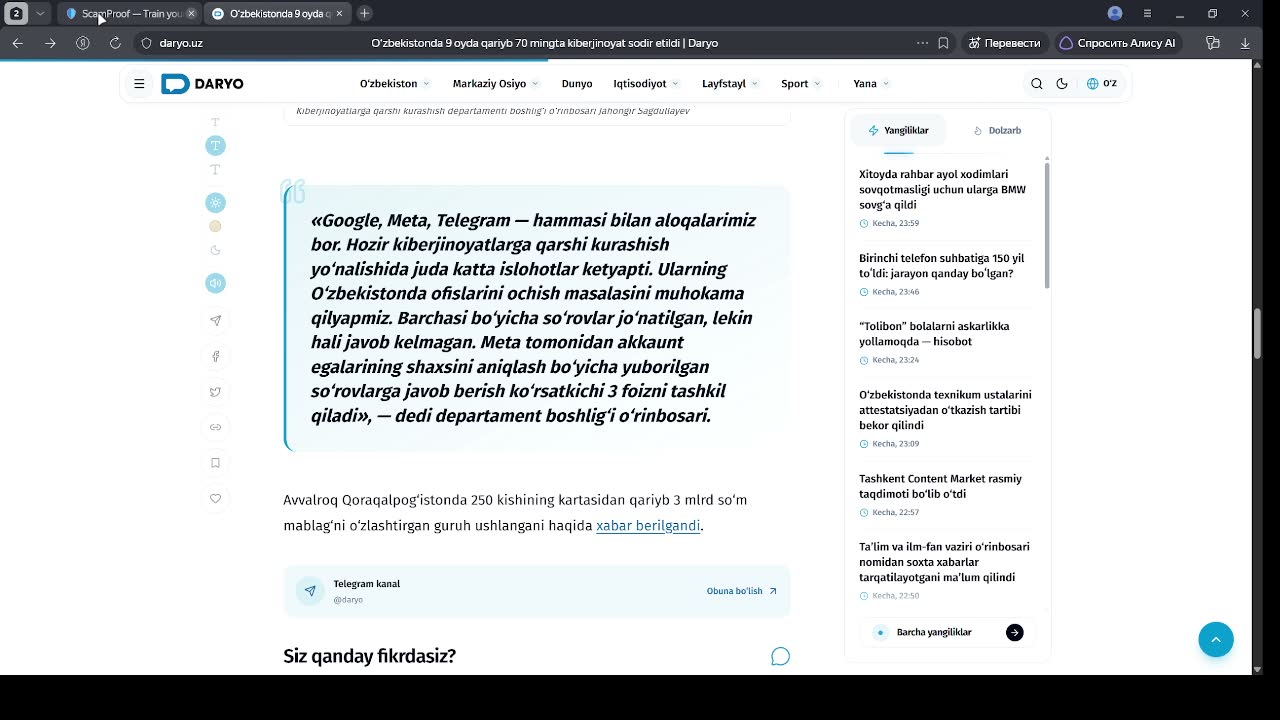
This month, Uzbekistan's Ministry of Internal Affairs announced 69,962 crimes committed using information and communication technologies in just six months — the vast majority, money stolen from ordinary people through electronic payment systems. Almost every one of those crimes started the same way: a single message engineered to create fear, greed or urgency.
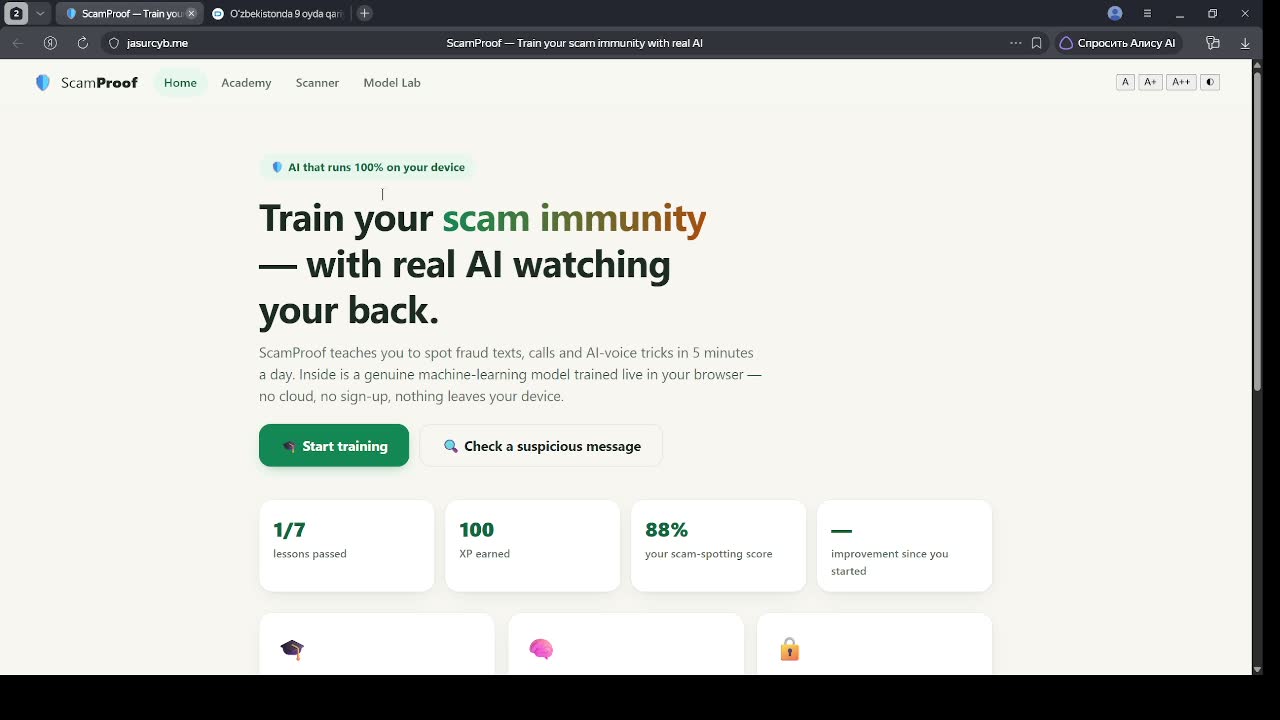
The AI + Cybersecurity track asks how we can help people recognize, prevent, verify and respond to scams — and that is exactly the pipeline ScamProof implements: recognize (Academy), verify (Scanner), respond (You vs the AI), all powered by a genuine ML model that runs 100% on-device. Fraud awareness training is the most effective defence — once a person can name the trick, the trick stops working — so we turned it into a daily 5-minute habit, like Duolingo for scam immunity.
What it does
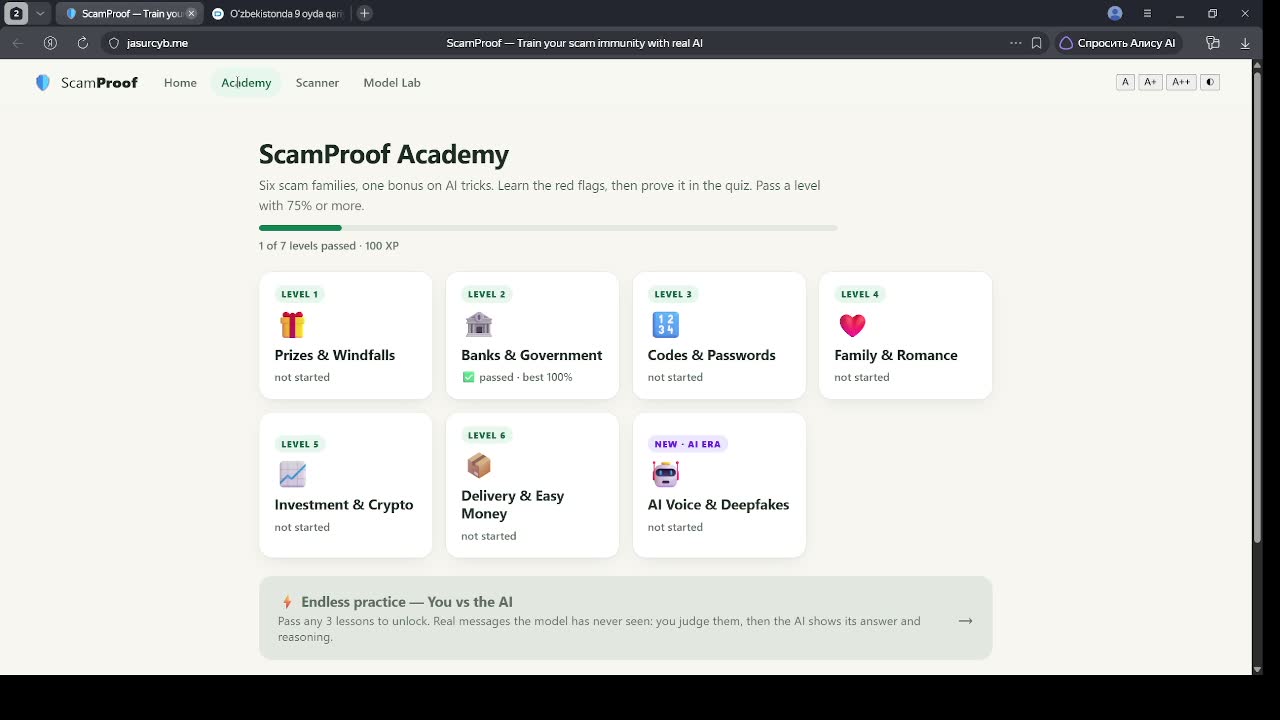
- Academy — six scam families (prizes, fake banks, OTP theft, family/romance, investment, delivery) plus a bonus level on AI voice & deepfakes. Three memorable red flags per level, a "golden rule", then a quiz with instant plain-language feedback. The app tracks each user's scam-spotting score and improvement since their first session.
- You vs the AI — endless practice on real messages the model has never seen. You give your verdict first; then the AI reveals its verdict, confidence and reasoning.
- Scanner — paste any suspicious text: scam probability in ~0.2 ms, classic red flags found (links, urgency, gift cards, OTP requests), and the exact words that pushed the decision. Nothing is uploaded — there is no server to upload to.
- Model Lab — watch the model train from scratch in the browser: loss curve, accuracy/precision/recall/F1/ROC-AUC, confusion matrix, top scam & safe signals. Press Retrain and the numbers hold up on a fresh random split.
Senior-first by design: three text sizes, high-contrast mode, shame-free tone, works offline once loaded, runs on a 10-year-old phone.
How we built it
Vanilla HTML/CSS/JavaScript — zero frameworks, zero dependencies, zero build step. The ML pipeline is our own implementation (~200 lines):
- Tokenizer — URLs, phone numbers, money amounts and shouty punctuation map to dedicated signal tokens; unigrams + bigrams.
- Vectorizer — sparse binary features, top 6,000 n-grams.
- Model — class-weighted, L2-regularized logistic regression, full-batch gradient descent, 1,200 epochs — trained live in the browser in under a second.
- Evaluation — on the UCI SMS Spam Collection (5,574 raw → 5,118 cleaned messages), 80/20 split: 98.9% accuracy, 99.2% precision, 92.2% recall, F1 95.5%, ROC-AUC 0.988 — 118 of 128 scams caught, 1 false alarm in 895. Metrics are computed only on the held-out set; the Retrain button re-splits the data so anyone can verify stability.
- Hybrid layer — a transparent rule engine surfaces classic red flags with human explanations alongside the learned model.
Disclosure
ScamProof was originally built for the ML Empowerment Build Challenge 3.0. During the ForgeHacks window (Oct 3–10, 2026) we added the work submitted here: final polish of the Scanner and Model Lab, the accessibility pass (three text sizes + high-contrast mode), the full screenshot set, the live deployment at https://jasurcyb.me/, and this submission package. [→ если делал что-то ещё 3–10 октября — добавь строкой выше]
Challenges we ran into
- Class imbalance (87% ham / 13% spam) silently destroyed a naive classifier — it could claim 87% accuracy by always saying "safe". Class weighting mattered more than anything else.
- Training fast enough to be interactive — sparse binary features and full-batch GD won over anything fancier; sub-second training in a browser tab.
- Honest evaluation — every metric in the UI is computed on messages excluded from training, and retraining re-splits so users can check stability themselves.
- Designing for the actual victims — large text and high contrast started as constraints and ended up improving the design for everyone.
Accomplishments that we're proud of
- A from-scratch ML model that beats many published baselines on this dataset — small enough to retrain in a browser tab in 0.6 s.
- Zero-cloud, zero-account architecture: the whole project is a folder anyone can run by double-clicking
index.html. - Lesson content covering the newest tricks, including AI voice cloning.
What we learned
- Feature engineering beats model complexity.
- Interpretability is not a luxury for safety tools — it is the product.
- Trust is built by showing your work: the Model Lab convinced more people than any slide ever could.
What's next for ScamProof
- Multilingual interface and lessons (Russian and Uzbek first — the scams in the news above happen in those languages, on Click/Payme-style rails).
- Family mode — caregivers generate fresh practice quizzes from recent real scam reports.
- Voice-clone awareness mini-game with synthetic audio examples.
- Community lesson packs for new scam families as they emerge.
Built With
- css
- explainable
- explainable-ai
- feature
- html
- javascript
- machine-learning
- sms
- spam
- storage

Log in or sign up for Devpost to join the conversation.