Inspiration
Scam advice is usually a black box: a "safe/unsafe" verdict you have to trust. But the people most targeted by scams - new internet users, elders, people under stress - deserve the reasoning, not just an answer. We built a lens, not a judge: it shows the specific warning signs in a message so the user learns to spot the pattern themselves next time.
What it does
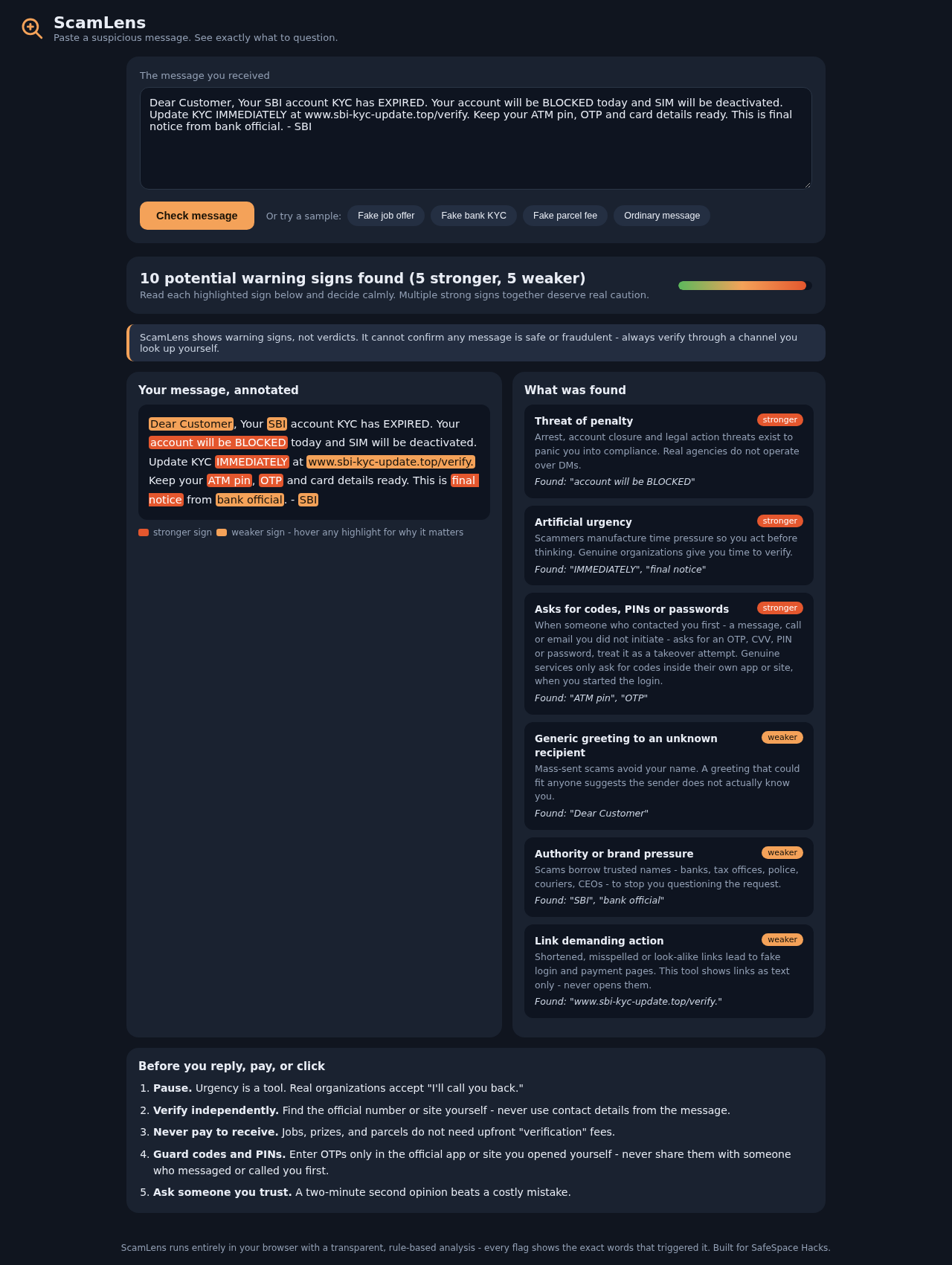
Paste any suspicious text - SMS, DM, email, marketplace message. ScamLens runs ten transparent heuristic checks and reports each as a clear finding with a severity: urgency pressure, gift-card or crypto payment demands, requests for one-time codes or passwords from someone who contacted you out of the blue, suspicious links, impersonation phrasing, too-good offers, secrecy demands, and more. Every finding quotes the exact phrase that triggered it and explains why it is dangerous. There is no "safe" verdict - a low score means "no obvious signs found," and the app says so plainly. A built-in checklist covers what to do next: don't reply, don't click, verify through official channels you look up yourself, report it.
Pasted messages are treated strictly as data: the text is never executed, links are displayed as inert text, never clickable, never fetched.
How we built it
Plain HTML, CSS, and JavaScript - fully static, no network calls, no backend. The analyzer is ten independent rule functions, each returning findings with the matched phrase, a severity, and a plain-language "why." All rendering goes through text nodes only, so pasted HTML or scripts can never execute. Findings are grouped and ordered by severity with an overall indicator that is deliberately framed as "signs found," not a verdict.
Challenges we ran into
Copy discipline is harder than code here. An early draft said "no genuine company asks for your OTP" - which is false, because your own bank does when you call them. We narrowed every claim to unsolicited contact. We also had to resist shipping a confidence score, because a wrong "probably safe" is worse than no verdict at all.
Accomplishments
The tool teaches: after a few pastes, users start recognizing urgency scripts and payment-demand patterns on their own. And it is safe by construction - the most hostile paste imaginable renders as inert text.
What we learned
Detection is the easy half; calibrated, non-alarmist explanation is the hard half. Saying "I don't know" honestly is a feature.
What's next
More languages, an image paste mode with on-device OCR, and a shareable anonymized report format for warning family members.
Built with
JavaScript, HTML, CSS. No dependencies, no network, no data leaves the page.

Log in or sign up for Devpost to join the conversation.