ScamLens Guardian V4 — Think Before You Trust
Inspiration
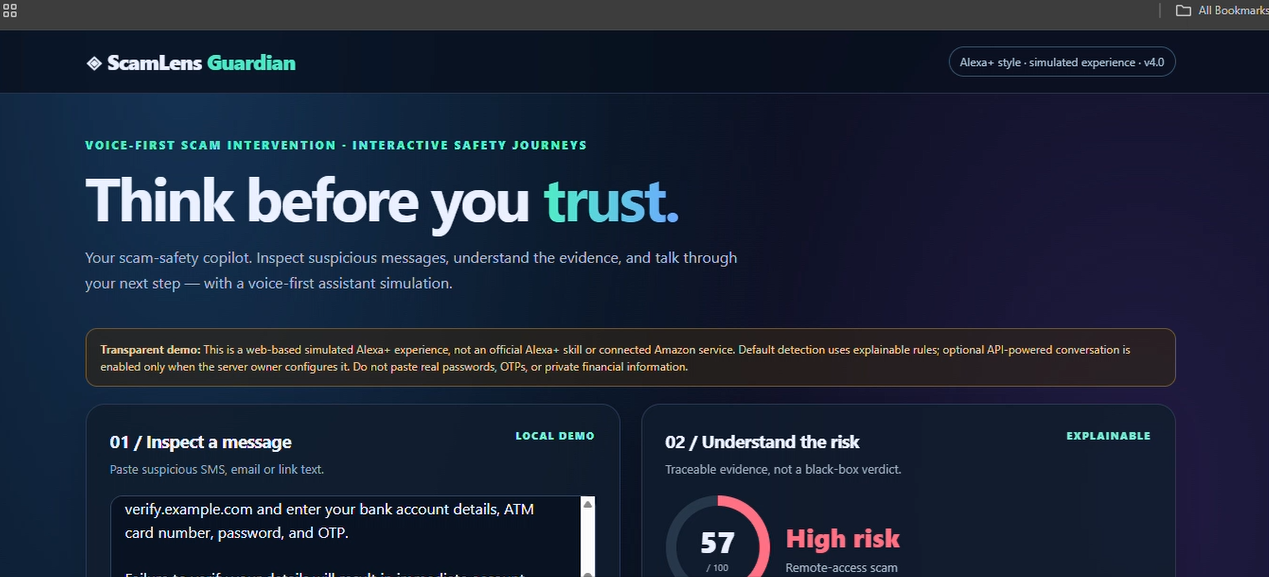
Online scams are becoming increasingly convincing. Fraudsters impersonate banks, delivery companies, and trusted organizations to pressure people into clicking suspicious links or sharing passwords and OTPs.
I wanted to build a tool that does more than label a message as suspicious. It should explain why a message may be dangerous and help users understand what to do next, especially when they have already interacted with a scammer.
This inspired ScamLens Guardian V4, a voice-first scam safety assistant with an Alexa+-inspired conversational experience.
What it does
ScamLens Guardian helps users recognize suspicious messages and respond to potential fraud.
Its key features include:
- Scam Message Analysis: Users can paste suspicious SMS, email, or link text for analysis.
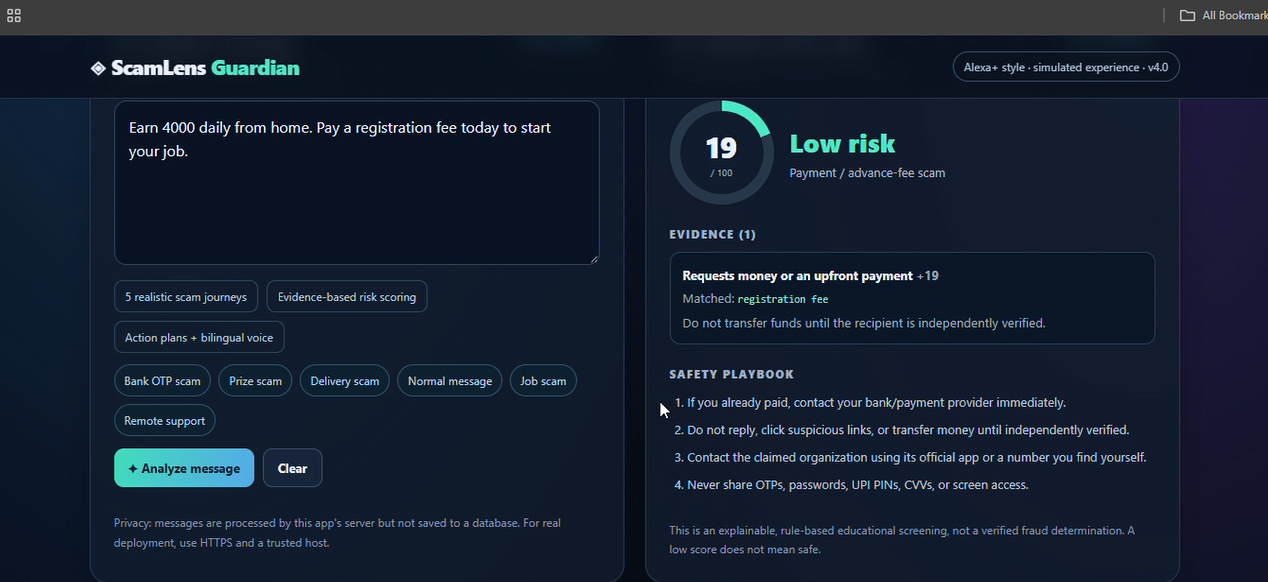
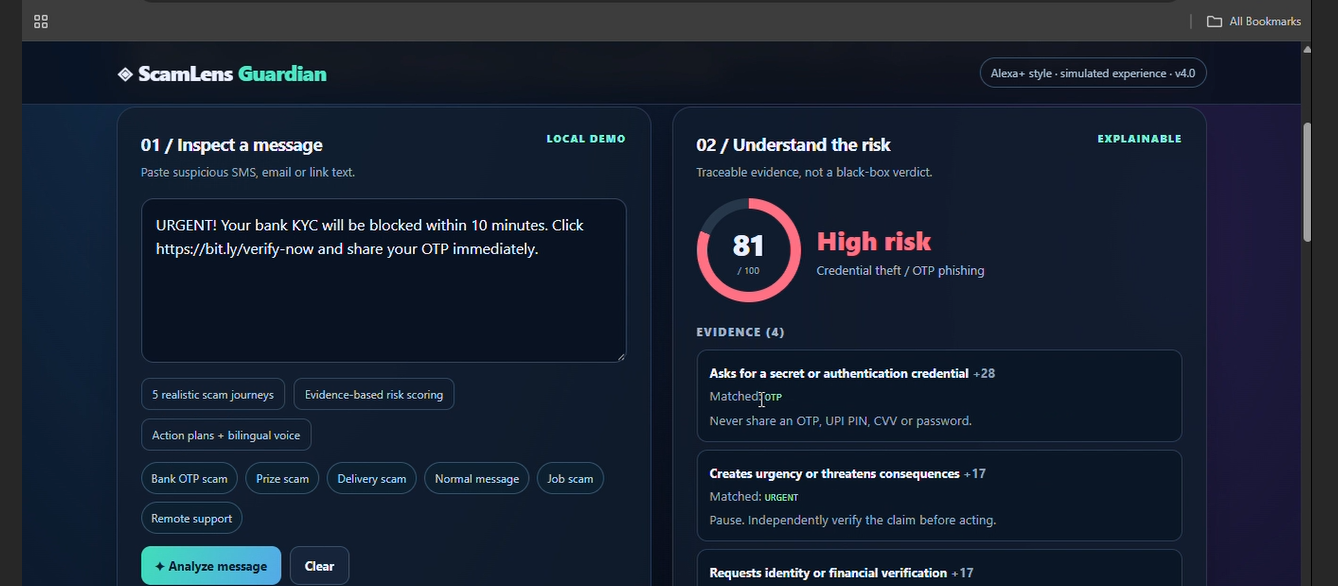
- Explainable Risk Scoring: The application calculates a risk score from 0 to 100 and explains the warning signs contributing to the result.
- Phishing and Credential Warnings: It identifies indicators such as urgency, impersonation, suspicious links, and requests for sensitive information.
- Safety Playbook: Users receive practical recommendations for avoiding common scams.
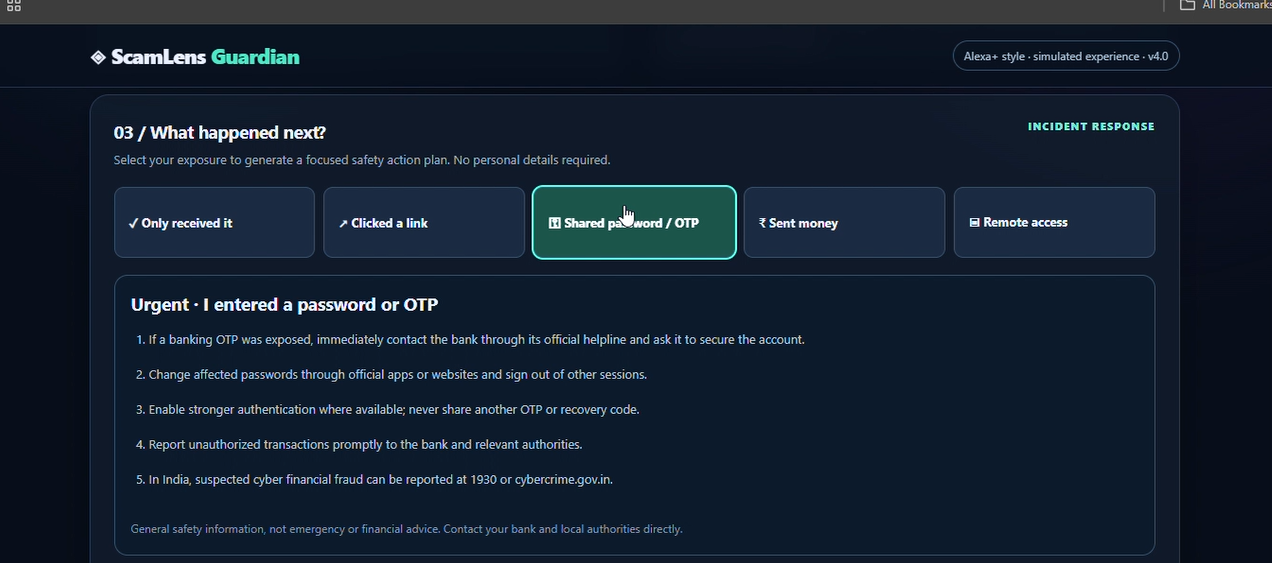
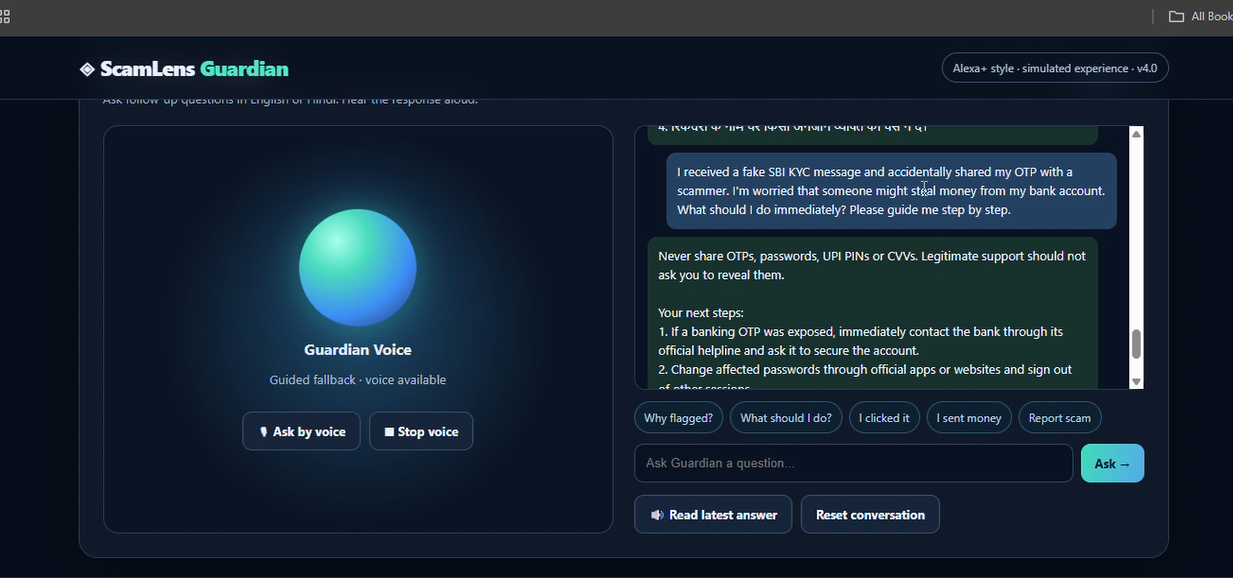
- Incident Response: The application guides users through immediate actions after events such as sharing an OTP, exposing credentials, or clicking a suspicious link.
- English and Hindi Voice Support: Browser-based speech recognition and text-to-speech make the experience more accessible.
- Conversational Safety Assistant: Users can ask safety-related questions through the Talk to Guardian interface.
How I built it
I developed the backend using Python and FastAPI, with a responsive frontend built using HTML, CSS, and JavaScript.
The default detection engine uses transparent, rule-based analysis to identify common fraud indicators and calculate an explainable risk score.
For voice interaction, I integrated browser-based speech recognition and speech synthesis using the Web Speech API.
I also created predefined scam scenarios, safety recommendations, and incident-response guidance to demonstrate how a conversational assistant could support users in stressful situations.
The source code is hosted on GitHub, and the working web application is deployed using Render.
Challenges I ran into
One challenge was making scam analysis understandable instead of presenting a confusing technical score. I addressed this by displaying individual risk indicators and actionable explanations.
Another challenge was browser compatibility for voice interactions. Speech recognition behavior varied between browsers, so I tested the experience and kept text interaction available as an alternative.
I also worked on making emergency guidance practical, especially for users who might panic after accidentally sharing sensitive information.
Accomplishments that I'm proud of
- Built and deployed a working end-to-end scam safety web application.
- Implemented transparent, explainable scam risk scoring.
- Added bilingual English and Hindi voice interaction.
- Combined scam detection, prevention guidance, and incident response in one interface.
- Published the source code and made the application publicly accessible.
What I learned
This project strengthened my understanding of FastAPI, frontend-backend integration, browser speech APIs, deployment, and user-centered security design.
Most importantly, I learned that effective safety tools need to provide clear explanations and actionable guidance rather than simply displaying warnings.
What's next for ScamLens Guardian
Future improvements could include more sophisticated scam classification, improved multilingual voice support, stronger browser compatibility, expanded scam patterns, and user testing.
I would also like to explore official voice-assistant integrations where supported.
Alexa+ Inspiration and Technical Disclosure
ScamLens Guardian demonstrates an Alexa+-inspired, voice-first conversational safety experience through a standalone web simulation.
It is not an official Alexa+ skill or Amazon service integration. Its default detection engine is rule-based rather than a trained AI fraud-detection model. The results provide educational safety guidance and are not guaranteed fraud determinations.
Try ScamLens Guardian
Live Demo: https://scamlens-guardian.onrender.com
Source Code: https://github.com/rajneeshchaurasia47-ctrl/scamlens-guardian
Built With
- css3
- cybersecurity
- fastapi
- github
- html5
- javascript
- python
- render
- speech-recognition
- text-to-speech
- web-speech-api

Log in or sign up for Devpost to join the conversation.