Inspiration
Scams are becoming smarter, more convincing, and harder to recognize. A suspicious message can look almost identical to a genuine message from a bank, delivery service, company, or government organization. Many people know they should "be careful," but when faced with a realistic scam, it can be difficult to know what exactly makes it dangerous.
We wanted to build something that goes beyond simply saying "This is a scam."
Our inspiration was to create an AI investigator that could examine suspicious content, identify multiple warning signs, and explain the evidence in a way that anyone can understand.
That idea became ScamLens — an AI-powered scam investigation agent designed to help people see the warning signs before they become victims.
What it does
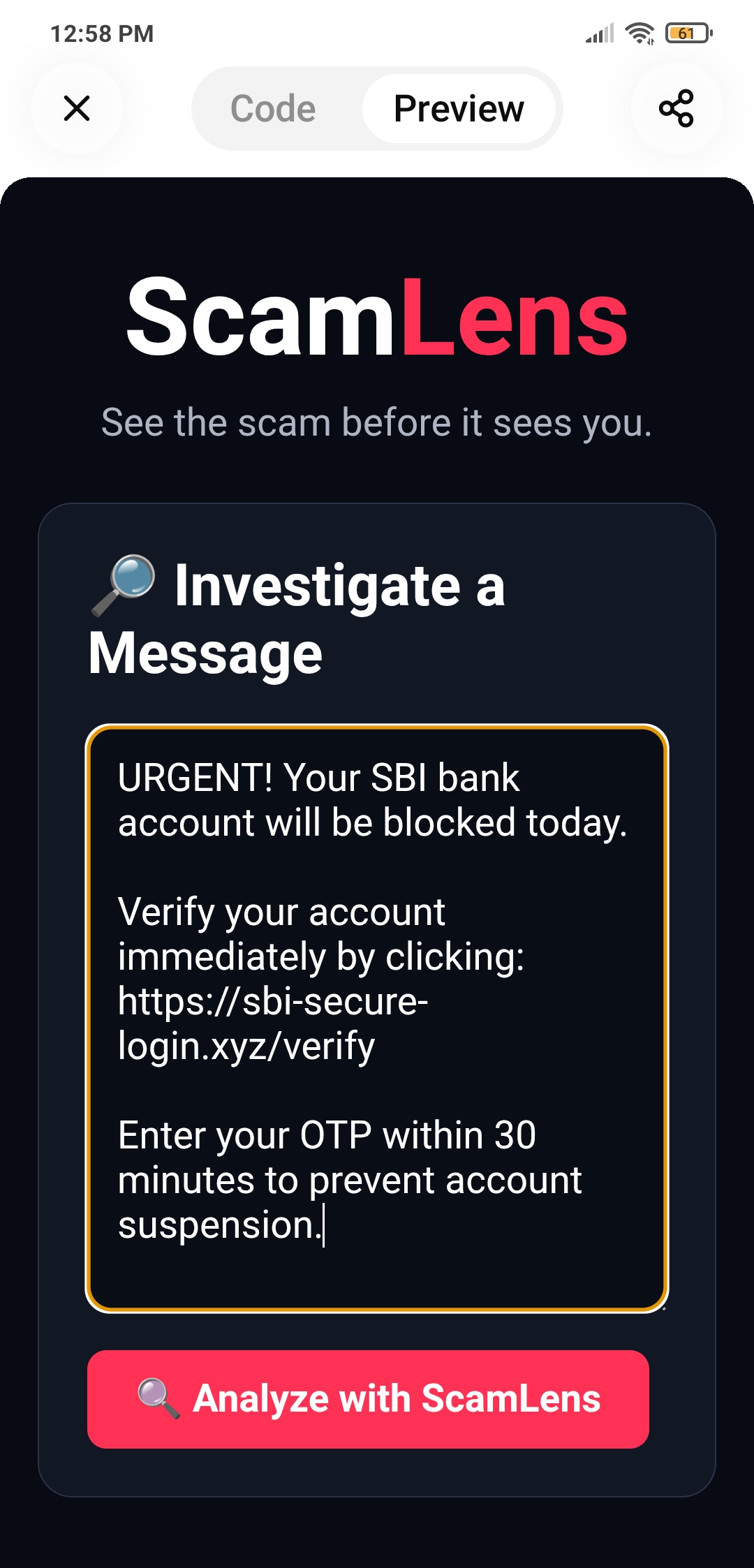
ScamLens analyzes suspicious messages, emails, URLs, screenshots, QR codes, and payment requests.
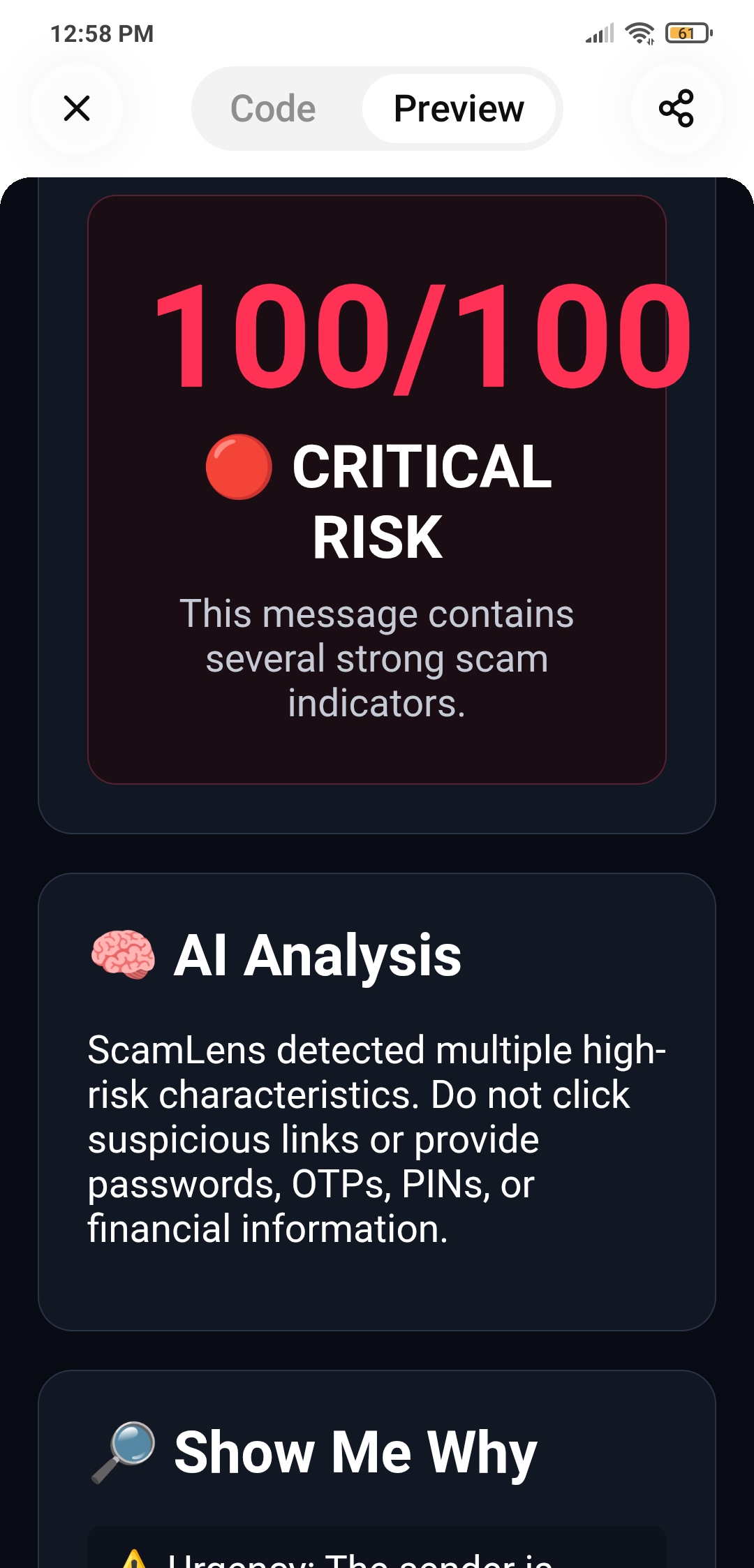
Instead of giving only a yes/no prediction, ScamLens investigates the content and provides:
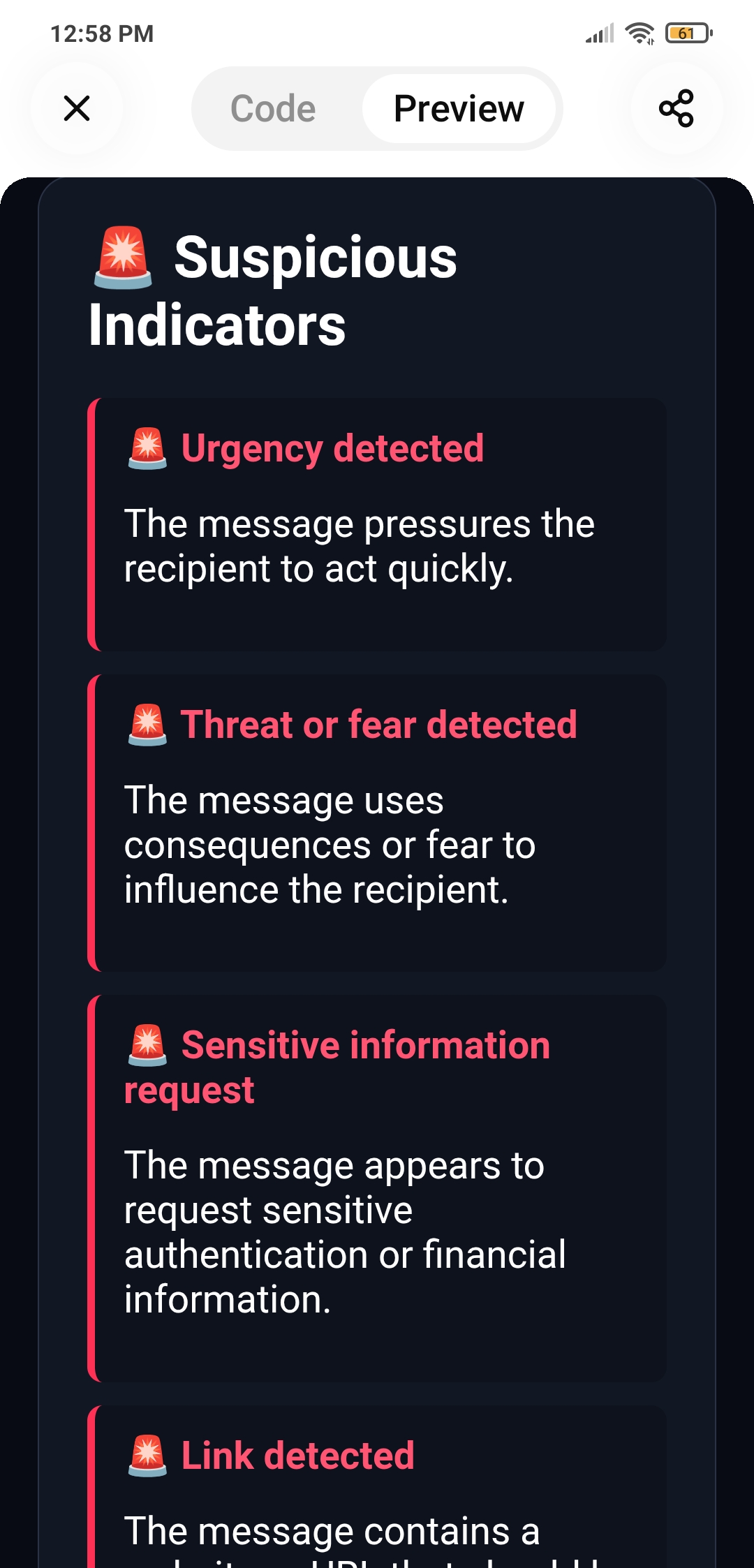
- 🔍 Suspicious elements detected
- 🚨 Risk level and risk score
- 🔗 Link and domain analysis
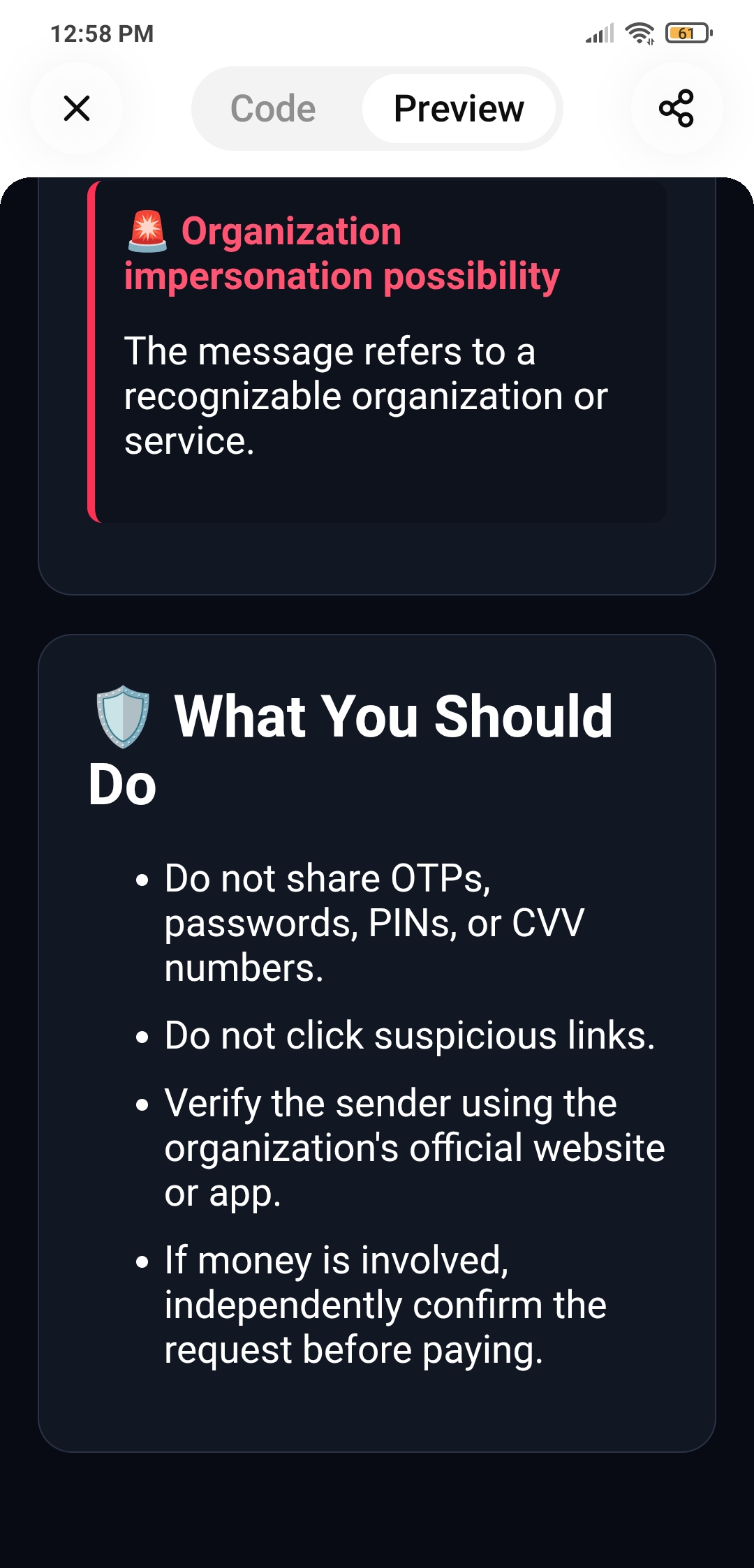
- 🏢 Organization impersonation indicators
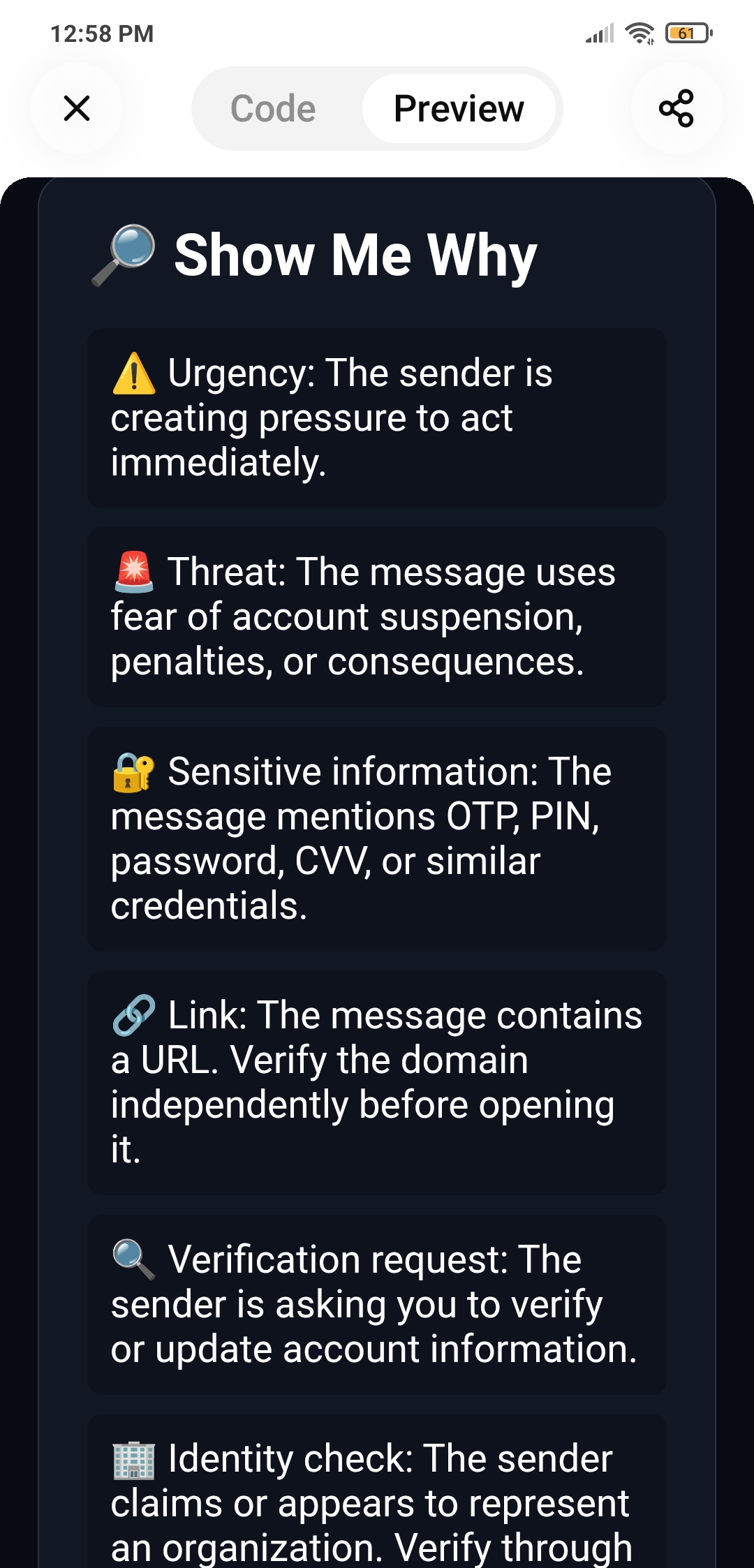
- ⚠️ Social-engineering patterns such as urgency, fear, and pressure
- 🔐 Requests for sensitive information such as OTPs, passwords, or PINs
- 🧾 Evidence explaining the risk assessment
- 🛡️ Recommended safety actions
Our key feature is "Show Me Why."
Rather than asking users to blindly trust an AI prediction, ScamLens highlights the suspicious parts and explains how they contributed to the final assessment.
How we built it
We designed ScamLens around an agentic AI architecture, where specialized AI agents handle different parts of a scam investigation.
The process begins with an Orchestrator Agent, which determines what needs to be investigated.
Specialized agents then analyze different aspects:
- Message Analysis Agent — identifies suspicious language, claims, requests, threats, and urgency.
- URL Analysis Agent — analyzes links and domains for suspicious characteristics.
- Identity Analysis Agent — examines claims about banks, companies, services, or other organizations.
- Scam Pattern Agent — detects common phishing and social-engineering patterns.
- Evidence Agent — organizes the findings into understandable evidence.
- Risk Assessment Agent — combines the available signals into an overall risk assessment.
The final results are presented through a simple interface so that even a non-technical user can understand what is happening.
The system is designed around one principle:
«Don't just tell me it's dangerous. Show me why.»
Challenges we ran into
One of our biggest challenges was making scam detection useful without treating every suspicious-looking message as automatically fraudulent.
Scams can be subtle, and legitimate messages can sometimes contain similar language. We therefore focused on analyzing multiple signals together rather than relying on a single keyword or pattern.
Another challenge was designing an agentic workflow that could divide the investigation into specialized tasks while still producing one clear result for the user.
We also had to think carefully about privacy and safety because suspicious messages can contain sensitive personal or financial information.
Finally, we wanted to make the AI's results understandable. A complicated technical report isn't useful to someone who simply wants to know whether they should click a link. This led us to develop the Show Me Why approach.
Accomplishments that we're proud of
We are proud of turning a common everyday problem into an agentic AI investigation workflow rather than building another generic chatbot.
Our biggest accomplishment is the idea of making scam detection explainable.
Instead of producing an unexplained score, ScamLens connects the risk assessment to specific warning signs and presents them in a way that ordinary users can understand.
We are also proud of designing ScamLens to handle multiple forms of suspicious content, including messages, emails, links, screenshots, QR codes, and payment-related requests.
Most importantly, we built the project around a simple goal:
Help people understand the warning signs before they make a dangerous decision.
What we learned
We learned that building a useful AI system is not just about getting an LLM to generate an answer. The real challenge is designing a reliable workflow around the model.
While building ScamLens, we learned how different AI agents can work together to break a complex problem into smaller investigations.
We also learned the importance of explainability and uncertainty. An AI system should not pretend to be perfect, especially when dealing with potentially fraudulent or financial situations. Users need to understand what evidence was found and how confident the system is.
Most importantly, we learned that AI can be much more powerful when it acts as an investigator and reasoning system, rather than simply a chatbot.
With ScamLens, our goal is to make that capability accessible to everyday users.
ScamLens — See the scam before it sees you.
What's next for ScamLens — AI Scam Investigation Agent
Built With
- agent
- ai
- javascript
- python

Log in or sign up for Devpost to join the conversation.