Inspiration
Scammers steal over $7.7 billion a year from US seniors alone, with 201,000+ victims aged 60 and older, a 37% increase in losses year over year, and an average loss of $38,500 per victim.
We noticed that scam education for seniors or older adults was always reactive - a news article after the fact, a warning email from a bank, a lecture from family. There was no safe and no pressure place for them to practice spotting a scam before it's their turn to face a real one. Modern scams have also become harder to catch. With AI voice cloning, wrong number scams, and bank fraud texts are designed to exploit the mistakes seniors are more likely to make.
We wanted to build something that felt like practice, not a lecture, something a senior would actually want to open again the next day.
What it does
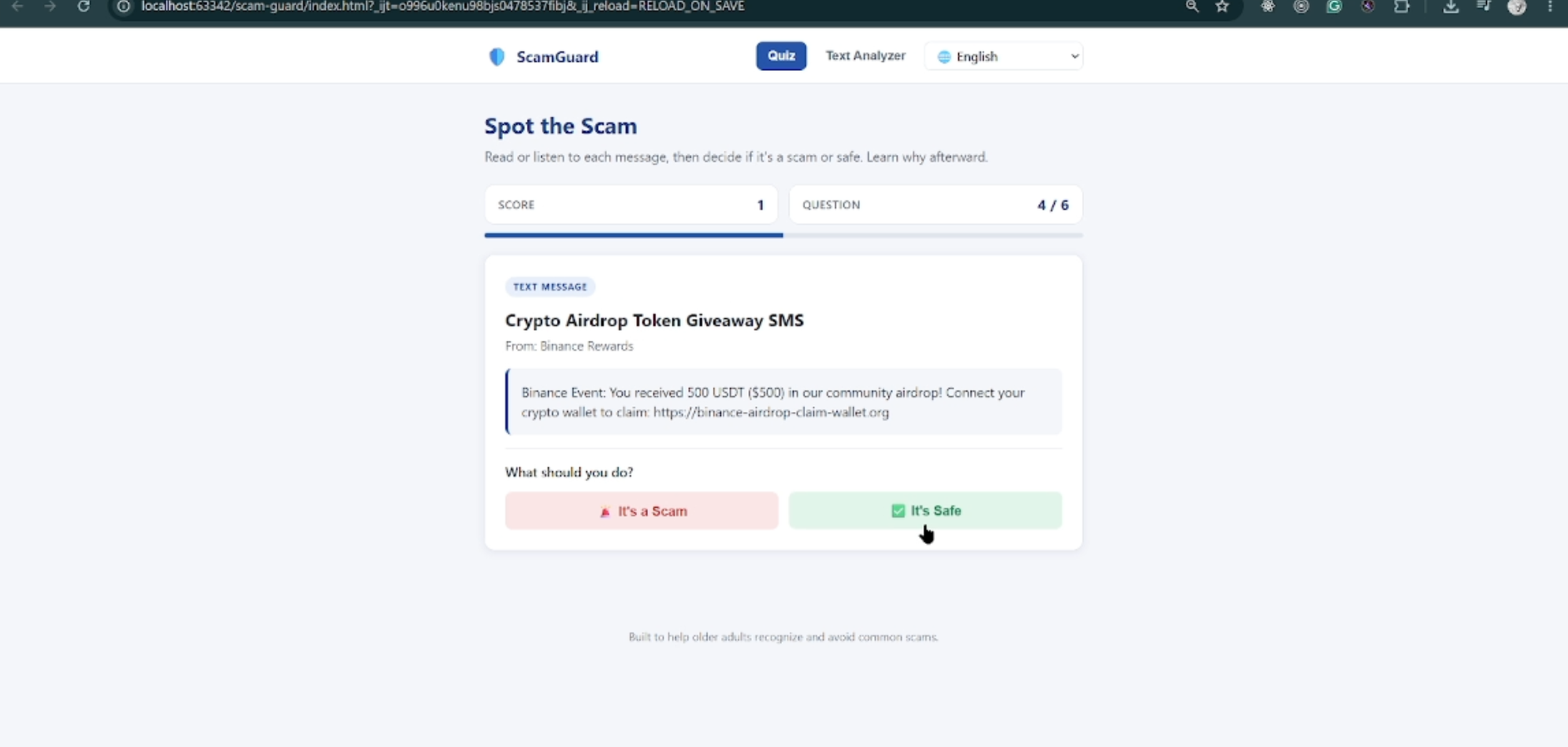
- Interactive scam spotting quiz with 50+ realistic scenarios covering text messages and simulated voice calls:
- Fake bank fraud alerts, package delivery notices, prize/lottery texts
- AI-voice cloned "grandchild in trouble" emergency calls
- Tech support scam
- Legitimate look-alikes so users learn to tell the difference
- Simulated voice calls using the Web Speech API to read scam call scripts aloud, so users practice with something closer to a real phone
- Instant feedback after every answer explaining exactly what gave the scam away, or why a message was safe.
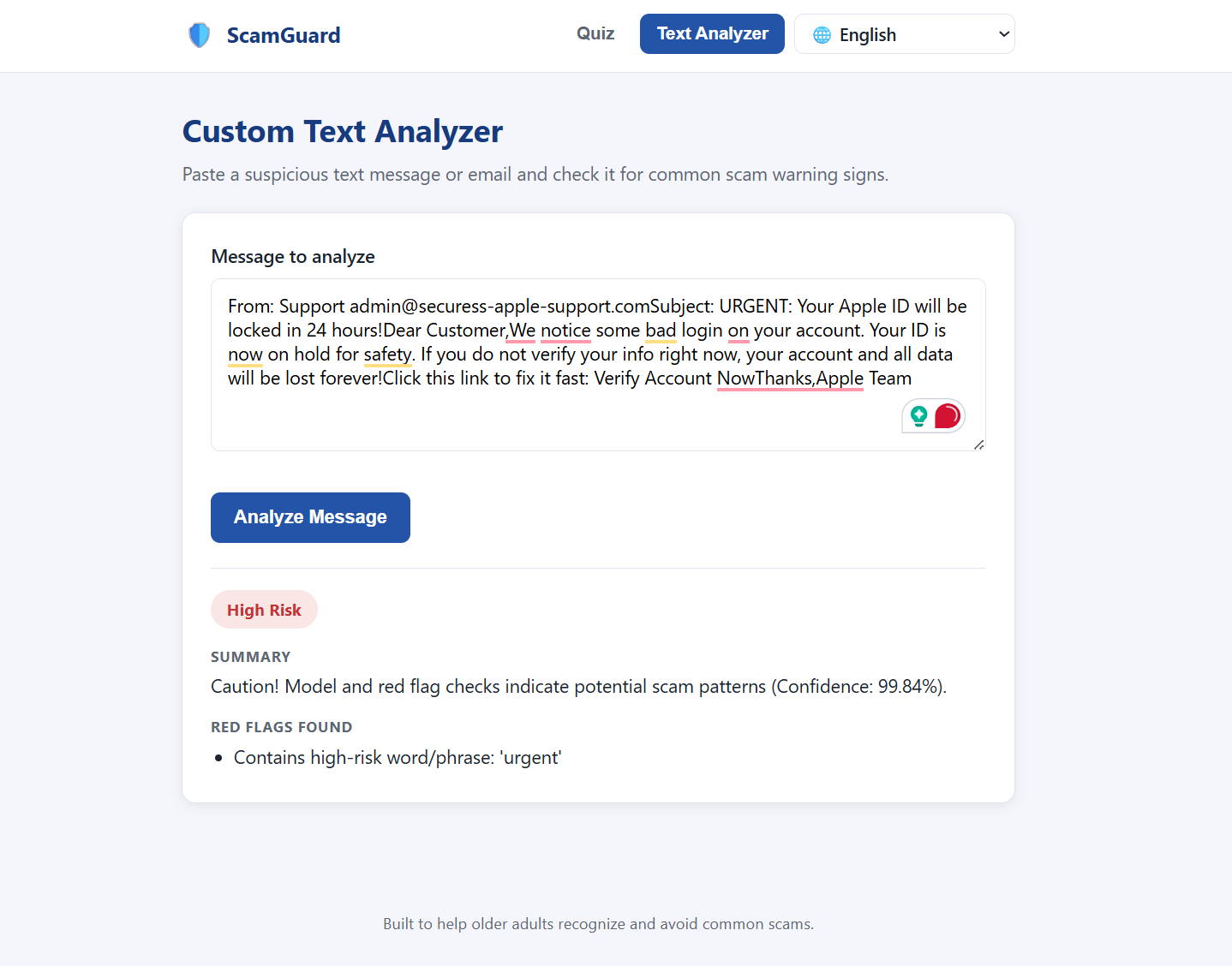
- Smart Text Analyzer: users paste in any real message, email, or call transcript they've received and get:
- A machine learning verdict from a model fine-tuned on hundreds of scam and legitimate emails
- A keyword layer that flags phrases and suspicious links.
- A risk score (low/eedium/high) with a confidence percentage
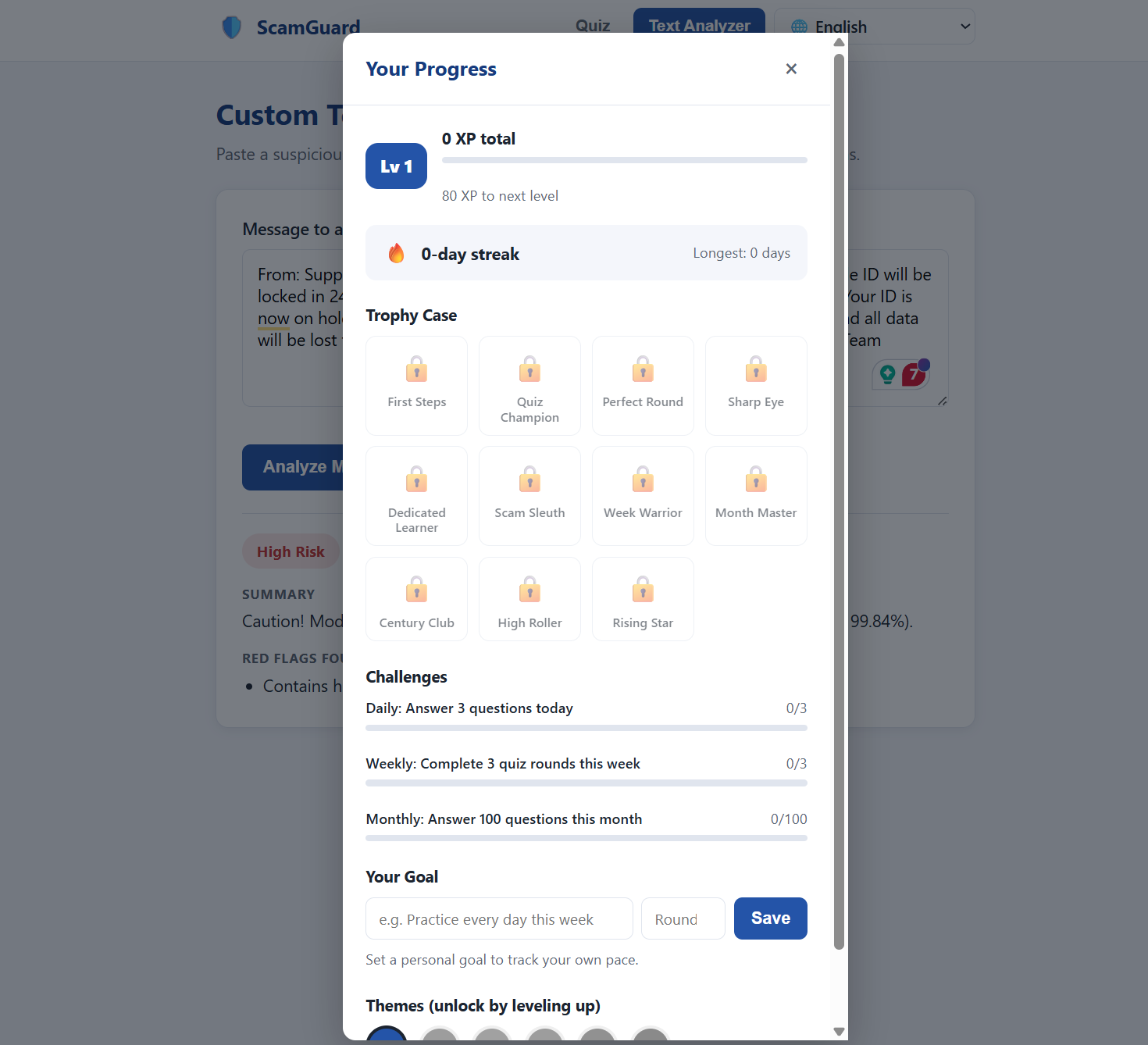
- Gamification system designed to build a habit:
- XP for every question answered, with bonus XP for correct answers and full completed rounds
- Levels that unlock cosmetic color themes
- A risk score (low/medium/High) with a confidence percentage
- 11 unlockable achievement badges (first answer, perfect round, streak milestones, XP milestones, etc)
- Daily, weekly, and monthly challenges that reset automatically
- Personal goals users can set and track at their own pace
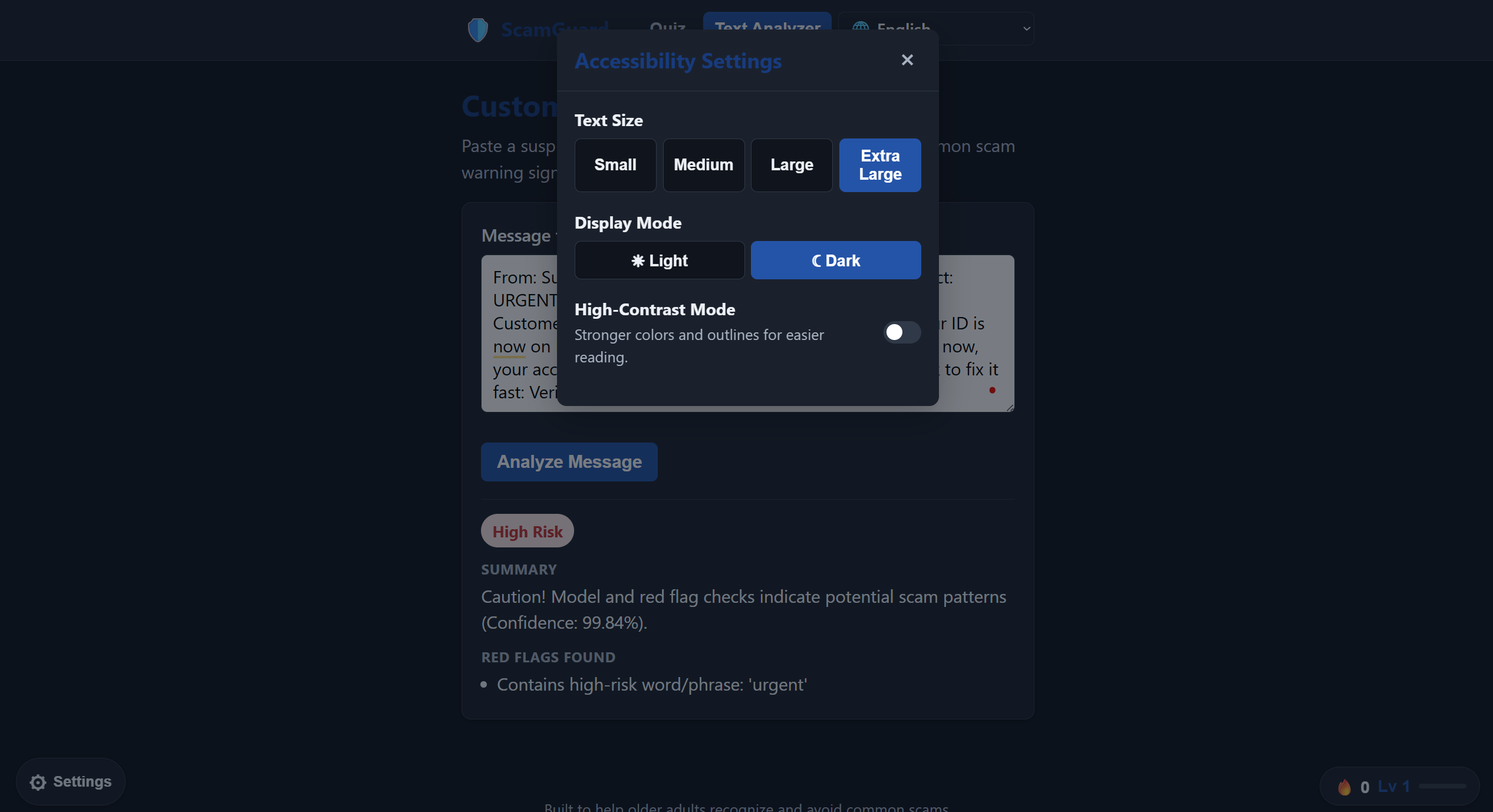
- Accessibility built in:
- Four adjustable text sizes
- Dark mode and light mode
- High contrast mode for low vision users
- Multi language support via the Google Translate API, so the experience isn't limited to English speakers.
How we built it
- Used a dataset of hundreds of legitimate and scam scenarios which we fine tuned an existing transformer model called distilBERT on
- We had FastAPI be used for a convenient backend and used Vanilla JS, HTML, and CSS to provide the model responses, and json questions
- Used Google Translate API to have it be used across multiple languages
Challenges we ran into
- At first, the ML model alone kept having false positives so we combined this with common keywords to fix the model's mistake
- It was a bit challenging for us to come up with an idea that made use of all of our skills ## Accomplishments that we're proud of
- Shipped 50+ scam scenarios consisting most of the major scam categories seniors actually report.
- Built an ML classifier specifically for scam detection.
- Built a fully accessible, senior interface with adjustable text size, dark/light mode. ## What we learned
- Working with Hugging Face NLP model.
- UI specifically for seniors.
- Gamification mechanics for a safety focused product. ## What's next for ScamGuard
- Accounts
- Leaderboard
- Increased scenario library
- Real-time protection
- Personalized difficulty.
Built With
- css3
- fastapi
- html5
- huggingface
- javascript
- pandas
- pydantic
- python
- uvicorn
- vanilla
- webspeechapi

Log in or sign up for Devpost to join the conversation.