Scammers often use fear, urgency, and trust to pressure people into making quick decisions, especially when money is involved. We wanted to build something that could help people recognize these tactics before becoming victims of financial scams.
That's how we came up with ScamBrake. Our goal was to create an AI-powered tool that doesn't just detect suspicious messages but encourages users to pause, think, and verify information before sending money.
What it does
ScamBrake is an AI-powered scam detection tool that analyzes suspicious text messages and screenshots to identify potential scams and manipulation tactics.
Instead of simply labeling a message as suspicious, ScamBrake helps users understand why it might be risky and what they can do next.
Inspired by academic research on fraud warning design, we incorporated four persuasion strategies:
- Questioning: Asks users specific verification questions to help them evaluate suspicious requests.
- Authority: Encourages users to verify information through trusted sources and official channels.
- Social Influence: Helps users recognize common scam patterns and manipulation tactics.
- Diversion: Redirects users away from rushed decisions toward safer actions.
Our goal is to help users make informed decisions rather than relying entirely on an AI-generated warning.
How we built it
We built ScamBrake using Python, Streamlit, Mistral AI, and OCR (Optical Character Recognition).
- Python: Handles the backend logic, message processing, and AI integration.
- Streamlit: Provides an interactive interface where users can submit suspicious messages and screenshots.
- Mistral AI: Analyzes messages to identify potential scam tactics and generate verification questions and safer next steps.
- OCR: Extracts text from uploaded screenshots so the AI can analyze the content.
We also developed structured responses to keep the AI's recommendations consistent and easy for users to understand.
Challenges we ran into
One of our biggest challenges was integrating the different technologies within the limited time of the hackathon.
We also had to figure out how to make AI-generated responses useful without overwhelming users with too much information.
Another challenge was distinguishing suspicious messages from legitimate requests. We wanted ScamBrake to identify warning signs without automatically assuming every unusual message was a scam.
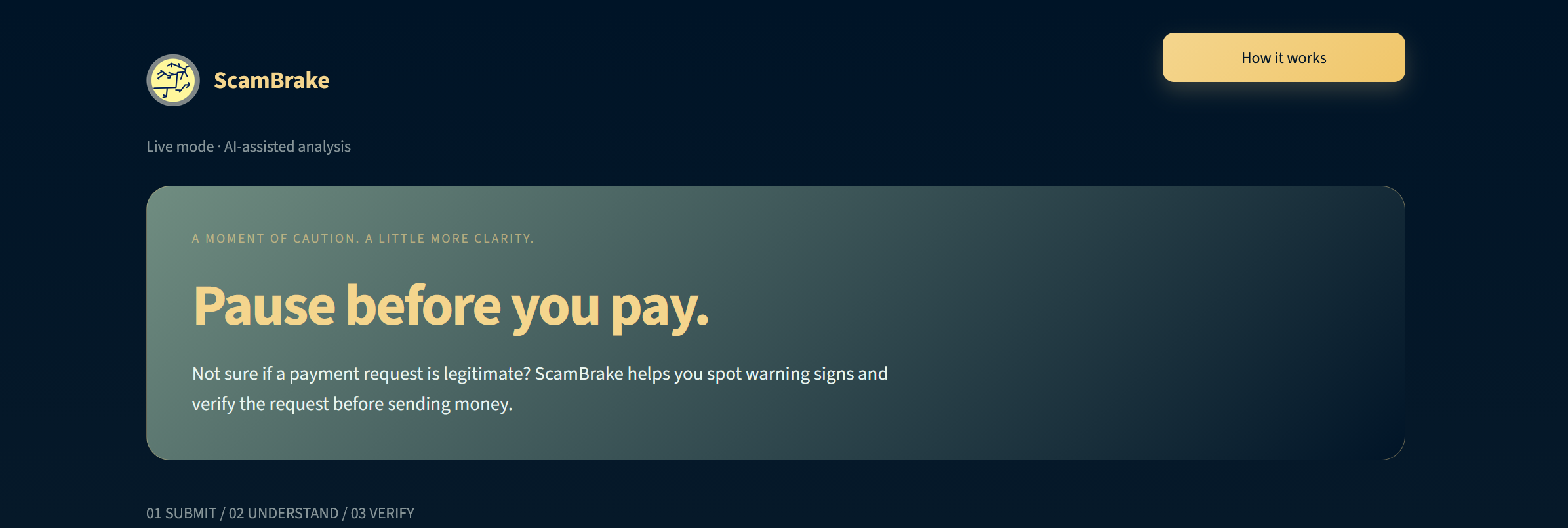
ScamBrake: Pause before you pay.

Log in or sign up for Devpost to join the conversation.