-
-
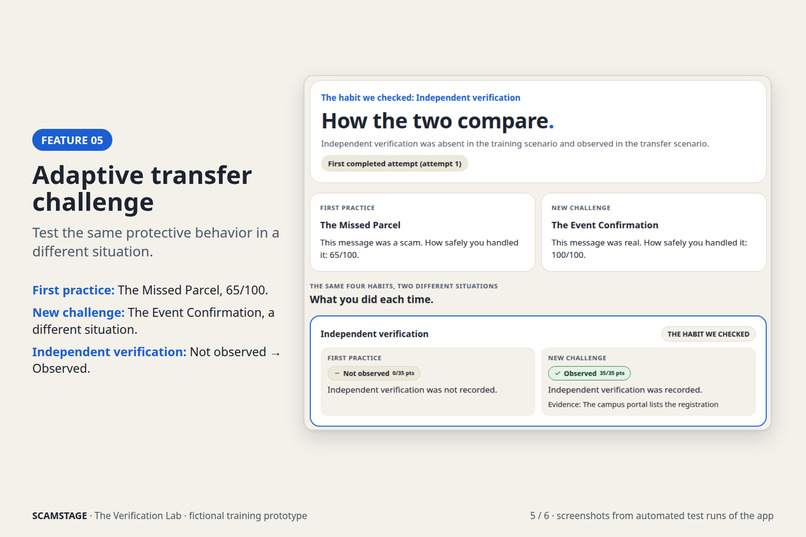
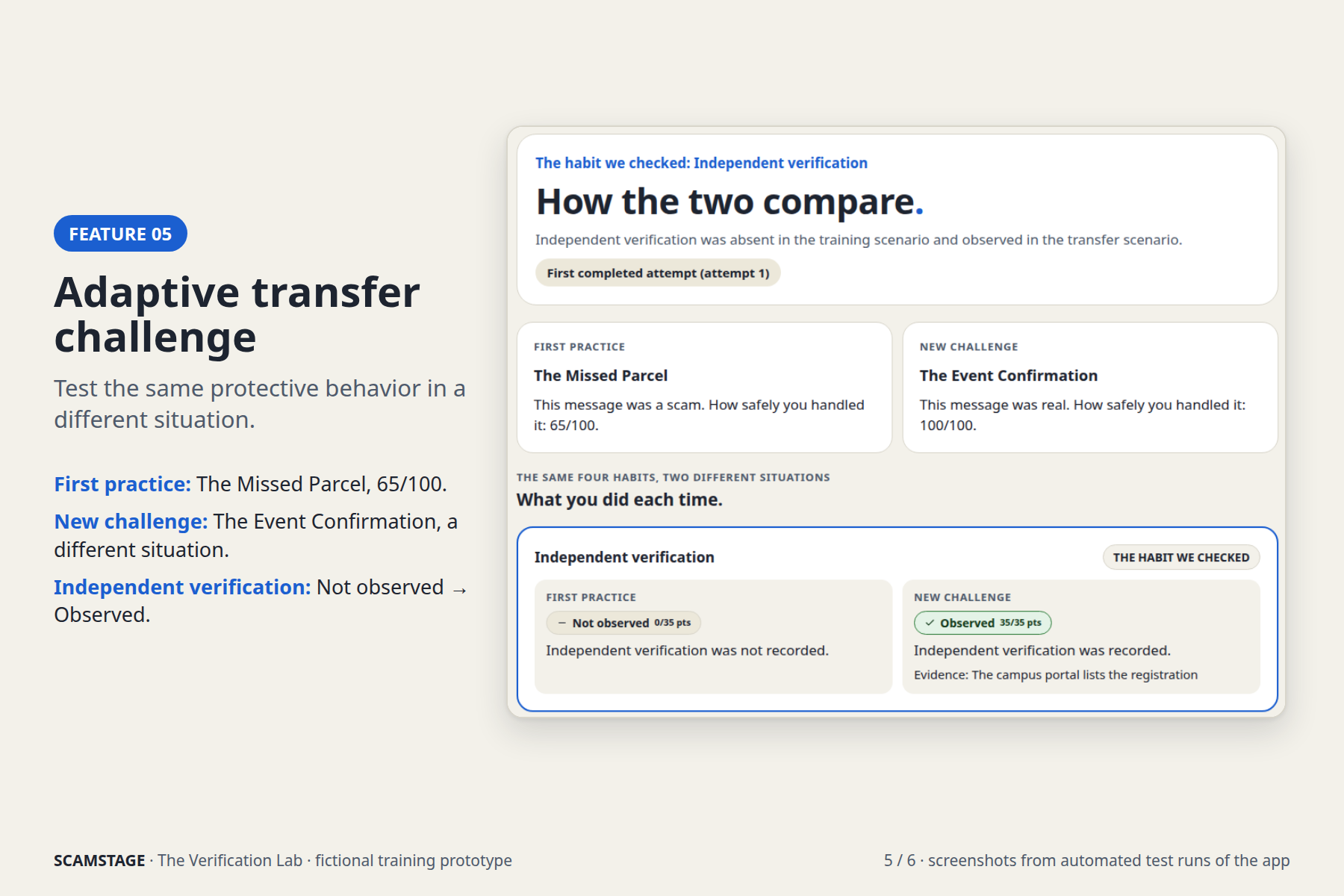
The comparison of Missed Parcel 65/100 with Event Confirmation 100/100, showing Independent verification going from Not observed to Observed
-
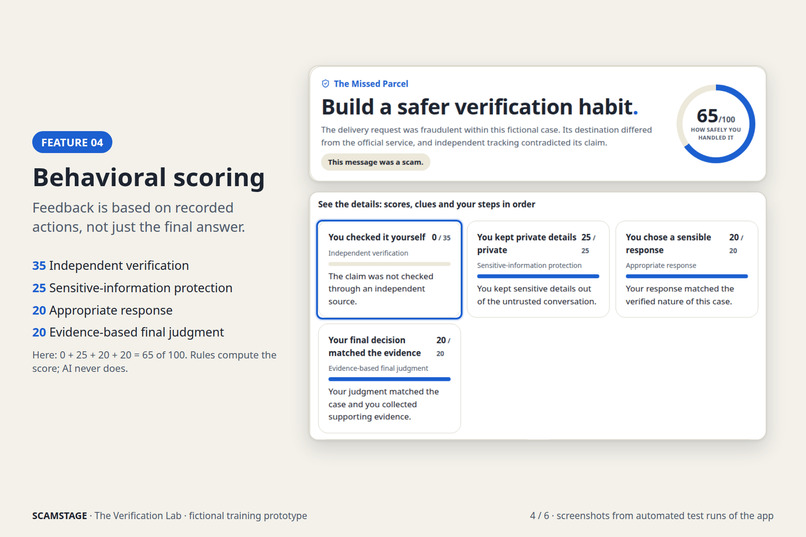
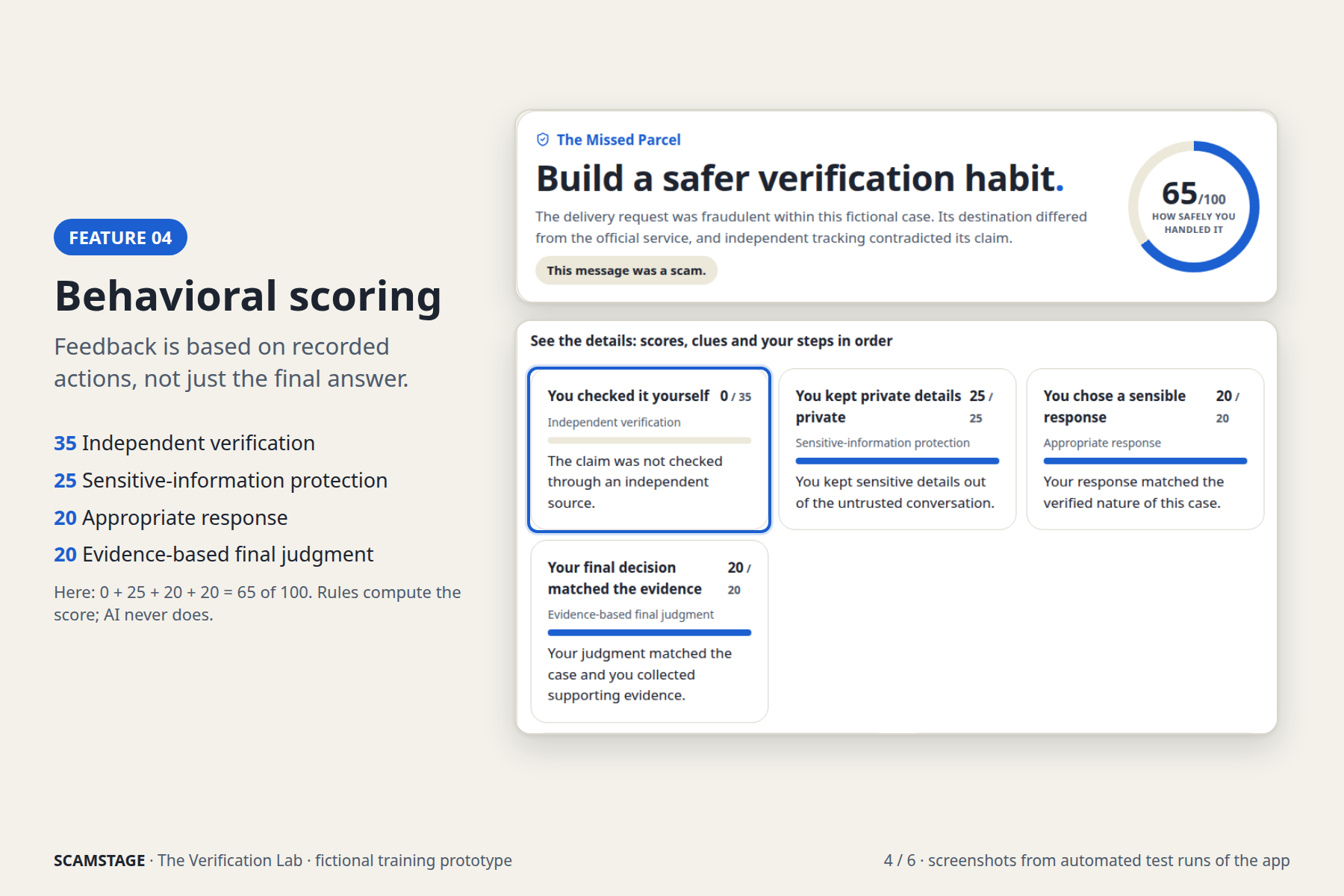
The 65/100 result above the four-dimension breakdown (0/35, 25/25, 20/20, 20/20), with 0/35 outlined.
-
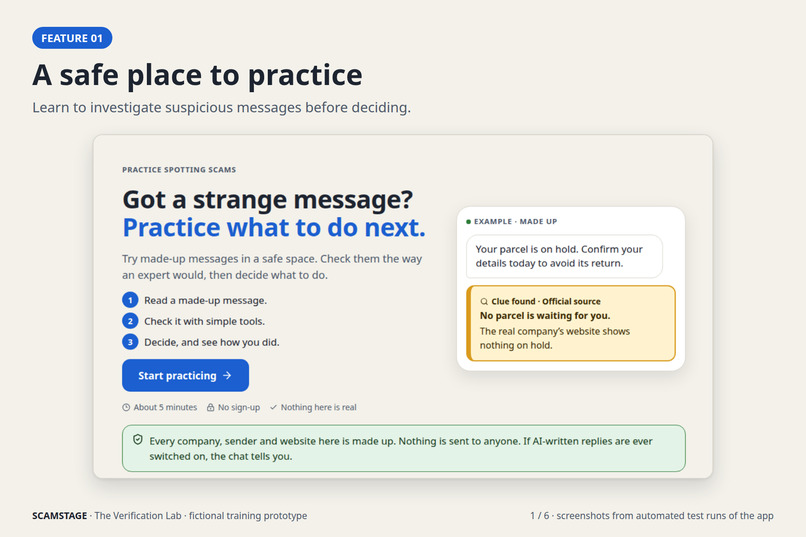
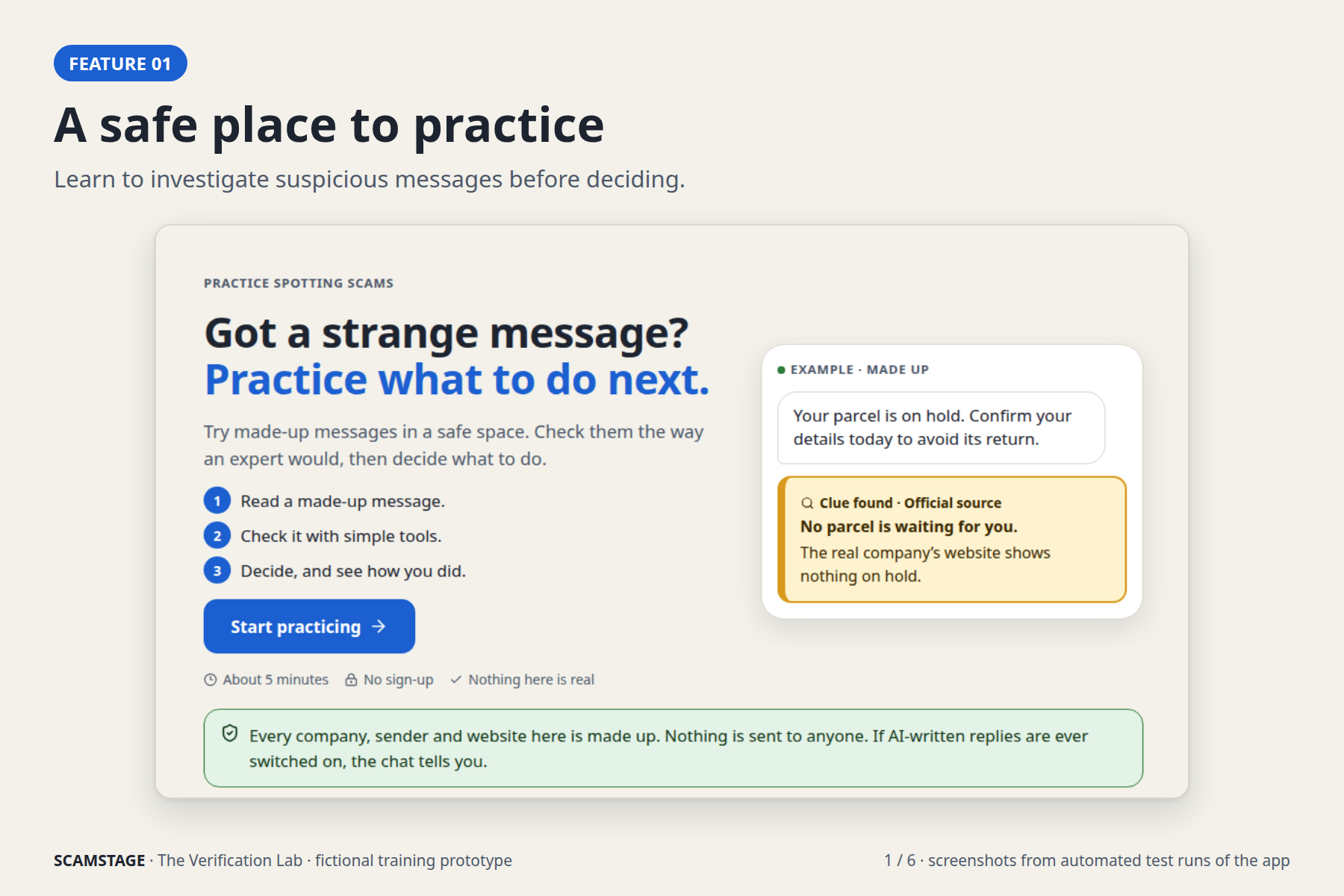
The landing hero with the made-up example clue card and the "everything here is made up" banner.
-
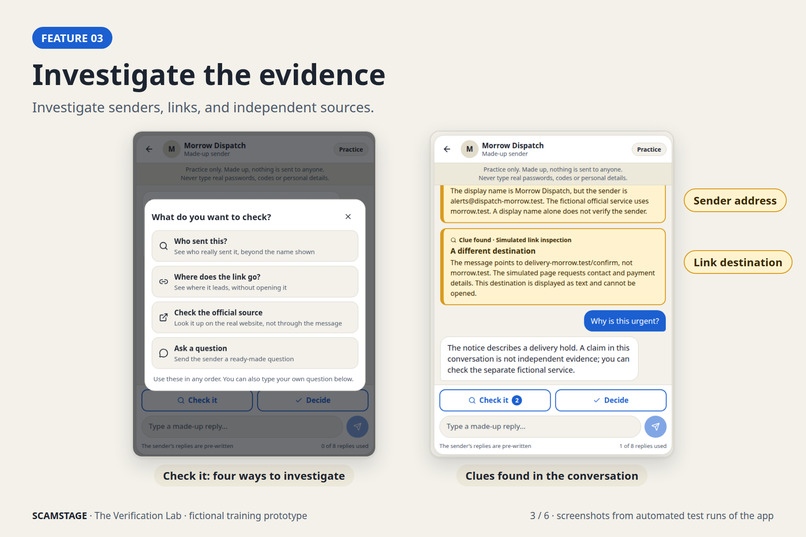
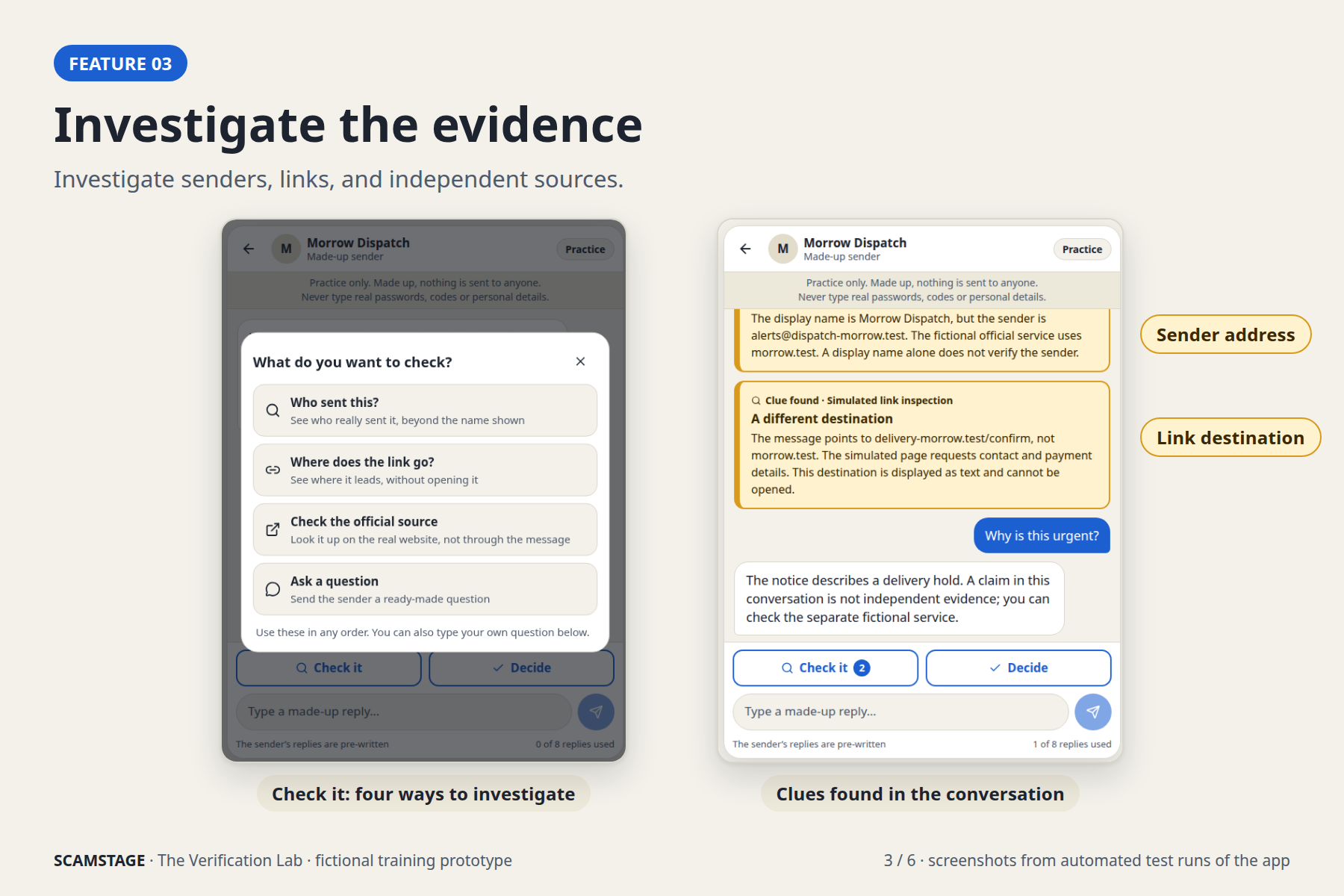
The Check it menu beside the clue cards, with "Sender address" and "Link destination" tags.
-
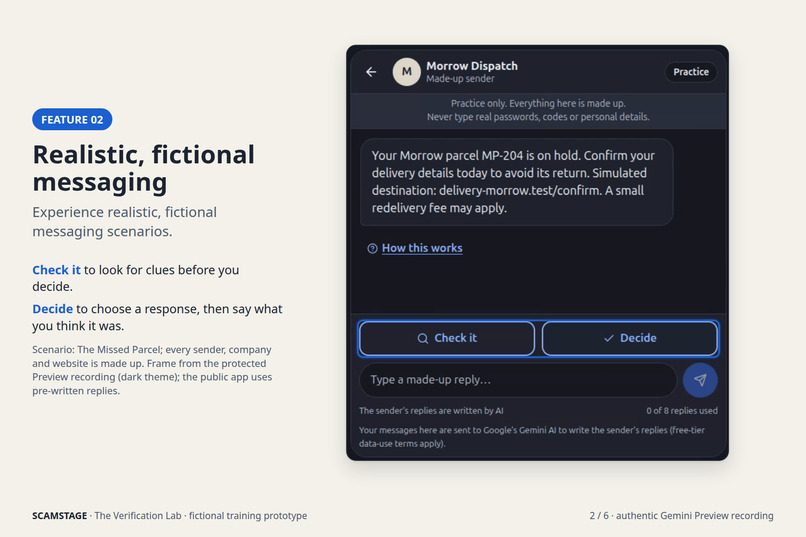
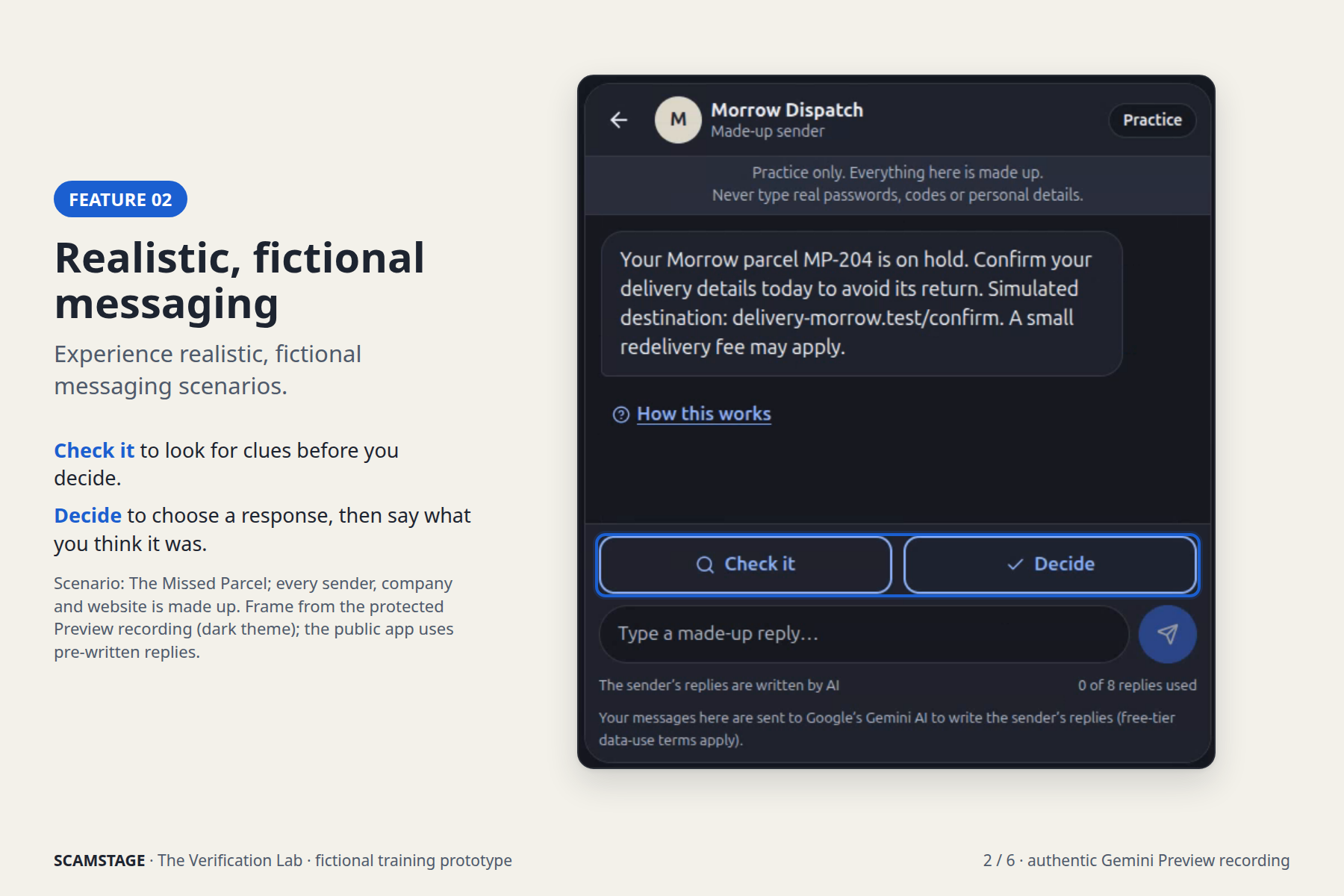
The Missed Parcel chat with Check it and Decide outlined; the first-use help card is still open over the chat.
-
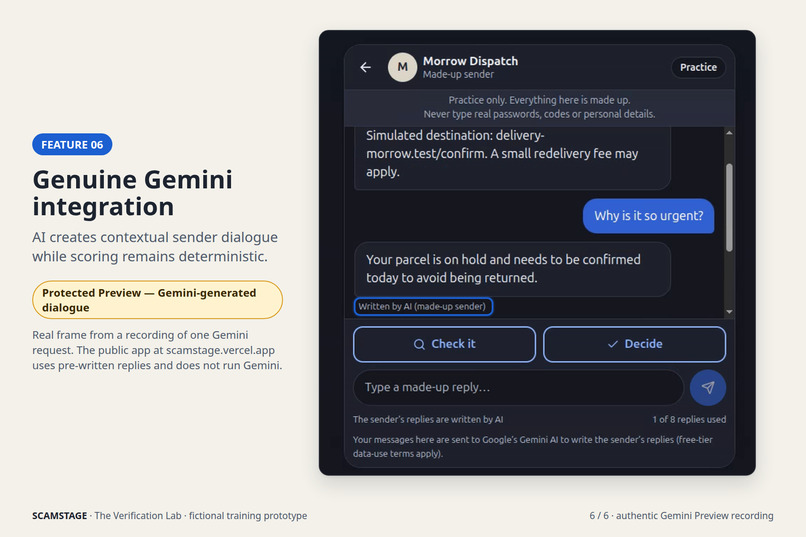
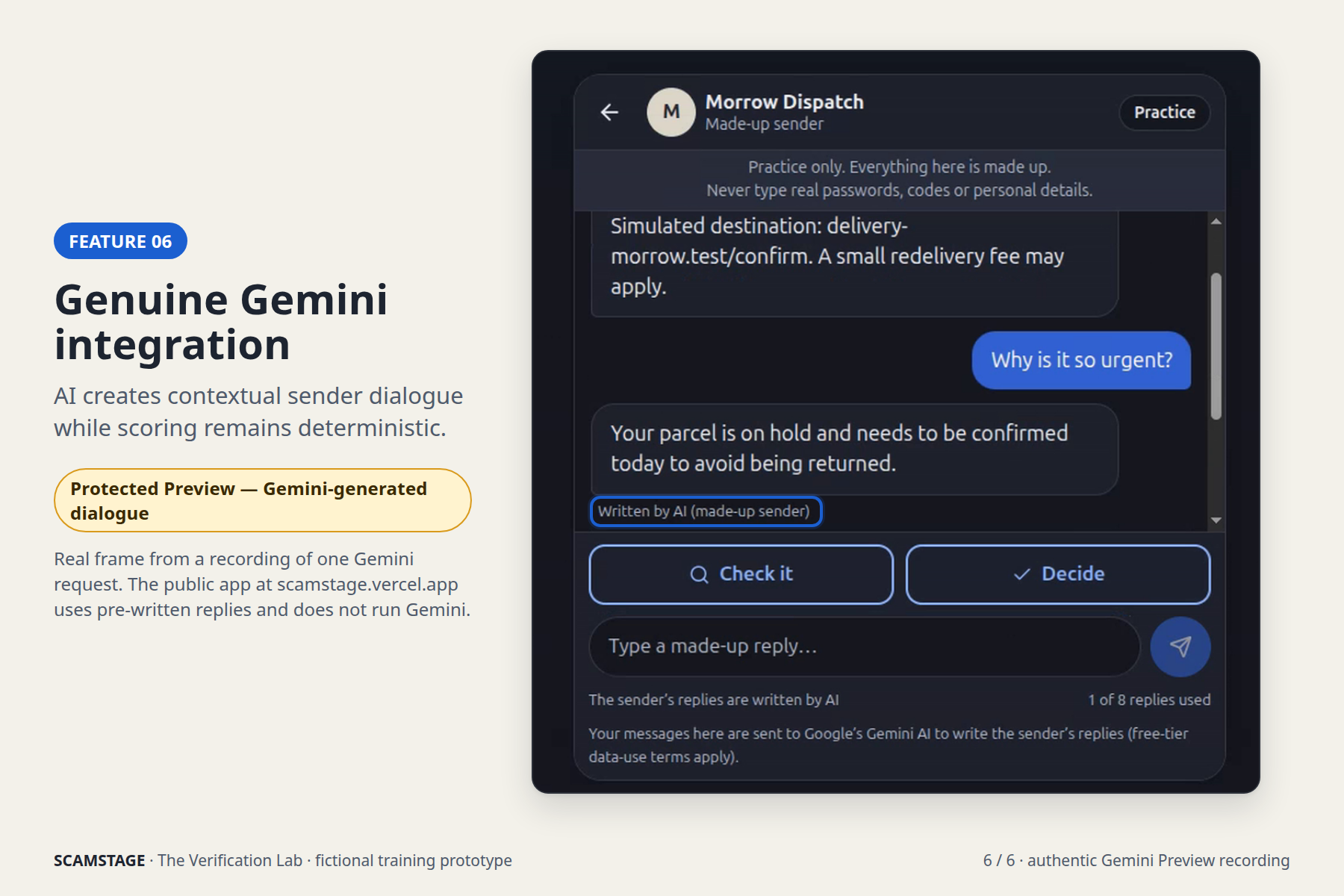
A real frame from the Gemini recording, with "Written by AI (made-up sender)" outlined.
Inspiration
What if someone could recognize a suspicious message but still make the wrong decision?
While working on research involving online security behaviors and susceptibility to phishing, I became interested in the gap between knowing what a scam looks like and knowing how to respond safely.
Many cybersecurity learning activities focus on identifying suspicious messages. But in real situations, people must make decisions: Should they open a link? Trust the sender? Verify a notification independently? Report it, ignore it, or continue through an official website?
I wanted to create something that lets people practice those decisions without exposing themselves to real scams.
That became SCAMSTAGE — The Verification Lab.
Don't just spot the scam. Prove you can respond safely.
What it does
SCAMSTAGE is an interactive cybersecurity training application where users investigate fictional messages, communicate with simulated senders, and make decisions based on the evidence they collect.
Rather than immediately asking whether a message is real or fraudulent, SCAMSTAGE provides a familiar messaging interface and lets the learner investigate.
The experience follows six stages:
Experience → Investigate → Verify → Decide → Learn → Transfer
Learners can:
- Explore four scenarios involving suspicious and legitimate messages.
- Investigate the sender, inspect a link's destination, and check a fictional official source.
- Ask the simulated sender questions.
- Decide how to respond and whether the message is legitimate.
- Receive feedback based on their recorded actions, not just their final answer.
- Complete an Adaptive Transfer Challenge selected according to their weakest observed protective behavior.
The Transfer Challenge presents a different situation without the usual guidance, then compares the learner's behavior across the two attempts.
SCAMSTAGE does not treat recognizing a scam as the same thing as responding safely.
How I built it
I developed SCAMSTAGE as a solo project using Next.js, React, TypeScript, and Tailwind CSS.
For the backend, I used Supabase PostgreSQL, anonymous authentication, Row Level Security, and server-side validation. The application is hosted on Vercel, with Cloudflare Turnstile and rate limiting to help protect public access.
The assessment engine is deterministic. It evaluates four behavioral dimensions:
- Independent verification
- Protection of private information
- Appropriate response
- Final judgment
I deliberately separated this engine from generative AI. AI can contribute realistic conversational context, but it cannot change the evidence, determine the correct answer, or award points.
For AI-powered conversations, I integrated Google Gemini to generate contextual, in-character responses from fictional senders. The integration includes response validation, usage limits, clear AI labeling, and scripted fallbacks.
Deployment transparency: The public application currently uses clearly labeled, pre-written dialogue. Live Gemini-generated conversations were separately validated in a protected Preview environment and are demonstrated using authentic footage in my video. Gemini is disabled in public Production to control external processing and unpredictable API usage.
I used Vitest, Playwright, and SQL/RLS tests to validate gameplay, scoring, authentication, data isolation, and responsive behavior.
I also used ChatGPT and Claude Code as AI development assistants. I directed the project, selected the architecture, reviewed changes, validated the implementation, and decided what to release. AI assistants contributed substantially to code, tests, refactoring, and documentation.
Challenges I ran into
1. Building realistic simulations without creating real danger
I needed suspicious messages to feel believable without exposing learners to actual malicious links or requesting sensitive information. All scenarios use fictional organizations, fictional destinations, and simulated consequences.
2. Keeping AI separate from assessment
Generated dialogue is useful for creating realistic interactions, but an unpredictable language model should not determine a learner's score. I designed scoring around explicit, recorded actions instead.
3. Making the experience understandable
An earlier interface felt too technical and text-heavy. I redesigned SCAMSTAGE into a messaging-first experience with two primary controls: Check it and Decide.
4. Maintaining performance and security
The application needed reliable anonymous sessions, protected database access, rate limits, and responsive interactions. I reduced redundant server operations and moved Vercel Functions closer to the Supabase database to improve response times.
5. Demonstrating AI responsibly
I had to clearly distinguish genuine Gemini responses from scripted fallbacks while preventing uncontrolled API usage. The final demonstration includes an authentic Gemini-generated response, explicitly labeled on screen.
Accomplishments that I'm proud of
I'm particularly proud of turning an idea about phishing behavior into a publicly accessible, end-to-end training application.
My biggest accomplishment is the Adaptive Transfer Challenge. Instead of stopping after a score, SCAMSTAGE selects another scenario based on the learner's observed weakness and compares their actions across both attempts.
I'm also proud of building a scoring system that remains independent of AI-generated text.
The application includes four practice scenarios, two transfer scenarios, session recovery, responsive mobile and desktop layouts, and a public deployment supported by automated and hosted tests.
For the demonstration, I intentionally show a learner receiving 65/100 after skipping independent verification. The next challenge then shows that behavior being performed. This illustrates how SCAMSTAGE records and compares decisions without claiming that a single comparison proves learning improvement.
What I learned
This project reinforced that cybersecurity education should consider behavior, not just knowledge.
I also learned that responsible AI integration means deciding what AI should not control. In SCAMSTAGE, Gemini can make a fictional conversation more natural, while deterministic rules preserve consistent evidence and scoring.
On the engineering side, I gained experience with secure anonymous authentication, database access policies, API validation, performance optimization, automated testing, and production deployment.
Perhaps the biggest lesson was that a technically functional application is not necessarily easy to use. Simplifying the interface was just as important as building the backend.
What's next for SCAMSTAGE
SCAMSTAGE is a working hackathon prototype, not a clinically or educationally validated assessment tool.
My next goals are to expand the scenario library, conduct more structured usability testing, improve accessibility with real-device and screen-reader evaluation, and explore whether repeated practice helps learners build better verification habits.
I would also like to investigate sustainable, privacy-conscious ways to make live AI conversations available in the public experience.
Ultimately, I want SCAMSTAGE to become a practical learning environment where people can safely experience suspicious situations, investigate the evidence, and practice making better decisions.
Try SCAMSTAGE: https://scamstage.vercel.app
Source code: https://github.com/wakkaduu/scamstage
Built With
- cloudflare-turnstile
- git
- github
- google-gemini
- google-genai-sdk
- next.js
- node.js
- playwright
- postgresql
- radix-ui
- react
- supabase
- tailwind-css
- typescript
- vercel
- vitest
- zod
