
Inspiration
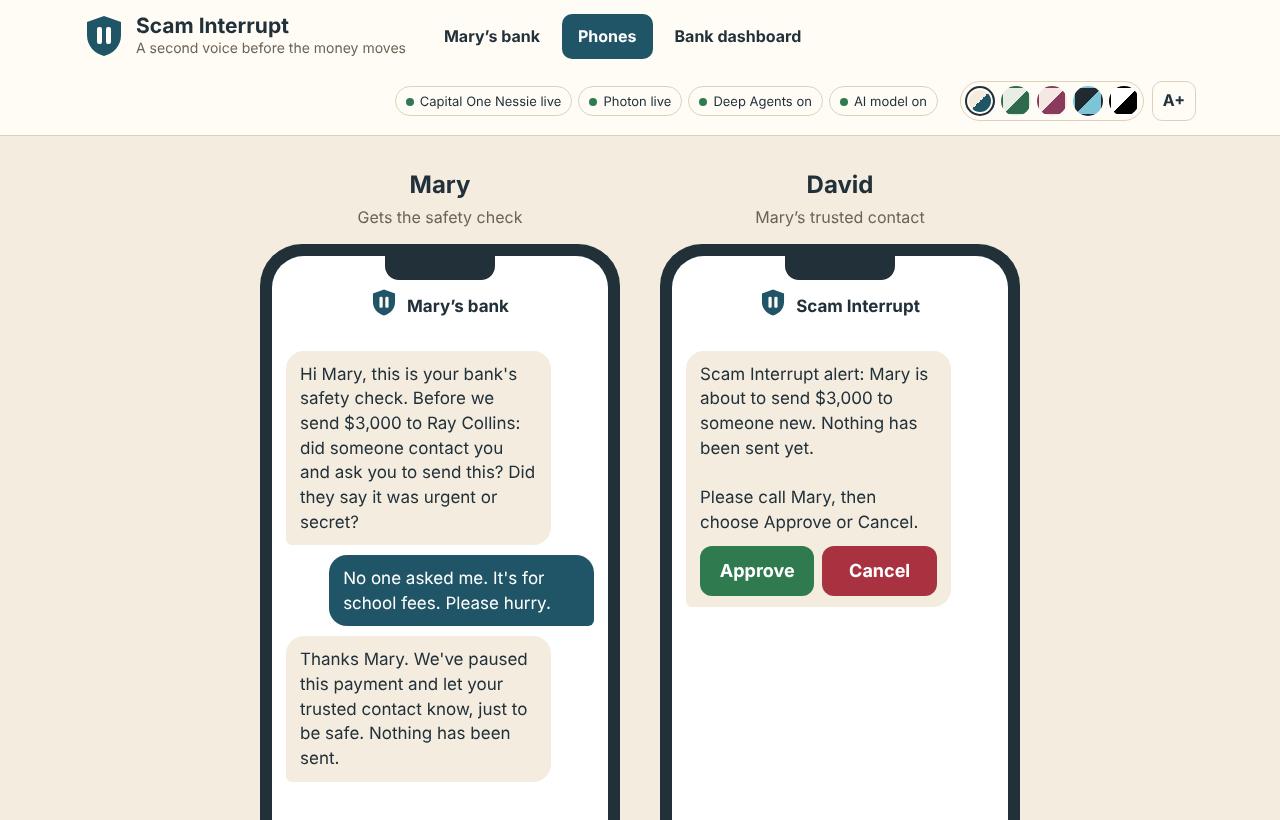
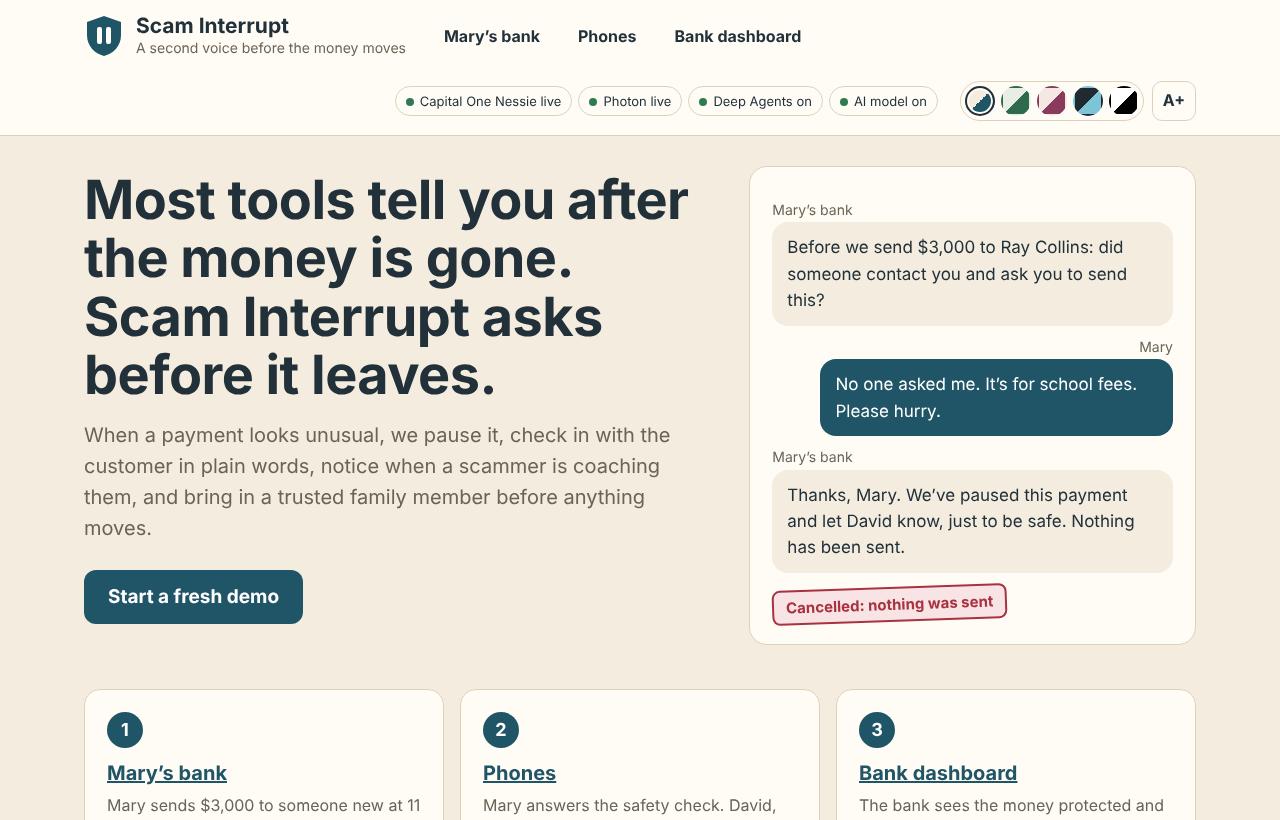
Scammers don't just trick older adults. They coach them on exactly what to tell the bank: "No one asked me to send this. It's for school fees. Please hurry." Bank fraud checks ask yes/no questions the victim has already been told how to answer, and most protection tools alert family only after the money is gone. We wanted a second voice before the money moves.
What it does
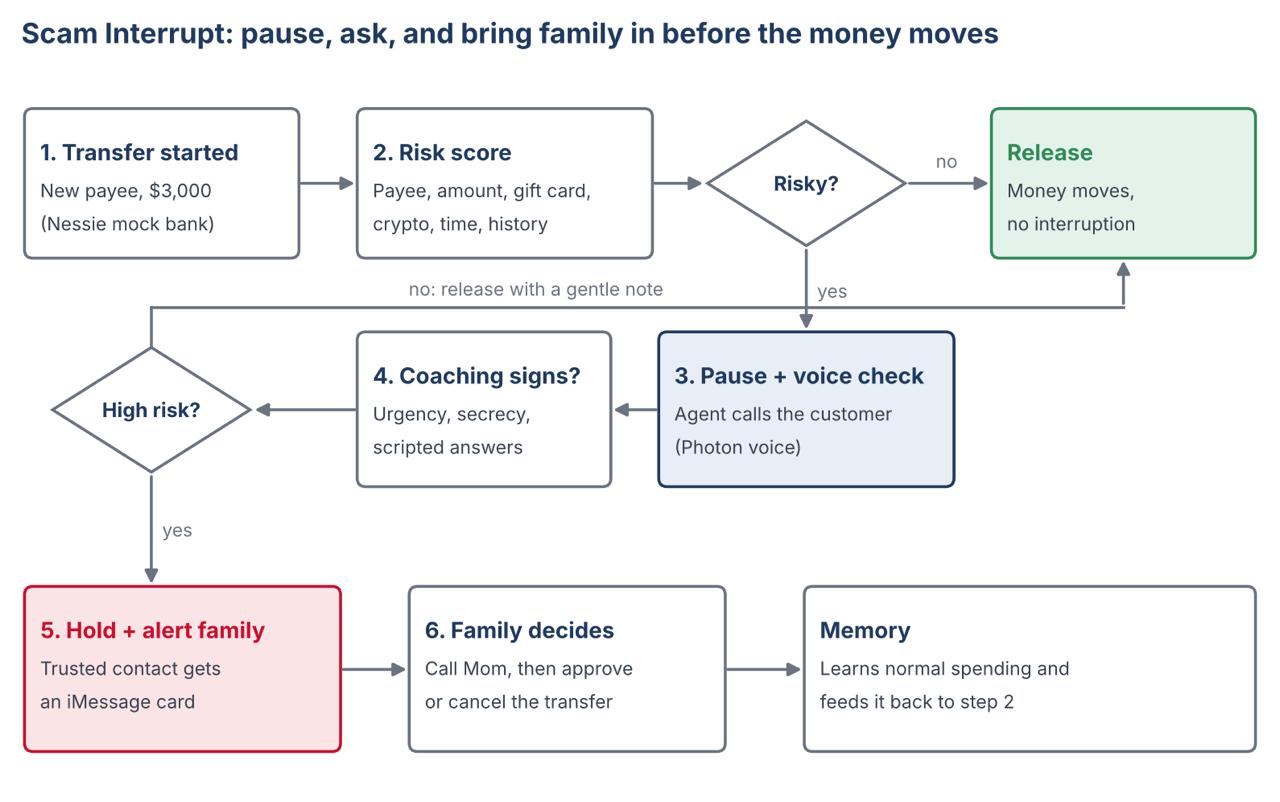
Scam Interrupt is an AI agent that sits inside the payment:
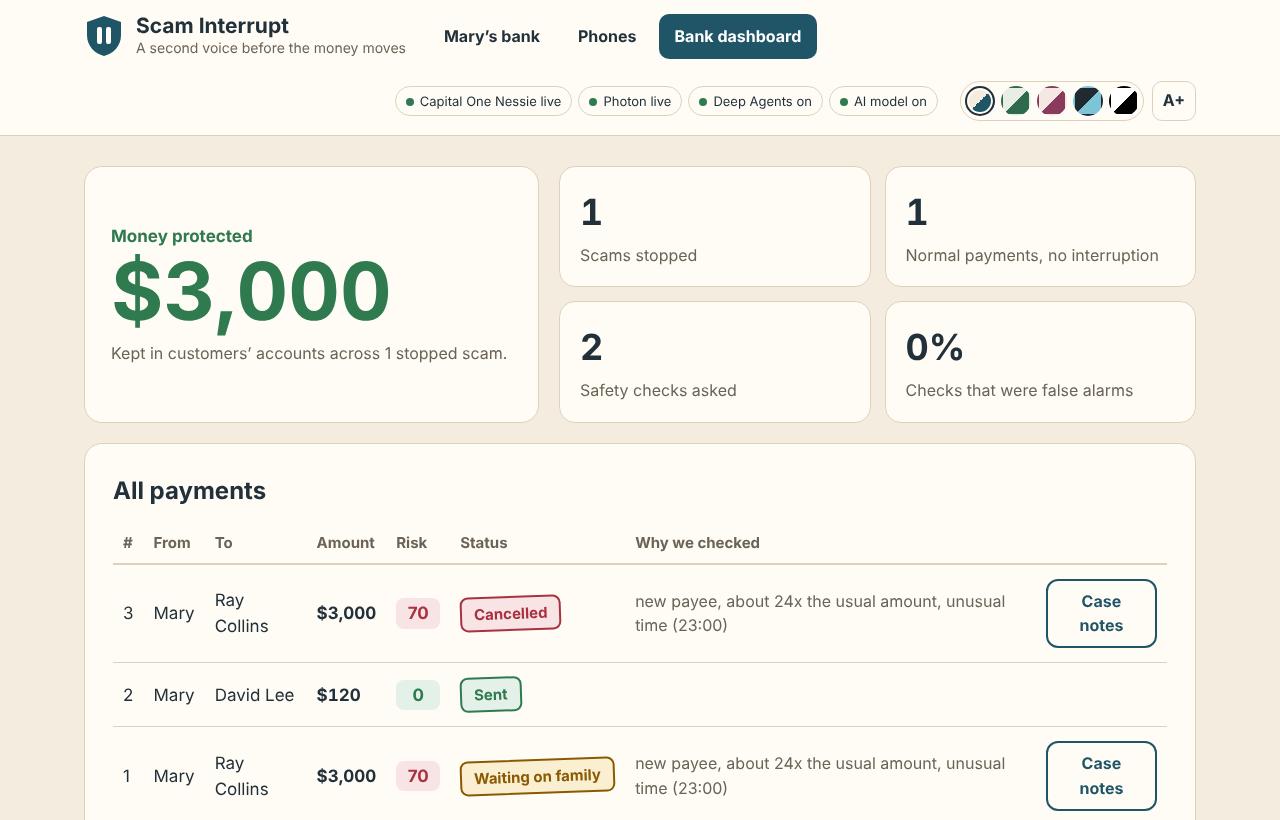
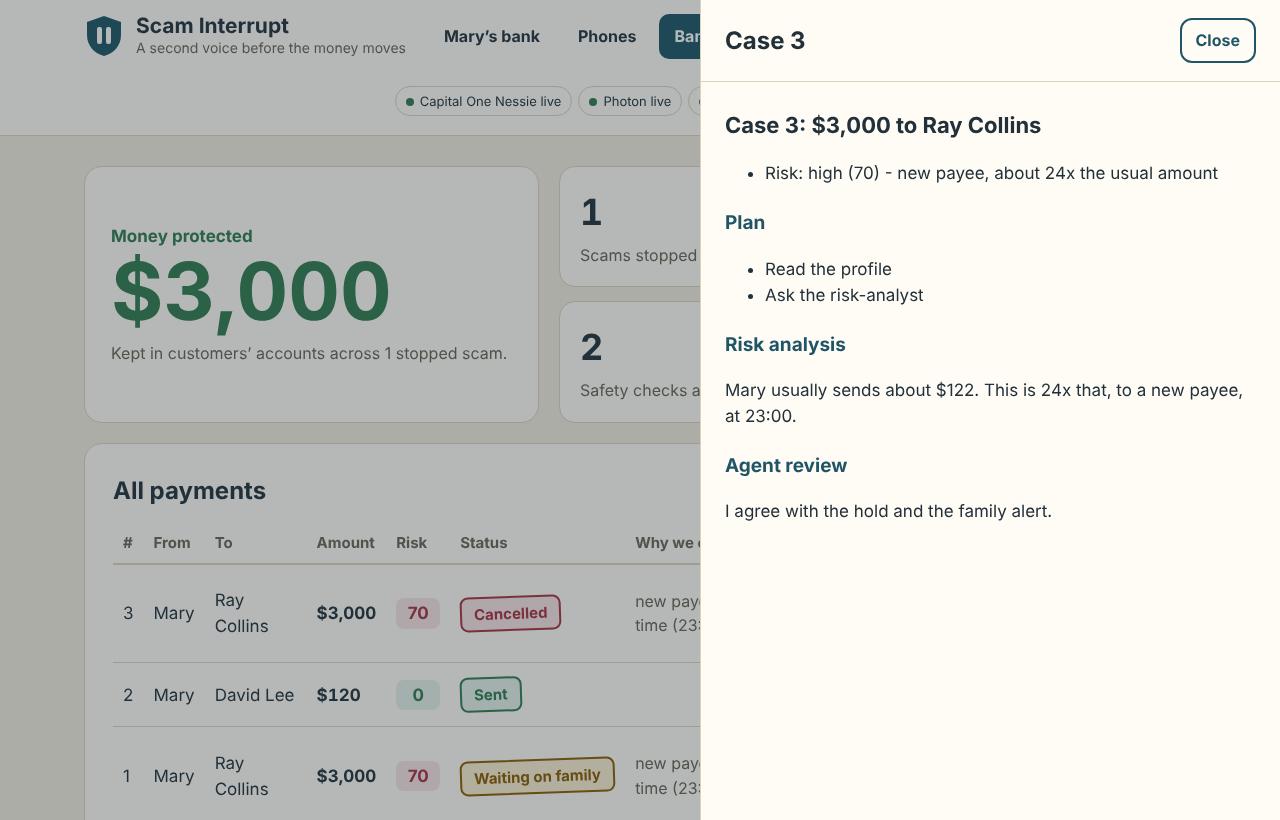
- Holds risky transfers. Each transfer is scored against the customer's own Capital One Nessie data: new payee, amount far above her usual, unusual hour, and whether it would leave too little for an upcoming bill.
- Checks in by iMessage. The customer gets a short, kind safety check on her own phone through Photon.
- Asks one adaptive follow-up. If her answer is vague, the agent asks one question built from her own words, such as "How do you know Ray Collins, and did you call your grandson back on the number you usually use?" A coached victim can recite a script; she can't easily explain a story that doesn't hold together.
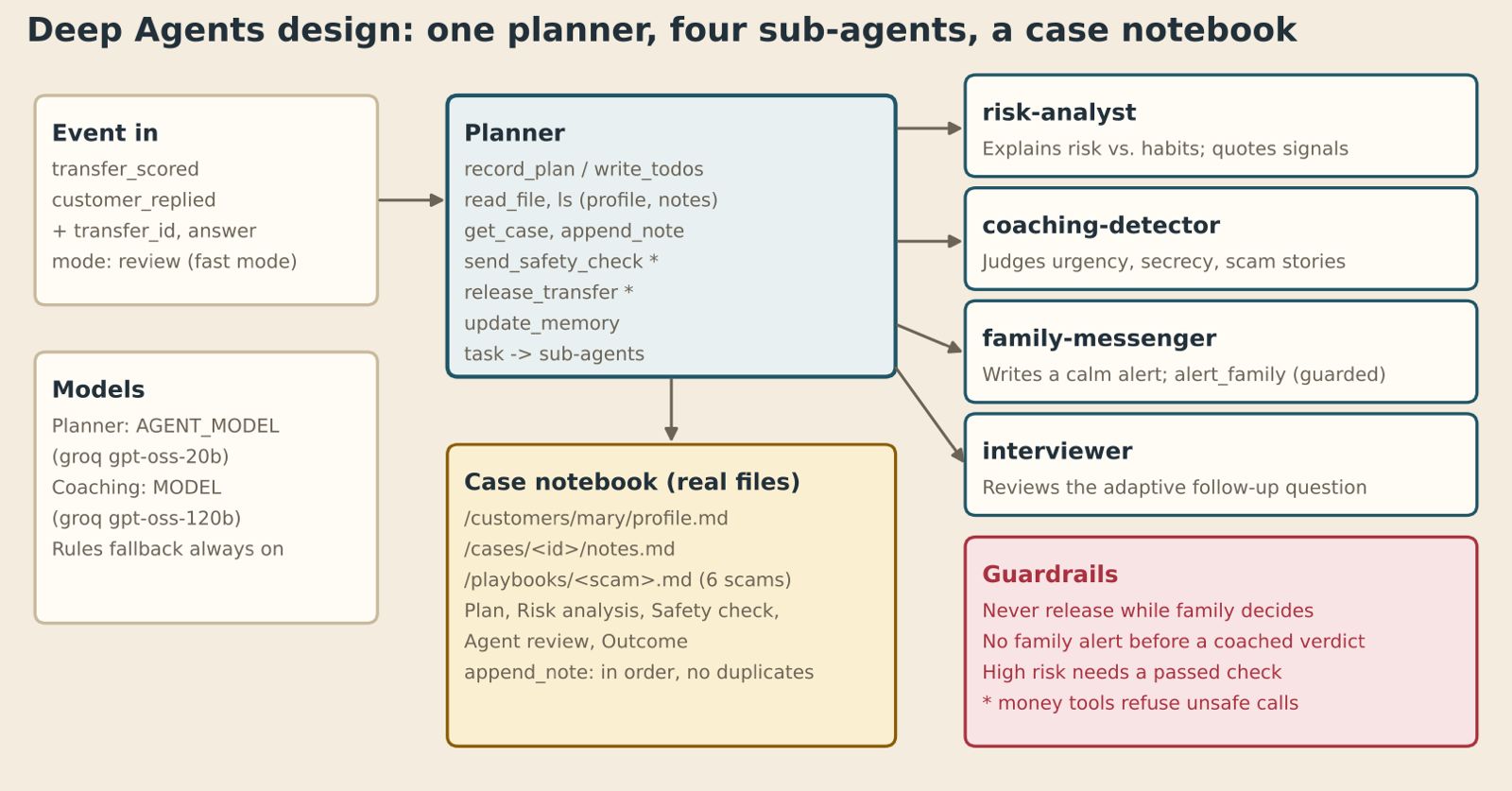
- Names the scam. Six scam playbooks (grandparent emergency, government impersonation, "safe account," tech support, romance, prize) let the agent tell the family what kind of scam it looks like and what to ask.
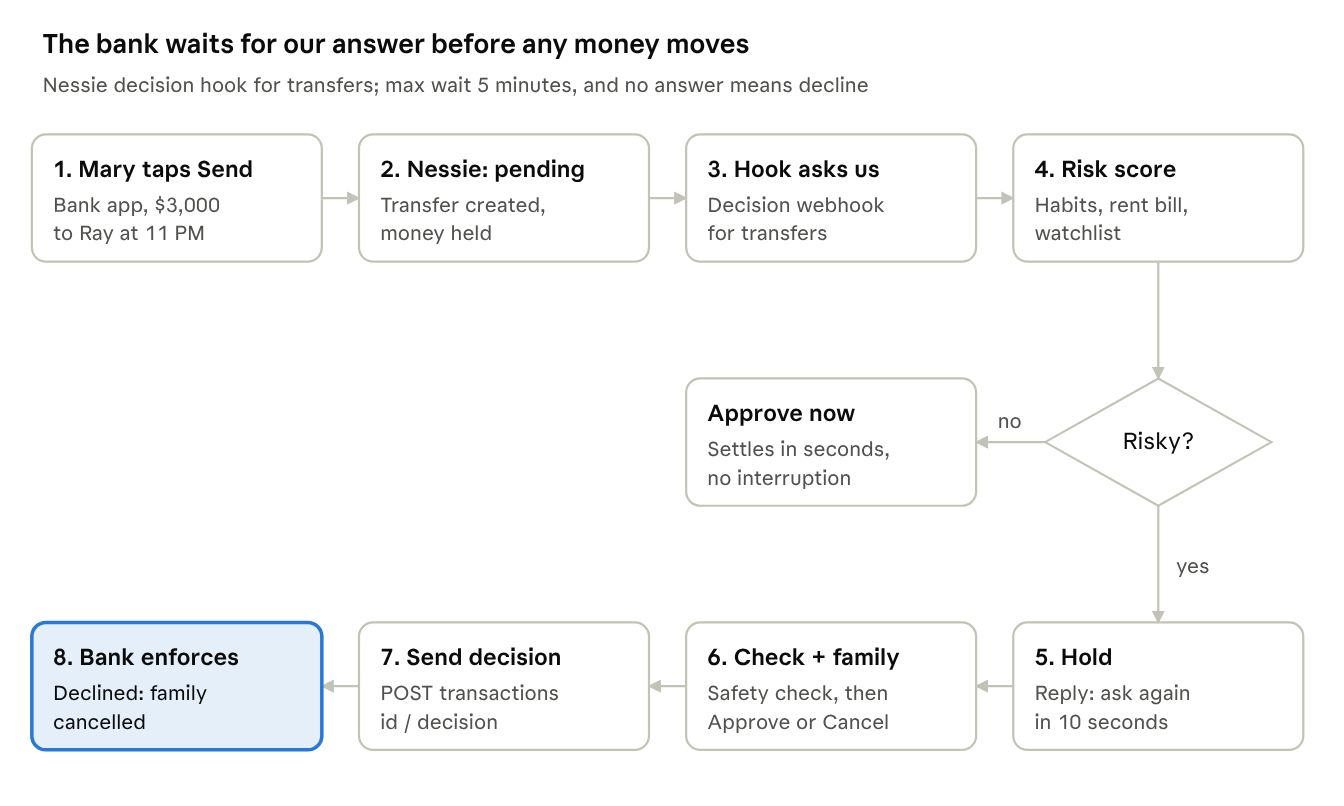
- Lets the family decide. An opted-in trusted contact gets the alert and replies APPROVE or CANCEL. With Nessie decision hooks, the bank itself waits for our answer and records the decline with our reason.
- Teaches and respects. After a cancel, the customer gets a short explanation of the scam. Normal payments go straight through, and she can always choose "Send anyway."
How we built it
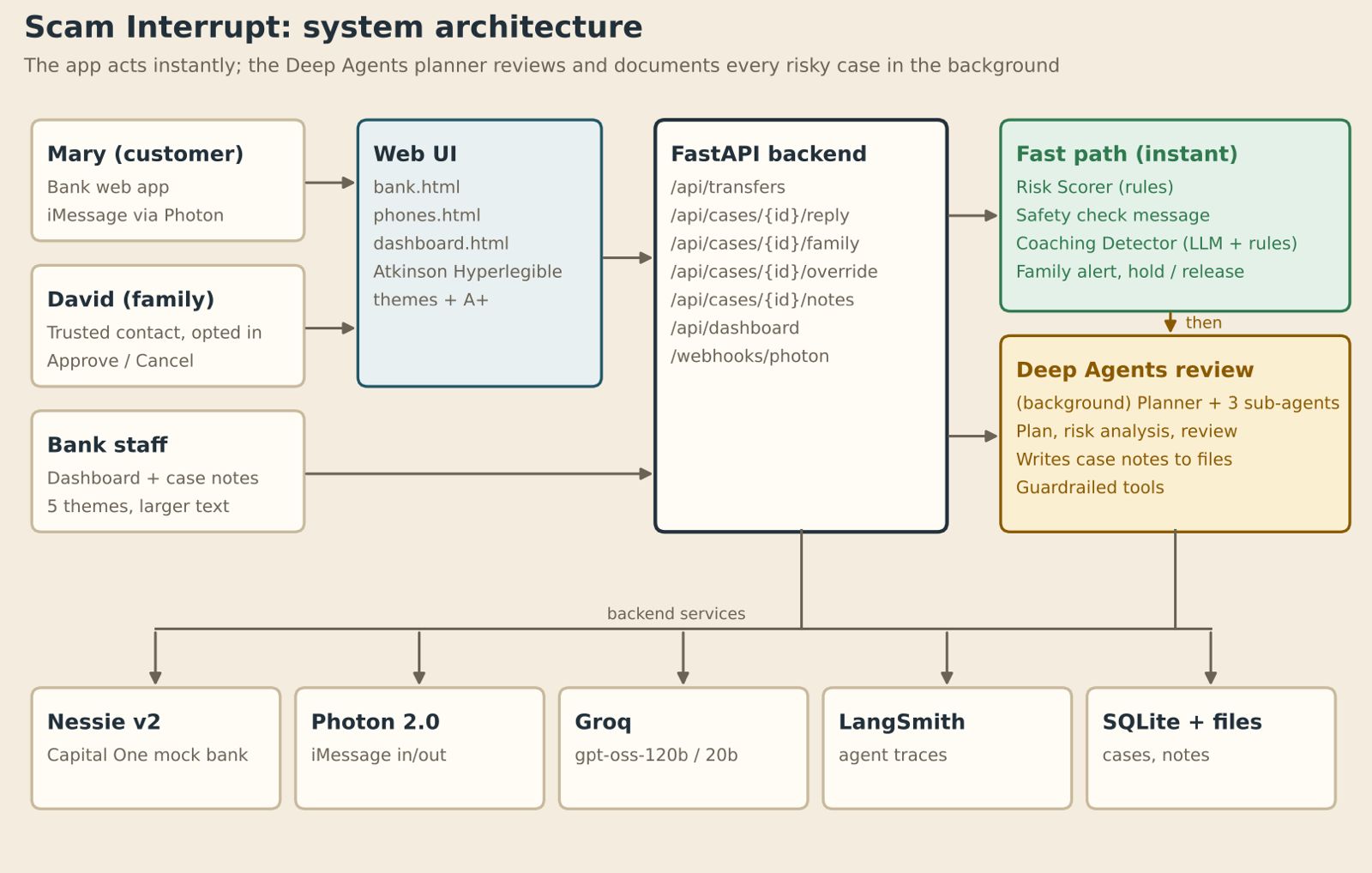
- LangChain Deep Agents planner with four sub-agents (risk analyst, coaching detector, family messenger, interviewer), a planning tool, and a file system holding the case notebook and scam playbooks. Every run is traced in LangSmith.
- Capital One Nessie v2: balances, bills and transaction history explain risk in the customer's own terms; a bank-wide payee watchlist; and decision hooks, so the bank holds a risky transfer and settles or declines it based on our answer.
- Photon 2.0: a TypeScript bridge built with the Spectrum SDK carries the safety check, the follow-up conversation and the family alert over iMessage on real phones, and forwards replies to our backend.
- Groq models for the coaching detector and the planner, always backed by a rules safety net so the demo works even if a model is slow.
- FastAPI + SQLite backend; a plain HTML/CSS/JS front end designed for older adults (Atkinson Hyperlegible font, high contrast theme, larger-text button).
The key design choice: customer-facing decisions run on a fast, proven pipeline in about a second, while the Deep Agents planner reviews each case in the background and writes plain-English case notes.
Challenges we ran into
- Scripts are the weakness of every fraud check. Coached victims answer scripted questions perfectly, so we made the check adaptive.
- False alarms vs. missed scams. On 10 test answers we wrote independently of our rules, the detector caught all 5 scams but sent 3 of 5 honest answers to a family check. All three were honest people answering literally ("Nobody contacted me...") or mentioning "today." We then adjusted the rules for that pattern. Because we changed them after seeing those answers, we don't present a re-run of that set as independent.
- Connecting Python to Photon's TypeScript SDK reliably in both directions, and matching each person to the right conversation.
- Nessie decision hooks needed a public URL, signature verification, and careful handling of the bank's wait window.
- Agents are slow and rate-limited on free tiers, which led to the fast-path + background-review design.
Accomplishments that we're proud of
The full loop runs live: a risky transfer is held, a real iPhone gets the safety check, a vague answer triggers a follow-up, the agent names the scam, a family member's phone gets the alert, their reply decides the outcome, and Nessie records the decline on the bank's own transaction.
What we learned
- A good question beats a long questionnaire: one follow-up built from the customer's own story reveals more than a script.
- Honest evaluation matters: measuring on answers the rules weren't tuned on showed us exactly where false alarms came from.
- Designing for older adults means plain words, large text, and never taking control away from the customer.
What's next
A pilot with a local credit union, voice safety calls for customers who prefer the phone, a larger independent test set, and false-alarm tracking over time.

