-
-
Overview
-
Architecture
Inspiration
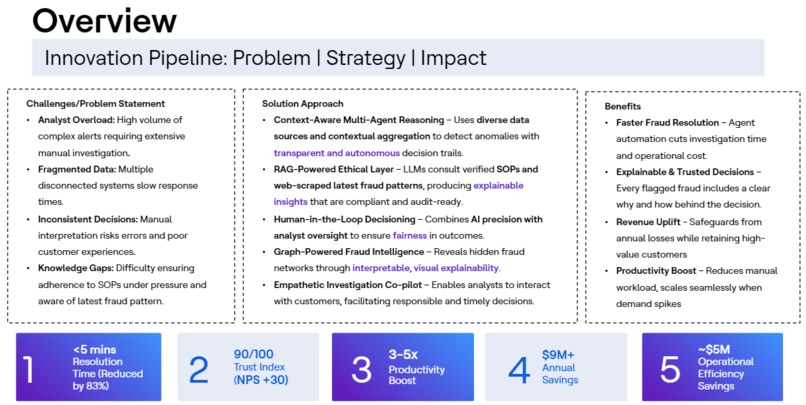
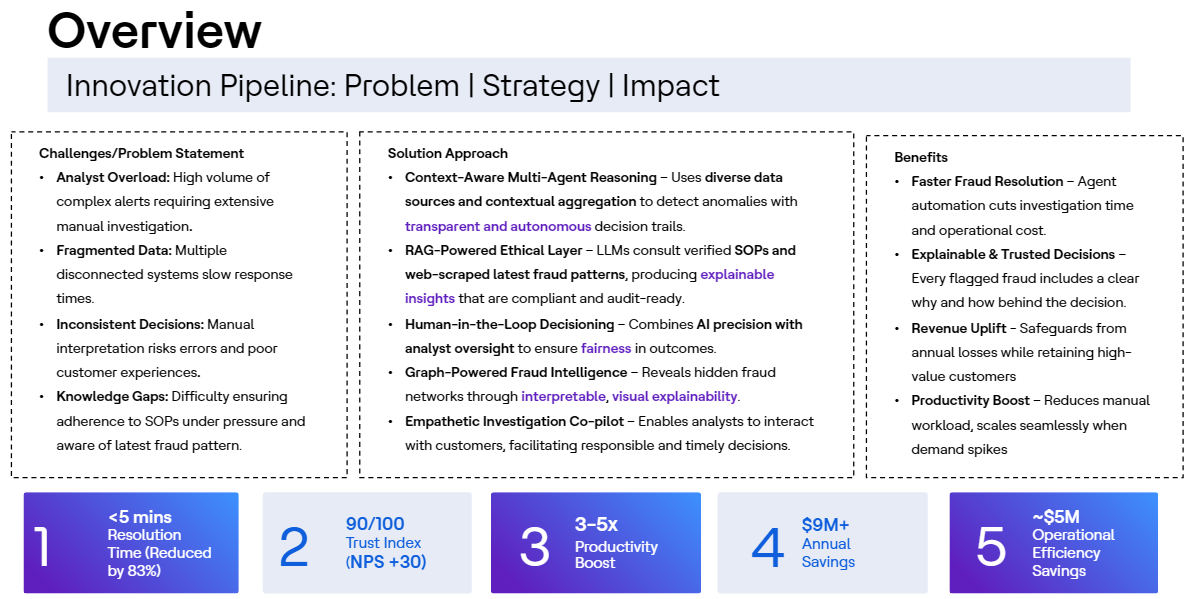
In the financial world, "authorized payment fraud" is a massive, multi-billion dollar problem. When a bank's system flags a suspicious transaction, it triggers a painful, manual investigation. A human analyst must spend an average of 45 minutes navigating fragmented systems siloed databases, transaction histories, call logs, and static policy manuals just to determine if a transaction is fraudulent. This process is cripplingly slow, astronomically expensive for banks, and creates a high-friction, "guilty-until-proven-innocent" experience for legitimate customers. We were inspired to solve this by asking: What if we could build an autonomous AI workforce that could execute this entire investigation from data analysis to customer interaction in minutes, not hours?
What it does
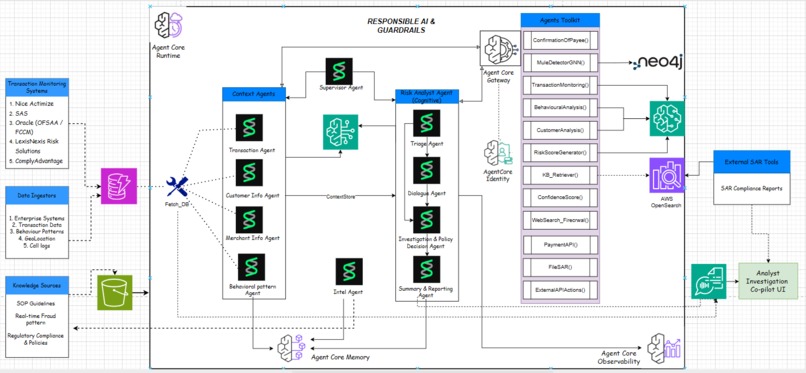
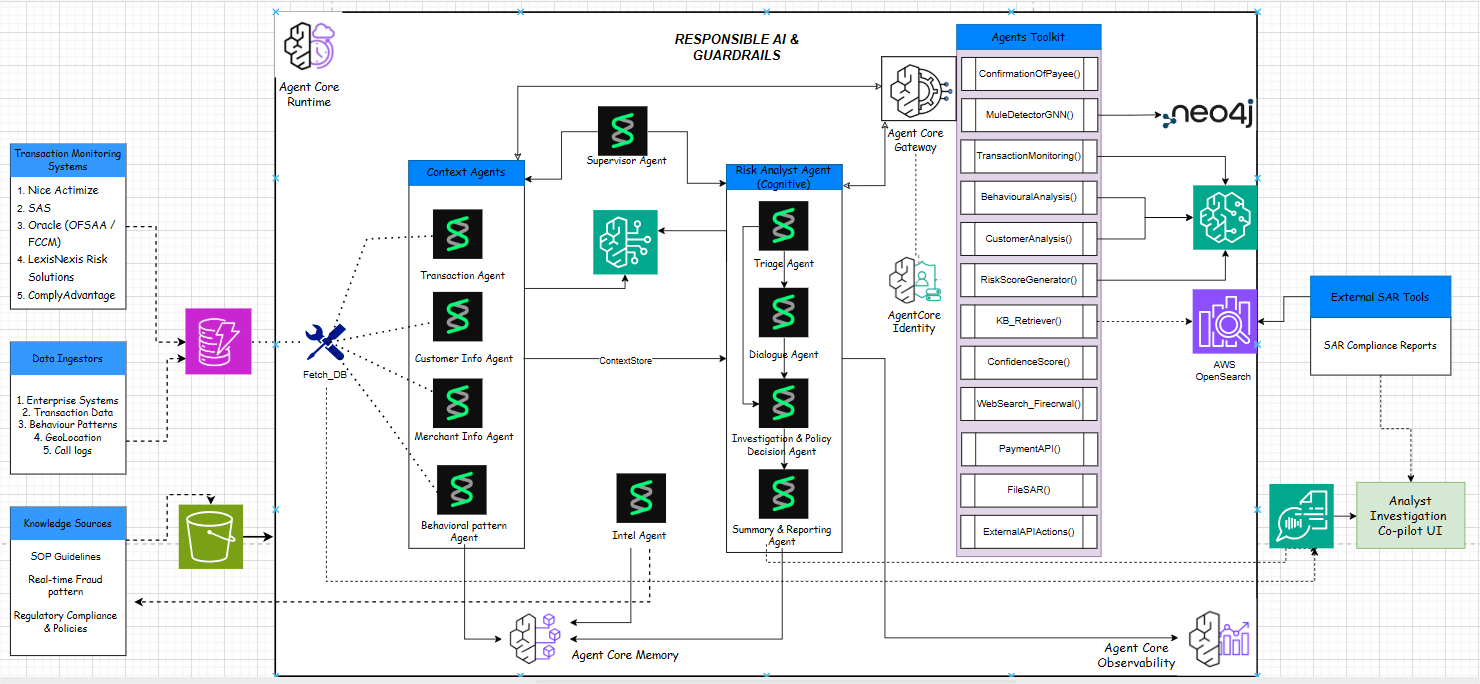
AWS AURA is an autonomous, multi-agent AI system that fully automates the investigation and resolution of financial fraud alerts. When a transaction is flagged, our "AI Analyst team" instantly activates: Investigates: Context Agents instantly gather and synthesize all fragmented data (transaction history, demographics, SOPs) in seconds. Analyzes: A Risk Agent assesses the transaction against known patterns and a dynamic knowledge base to generate a comprehensive risk score. Triages: A Triage Agent makes the first critical decision: approve, deny, or investigate further. Interacts (if needed): If the agent is skeptical, a Dialogue Agent autonomously contacts the customer via chat to hold a natural, probe-based conversation to verify the transaction's intent. Learns & Decides: A final Decision Agent, using all available data, makes the definitive "approve" or "deny" call. Crucially, our system features a Fraud Pattern Agent (powered by Claude 3) that constantly analyzes resolved cases to discover new fraud patterns, automatically updating the knowledge base for the entire agent team. We slash the resolution time from over 45 minutes to under 5 minutes.
How we built it
We built AWS AURA as an event-driven, serverless, multi-agent system, natively on Amazon Bedrock agentcore. Core AI Engine: Amazon Bedrock provides access to high-performance models. We use Claude sonnet 4 for our real-time agents (Context, Risk, Dialogue) to ensure speed and low latency, and Claude 4.5 Haiku for our deep-analysis Fraud Pattern Agent. Agent deployment: We use Bedrock AgentCore as the foundation for our "Strands" agent framework. This allows our specialized, serverless agents to collaborate, pass context, and intelligently route tasks in a complex, non-linear fashion. Dynamic RAG: Our "brain" is a Knowledge Base for Amazon Bedrock (backed by Amazon OpenSearch Serverless). This is not a static RAG. It's a dynamic, self-updating RAG that is constantly enriched by our Fraud Pattern Agent, keeping the entire system one step ahead of fraudsters. Data Sources: The system integrates with diverse data silos, pulling from bank SOPs, customer data, and transaction logs to build its 360-degree context.
Challenges we ran into
Static RAG is Obsolete for Fraud: Fraud isn't static; it evolves daily. A simple RAG built on old data is useless. Our solution was to build a self-improving RAG. We designed a "feedback loop" where a powerful agent analyzes new, confirmed fraud cases and automatically updates the vector store, so the system learns without human intervention. Simulating Analyst Judgment: Replicating a human's "gut feeling" is hard. We solved this by creating a Dialogue Agent that doesn't just ask "yes/no" questions. It's trained to conduct a probe-based conversation, analyzing the sentiment and consistency of the customer's answers to make a human-like judgment.
Accomplishments that we're proud of
The 90% Time Reduction: Slashing the 45-minute investigation to under 5 minutes is a massive, quantifiable win. This translates to millions in annual operational savings for a bank. The Self-Improving RAG: This is our biggest technical accomplishment. The system actively hunts for new fraud patterns and teaches itself, making it smarter with every case it handles. End-to-End Autonomous Workflow: We didn't just build a co-pilot. We built an autonomous system that handles the entire process—from the initial alert to the final decision, including real-time customer conversation. The Collaborative "Strands" Agents: We successfully built a team of specialized AI agents on Bedrock AgentCore that can collaborate to solve a problem far too complex for a single monolithic model.
What we learned
Specialized Agents > One Giant Model: A team of smaller, faster, specialized agents (like our "Context Agent") collaborating is far more effective and scalable than a single, slow, "do-it-all" model. Bedrock AgentCore is a Game-Changer: Moving from prototype frameworks to Bedrock AgentCore allowed us to build a robust, scalable, and observable agentic system that feels "production-ready," not like a science experiment.
What's next for AWS AURA
Our vision is to create a fully autonomous, self-learning fraud-detection network for the entire financial industry. Expand to Voice: Integrate Amazon Connect to allow our Dialogue Agent to make autonomous voice calls, not just chat. Cross-Bank Intelligence: Create a federated learning model where banks can (anonymously) share new fraud patterns discovered by their AWS AURA instances, making the entire ecosystem safer. Predictive Prevention: Use the data from the Fraud Pattern Agent to move from detecting fraud to predicting it before the transaction is even attempted. Production API: Package our solution as a scalable, secure API that any bank or FinTech company can integrate in days, not months.

Log in or sign up for Devpost to join the conversation.