Inspiration
Recognizing how a quantity scales is different from recalling its formula. The prototype invites a learner to make a prediction, fit an interpretable relationship and look for a counterexample. This is a proposed learning interaction; no classroom experience or measured learning gain is claimed.
What it does
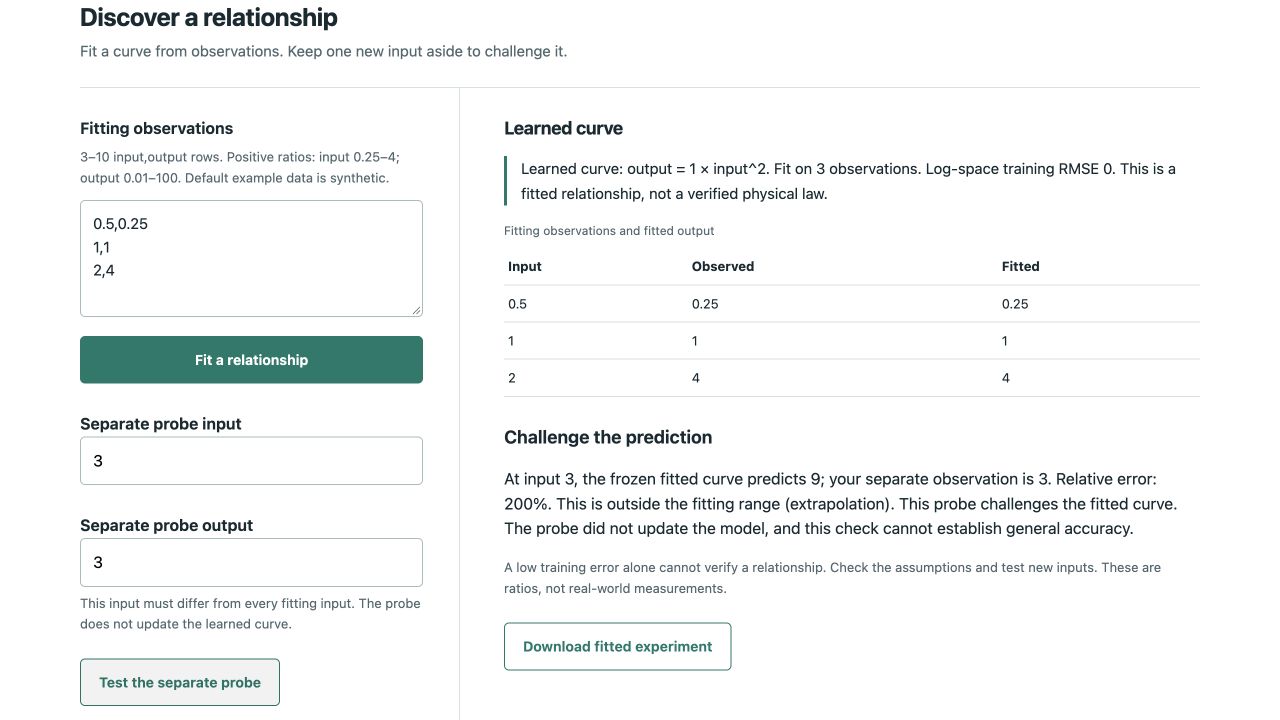
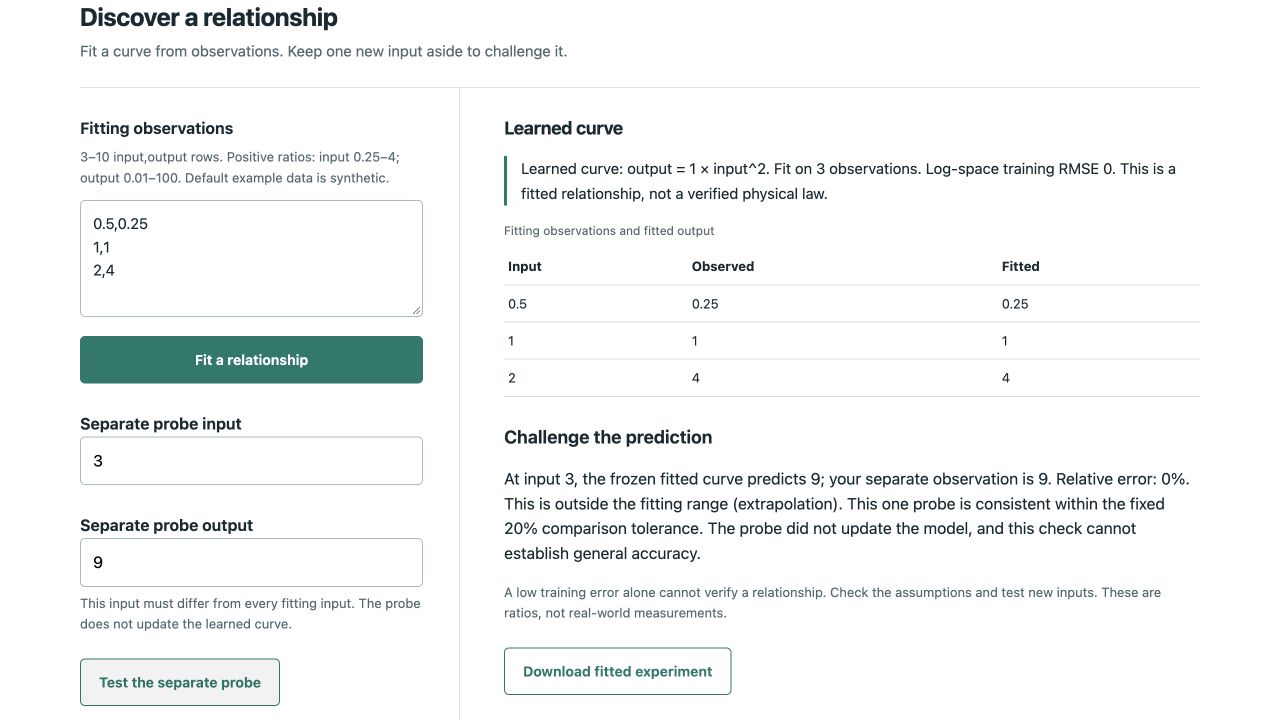
The primary experiment learns the constant and exponent of a power-law curve from 3–10 positive numeric observations. A separate probe tests the frozen model without retraining it. Training residual, probe error and extrapolation are labelled separately. An additional six-system sandbox contrasts a learner-confirmed scaling interpretation with a mathematical relationship whose assumptions are visible. Local Markdown exports preserve the experiment and reflection.
How it was built
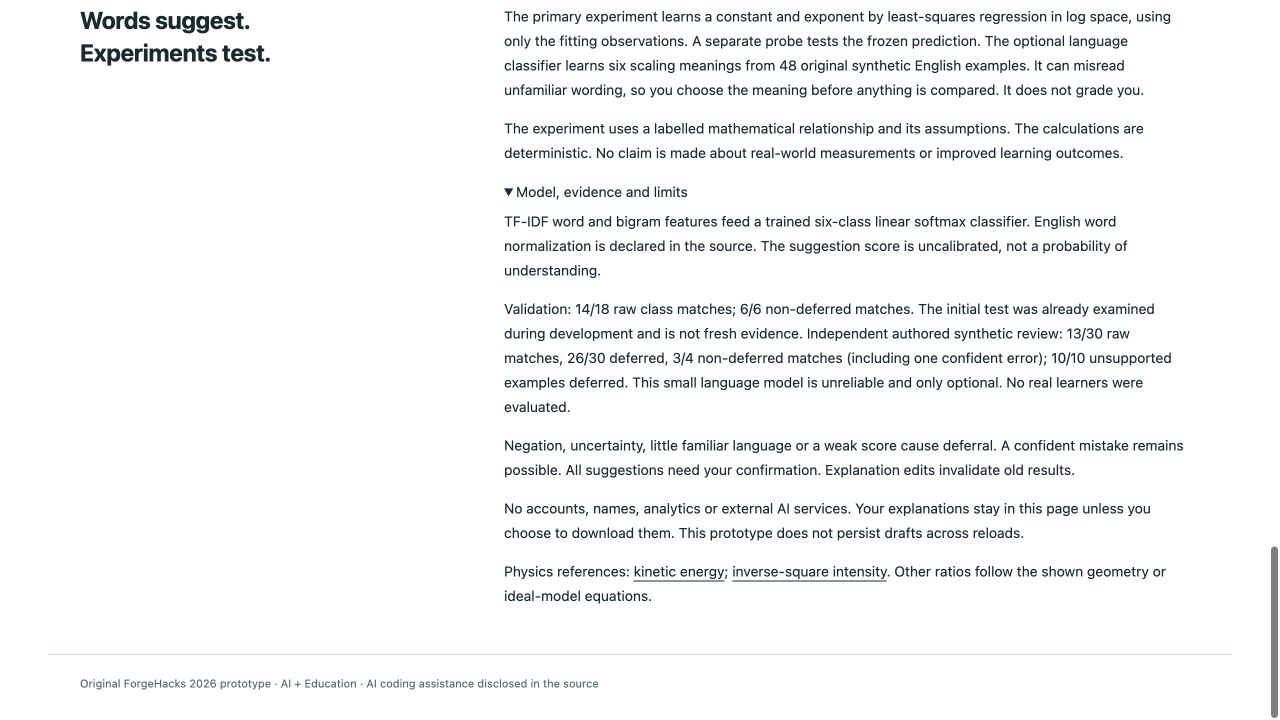
The numeric ML component is least-squares regression in log space. It learns two parameters directly from the fitting rows and never reads the separate probe while fitting. A secondary TF-IDF/softmax English classifier is trained from 48 authored synthetic sentences; its suggestion is optional and always requires confirmation. The implementation uses modular JavaScript, HTML and CSS, a table alternative to the SVG graph, and no accounts, telemetry or runtime commercial APIs. Source, synthetic data and UI were produced with Codex coding assistance during the event window. The AI/ML running in the product is separately described from that coding assistance.
Challenges and honest limits
The first language model generalized poorly. The frozen selected language model also matched only 13/30 independent authored synthetic examples, deferred 26/30 and made one error among four non-deferred suggestions. We preserved these findings and strengthened the principal interaction with interpretable numeric learning and a separate probe. Both modules remain prototypes. No real learner study or broad accuracy claim is made. Small samples and ideal-model assumptions can mislead; extrapolation and mismatch are surfaced rather than converted into grades.
What is complete
Working local fit/probe and confirmed-scaling workflows, bounded validation, state invalidation, responsive controls, local exports, original corpus and frozen language-model artifacts. Sixteen test groups passed and the principal paths were operated in the in-app browser. The public repository includes run instructions and the full source. The demo uses annotated captures of six actual UI states, not continuous screen recording.
Intended users and proposed impact
The intended users are students comparing proportional, square-law and inverse relationships, and educators demonstrating why a fit must be challenged with a separate observation. Users can inspect a fitted constant and exponent, distinguish interpolation from extrapolation, and record a counterexample and reflection locally. This may support discussion of model assumptions; improved learning outcomes have not been measured.
Track
AI + Education
Built With
- codex
- css3
- html5
- javascript
- linear-regression
- machine-learning
- tf-idf

Log in or sign up for Devpost to join the conversation.