SaySafe — Shop Simply. Pay Safely.
Inspiration
Shopping online should be simple, but for many older adults, it can feel overwhelming.
Imagine Mary, who wants to buy a microwave. She might struggle to find the right product, receive a suspicious payment message, forget whether she has already paid, or worry about making an expensive purchase without asking someone she trusts.
Most shopping applications focus on making payments faster. We wanted to focus on something equally important: helping people feel informed, independent and confident before they pay.
That inspired SaySafe, an AI-powered shopping and payment safety companion designed for older adults and the families who support them.
Our goal is simple: make online shopping easier, explain potential risks clearly, involve family when needed, and provide trustworthy proof after payment.
What It Does
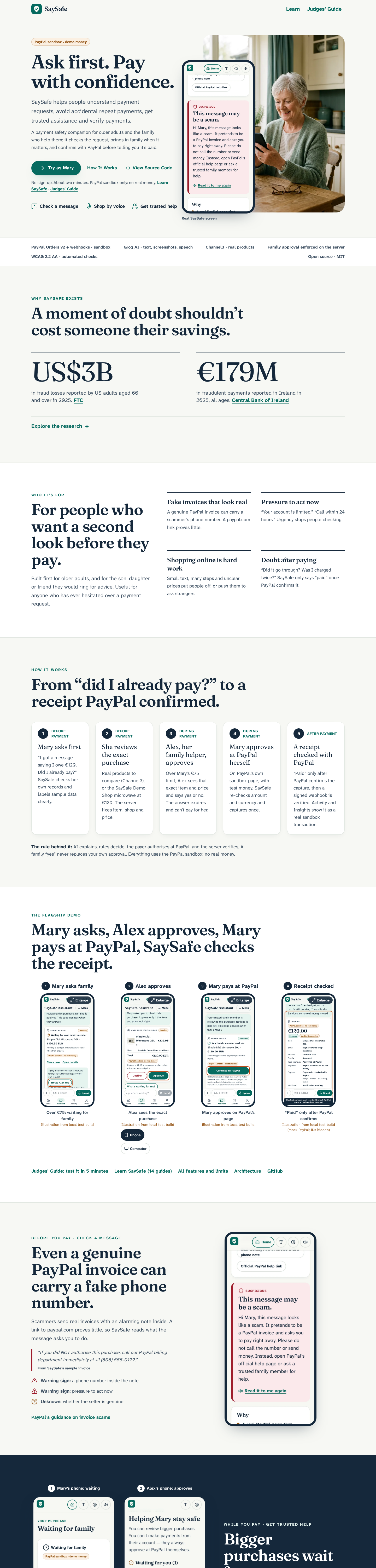
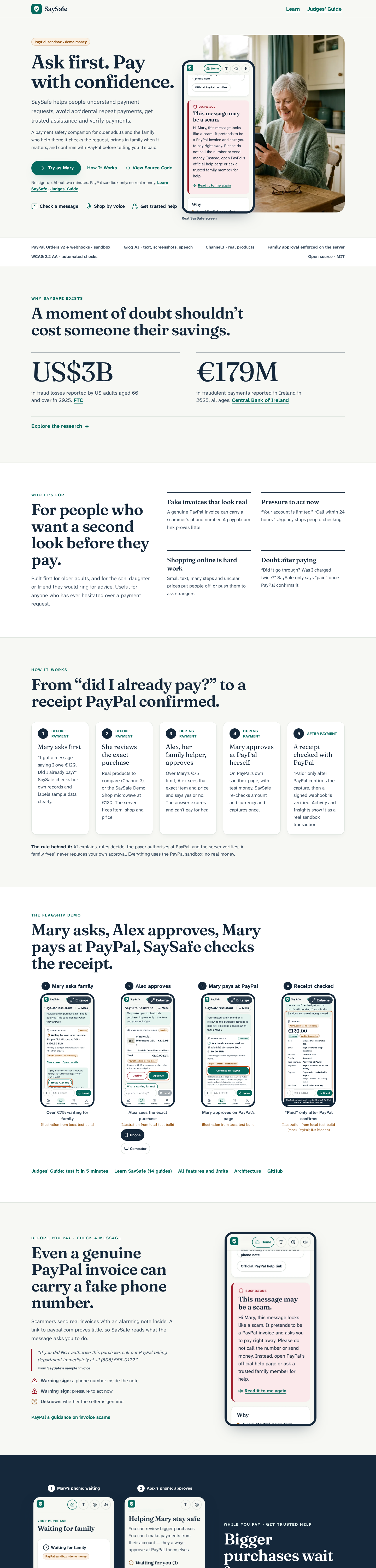
SaySafe brings shopping assistance, payment safety and trusted family support into one accessible experience.
1. Shop naturally with AI
Mary can type or speak requests such as:
"Find me a kettle."
"Show me something cheaper."
"Find a microwave for under €150."
SaySafe uses Channel3 to discover real products, prices and retailer links. It remembers recent shopping context and can use saved preferences to help with follow-up requests.
Real retailer listings open on the retailer's own website. SaySafe also provides a separate Demo Shop, where users can experience its protected PayPal Sandbox checkout.
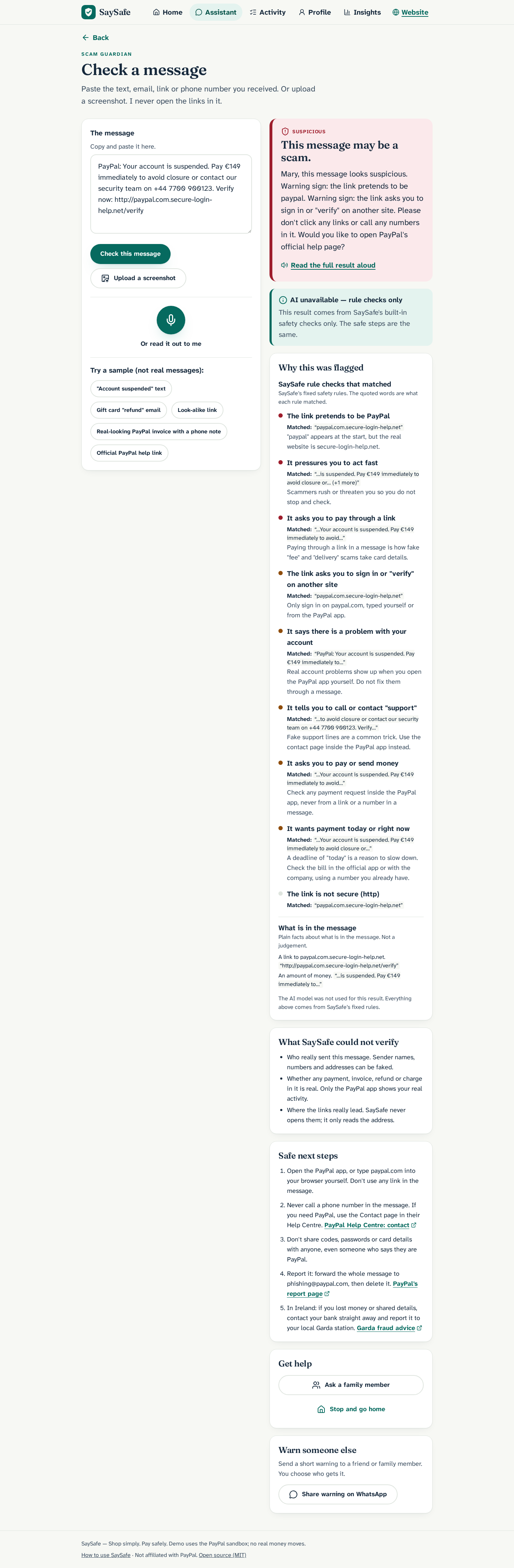
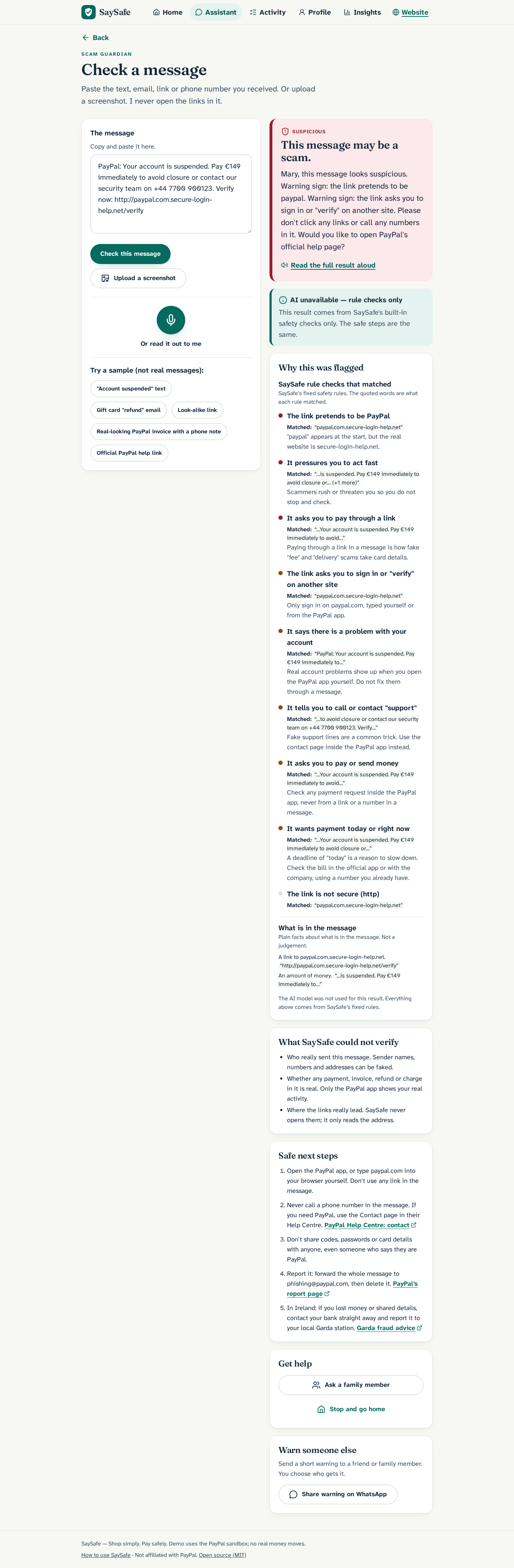
2. Understand suspicious payment messages
Mary can paste a suspicious message or submit a screenshot.
SaySafe's AI-powered Scam Guardian identifies possible warning signs, such as urgency, unfamiliar contact information or suspicious payment requests, and explains them in plain English.
It does not claim that a message is definitely safe or that fraud has been conclusively detected.
3. Check before paying twice
Mary can ask:
"Have I already paid €120?"
"Was I charged twice?"
SaySafe checks payment records available within the application and highlights possible matches or repeated payments.
It distinguishes genuine PayPal Sandbox transactions from illustrative sample records. A matching amount is never treated as proof that an invoice was paid.
4. Get trusted family approval
Mary can choose a spending threshold, such as €75.
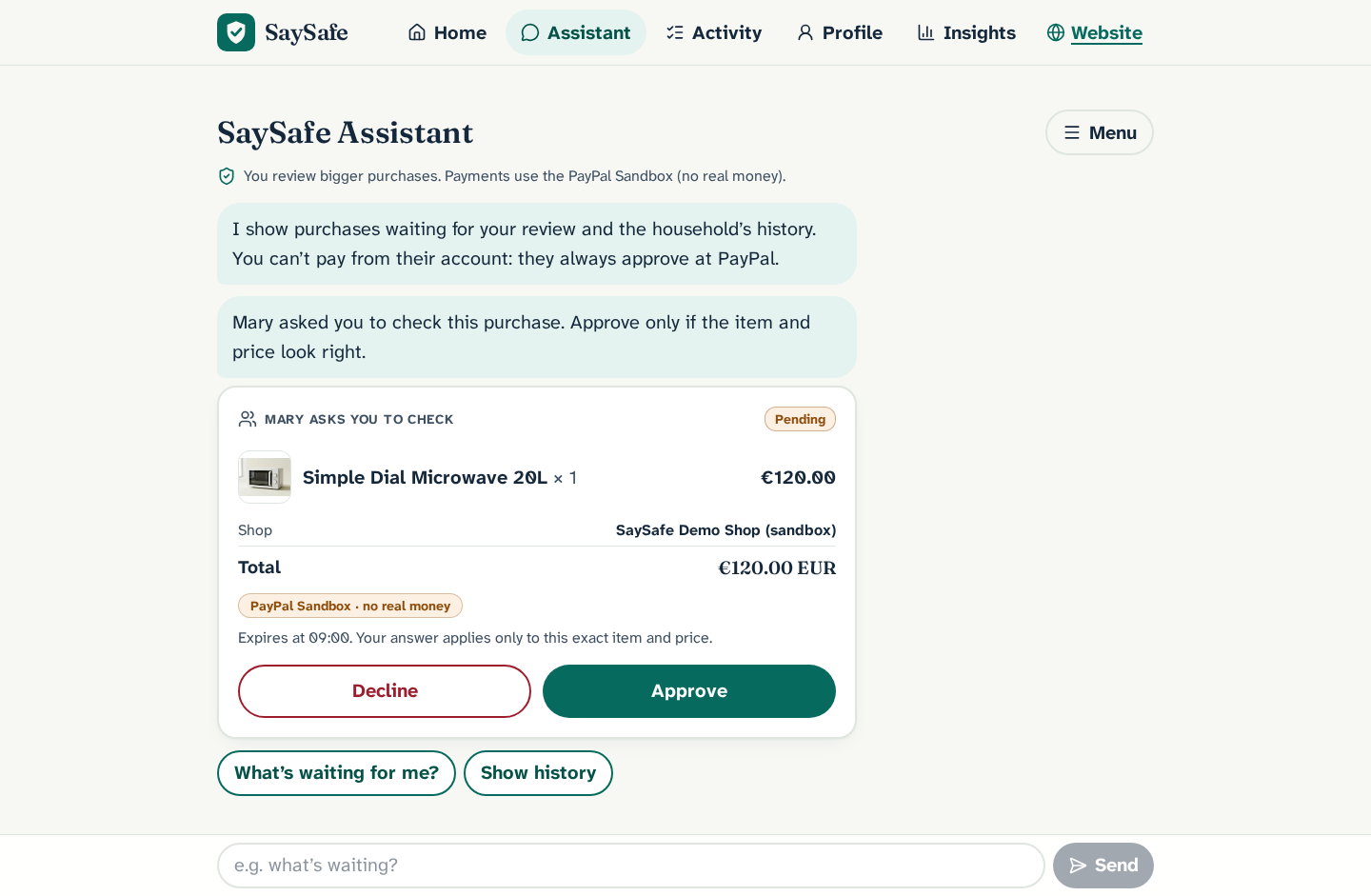
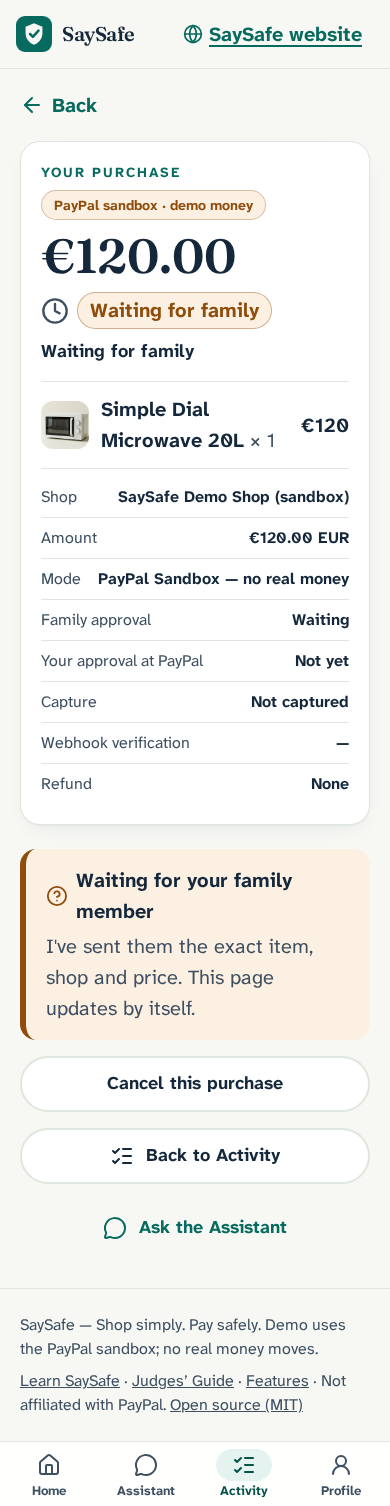
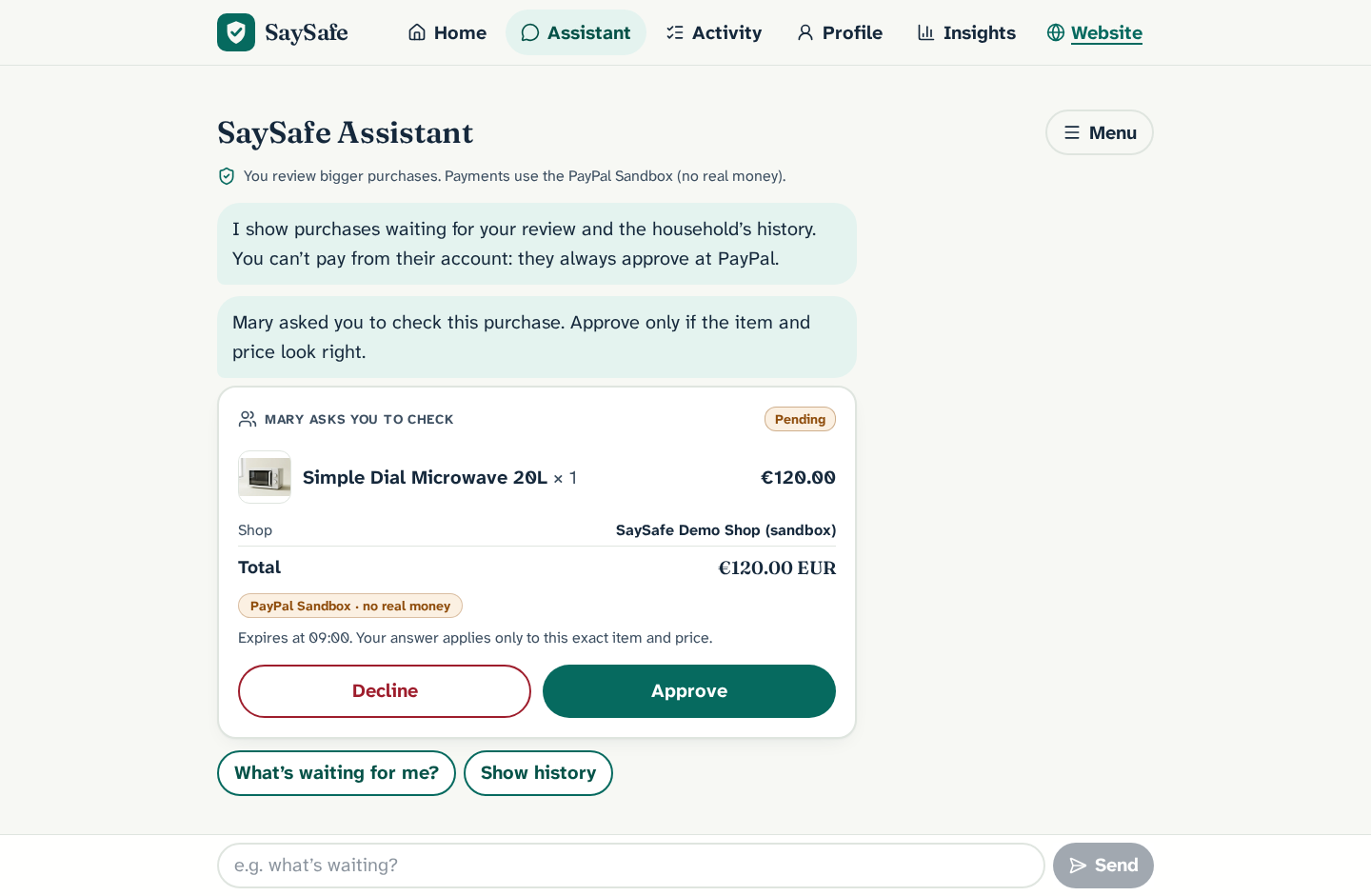
If she wants to purchase a €120 microwave from the Demo Shop, SaySafe requests approval from her trusted family helper, Alex.
Alex sees the exact purchase details and can approve or decline that specific request.
Family approval is not payment authorisation. Mary must still complete checkout herself.
Her unrelated purchases, conversations and personal preferences remain private unless she explicitly chooses to share supported information.
5. Complete a verified PayPal payment
SaySafe integrates with the PayPal Sandbox using Orders v2, Payments v2 and verified webhooks.
The payment journey includes:
- Server-controlled product prices.
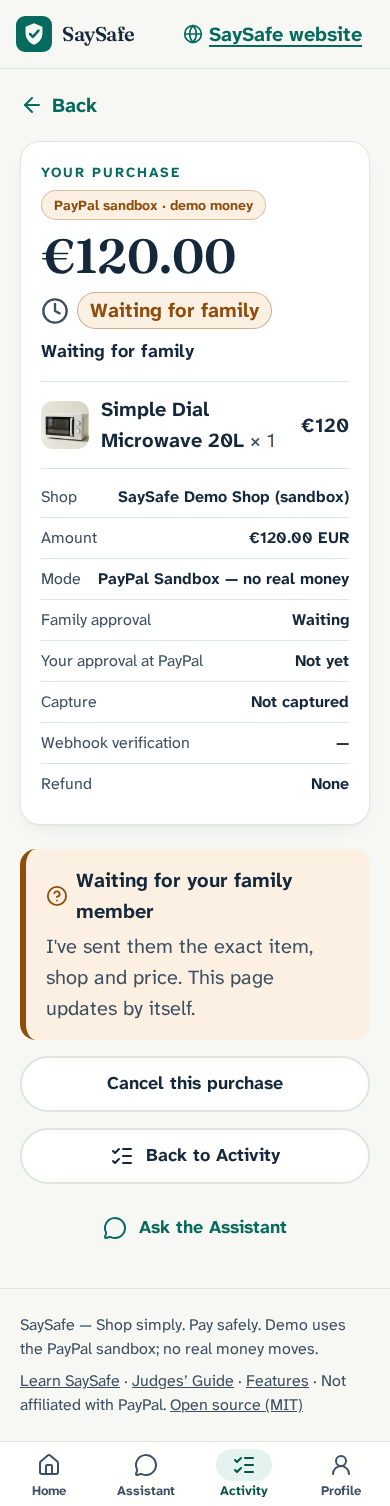
- Family approval when required.
- Customer authorisation on PayPal's hosted checkout page.
- Idempotent capture to reduce duplicate-payment risk.
- Verification of payment status through PayPal.
- A receipt with recorded payment evidence.
The entire checkout uses Sandbox test money. No real money is transferred or products delivered.
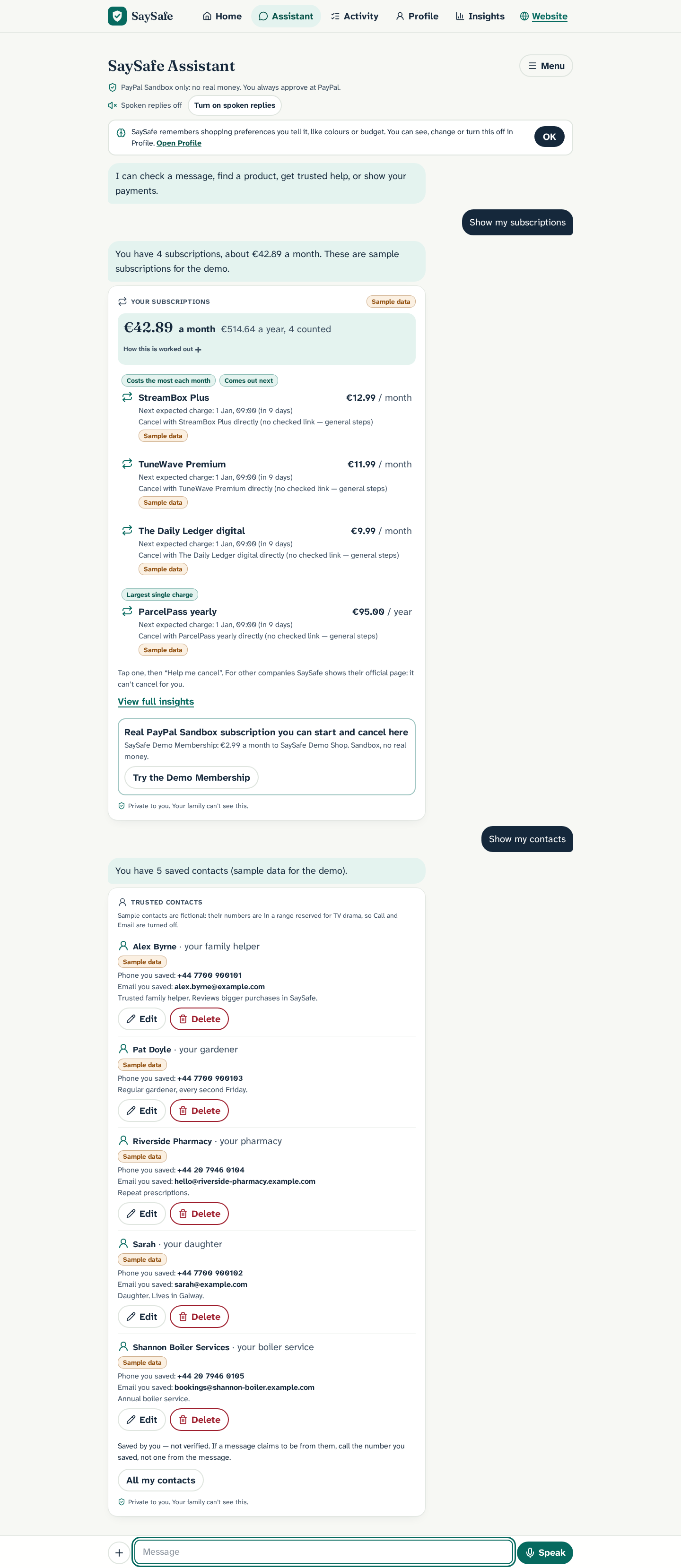
6. Understand activity and upcoming commitments
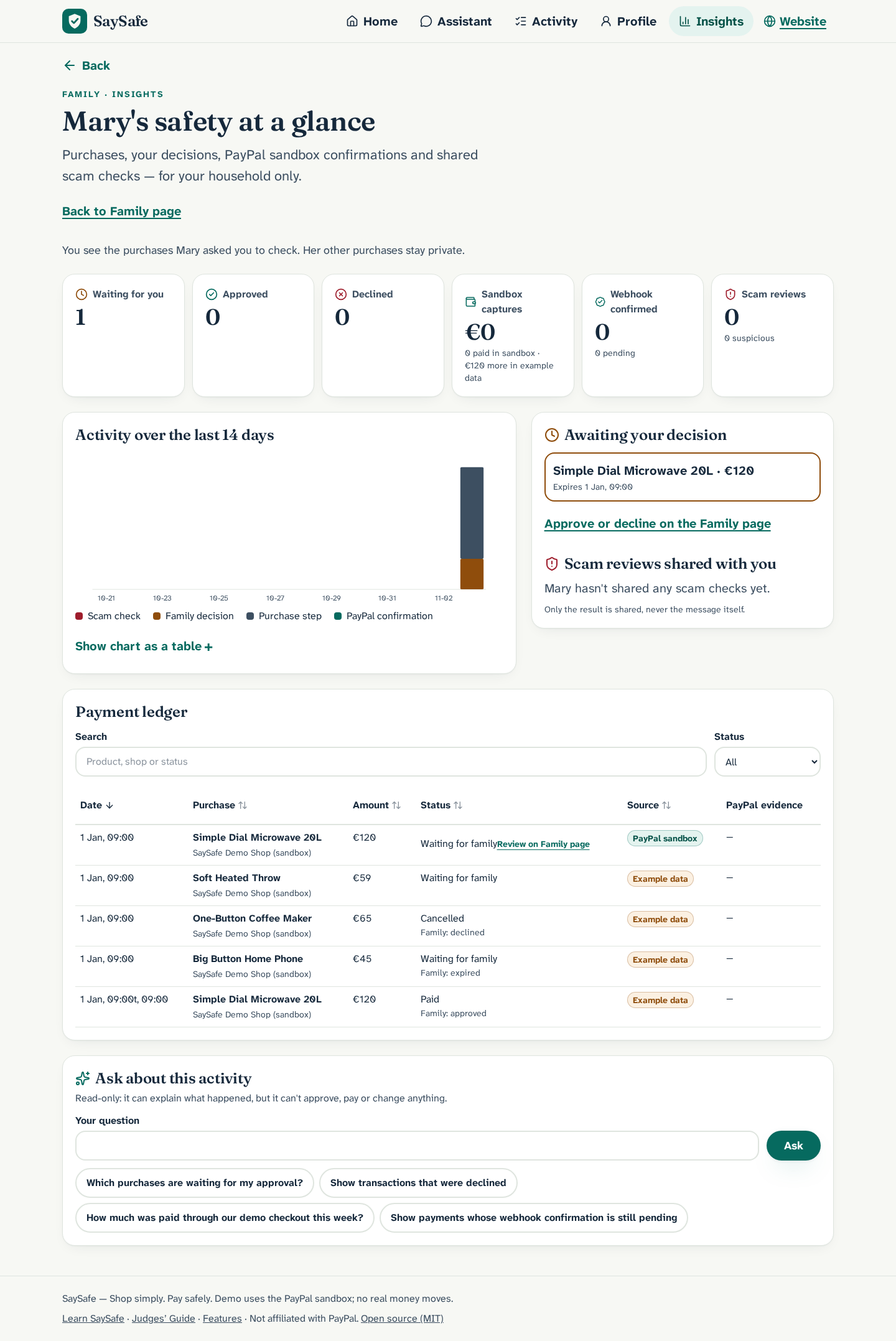
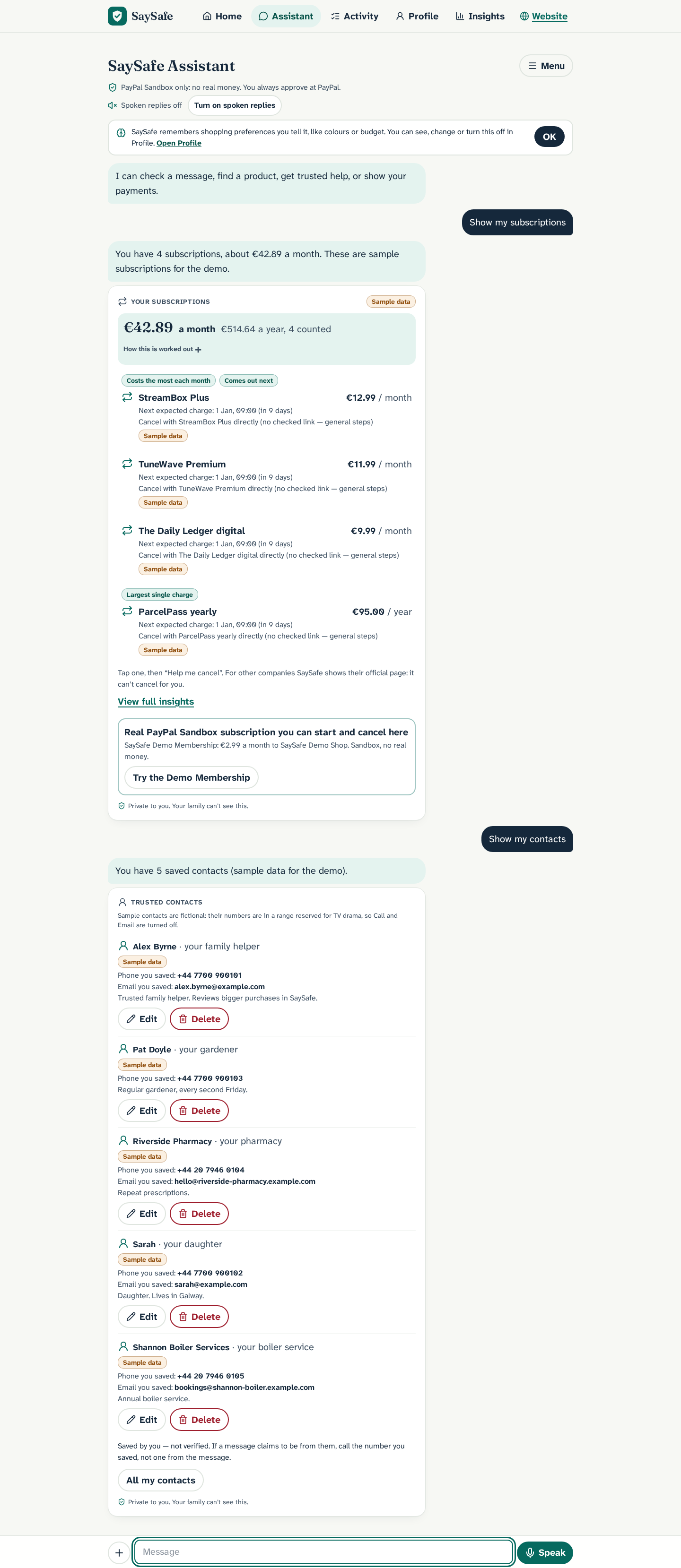
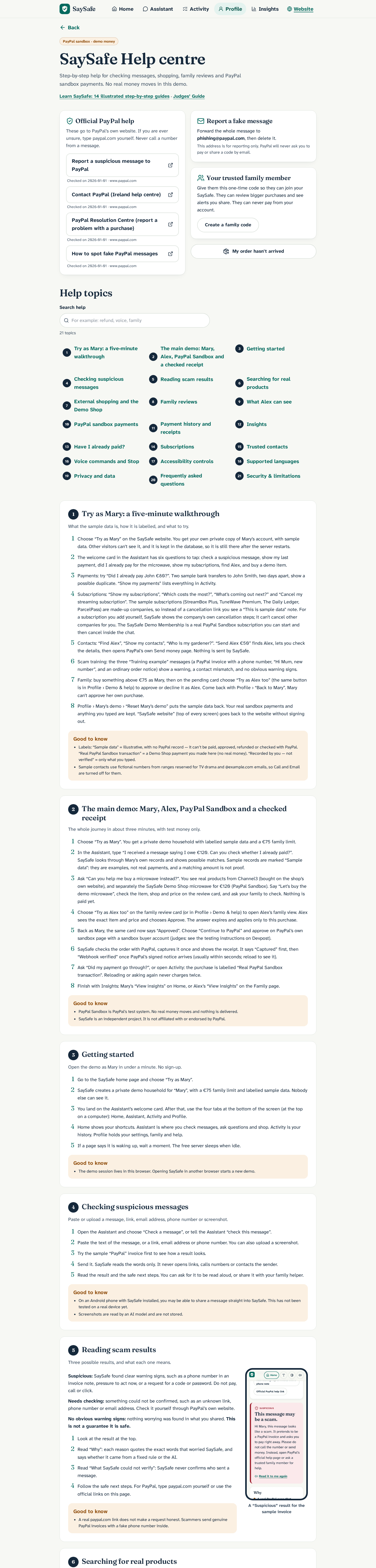
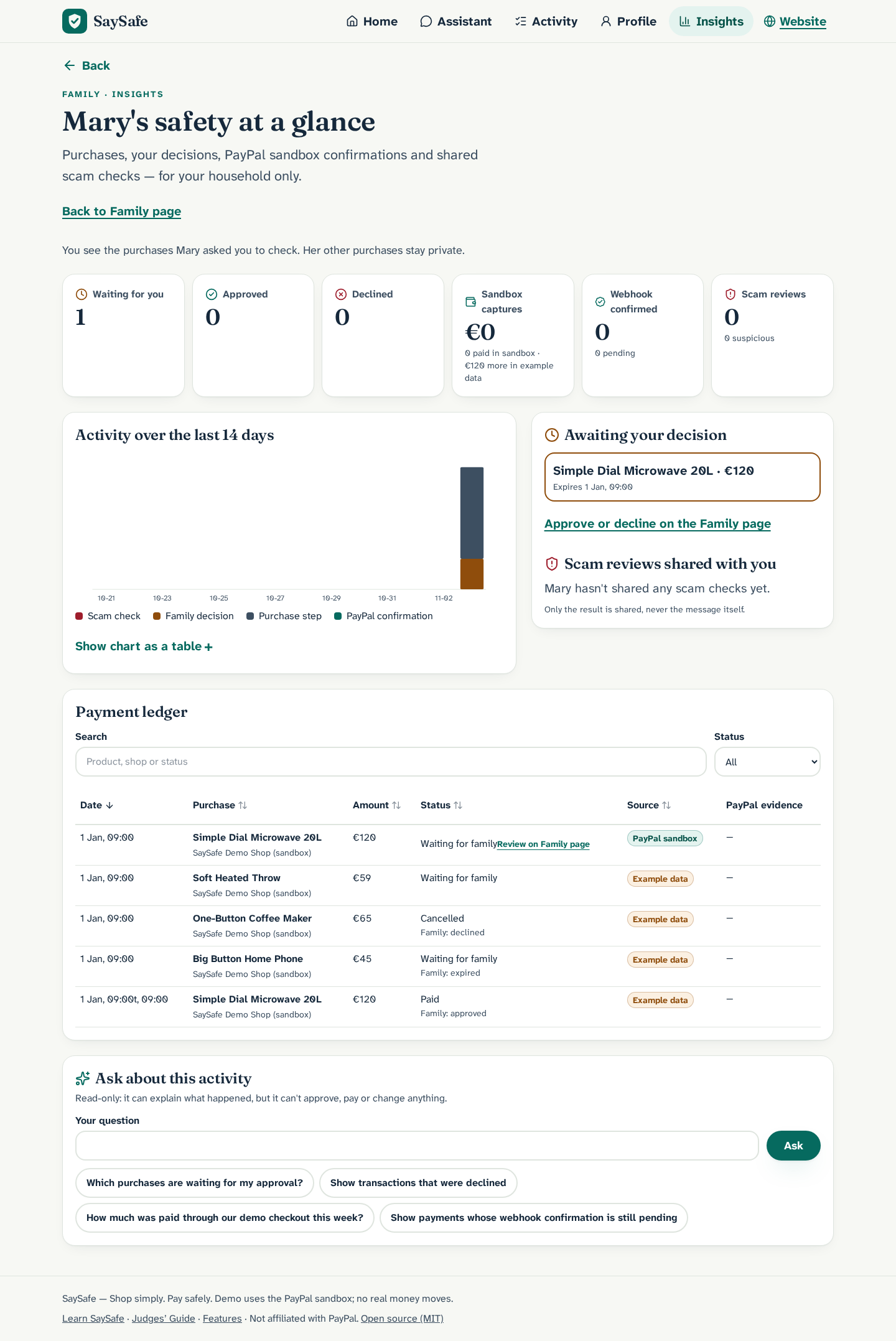
SaySafe provides accessible Activity and Insights pages for reviewing available purchases, payment statuses, subscriptions, safety checks and possible duplicate payments.
It clearly separates real Sandbox payment records from sample data.
Mary and Alex have separate, permission-controlled views.
How We Built It
We built SaySafe as a full-stack web application with a React and TypeScript frontend, a Node.js and Express backend, and Turso/libSQL for persistent storage.
AI: Groq-powered language models help interpret natural-language requests, explain potential scam warning signs and answer supported questions. Whisper enables speech transcription, while visual analysis supports submitted screenshots.
Shopping: Channel3 provides real product discovery, including prices and retailer links.
Payments: PayPal Sandbox APIs power checkout, capture verification, subscription demonstrations and payment webhooks.
Safety: Critical financial decisions remain under deterministic server-side control. AI can interpret and explain, but it cannot independently authorise or execute payments.
Family protection: Approval requests are restricted to the exact purchase, amount and authorised family helper, with expiry and single-use enforcement.
Hosting: Render hosts the application, while Turso provides persistent database storage.
We also developed automated tests covering payment states, permissions, duplicate-capture protection, webhooks, accessibility and major user journeys.
Challenges We Faced
Making AI helpful without giving it financial authority
One of our biggest challenges was ensuring that AI could understand everyday language while preventing it from inventing payment information or authorising transactions.
We addressed this by separating AI interpretation from payment execution. The backend validates requests, applies permissions and verifies payment outcomes independently.
Preventing duplicate payments
Payment redirects, network failures and repeated confirmations can cause difficult edge cases.
We implemented idempotent payment capture, durable payment state and webhook verification so a repeated request does not automatically create another capture.
Protecting independence and privacy
We wanted family assistance without turning family members into unrestricted financial administrators.
Mary controls her spending threshold and sharing preferences. Alex can review eligible purchase requests without automatically gaining access to Mary's entire purchase history or conversations.
Separating shopping discovery from actual checkout
Channel3 returns real products from external retailers, but those retailers are not automatically connected to our PayPal Sandbox merchant account.
We therefore distinguish between real product discovery and the SaySafe Demo Shop checkout, explaining exactly where each purchase takes place.
Building an accessible experience
We focused on readable typography, straightforward navigation, voice input, calm explanations and clear action buttons.
We also recognise that automated accessibility checks are not a replacement for real-world testing with older adults.
What We Learned
Building SaySafe taught us that useful financial AI is not just about generating convincing answers.
It must know the limits of its knowledge.
A system should not invent account balances, mistake a sample record for a real transaction or confuse family approval with actual payment authorisation.
We also learned that meaningful AI applications can combine flexible natural-language understanding with deterministic financial controls.
Most importantly, we discovered that payment confidence comes from the complete experience: understanding a request, recognising uncertainty, involving the right people and confirming what actually happened.
What's Next
SaySafe is currently a working PayPal Sandbox demonstration.
Our next priorities are real-device accessibility testing, feedback from older adults and caregivers, improved multilingual support, richer merchant verification and broader supported financial integrations.
Longer term, we want SaySafe to become a trusted shopping and payment companion that helps people remain independent without facing unfamiliar financial decisions alone.
Try SaySafe
Live application: https://saysafe.onrender.com
GitHub: https://github.com/laxmanprasadsomaraju/SaySafe
Judges' walkthrough: https://saysafe.onrender.com/judges
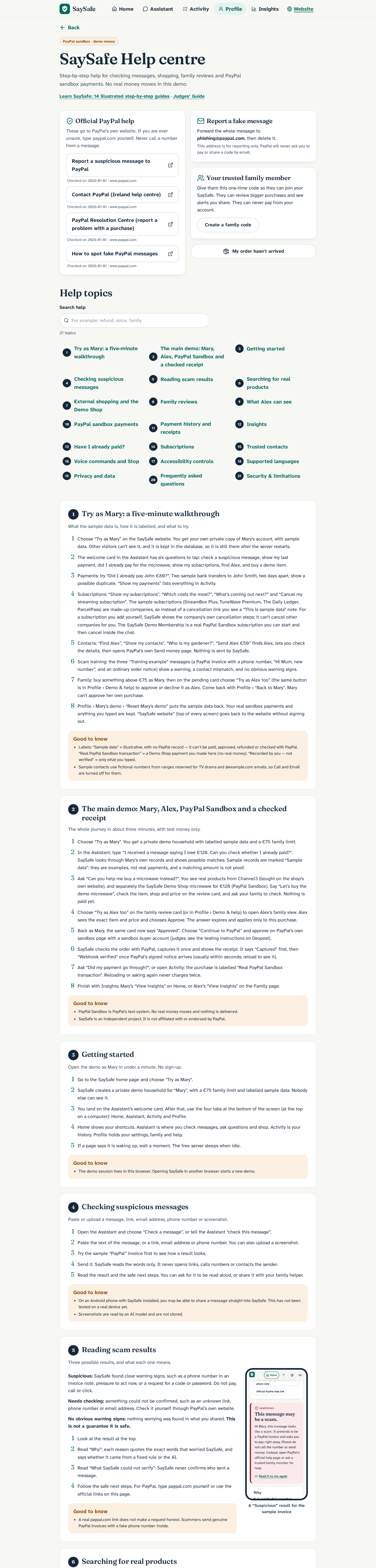
Help centre: https://saysafe.onrender.com/learn
SaySafe is an independent hackathon project using PayPal Sandbox test transactions. It is not affiliated with or endorsed by PayPal.
Built With
- ai
- channel3
- express.js
- groq
- libsql
- node.js
- paypal
- paypal-rest-api
- paypal-sandbox
- paypal-webhooks
- playwright
- react
- render
- tailwind-css
- turso
- typescript
- vite
- whisper
- zod
