-
-
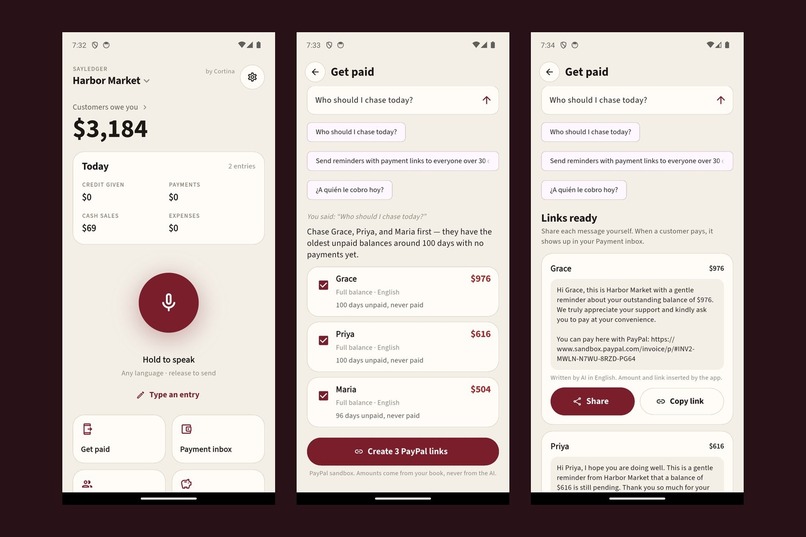
AI agent plans who to chase, then creates PayPal payment links for the exact amount owed
-
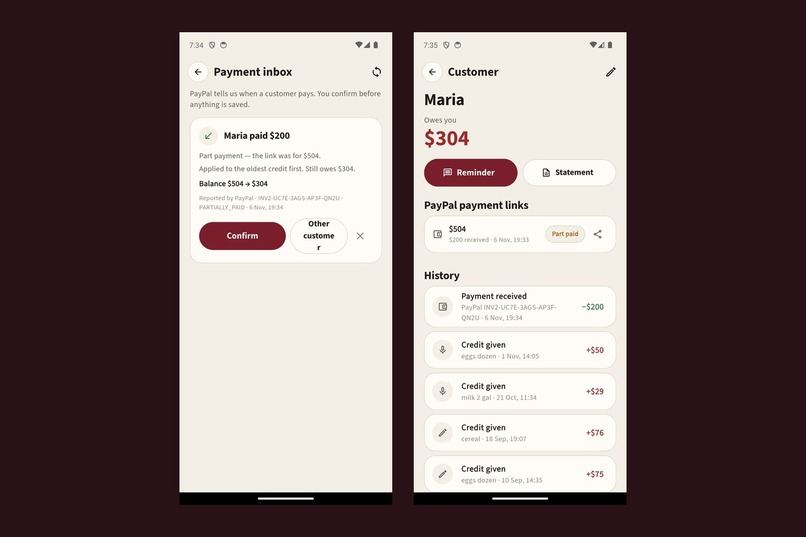
Payment inbox: Maria paid $200, still owes $304. One tap to confirm. Link history per customer.
-
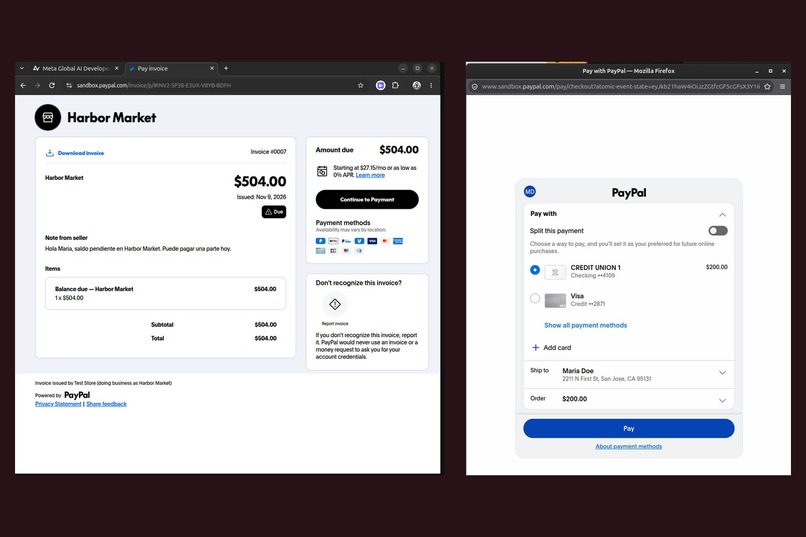
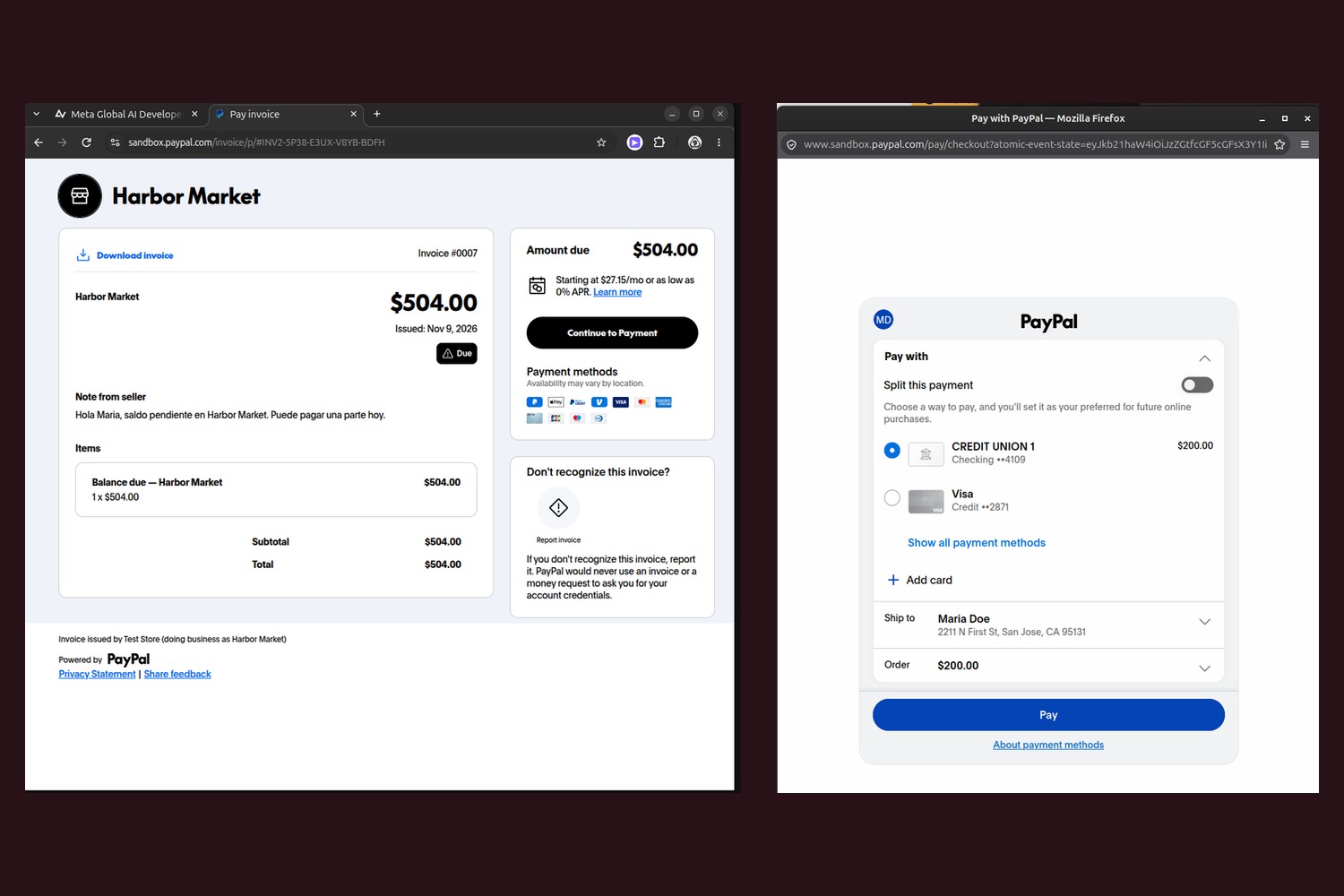
Customer side: PayPal sandbox invoice for $504, paid $200 (partial payment)
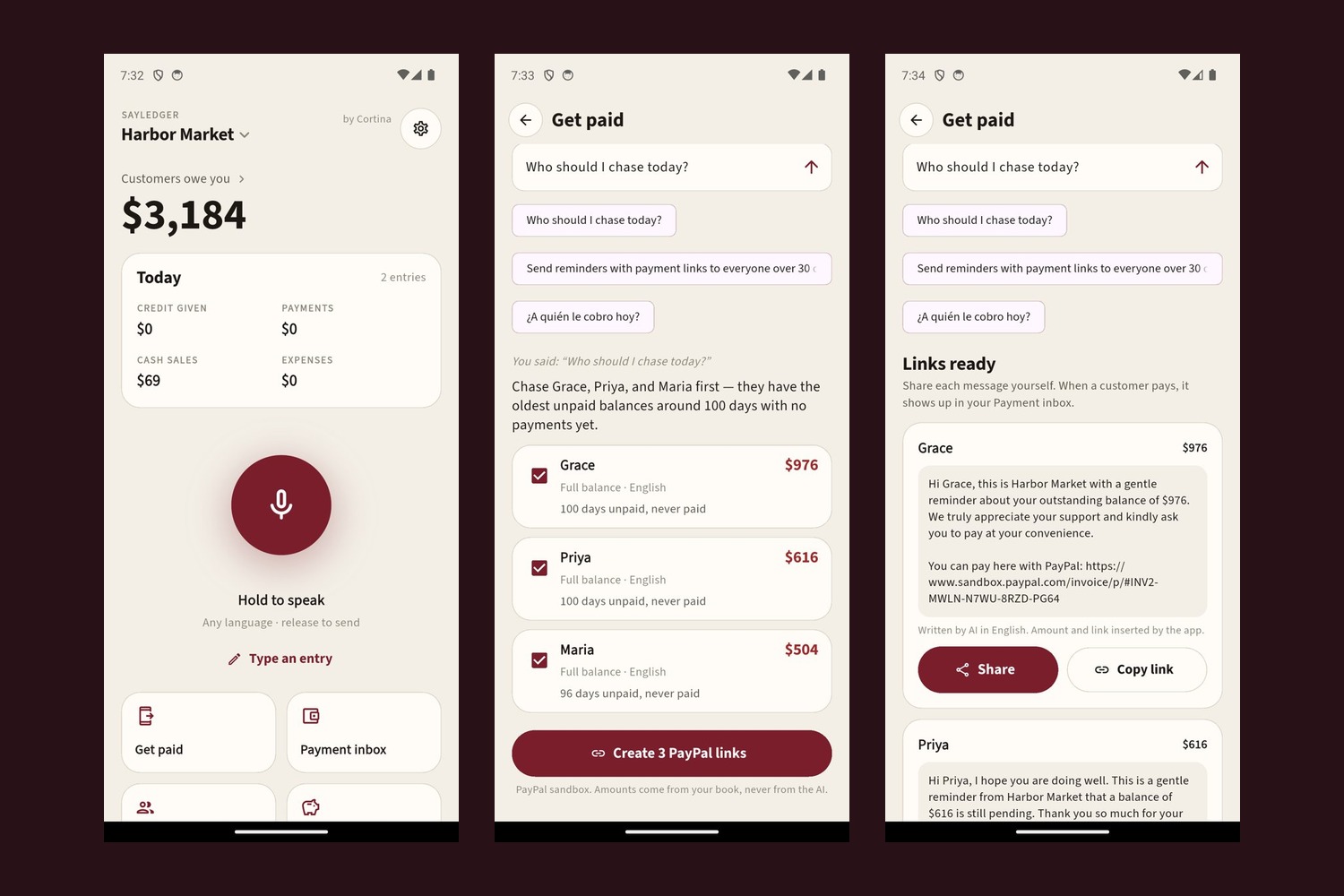
Around 150,000 corner stores, bodegas, delis and food trucks in the US — and millions of small shops worldwide — still run customer tabs in a paper notebook. We had already built SayLedger, a voice credit book: say "Maria took $40 of groceries on credit" and it's in the book. But writing the credit down is only half the job. The hard part is getting paid: noticing who's overdue, asking politely, and remembering to cross it off when the money arrives somewhere else.
What it does
- "Who should I chase today?" (voice or text, English or Spanish). An AI agent reads the credit book and proposes reminder cards: customer, amount owed, language, and why.
- One tap → PayPal payment links. Each ticked card becomes a PayPal invoice for the exact balance (or a smaller amount the shopkeeper chooses), with a payer link inside a friendly AI-written message the shopkeeper shares on WhatsApp or SMS.
- The customer pays on PayPal — in full or in part. No app needed.
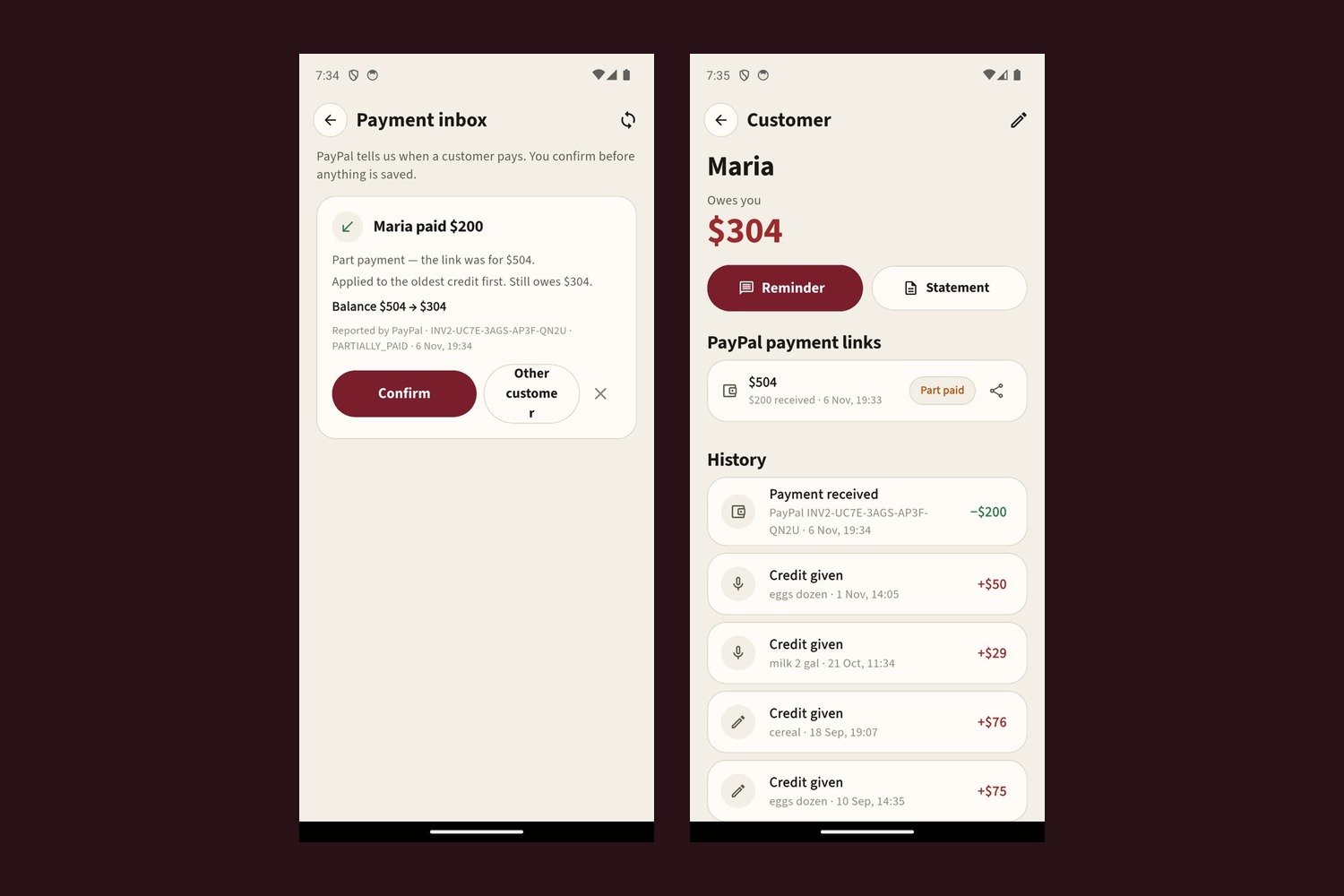
- Payment inbox. PayPal's webhook arrives, we verify it and re-fetch the invoice, and a card appears: "Maria paid $200 — still owes $304." One tap on Confirm and the book is up to date (oldest credit cleared first). Refunds, cancelled links, over-payments (kept as advance) and "wrong customer" are handled.
- One live link per customer. A new link cancels the old unpaid one; a part-paid link is reused for the remainder.
How we built it
- PayPal Invoicing v2 (sandbox): create → send (
send_to_recipient: false) → payer-view link; get; cancel; record payment (cash at the counter). Partial payments enabled. - PayPal Webhooks:
INVOICING.INVOICE.PAID / REFUNDED / CANCELLED, signature checked withverify-webhook-signatureon the raw body; duplicate and unverified events are ignored. A Check PayPal now sync is the fallback. - AI: a Meta
muse-spark-1.3tool-calling agent (max 6 steps) with read-only ledger tools;muse-voice-transcribe-1.0for voice commands; Muse Spark for reminder text with an{AMOUNT}placeholder that our code fills. - Backend: Python FastAPI + SQLite (one private book per install, integer minor units, all maths in
ledger.py). App: Flutter (Android). The phone never holds a PayPal or AI key. - 61 automated tests (fake PayPal + fake model, no network).
Tools used (AI and PayPal)
- Meta
muse-spark-1.3— the Collect agent. It calls read-only ledger tools (who owes, how much, how old, last reminder) in a loop of at most 6 steps and returns reminder cards. Our code checks every card against the ledger before it is shown. - Meta
muse-voice-transcribe-1.0— turns a spoken command ("Who should I chase today?", in English or Spanish) into text for the agent. - Meta
muse-spark-1.3(writing) — writes the friendly reminder message with an{AMOUNT}placeholder; our code puts in the amount and the PayPal link. - PayPal Invoicing v2 (sandbox) — creates the payment link, takes partial payments, and records cash payments. PayPal Webhooks + verify-webhook-signature — tell us when a customer pays.
- Code was written with AI coding assistance (Claude Code).
Trust by design
The AI never moves money and never writes to the book. Amounts always come from the ledger or from PayPal's re-fetched invoice — never from AI text or the webhook body. The shopkeeper ticks cards before links are created, shares each message themselves, and confirms each payment.
Challenges we ran into
- PayPal refuses to cancel a part-paid invoice (HTTP 422), which broke our "one live link per customer" rule. We now reuse the part-paid link when its remainder matches what's owed.
- Webhooks need a public HTTPS URL, so local development uses a sync fallback that runs the exact same reconciliation code.
- Keeping an LLM agent honest about money: every proposed card is validated (customer exists, owes money, amount from the book, max 5 cards, language from a fixed list); anything else is shown as "Skipped".
Accomplishments that we're proud of
The full loop works end to end in the PayPal sandbox: agent plan → three real invoice links → a $200 partial payment → inbox card → Confirm → balance $304 with ageing updated → the next reminder reuses the link for the remainder.
By the numbers (PayPal sandbox, Nov 4–10 2026):
- 61 backend tests pass (ledger maths, webhook verification, duplicate events, partial/over-payment, refunds).
- 4 real sandbox invoices created and checked against PayPal: full flow $504 → $200 part payment → $304 left.
- 5 live agent commands tested, including one in Spanish and one off-topic request the agent refused.
- The agent never writes an amount: every amount on a card is checked against the ledger before it is shown.
What we learned
Payments UX is mostly about reconciliation and trust, not the "pay" button. Small details — part payments, refunds, the wrong customer paying — decide whether a shopkeeper can rely on it.
What's next
Live PayPal (after review), QR code at the counter, multi-currency books, and a weekly "who to chase" nudge.
What is new for this hackathon (honesty note)
SayLedger (the voice credit book) was built Oct 26 – Nov 4 2026 for a separate Meta hackathon.
Everything PayPal and agentic — Invoicing, webhooks, Payment inbox, Collect agent, Get paid screen,
link history — was built during this hackathon (Nov 4 – Nov 12 2026). PayPal sandbox only; all demo
names and amounts are invented. Code was written with AI coding assistance.
The backend is hosted (https://cortinainfinity.com/sayledger-collect) and the PayPal webhook is
registered there. The demo video is a real screen recording of the app on an Android emulator against
that hosted backend, sped up: a person paid $150 of Maria's $504 as a sandbox buyer (PayPal shows
PARTIALLY_PAID, $354 due), PayPal's verified INVOICING.INVOICE.PAID webhook put the card in the
Payment inbox, and the shopkeeper confirmed it. The sandbox webhook took about 3 minutes to arrive;
that wait is cut from the video. Narration is an AI voice (Kokoro).
