-
-

Sayangi Logo
-
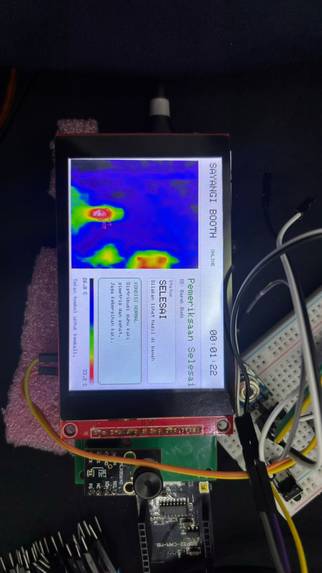
Prototype On Progress
-
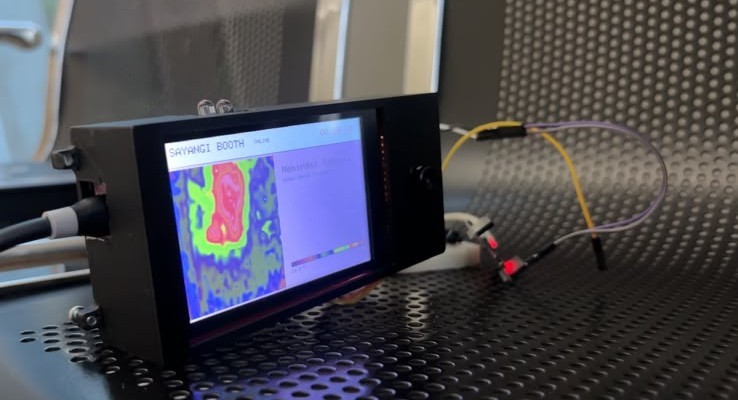
Final Prototype
-
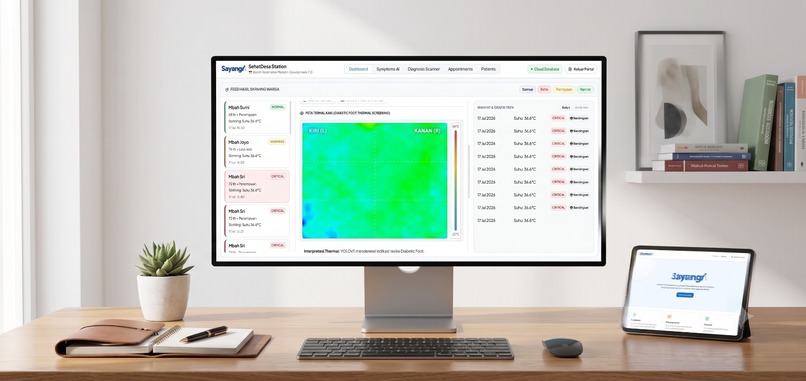
Web Dashboard Mockup

Sayangi - Diabetic Foot Screening for Village Elders
"Sayangi" is Indonesian for "care for them." A thermal foot-screening station that catches diabetic foot problems early — before they become wounds or amputations.
In a remote Indonesian village, an elder with diabetes has been walking on a slowly forming wound for weeks — diabetic nerve damage means he simply can't feel it, and the nearest clinic is 10–20 km away over difficult roads. By the time anyone notices, it's often too late to save the limb: a quarter of people with diabetes will develop a foot ulcer in their lifetime, and 85% of diabetes-related amputations start with exactly that kind of unnoticed wound. Sayangi brings the fix to him instead. It's a screening station for the village hall (Balai Desa), run by a local health cadre, that gives him a 2-minute, non-contact thermal scan of his feet — using the same temperature-asymmetry method proven in clinical trials to catch inflammation or poor circulation weeks before a wound ever appears. An AI assistant turns the scan into a clear summary for the nearest health worker, so a problem that used to go unnoticed for months gets caught, and referred, while there's still a leg to save.
🌱 Inspiration
Picture an elderly farmer in a village hours from the nearest town. He has diabetes, like millions of others in Indonesia. He doesn't feel the small callus forming on his heel — diabetic nerve damage numbed that sensation years ago. He doesn't go to the clinic to check, because the clinic is a tiring, half-day trip he can't justify for a foot that "feels fine." Weeks later, the callus is an open wound. Weeks after that, it's infected. By the time his family gets him to a hospital, amputation is the only option left.
This isn't a rare story. Indonesia carries one of the world's largest diabetes burdens — the IDF Diabetes Atlas ranks it 5th globally by number of adults living with the disease, with prevalence climbing from 5.7% in 2007 to 8.5% by 2018.[^1] A quarter of people with diabetes will develop a foot ulcer like this in their lifetime, and roughly 85% of diabetes-related lower-limb amputations are preceded by exactly that kind of ulcer. At Indonesia's own national referral hospital, about a third of diabetic inpatients are admitted for foot complications, and post-amputation survival is grim: over a third of patients die within three years.[^2]
Geography is what turns a preventable wound into an amputation. In archipelagic provinces like Maluku, villagers travel an average of 9–18 km just to reach a Puskesmas (community health center), and much further — 56–73 km — to a hospital; two-thirds of surveyed Puskesmas in the region have no physician on staff at all.[^3] The tragedy is that the fix already exists in medicine: temperature-asymmetry monitoring has been shown in randomized trials to catch pre-ulcer inflammation over a month before it's visible to the eye.[^4] It just lives in specialty clinics in big cities — nowhere near the people who need it most.
We kept coming back to that farmer, and the thought that he could have kept his leg if someone had simply looked at his feet with the right tool, at the right time, close to home. We named the project Sayangi — Indonesian for "care for them" — because that's the whole point: putting a proven piece of preventive medicine where the people who need it actually live.
💡 What It Does
Sayangi is a communal, cadre-assisted screening station designed to sit in the village hall — so the farmer from our story doesn't need to travel anywhere to get his feet checked; the check comes to him once a month. It doesn't replace a helper — instead, it lets a single trained cadre run a foot screening that would otherwise require a hospital thermography lab. Guided by large visuals and voice prompts (which lighten the cadre's load and help even illiterate patients follow along), the check itself takes about two minutes:
The elder lies down with bare soles facing a thermal camera — non-weight-bearing and non-contact, following the validated clinical protocol, because standing or touching a surface would distort the reading. The camera maps the temperature across both soles to detect the two early warning signs of diabetic foot complications:
- Hotspots (warmer areas) — inflammation or a pre-ulcer forming.
- Cold spots (cooler areas) — poor circulation / ischemia.
In healthy feet, temperature variation between regions is typically minimal — under 1 °C.[^5] Clinical research established that a difference of more than 2.2 °C between matching spots on the left and right foot is a reliable early-warning marker; remote monitoring studies using this threshold have predicted ulcers an average of ~35–37 days before they became clinically visible.[^4] Comparing a foot against its own contralateral partner works well because it cancels out confounders like room temperature, circadian rhythm, and systemic fever — both feet experience the same environment, so a real difference points to a real problem.
Sayangi analyzes each scan with two complementary layers, not just one:
| Layer | Method | Role |
|---|---|---|
| Rule-based clinical logic | Left-vs-right zone comparison + per-zone deviation | Fast, transparent, directly traceable to the clinical literature above |
| ML classifier | YOLOv11, trained on our own curated dataset of 1,000+ diabetic foot thermal images | Catches DFU-risk patterns a fixed threshold might miss |
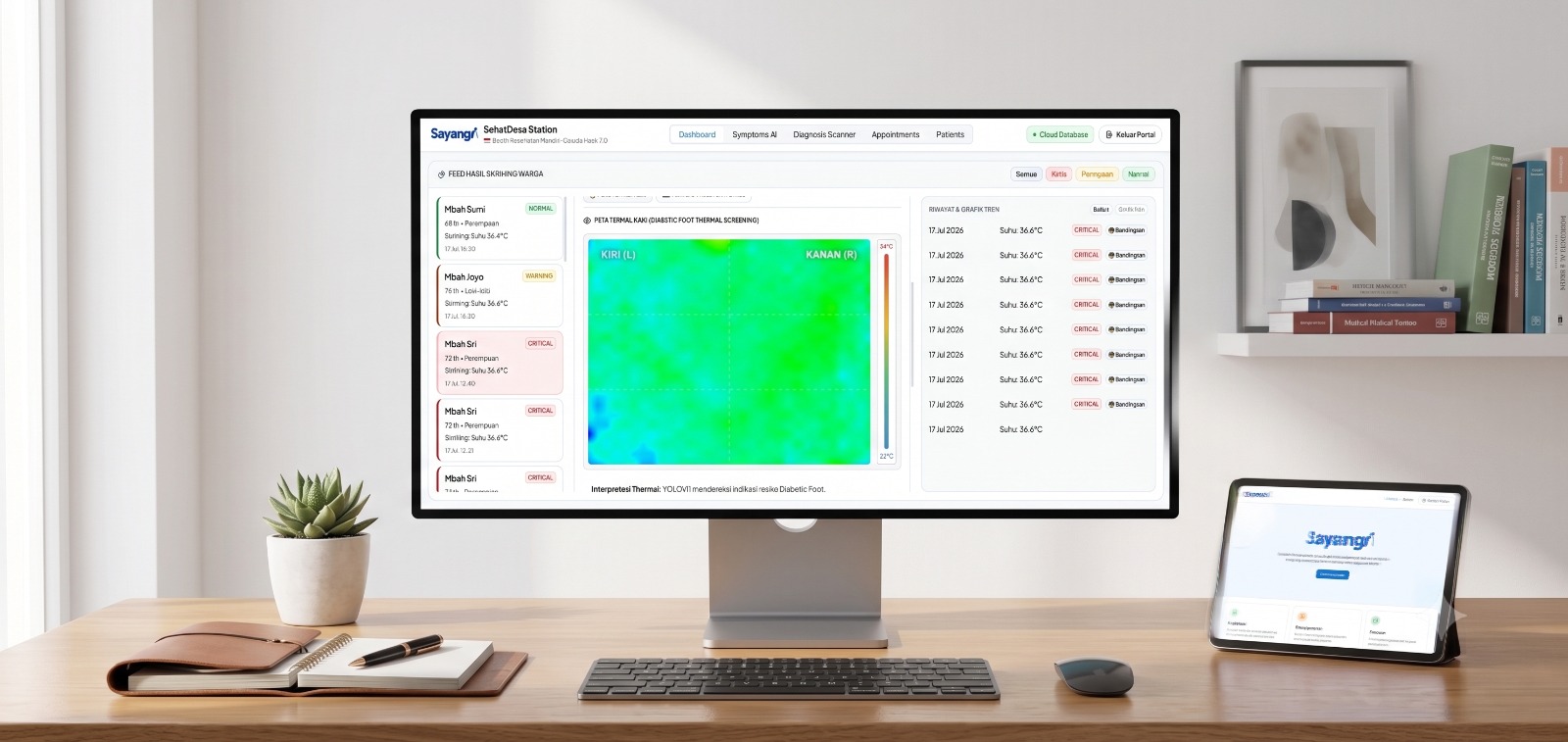
Google's Gemini isn't the detector — it's the translator. Once both layers produce a result, Gemini turns the combined finding into a clear clinical summary and sends it to a dashboard monitored by the nearest health worker (village midwife or Puskesmas staff). Risky results are flagged as priority. The health worker reviews the case and alerts the village for follow-up — keeping a trained human in the loop before any action is taken.
Important: Sayangi doesn't diagnose diabetes — that needs a blood glucose test. It screens for the foot complications of diabetes, which are the most damaging and the most preventable, so patients get referred before a wound, infection, or amputation.
🛠️ How We Built It
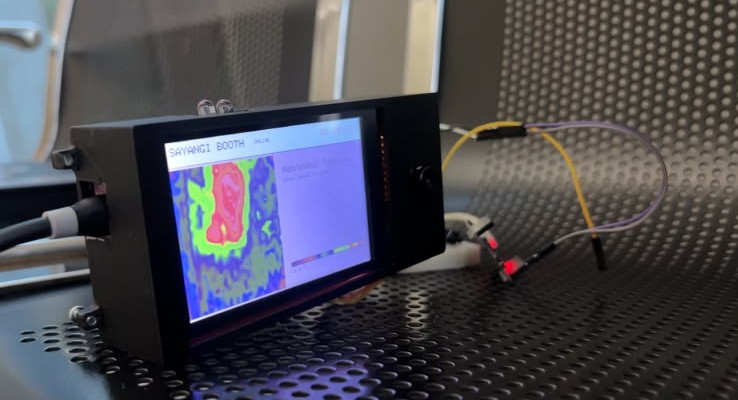
Sayangi runs on two ESP32 nodes (plus a spare) coordinated by a laptop acting as an edge gateway:
| Component | Handles | Sends to laptop |
|---|---|---|
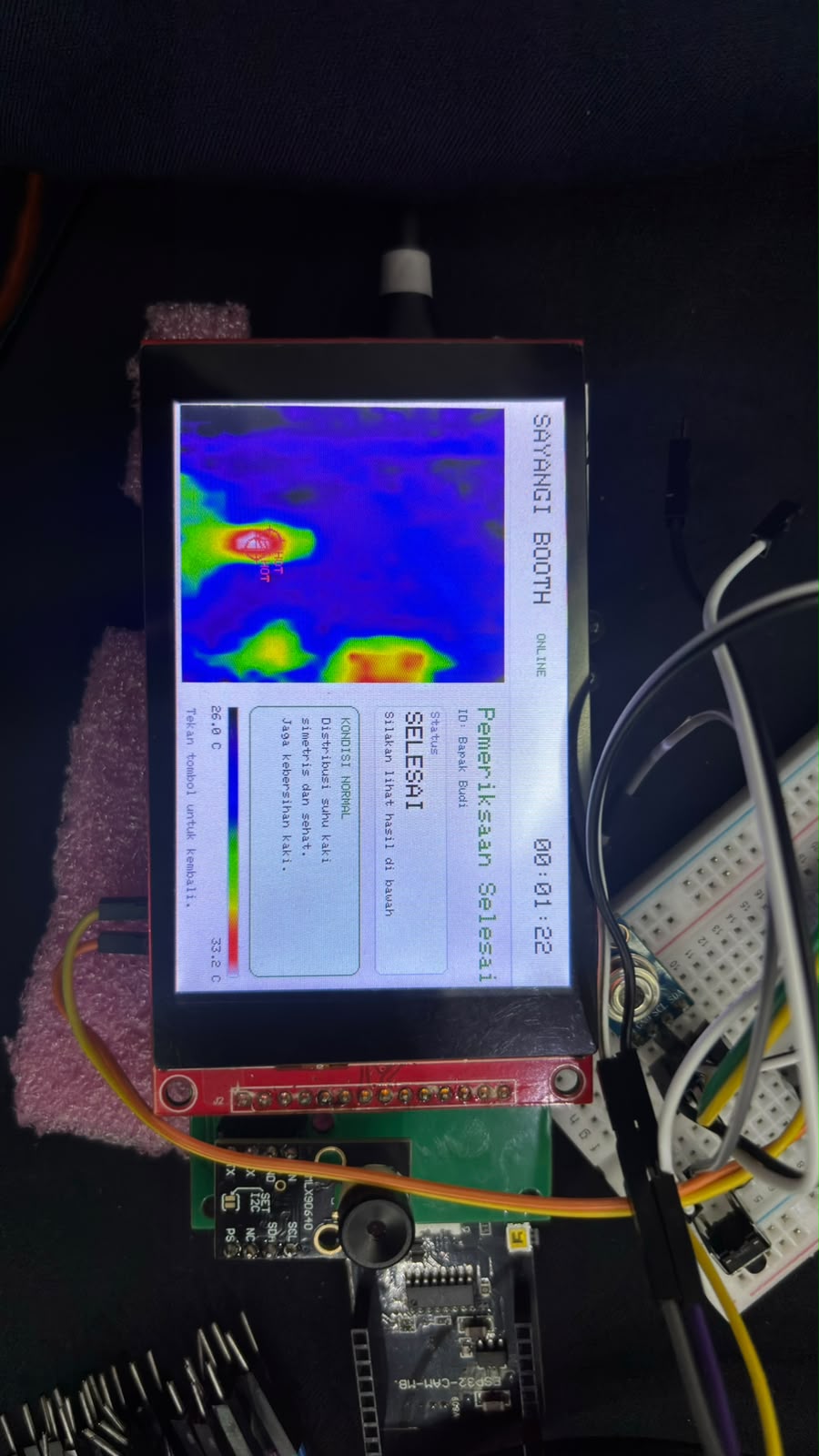
| Node 1 (ESP32) | MLX90640 thermal camera, TFT display, physical buttons + LEDs | Raw thermal frames |
| Node 2 (ESP32-CAM) | QR patient ID scan, verifies both feet are correctly framed | Confirmation + captured frame |
| Laptop hub (Python) | State machine, rule-based analysis, YOLOv11 inference, Gemini + Roboflow calls, dashboard | — (this is the brain) |
The laptop hub receives thermal frames over WiFi, runs the check flow, and processes each scan two ways — rule-based zone/asymmetry analysis, and our YOLOv11 classifier — before calling Gemini to summarize both results and hosting the health-worker dashboard.
For accessibility, we deliberately avoided a touchscreen. Elders often struggle with them — mis-taps, dry skin that won't register, confusion over where to touch. Instead, Sayangi uses big physical buttons, large on-screen icons, spoken guidance, and auto-advancing steps that move forward on their own once the camera confirms the feet are correctly positioned. A cadre handles the admin side (selecting the patient, starting the flow) on the laptop, while these cues walk the elder through the scan.
🧗 Challenges We Ran Into
- Low-resolution thermal data. A 32×24 array is coarse, so we placed the camera closer than the clinical 1 m, averaged multiple frames, and focused on a few large foot zones (heel, mid-sole, forefoot) — comparing left-vs-right plus each zone against the foot's own average. A simple, clinically defensible approach without heavy machine learning for the rule-based layer.
- Building a dataset from scratch. With no patient thermograms of our own on day one, we compiled and curated a working dataset of 1,000+ diabetic foot thermal images to train our YOLOv11 model on — enough to get a real, trained detector running within the hackathon window, though not yet validated on our own MLX90640 hardware or an Indonesian patient population. We say so honestly in our roadmap.
- Segmenting the feet reliably. Separating warm feet from the background took careful thresholding and a controlled backdrop — and it's the step everything else depends on, so we built it first.
- Coordinating the hardware without a Raspberry Pi. With only ESP32s and their limited memory, we made the laptop the single "brain" and kept the ESP32s as simple sensor-and-display nodes — proving the WiFi link worked first, before building anything on top of it.
- Getting the foot protocol right. Our first design had the elder stand on a footpad — until we learned that's clinically wrong: standing compresses the foot's blood vessels and surface contact transfers heat, both distorting the reading. We switched to the validated non-weight-bearing method (patient reclined, soles facing the camera, no contact), which reshaped the whole enclosure.
- Designing for people who can't read. This pushed audio guidance from a "nice-to-have" to a core feature, and shaped every screen around icons instead of text.
🏆 Accomplishments We're Proud Of
- An end-to-end flow that takes an elder from "lie down" to "health worker notified" in about two minutes — the kind of check that, done routinely, could have changed the outcome for our farmer.
- A thermal foot-screening method grounded in real clinical research, combining an interpretable rule-based check with a YOLOv11 model we trained on our own 1,000+ image dataset — not just a generic sensor demo, and not a black box either.
- An interface genuinely usable by an elderly, possibly illiterate person, with zero typing required.
- A design that respects the existing healthcare chain: it supports health workers instead of replacing their judgment.
📚 What We Learned
- The hardest part of health tech isn't the sensors — it's access, trust, and human context. A communal kiosk maintained by local cadres solves adoption problems that a fancier personal gadget never could.
- Understanding the medical why matters. Digging into the clinical literature on thermal foot monitoring — why 2.2 °C is the threshold, why comparing left vs. right cancels out confounders, why hot and cold spots mean different things — changed how we built the detection logic and how we'd explain it to a clinician.
- Real-world numbers reshaped our framing. Once we found data on how far villagers already travel for basic care, and how much of that gap comes from a shortage of health workers rather than a shortage of roads, it was clear Sayangi needed to work offline and lean on a cadre, not replace one.
- Constraints breed better design. Having no touchscreen and no Raspberry Pi forced choices (physical buttons, voice, a clear node/hub split) that ended up making the product simpler and more robust.
🚀 What's Next for Sayangi
- [ ] Longitudinal tracking — monitor each patient's foot readings over months to catch slow-developing complications before they surface.
- [ ] Higher-resolution thermal imaging with angiosome-based segmentation (dividing the foot by arterial-supply territory), plus continued expansion of our training dataset with real field data from Indonesian villages.
- [ ] More parameters — add vital signs (heart rate, SpO₂, blood pressure) and integrate a blood-glucose test for a fuller diabetes picture. The architecture is modular by design.
- [ ] A true edge deployment — replace the demo laptop with a low-cost mini-PC or direct cloud link, and integrate with the national referral system so flagged cases flow straight into follow-up care.
- [ ] A Puskesmas-level dashboard to monitor the health trends of an entire village at a glance.
[^1]: IDF Diabetes Atlas, 11th edition (2024); Indonesia Basic Health Research (Riskesdas) 2007/2013/2018 — global & Indonesia diabetes prevalence trend. [^2]: Diabetic foot ulcer clinical outcomes at Indonesia's national referral & tertiary hospitals (multiple PMC-indexed studies, 2019–2024). [^3]: "Spatial evaluation of healthcare accessibility across archipelagic communities of Maluku Province, Indonesia." PLOS Global Public Health. 2023. [^4]: Lavery LA, Higgins KR, Lanctot DR, et al. "Home monitoring of foot skin temperatures to prevent ulceration." Diabetes Care. 2004;27(11):2642-7; and "Preventing diabetic foot ulcer recurrence in high-risk patients: use of temperature monitoring as a self-assessment tool." Diabetes Care. 2007;30(1):14-20. [^5]: "Advances in Machine Learning-Aided Thermal Imaging for Early Detection of Diabetic Foot Ulcers: A Review." Biosensors (MDPI). 2024;14(12):614.
Built With
- arduino
- c++
- colab
- computer-vision
- css3
- esp32
- esp32cam
- firebase
- firebase-realtime-database
- gemini-api
- html5
- iot
- javascript
- machine-learning
- opencv
- python
- thermal
- thermal-camera
- yolo


Log in or sign up for Devpost to join the conversation.