-
-
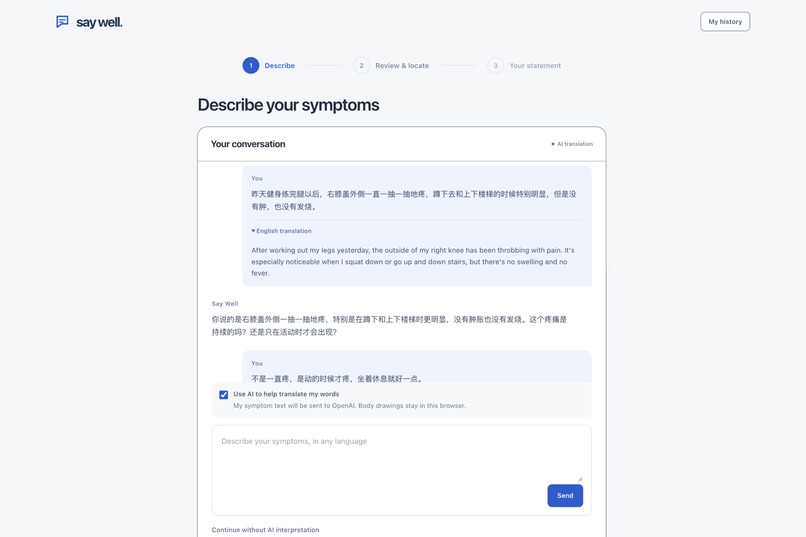
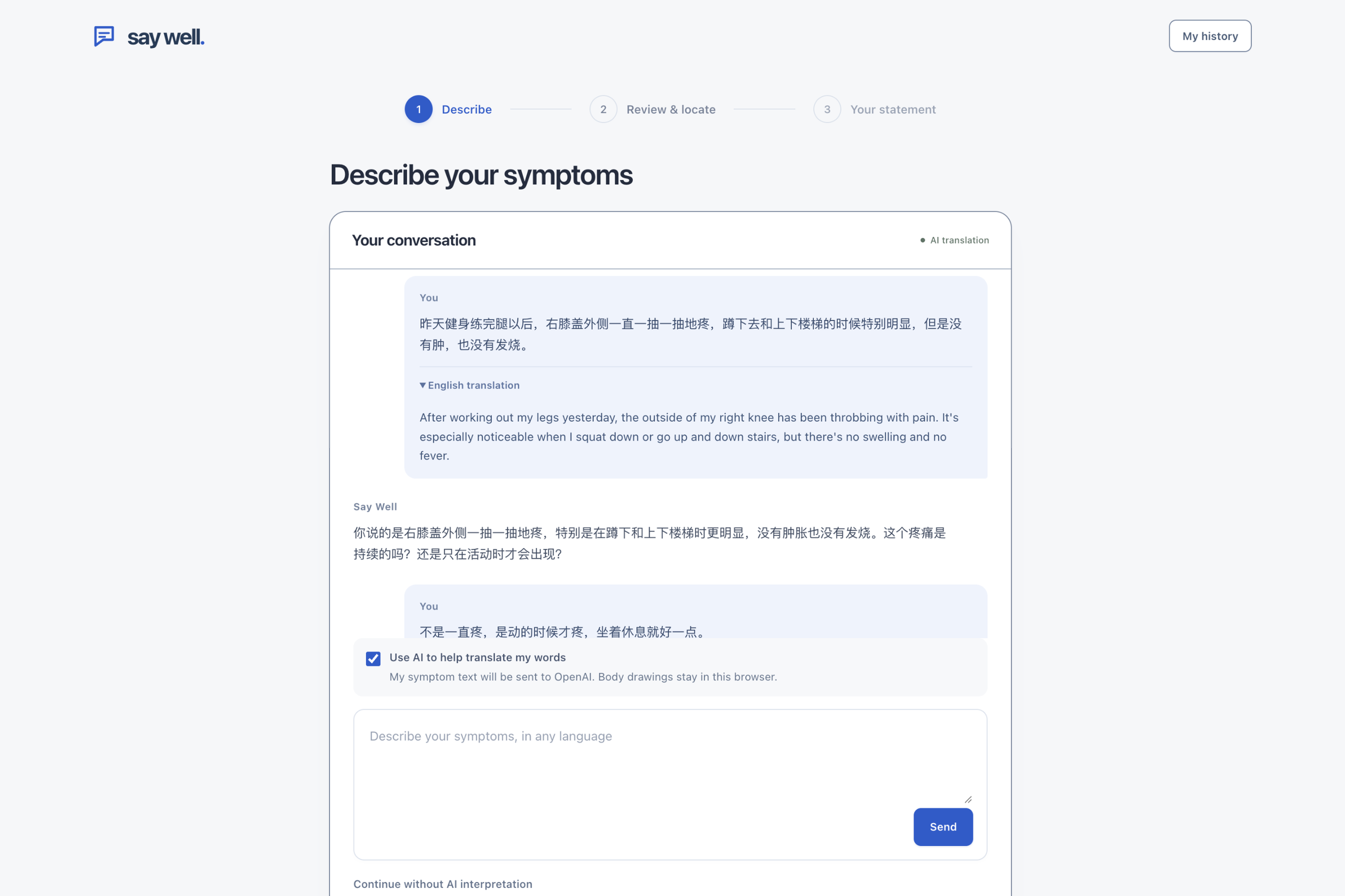
Describe in any language: AI asks one follow-up at a time and shows a faithful English translation of every message.
-
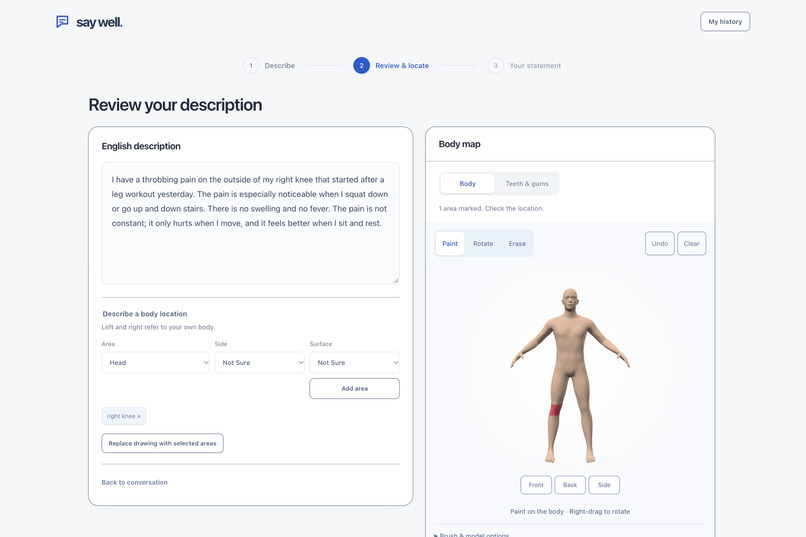
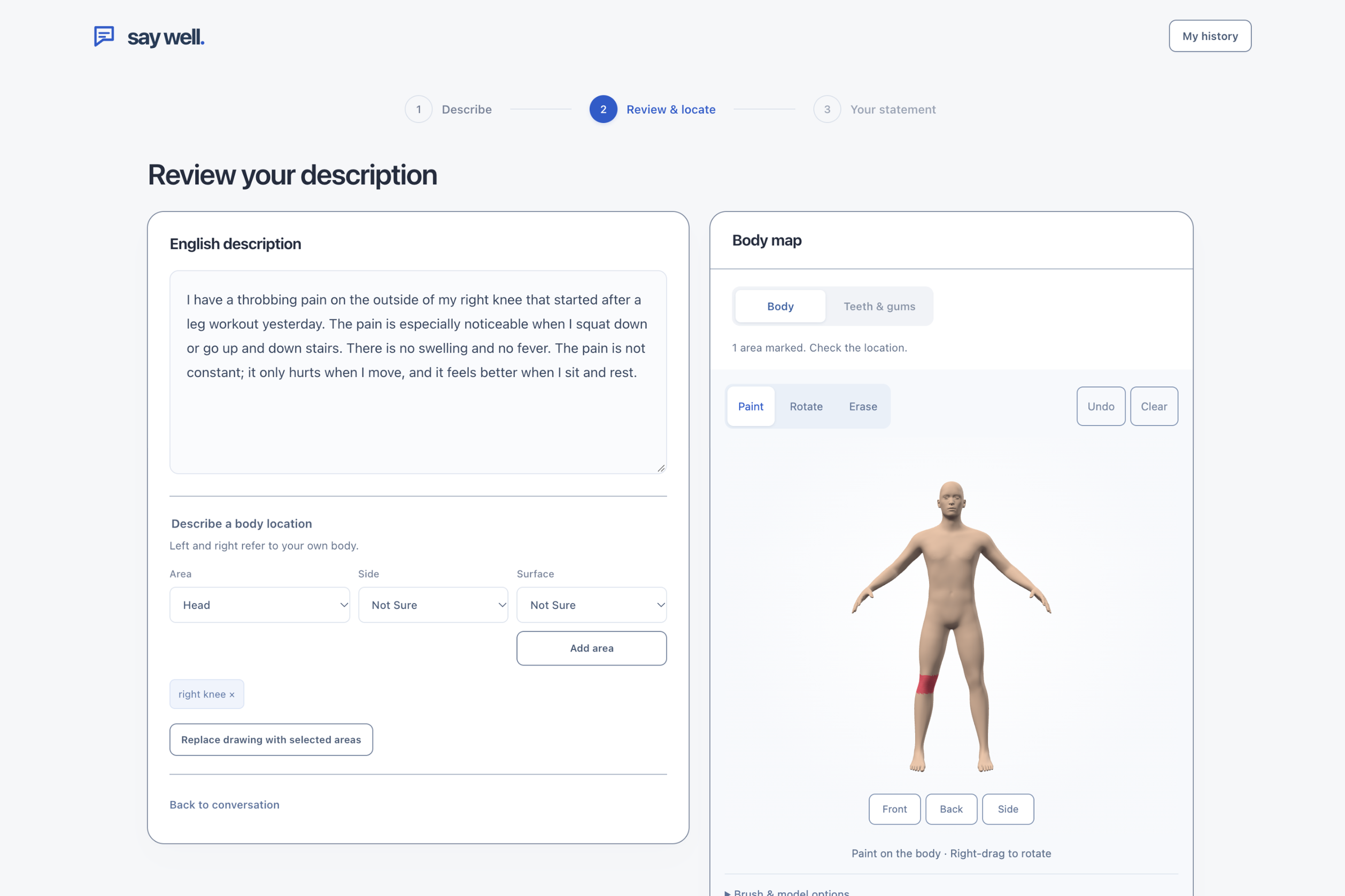
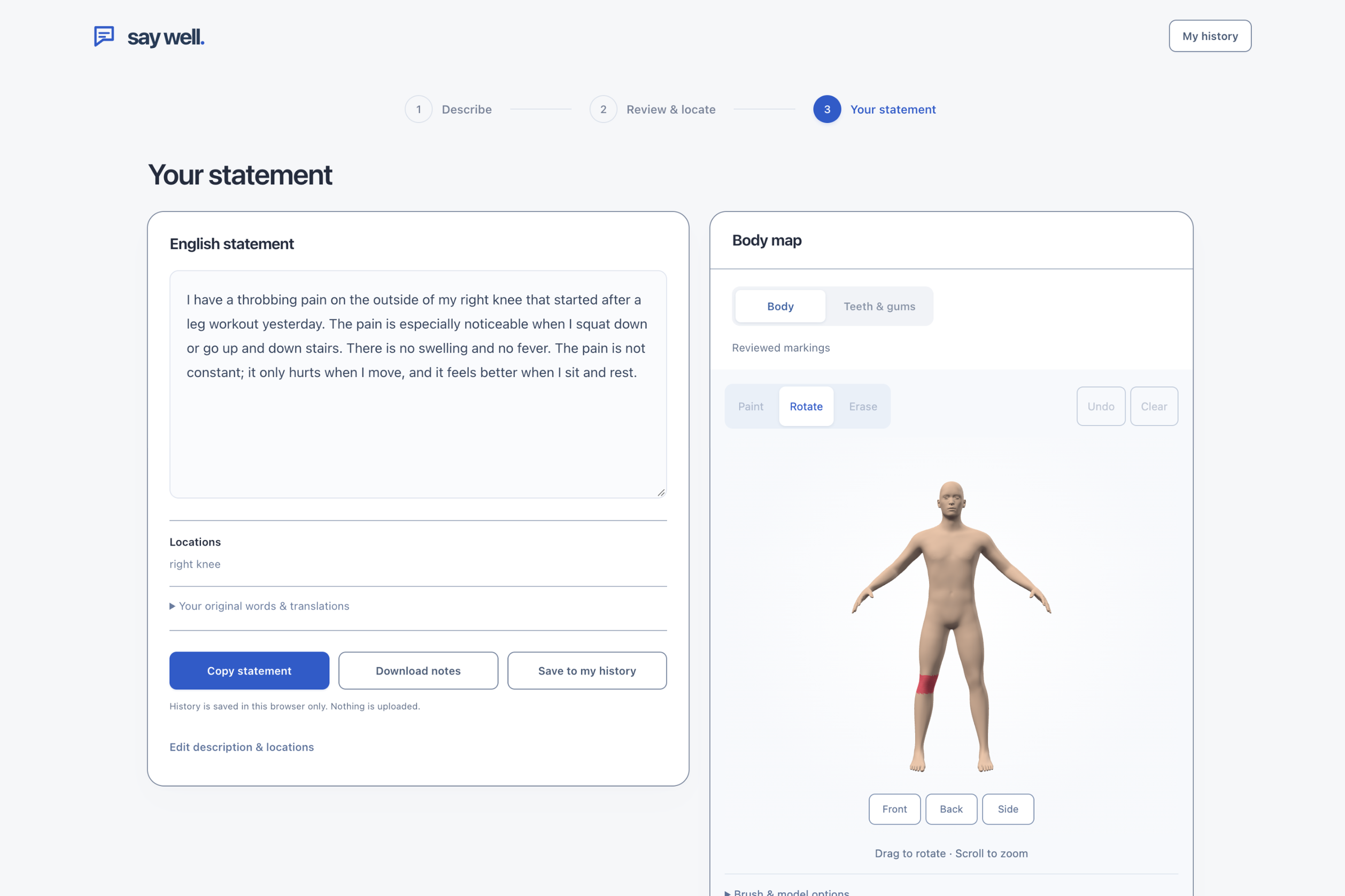
Review the complete English description; the location is marked automatically on the 3D body model and can be corrected.
-
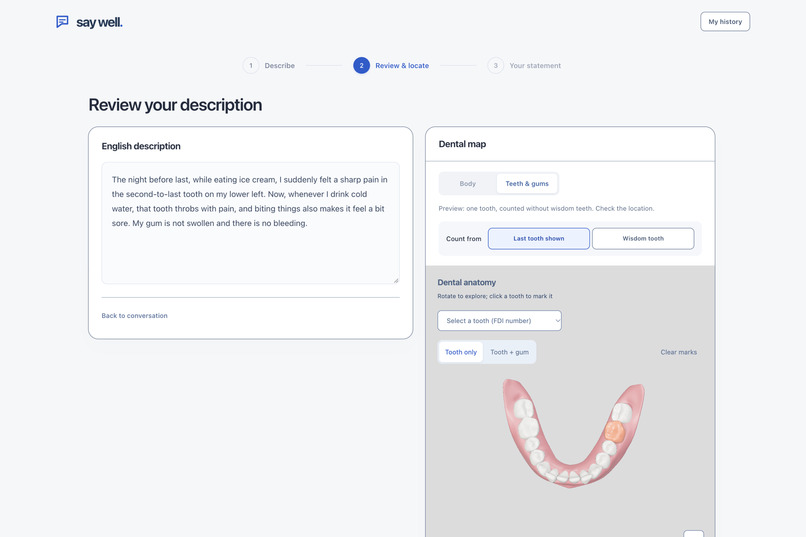
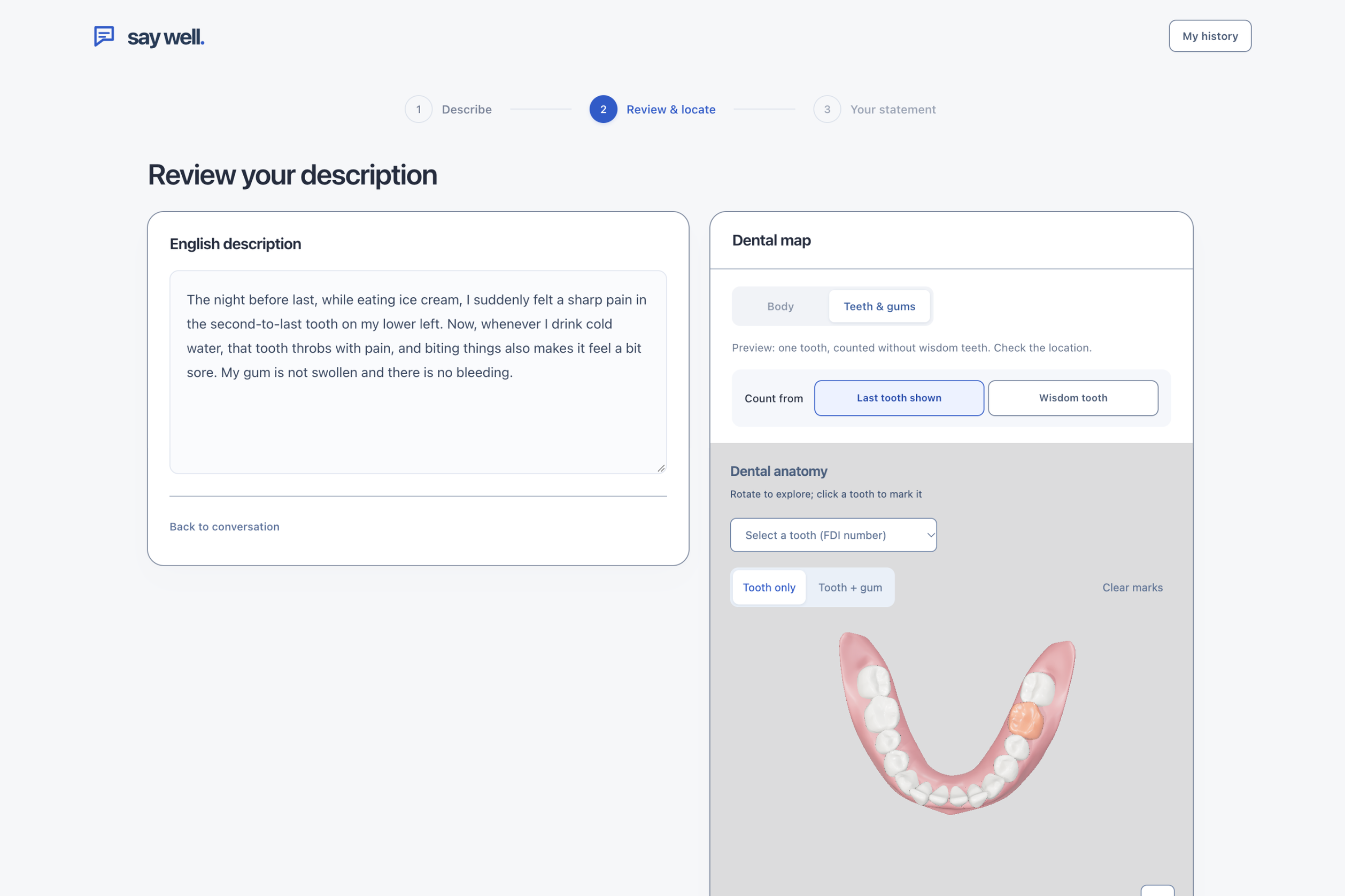
Toothaches go to a 3D dental model: “second-to-last tooth, lower left” is highlighted, and it asks how to count wisdom teeth.
-
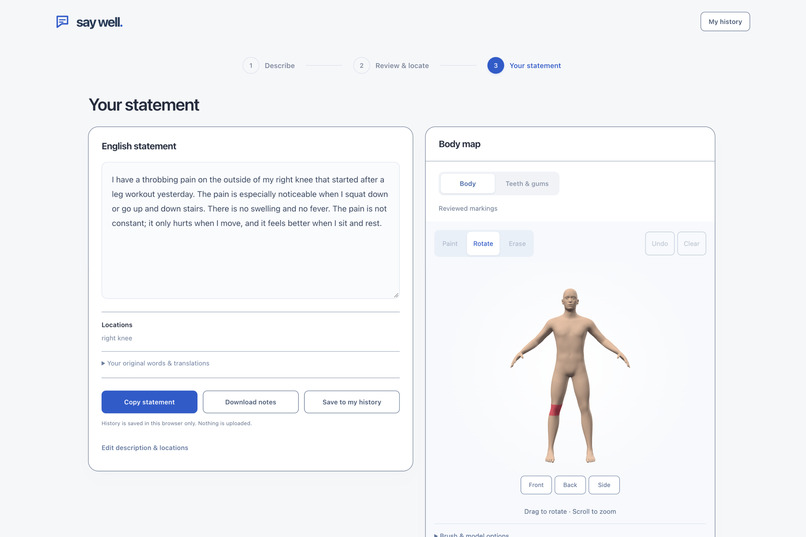
A first-person English statement to copy, download, or save to a private history on your own device.
-
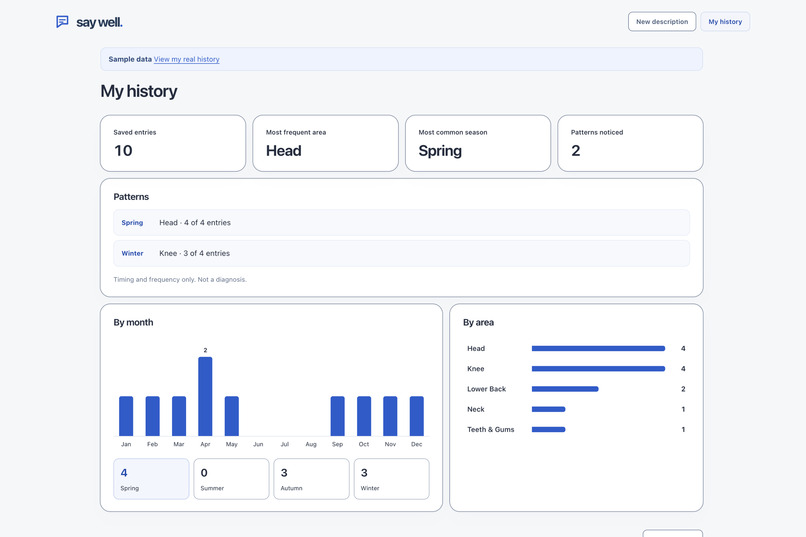
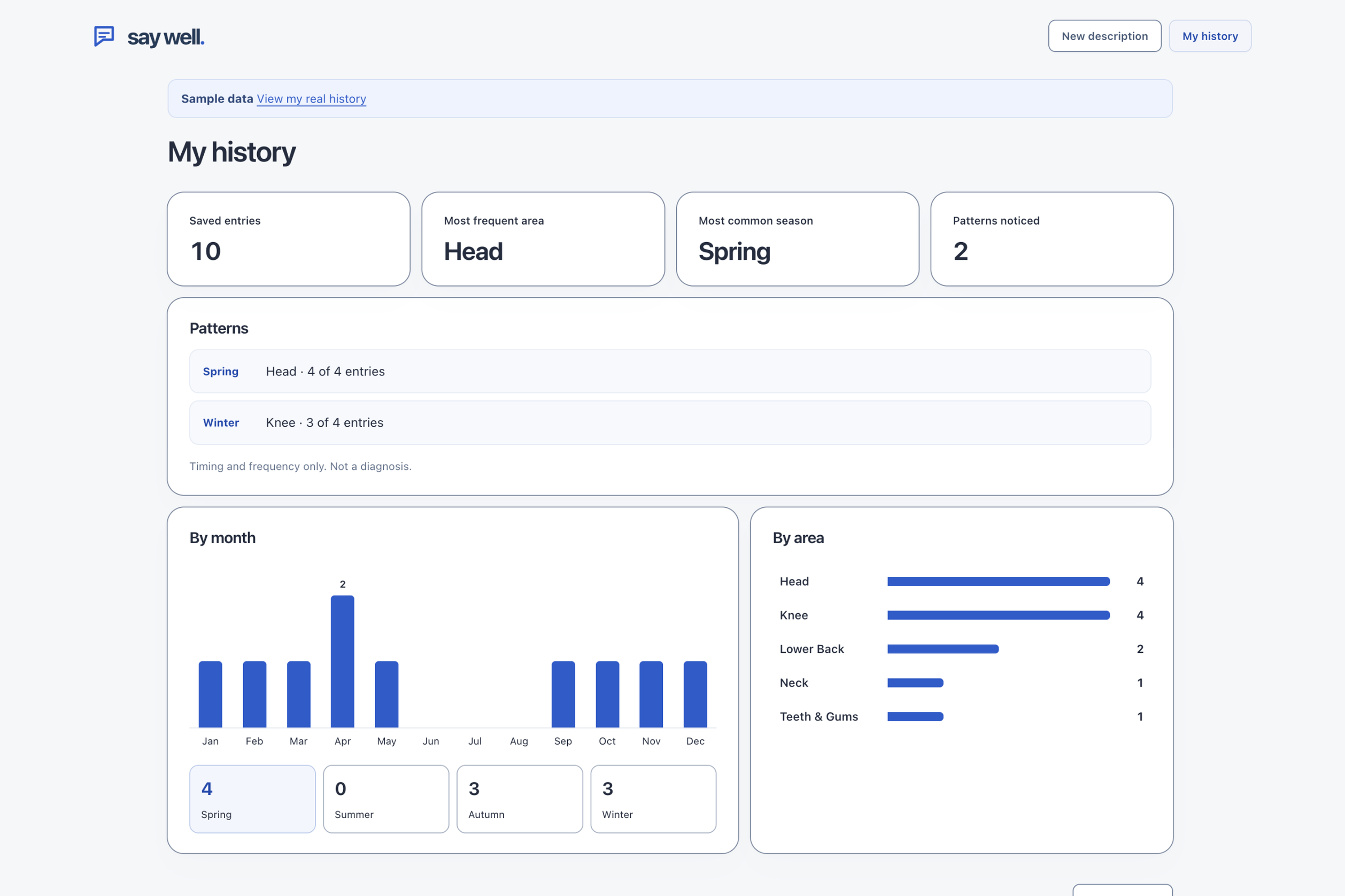
My history reveals patterns over time, e.g. headaches every spring and knee pain every winter (sample data).
Try it
- Live demo: say-well.replit.app
- Sample symptom history: say-well.replit.app/history.html?demo
- Code: github.com/NicoleeeL04/say-well
Inspiration
It started with a toothache. One of us sat in a dental chair, was asked "Which tooth hurts?", and could only point vaguely and say "somewhere back here." She knew more than that: it was the second-to-last tooth on the lower left, it had started three days earlier, cold water made it worse, and the gum wasn't swollen. But she couldn't put it into English, and you can't point at a tooth you can't see.
That moment is common for international students at USC. Translating a sentence isn't the hard part. The hard part is describing a sensation completely, showing exactly where it is, and being confident that what you're about to say is what you actually mean. When the symptom is pain, the language barrier gets bigger, not smaller.
What it does
Say Well helps students prepare a symptom description they have reviewed themselves and can share with a clinician.
- Describe freely, in any language. Students type the way they'd talk. Say Well replies in their language with one follow-up at a time, covering what it feels like, where, when it started and what makes it worse, and shows a faithful English translation of every message. "I don't know" and "skip" are always acceptable answers.
- Locate it, if that helps. Locations from the conversation are marked on an interactive 3D body model, and toothaches go to a separate 3D dental model. It understands phrases like "second-to-last tooth" and asks whether the student is counting wisdom teeth instead of guessing. Students can paint, erase, rotate or select an exact tooth. For symptoms that are hard to place, like fatigue, they can leave the model unmarked.
- Confirm, then share. Students review and edit the English account and the markings before generating a first-person patient statement in plain language rather than medical jargon. They can copy it or download notes that include their original words and an image of the model.
- My history. Saved statements stay in a private history on the student's own device. The history page charts entries by month, season and body area, and points out patterns such as "Knee: 3 of 4 entries in winter." It turns scattered sick days into something a clinician can act on, which a one-off chatbot conversation can't do.
How we built it
- 3D models: Three.js. The body model's skeleton bone weights define 24 regions (including wrists, ankles and lower back), and the dental model uses FDI tooth numbering.
- AI: OpenAI Chat Completions (GPT-4.1) with strict structured outputs. We split the work into two independent calls: a literal translation pass that translates only what the student said, and a conversation pass that asks the next question and extracts symptoms and locations into a fixed schema.
- Server: a dependency-free Python standard-library server that keeps the API key server-side and accepts only same-origin requests.
- Privacy: AI is opt-in, requests use
store: false, the server never logs symptom text, and history lives only in the browser'slocalStorage. - Testing: unit tests for region mapping, dental logic, statement building and history patterns, plus a live test harness with 14 synthetic scenarios across seven languages and 6 dedicated toothache scenarios.
- Deployment: Replit, imported directly from our GitHub repository.
Challenges we ran into
Our first scenario run was humbling:
- Translations that "helped" too much. Some English fields stayed in Chinese, Arabic, Japanese or Hindi, and explicit negatives disappeared ("no fever" and "not pain" were dropped). In a medical context, losing a "no" changes the meaning entirely. We moved translation into its own strictly literal pass and added checks that every negative and time reference survives.
- Locations that drifted. Lower-back pain described in Hindi was mapped to the hip, and correcting "right knee" to "left knee" didn't replace the old mark. We rebuilt region mapping on the model's bone weights and made sure the latest correction always wins.
- Not inventing details. Vague input ("I feel off and don't know where") must not produce a location, and "a back tooth" must not become a specific tooth number. We wrote these rules into the schema and tested them directly.
- Making it work online. Behind Replit's HTTPS proxy, our security check rejected the app's own requests. We fixed it to accept the same host over HTTPS while still blocking other sites.
What we learned
The 3D model gets people's attention, but the confirmation loop is what makes them trust it. Students don't just need a translation. They need to see what will be said on their behalf, fix it, and know that nothing was added that they never meant. We also learned to keep three things clearly separate: what the student reported, what is still unclear, and anything a clinician might say later. Say Well covers only the first two. It does not diagnose.
What's next
- A pilot with 5 to 10 USC students using fictional scenarios, measuring preparation time, number of corrections, and whether a reviewer can recover the intended details.
- Working with a campus partner such as USC Student Health to check whether the statements are useful to clinicians.
- Voice input, a severity field, and a post-visit summary that keeps the clinician's instructions separate from what the patient reported and links each one back to the original document.
Say Well is a communication aid, not a diagnosis.

