-
-
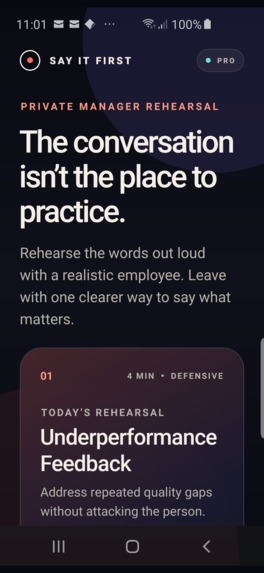
Start a private voice rehearsal for a difficult workplace conversation.
-
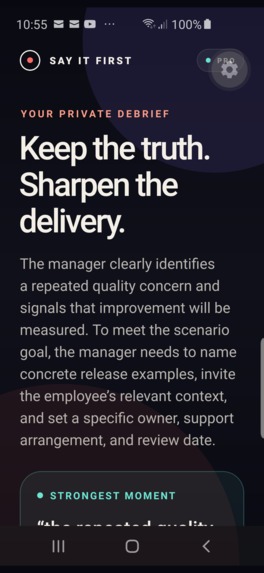
Receive transcript-grounded coaching and a focused next sentence to try.
Inspiration
New managers are surrounded by advice but rarely get a safe chance to practise. A script can tell someone what good feedback sounds like; it cannot recreate the moment when an employee says, “That is not fair,” the manager loses their thread, and the conversation becomes real.
Say It First was inspired by that gap between knowing and doing. It turns difficult management conversations into active rehearsals so people can find the words, hear the resistance, and try again before another person is affected.
What it does
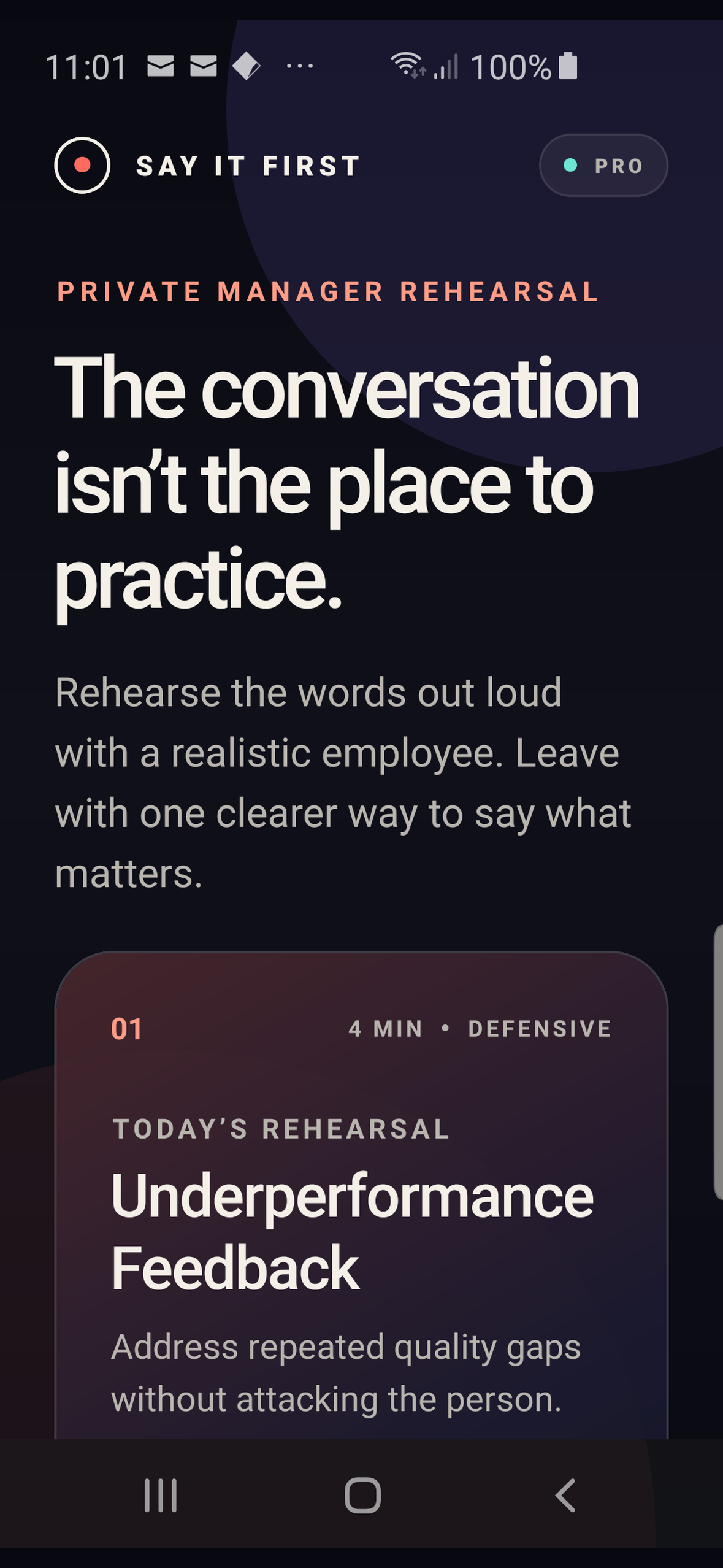
A manager enters a realistic underperformance-feedback rehearsal and speaks naturally with Alex, an AI-simulated software engineer who stays in character and pushes back credibly.
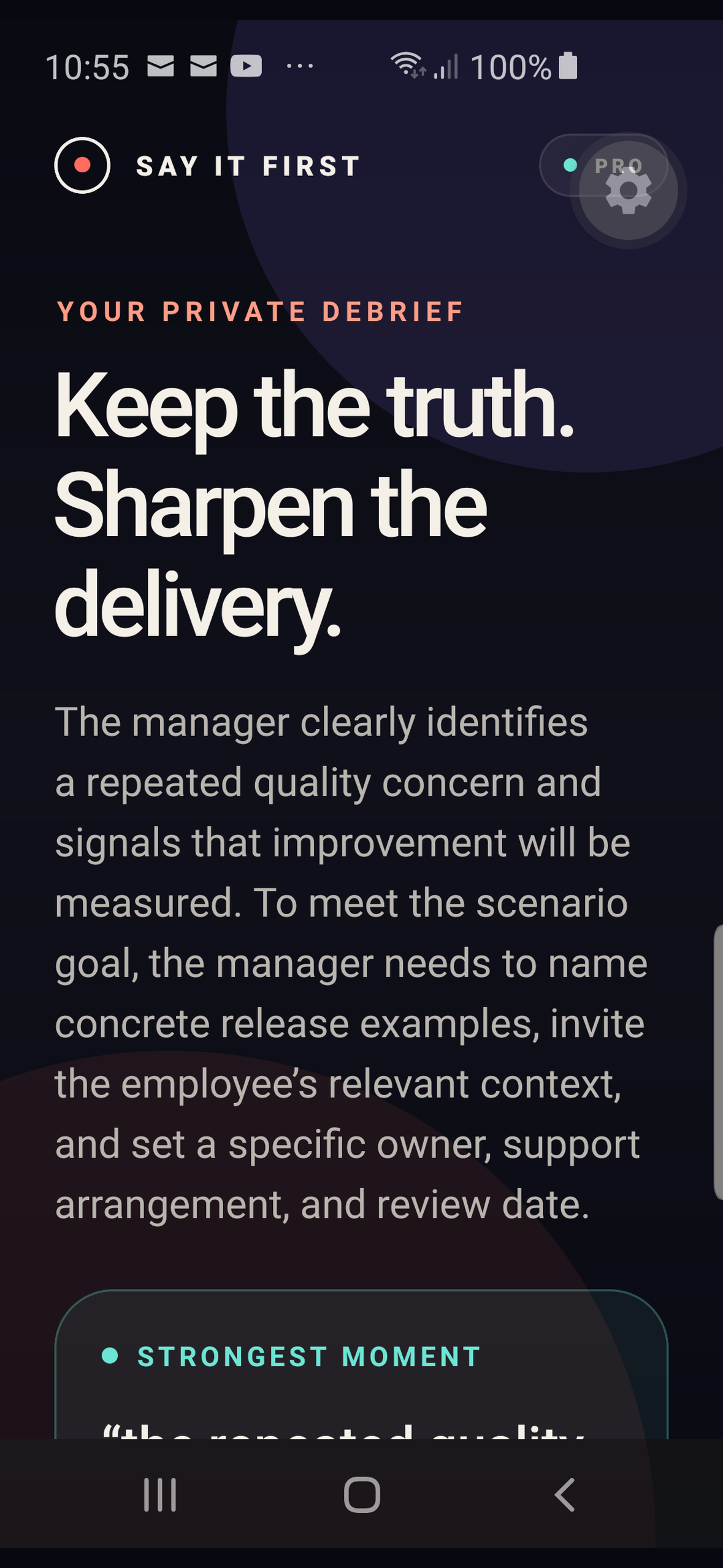
The app captures a live transcript and produces structured feedback grounded in the manager's own words. Instead of generic advice, it identifies the manager's strongest moment, explains why it worked, and prepares an exact coached sentence to try next.
The free experience includes the core rehearsal, private debrief, and strongest transcript-grounded moment. Say It First Pro reveals the exact coached sentence and unlocks an immediate focused retry through a contextual RevenueCat-powered monthly or annual offer.
How we built it
The Android app uses Expo and React Native with a native development client. A Fastify API owns the trusted AI boundary, provider credentials, session configuration, and evidence-grounded evaluation. OpenAI Realtime runs over WebRTC for low-latency voice, while shared TypeScript contracts keep the mobile, API, and domain layers aligned.
RevenueCat's React Native SDK powers dynamic packages, purchase and restore flows, entitlement refresh, and Customer Center. The coded paywall renders store-provided names and prices and derives annual savings only when the live package currencies are comparable. Development, preview, and production keys are isolated through EAS environments.
Every mobile, API, and provider interaction carries correlation identifiers and privacy-safe diagnostics. Logs include lifecycle, latency, audio receiver quality, package identifiers, and safe error codes, while excluding microphone audio, transcript text, payment details, and credentials.
Challenges we ran into
The hardest failure looked healthy in ordinary logs: an assistant reply completed at the protocol level but the user heard it stop or corrupt in the middle. We treated human listening as the source of truth, removed an accidental response ceiling, took explicit ownership of Android audio focus and speaker routing, and added per-turn receiver evidence for packet loss, jitter, and concealed samples. That made network delivery, decoding, provider completion, and device routing separately debuggable.
Billing exposed a similarly dangerous edge case. RevenueCat's dashboard-created entitlement was the immutable, case-sensitive Pro, while the first implementation checked lowercase pro. An actual Android purchase test caught the mismatch before release, and a regression test now locks the exact production contract.
Accomplishments that we're proud of
- A real-time spoken rehearsal, live transcript, clean teardown, and quote-validated structured evaluation run on Android.
- Controlled short, 30-second, and 50-second assistant replies reached their spoken completion markers with zero receiver packet loss in the measured runs.
- The native RevenueCat Test Store path loads live packages, completes an annual sandbox purchase, activates
Pro, restores access, and opens Customer Center in the actual Android UI. - The official Play-distributed build completed a no-charge Google Play license-test Annual subscription and activated the same
Proentitlement on a Samsung Galaxy S10. - A controlled Samsung regression played an approximately 53-second response through the prior 26-second failure point and reached its exact completion phrase; the session then produced a grounded debrief and clean audio teardown.
- Full repository lint, strict TypeScript, 30 automated tests, API/shared builds, Android export, and a separately signed Android lab build pass together.
What we learned
Protocol success is not user success. Audio has to be heard to the final word, feedback has to be traceable to something the manager actually said, and a purchase only matters when the exact entitlement unlocks the promised value.
We also learned that observability can improve the product rather than merely support it. The same boundaries that make a failure diagnosable—structured session states, grounded evidence, exact billing identifiers, and privacy-safe traces—make the experience more trustworthy for a nervous manager.
What's next for Say It First
Say It First is now publicly available on Google Play in Australia, Canada, New Zealand, the United Kingdom, and the United States. The next product step is deliberately narrow: learn from real practice completion, repeat use, conversion, and qualitative manager feedback before expanding the surface area.
The roadmap includes additional scenarios and personas, a highlighted-moment retry, private history and deletion controls, server-side entitlement enforcement, and deeper billing lifecycle verification for cancellation, renewal, expiry, and reinstall. License-test evidence will never be presented as customer revenue.

Log in or sign up for Devpost to join the conversation.