-
-
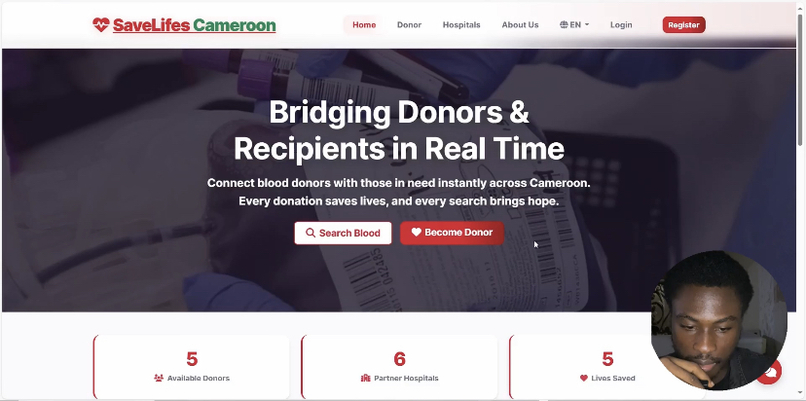
Savelifes bridging the gap between donors and recipents..
Our Inspiration: The "Why" Behind SaveLifes
This wasn't just another project for us. In many of our communities, we've all seen the struggle and heard the stories—a family frantically searching for a blood donor, a hospital facing a logistical nightmare in an emergency. The difference between life and death can come down to a single pint of blood, and too often, that connection is missed.
We were moved by this simple, powerful truth: the problem isn't always a lack of donors, but a lack of connection. We wanted to build a bridge across that deadly information gap, using simple, accessible technology to connect our communities and save lives right here at home.
⚙️ What It Does: A Lifeline in Real-Time
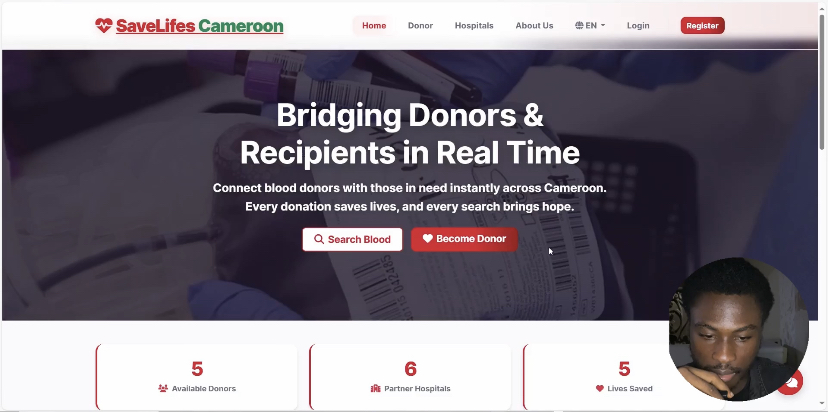
At its heart, SaveLifes does one simple thing: it connects people to save lives. It’s a real-time web platform that acts as a central hub for blood donation.
For anyone, it’s a live view of which nearby clinics have the blood they might need. For a hospital, it’s an emergency button—turning a chaotic, manual search into a single click that instantly alerts a network of available, local donors. It’s about replacing uncertainty and panic with clarity and hope.
🛠 How We Built It: A Philosophy of Accessibility
From day one, our guiding star was this: build for reality. We knew this had to work for everyone, everywhere, so we focused on reliability and accessibility above all else.
Our Stack: We deliberately chose a classic, robust stack of HTML, CSS, JavaScript, and PHP. Why? Because it’s bulletproof. It works on any device with a browser, no matter how old, ensuring no one is left behind.
The Database: We used MySQL because we needed a secure and efficient foundation to manage the critical data of donors, hospitals, and requests. There's no room for error here.
Directions & Navigation: For directions, we made a deliberate choice to be as lightweight as possible. Instead of embedding a data-heavy map, we simply capture a hospital's exact longitude and latitude during registration. When a user clicks "Get Directions," our platform instantly generates a link that opens Google Maps on their device, providing reliable, turn-by-turn navigation from their current location. This offloads all the heavy processing and uses an interface every smartphone user already knows.
This led to our core design philosophy: we chose a server-rendered web platform over a flashy native app. It was a conscious trade-off to guarantee maximum accessibility, keep data costs low, and ensure SafeLifes runs smoothly even on a 2G connection.
🧱 The Challenges We Fought (and Conquered)
Every meaningful project has its battles, and these were ours:
The Bandwidth Barrier: Our biggest fight was against slow, intermittent internet. We were obsessed with optimization, constantly asking, "How can we make this even lighter? Even faster?"
Universal Access: Making something that works flawlessly on a brand-new smartphone and a five-year-old shared computer is tough. It meant avoiding trendy frameworks and focusing on rock-solid fundamentals.
The "Offline" Problem: Without a native app, we couldn’t use push notifications. This was a huge challenge. Our solution—lightweight, periodic data requests—works well, but it also showed us our clear next step: integrating SMS for true offline alerts.
🏆 What We're Most Proud Of
Looking back on this hackathon, a few things really stand out:
We didn't just build a demo; we built a complete, functional, end-to-end platform that solves a real-world problem.
We achieved incredible performance, with pages loading in under 2.5 seconds on a simulated 3G network. In an emergency, that speed matters.
We created something so simple and intuitive that it requires virtually no training for donors or hospital staff.
Most of all, we proved that a powerful, life-saving network can be built not with the most complex tech, but with the most accessible.
📚 What We Learned: More Than Just Code
This sprint was a profound learning experience. We learned:
That empathy is the most important spec sheet. Building for the user's actual environment—not an idealized one—is what creates truly impactful technology.
How to make tough architectural calls, weighing the allure of new features against the absolute necessity of access for all.
And most importantly, that a well-designed, simple solution can often have a more profound and lasting impact than a complex one.
🔮 What's Next for SafeLifes: From Reactive to Predictive
This is just the beginning. Our vision for SafeLifes is bigger than what it is today.
SMS Integration: First things first, we'll integrate an SMS service to push critical alerts to donors, even when they're offline.
Predictive Shortage Alerts: This is our big leap forward. We want to use our data to predict potential blood shortages before they happen. The system will then launch proactive campaigns to alert donors, moving SafeLifes from a reactive tool to a predictive, life-saving model.
Growing the Network: We'll be working to strategically onboard more clinics and rural health centers to expand our life-saving reach.
Community Tools: We plan to empower local leaders and NGOs with tools to organize their own community blood drives directly through the SaveLifes platform.
Built With
HTML5
CSS3
JavaScript (Vanilla)
PHP
MySQL
Google Maps API (for Directions)
Try it out
[Live Application Link]
[GitHub Repo Link] https://github.com/WingoBery/SaveLifes-.git


Log in or sign up for Devpost to join the conversation.