-
-
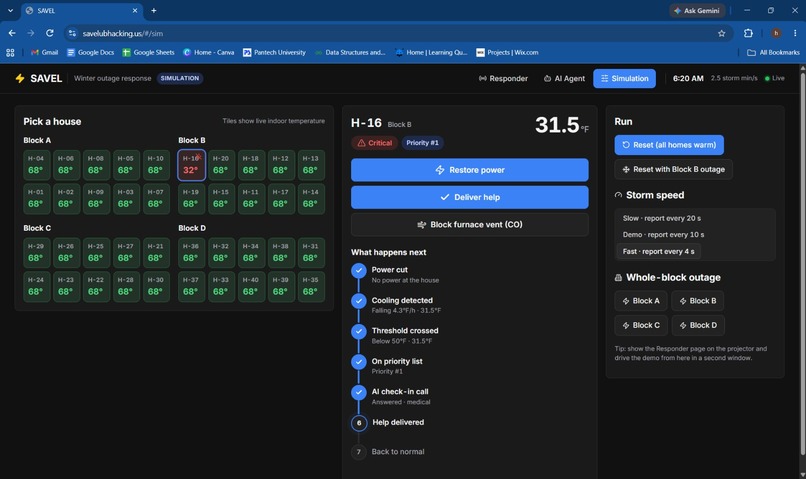
Simulator
-
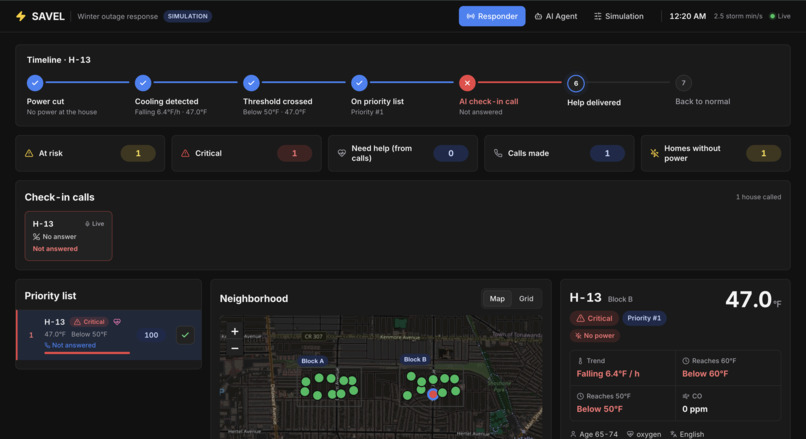
responder
-
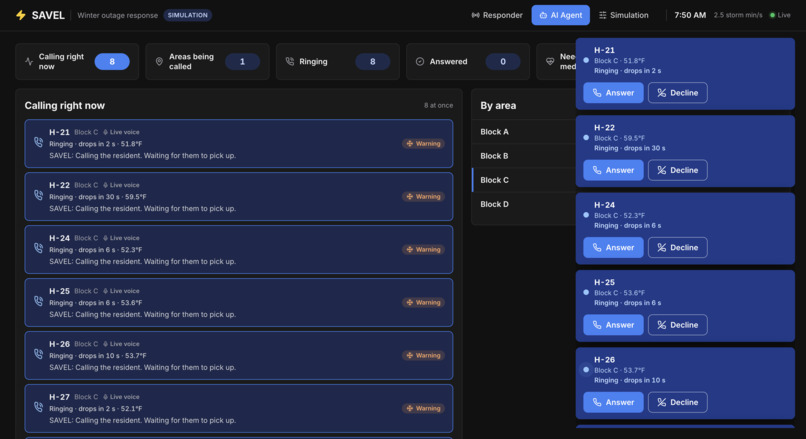
AI agent
-
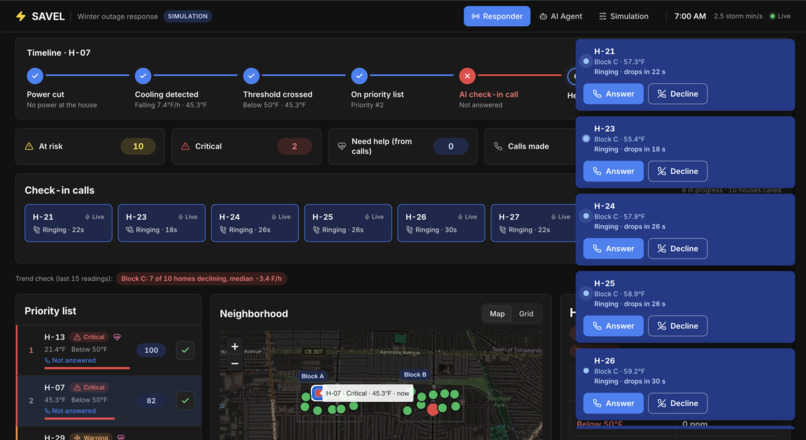
Multiple calls at the same time
In December 2022, a blizzard hit Buffalo, where we study. People died in their own homes after the heat went out, and many of them were older or relied on medical equipment. Emergency crews did go door to door, but nobody could tell them which doors to knock on first.
That stuck with us. When a neighborhood loses power, the question isn’t who is cold, because everyone is. It’s who runs out of safe time first. A healthy 30-year-old with a fireplace and an 80-year-old on oxygen in a drafty house are not the same emergency, and a list of outage addresses can’t tell them apart.
What it does
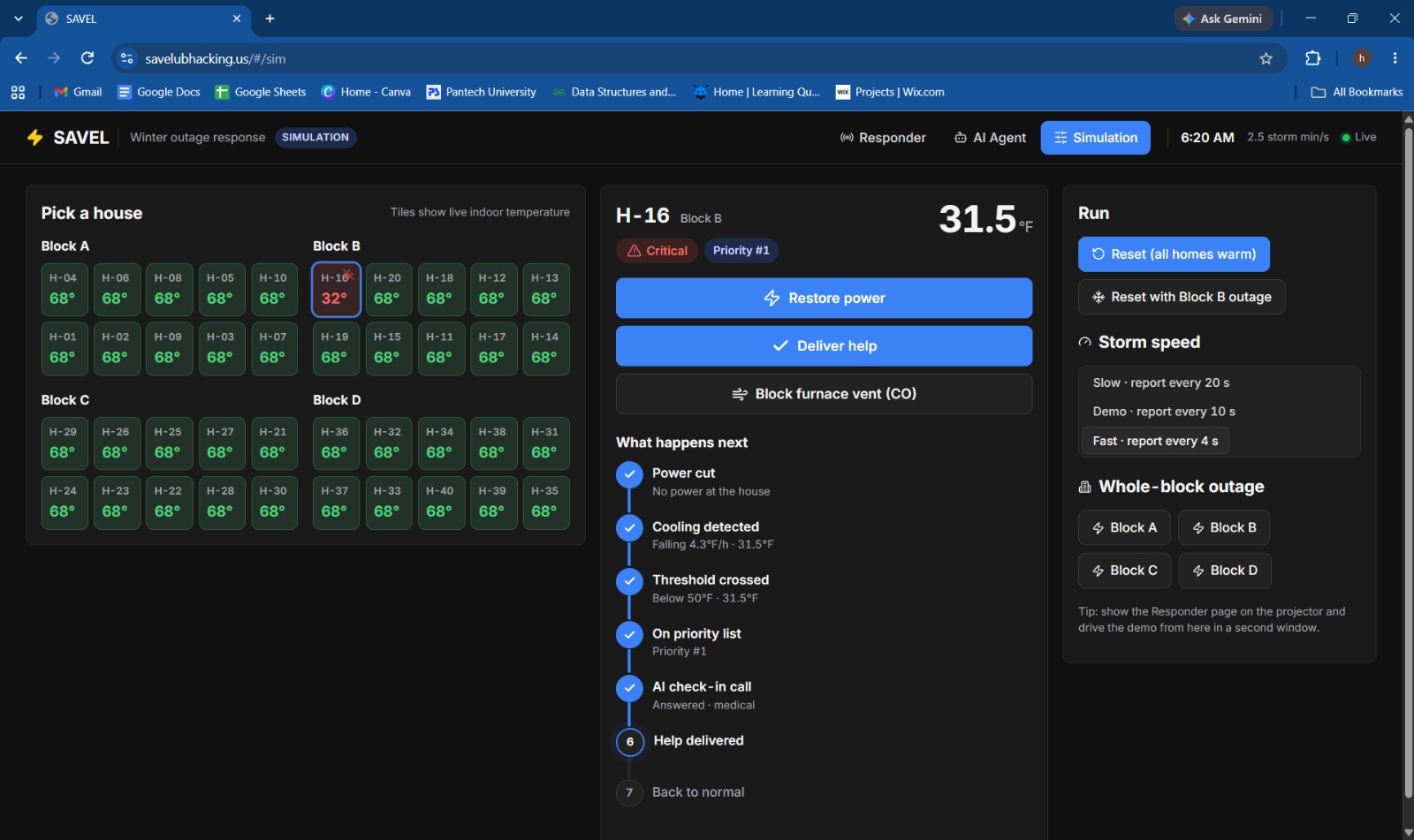
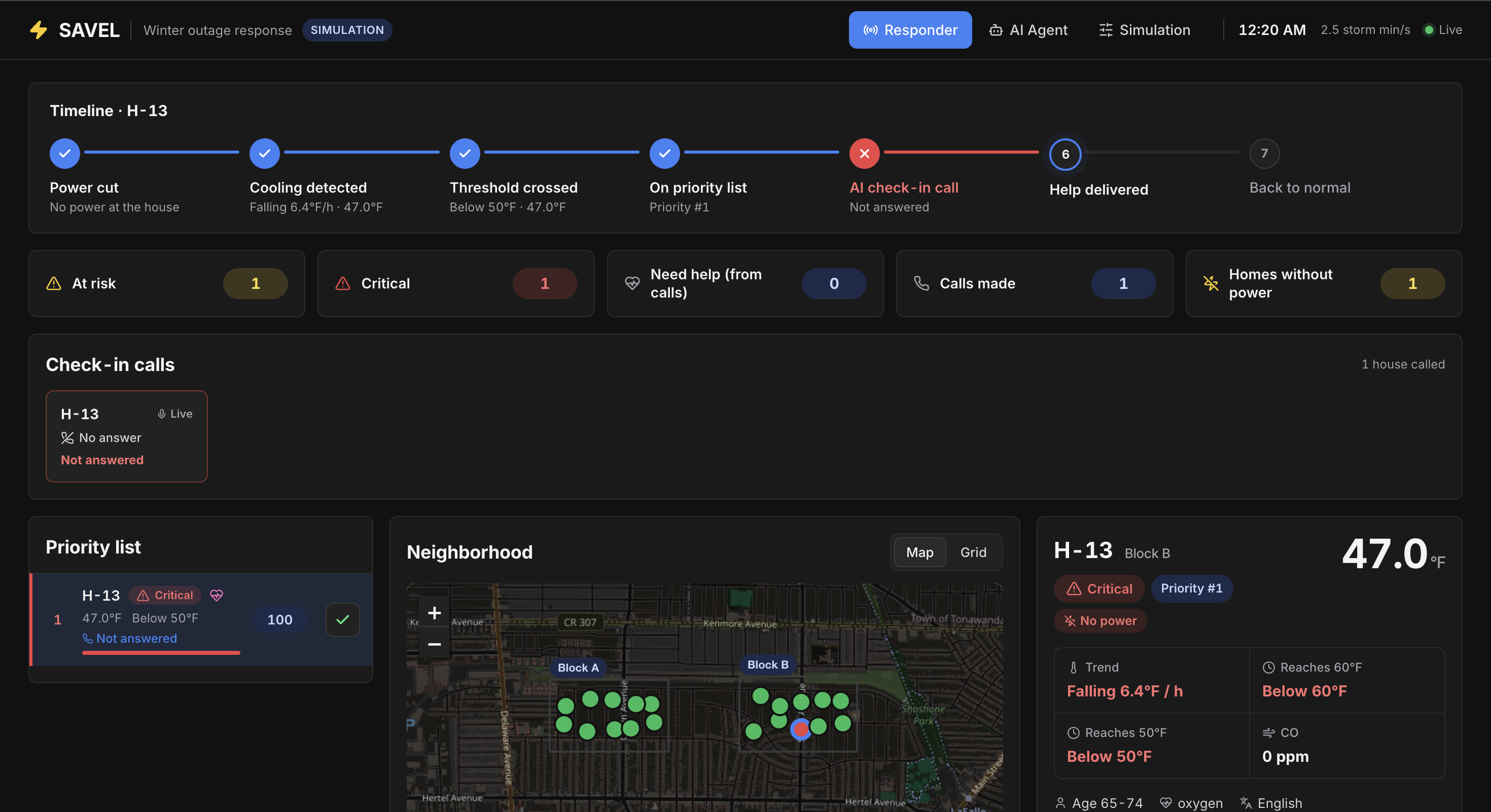
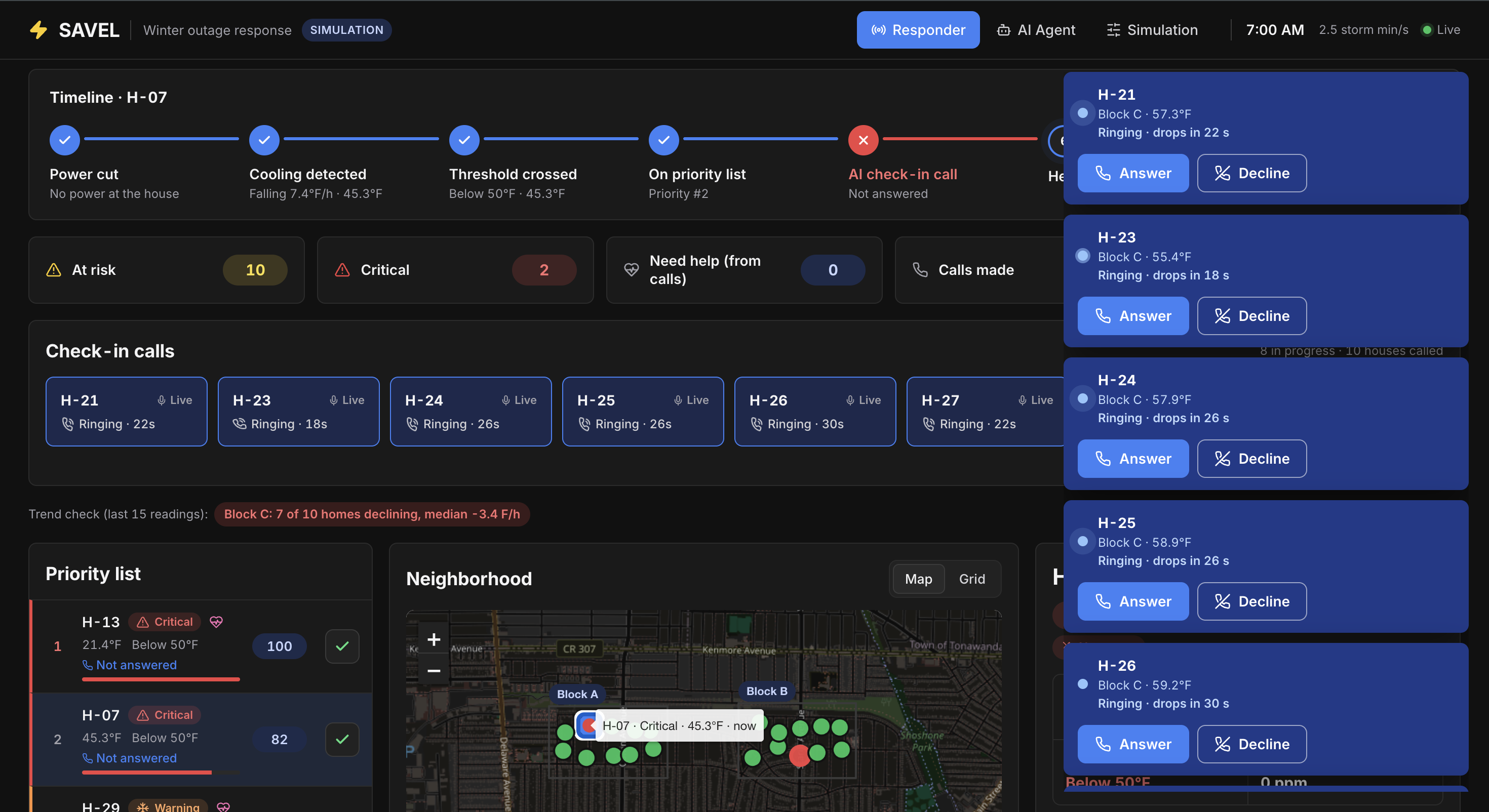
SAVEL watches indoor temperature and carbon monoxide sensors across a neighborhood. When a home stops heating, it predicts how many hours remain until the house hits 60°F and 50°F, and it ranks every home by time to danger. An AI voice agent then calls the resident, asks a few short questions, and turns the conversation into structured fields. The result feeds back into the ranking, so the home with the oxygen machine on a dying battery jumps to the top of a responder’s list.
If a furnace vent gets blocked by snow and carbon monoxide climbs, that overrides everything. The agent tells the resident to leave the house and call 911.
Everything in the demo runs on a simulation of 40 synthetic homes across four blocks. The residents are fictional, and the live calls are played by teammates.
How we built it
Prediction. Each home cools according to Newton’s law of cooling:
$$T(t) = T_{out} + (T_0 - T_{out})\,e^{-kt}$$
Here $k$ is that home’s insulation constant. We learn $k$ for every home from its own recent readings, fitting the last 10 readings taken while heating was off. The time until a threshold temperature $T_{th}$ follows directly:
$$t_{th} = \frac{1}{k}\ln!\left(\frac{T - T_{out}}{T_{th} - T_{out}}\right)$$
For example, a home at 64°F with 5°F outside and $k = 0.10$ reaches 60°F in about 0.70 hours and 50°F in about 2.71 hours. We log forecasts at 30 and 60 minutes ahead and score them against what actually happened, comparing the per-home learned $k$ with a single neighborhood-wide $k$. That comparison is our accuracy panel: learned insulation beat the global model by [X]°F at 60 minutes ahead.
Risk ranking. The ranking is deterministic. It combines time to 50°F, current temperature, age, medical needs, carbon monoxide, and the outcome of the call. We kept an LLM out of the ranking on purpose, so the order of who gets help first can always be explained and audited.
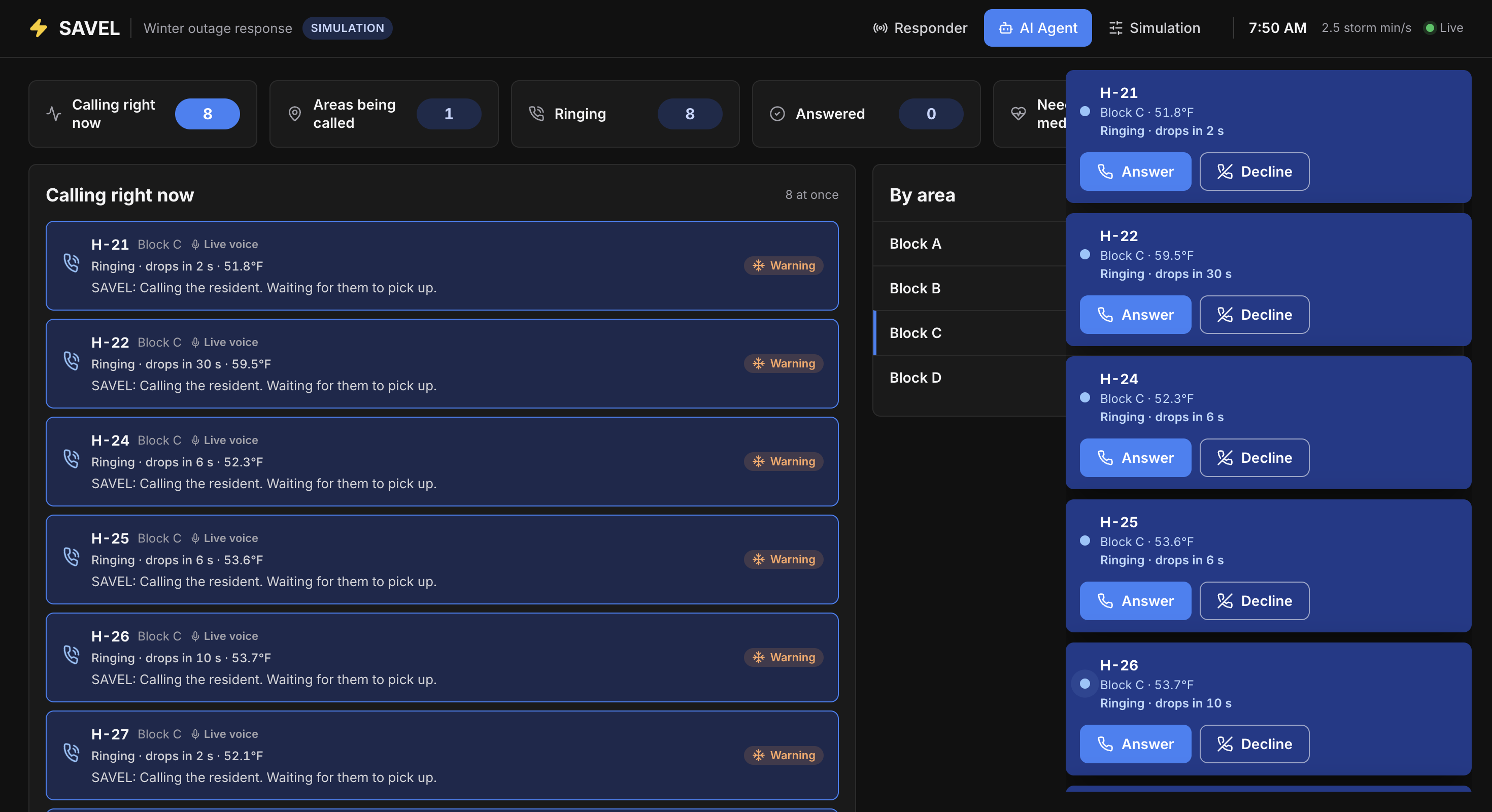
The voice loop. When a home crosses a threshold, the backend queues a call once per episode. An ElevenLabs agent runs the conversation. The post-call webhook sends the transcript to Gemini, which extracts has_heat, needs_help, medical_issue, can_leave, and leaving_now. Plain rules turn those fields into an outcome and feed the risk score. If Gemini is down, a keyword-based fallback extractor keeps the loop working. Gemini also writes a short briefing for each home, so a responder knows what to bring.
The stack.
FastAPI backend with a 2-second risk loop Tiger Data (TimescaleDB) hypertable for sensor readings React, Vite, Leaflet, and Recharts dashboard with a map, a ranked queue, per-home charts, a call panel, and simulator controls Docker Compose on a Vultr VM, with Caddy handling HTTPS on a GoDaddy Registry domain Challenges
Simulated time. The simulator runs at 300× speed, so one real second is five storm minutes. That broke several assumptions at once. Our first accuracy check looked for a reading within one simulated minute and found nothing. Our “sensor offline” rule flagged every home as offline, since readings arrive exactly five storm minutes apart. We rebuilt the fit window around reading counts instead of clock time, matched forecasts by interpolation, and set the offline threshold to three missed ticks.
Calls and time. During a live call we slow the storm down so the demo doesn’t race ahead of the conversation. Two calls overlapping would restore the speed too early, so the slowdown uses a counter and puts back the speed that was saved, not a hard-coded one.
Repeat calls. A home whose power comes back is still below 60°F while it warms up, and it kept triggering new calls. The trigger now only fires when heating is off, or when carbon monoxide is high.
Phone calls fell through. Our Twilio trial account had no usable number, so we moved live calls to browser-based ElevenLabs voice sessions. Every other home gets a scripted call that runs through the exact same extraction and risk pipeline, labeled as scripted on screen, so the demo never depends on 40 real calls.
Three people, one contract. We agreed on the API shapes and enums early and kept each part in its own lane, which let backend, frontend, and voice work move in parallel.
What we learned Learning a separate cooling rate for each home is a clear, measurable improvement over using one number for the whole neighborhood. LLMs are good at turning messy speech into structured fields and weak at deciding who gets help first. Keeping the ranking deterministic made the system easier to trust and easier to test. Every external service needs a fallback, because a demo is the worst time to find out one is down. Time is a design decision. Any system that mixes simulated time and wall-clock time needs one rule for which to use. What’s next Real battery-backed cellular sensors, since home Wi-Fi dies in the same outages we care about. When a sensor goes silent, SAVEL already keeps estimating from the learned $k$. Opt-in enrollment through existing medical-needs registries, with strong privacy controls. Customers who already carry the cost of these emergencies: home-care agencies, utilities, public housing, and insurers dealing with frozen pipes. Spoken-language support for non-English households.
Built With
- caddy
- docker
- elevenlabs
- fastapi
- gemini-api
- godaddy
- leaflet.js
- python
- react
- recharts
- tiger-data-(timescaledb)
- vite
- vultr
