-
-
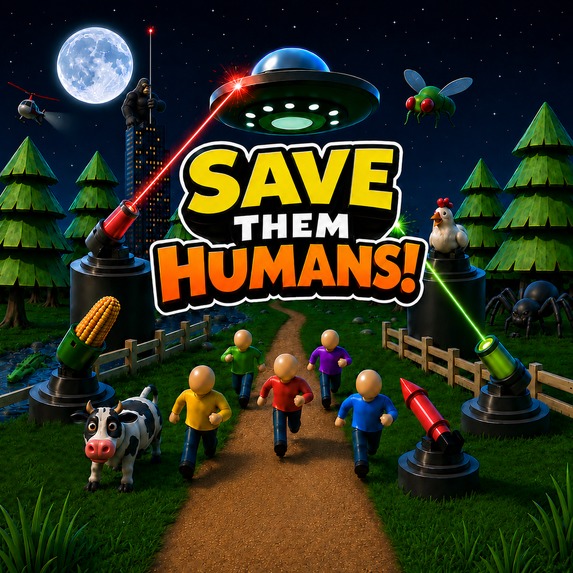
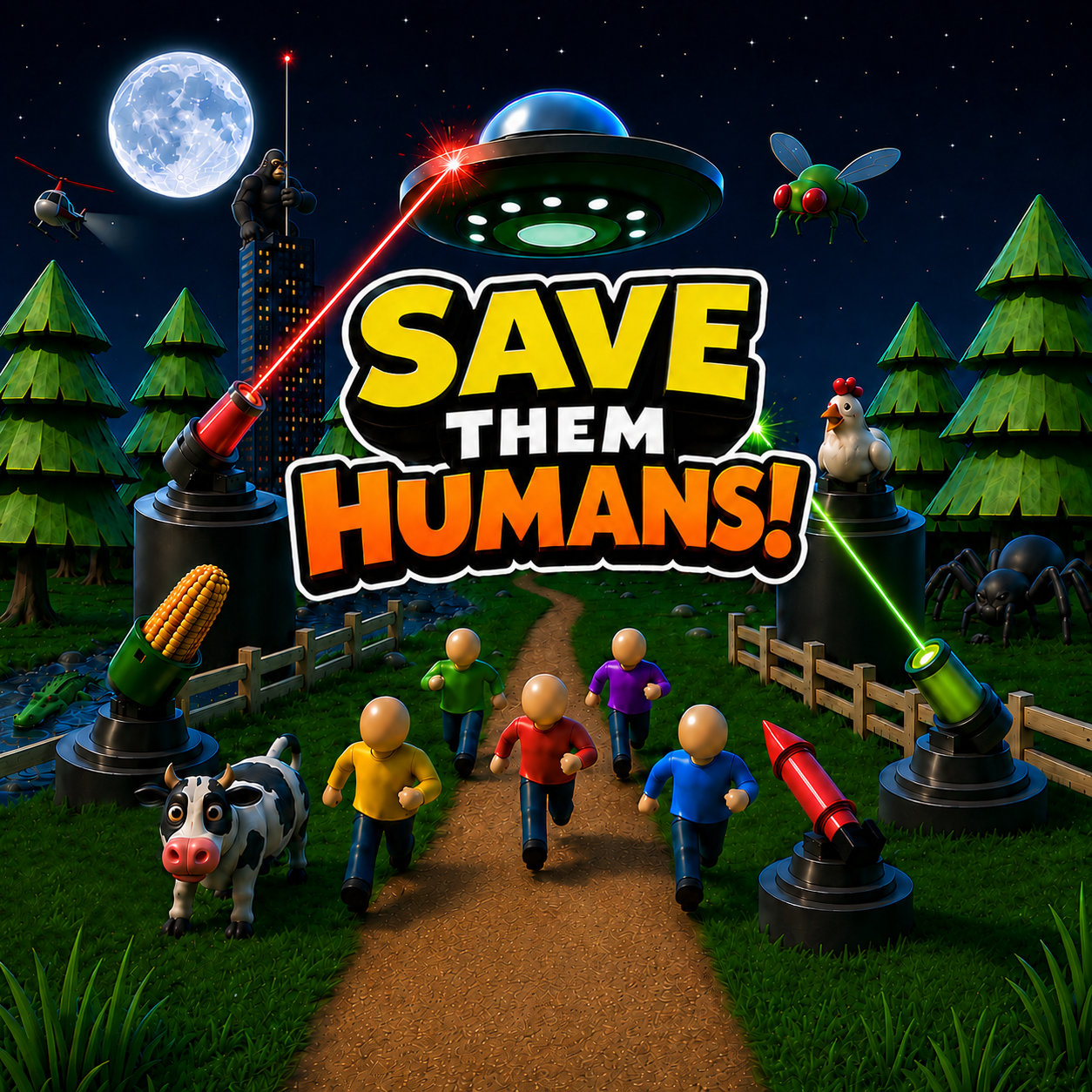
Poster 1
-
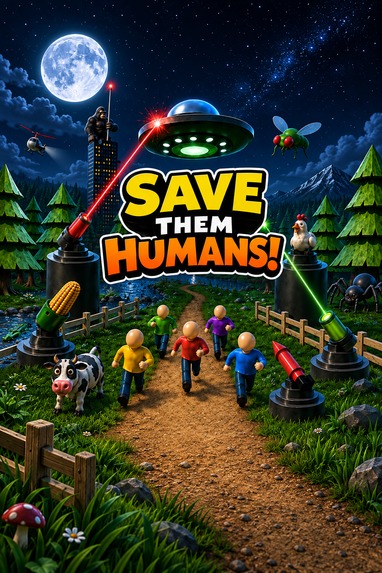
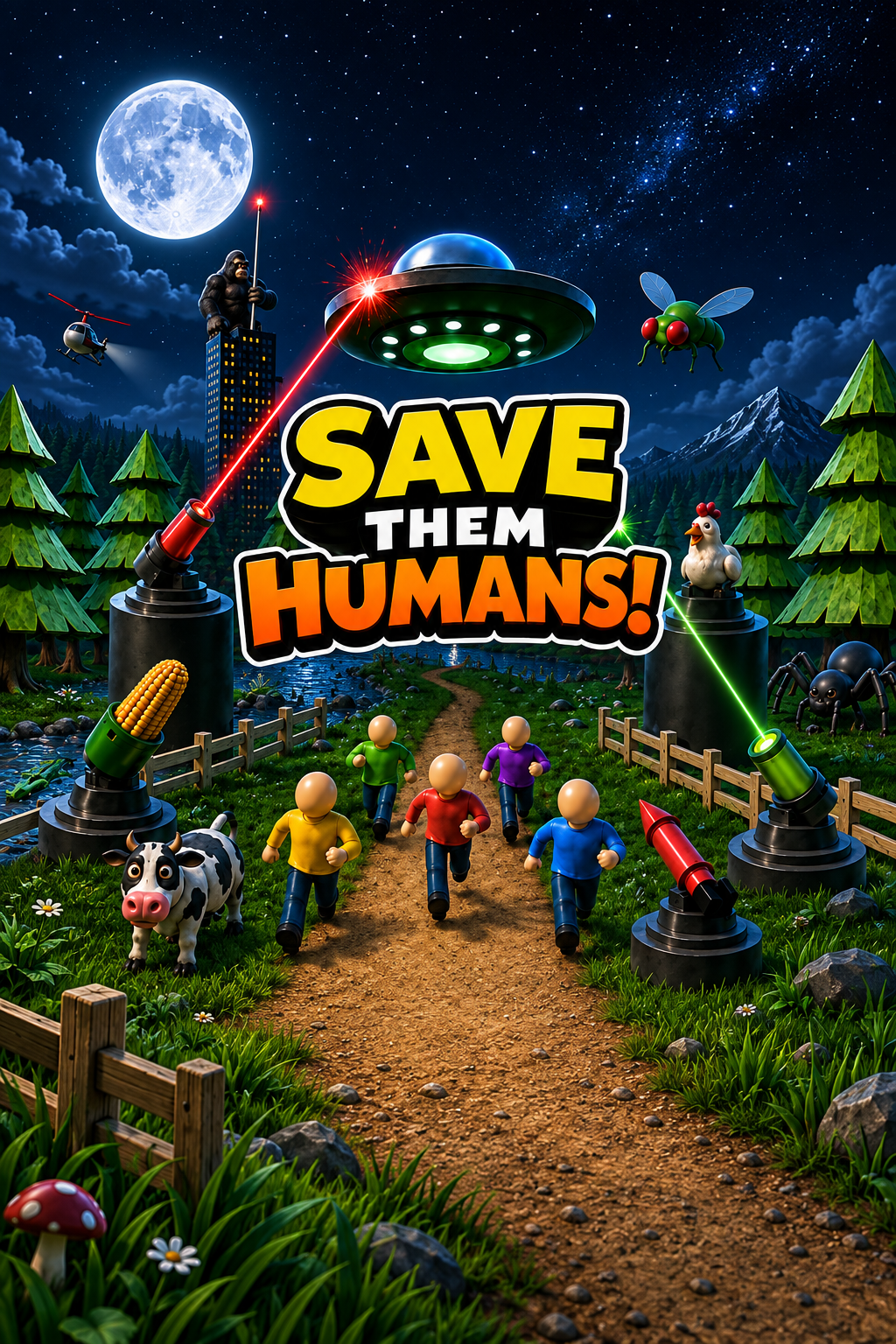
Poster 2
-
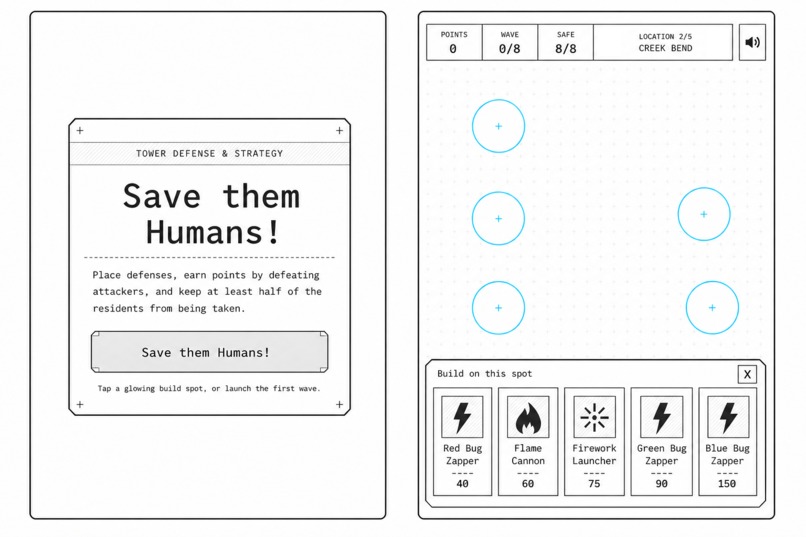
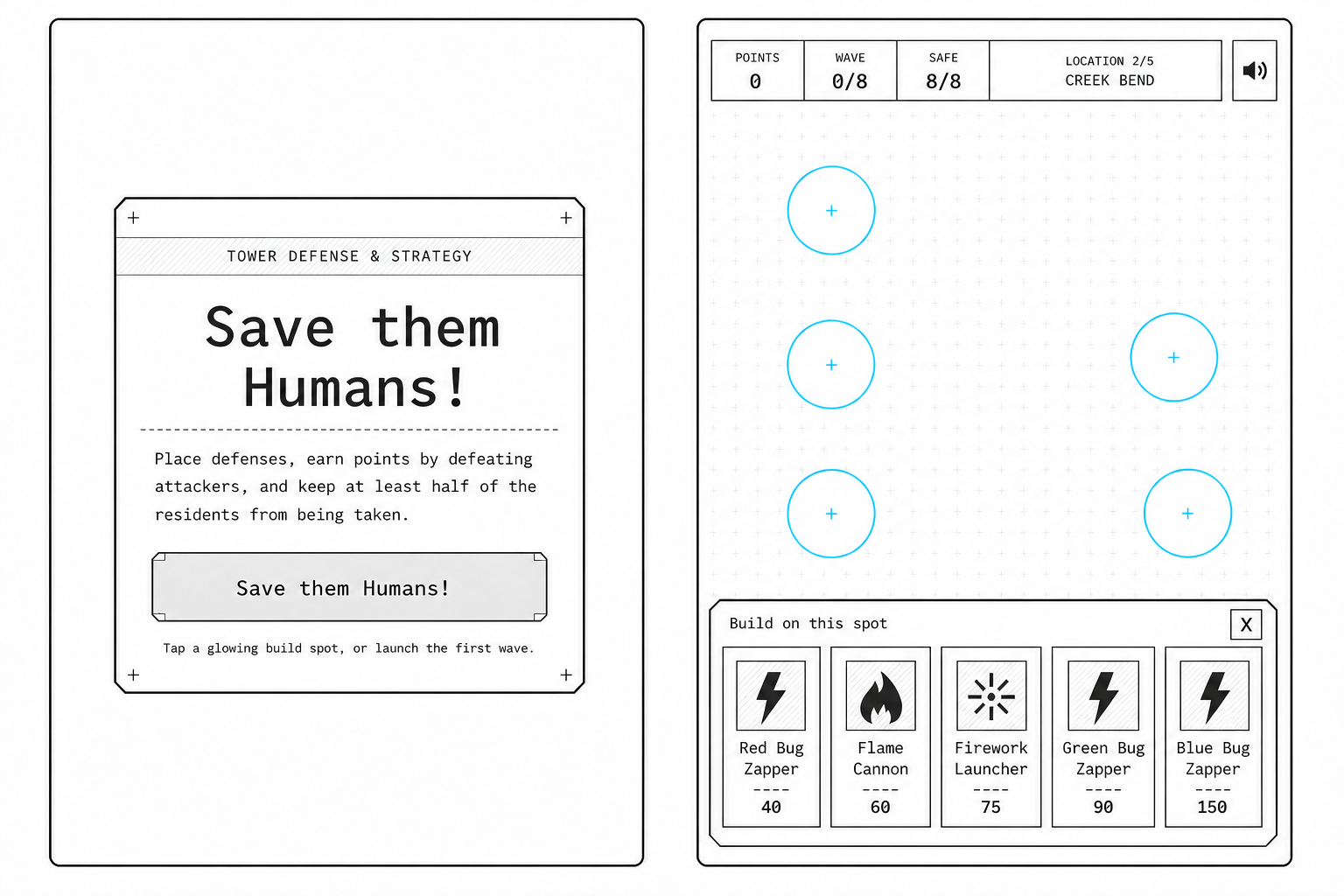
UI mockup
-
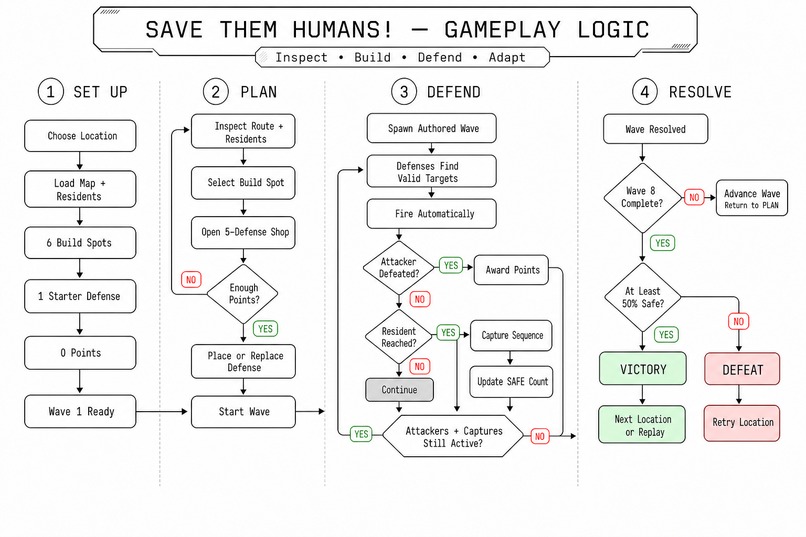
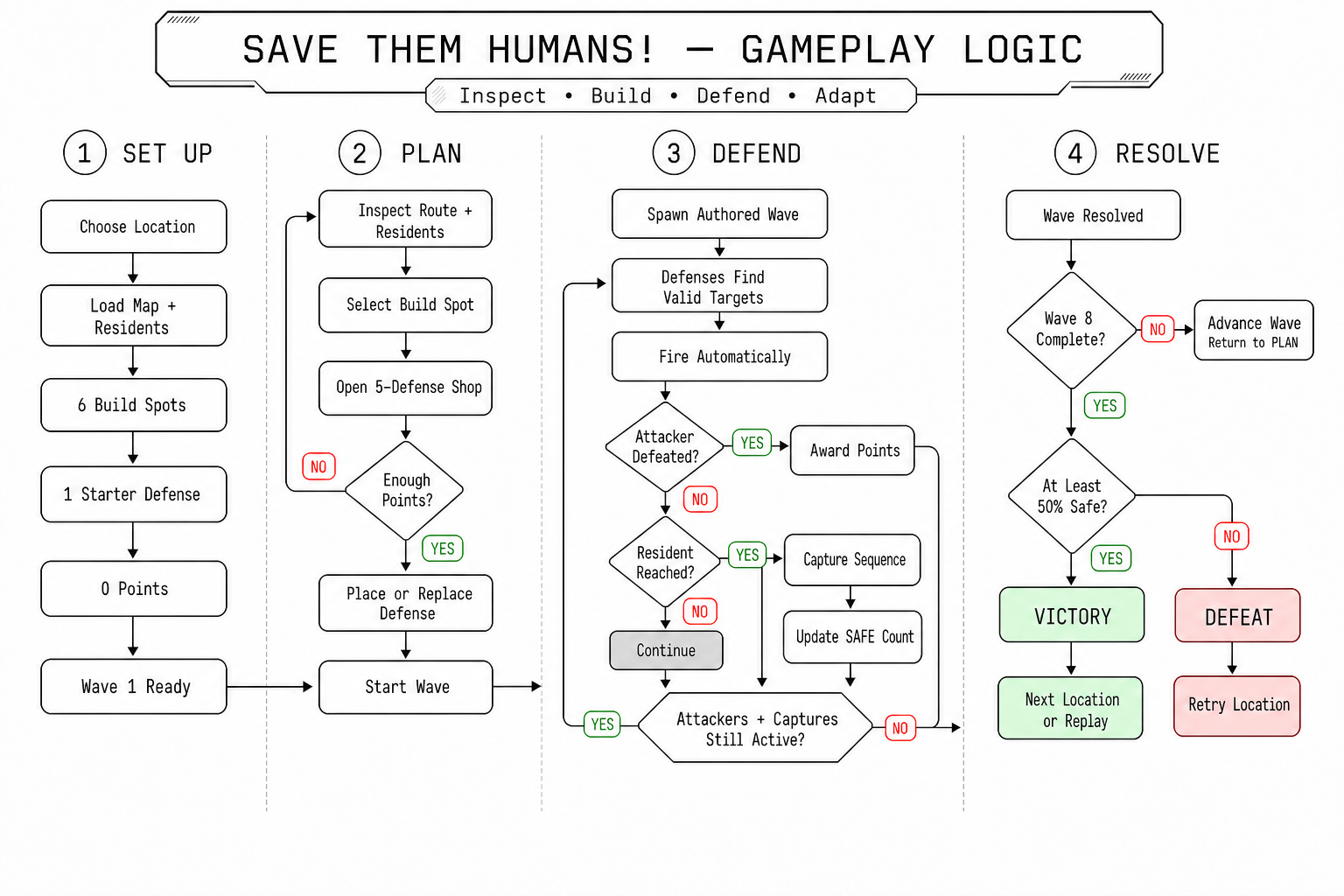
Gameplay Logic
Inspiration
I've always enjoyed tower-defense and strategy games, especially the classics. I wanted to create something fun and fully 3D that still captures the charm and playful spirit of the 16-bit era.
Most tower-defense games reduce failure to a bar, a gate, or a pile of hit points. I wanted the stakes standing in the scene: farmers, hikers, river crossers, and city residents who wander, panic, and visibly react when danger reaches them.
Save them Humans! began with that simple idea and one deliberately silly question: what if the defenses were just as memorable as the threats? That led to egg-launching chickens, corn cannons, fireworks, Bug Zappers, bows, steel cannons, and even a Fried Chicken Leg Cannon—all protecting a cast the player can actually see.
What it does
Save them Humans! is a portrait-oriented 3D tower-defense and strategy game built around visible residents and five authored threat stories.
Tap a grey build spot, choose a defense, spend points, and start the wave. Defenses automatically target attackers in range while the player watches projectiles, misses, reactions, captures, and rewards play out across the miniature scene. Finish Wave 8 with at least half of the starting residents safe to win.
Each location keeps the same approachable controls but changes the tactical problem:
🛸 Sunny Acres — UFOs open their beams, lift farmers and cows, and fly away with visible passengers.
🪰 Creek Bend — Giant flies weave around scenery. Colored Bug Zappers must attract one eligible fly, earn physical contact, and recharge, while Flame Cannon and fireworks provide direct damage.
🕷️ Pine Hollow — Articulated spiders leave the route to hunt fourteen roaming humans. A Fried Chicken Leg Cannon distracts a moving spider briefly, but the hunt resumes when the snack is gone.
🐊 Roaring River — Sixteen people gradually cross fast water over small stones while armored alligators hunt in the river and carry victims downstream.
🦍 City Edge — Gorilla squads leap from rooftops, grab residents, climb building faces, and leave captives above the streets while cars, signals, wrecks, and a searching helicopter keep the city alive.
Points carry through the eight waves of the current location and reset on refresh, victory, or defeat. Every location starts with one defense, contains six fixed build spots, and uses its own defense lineup.
How we built it
The prototype is built with JavaScript, HTML5, CSS, and Three.js as a fully local browser game. It runs without external network requests and keeps the runtime source readable.
The design is configuration-driven. Levels, paths, waves, residents, defenses, models, materials, sounds, camera values, effects, and player-facing text live in replaceable definitions. Shared shop slots can become completely different tools in each location without rewriting the shop or economy systems: a laser becomes a Bug Zapper, Egg Chicken becomes Flame Cannon or Bow & Arrow, and Cob Cannon becomes fireworks, a woodland bow, or a reflective Steel Cannon.
The five maps are handcrafted rather than procedural. Lightweight code-native models, instanced scenery, animated materials, particles, and local audio keep the build compact while leaving a clear path for textured GLB models and authored animation later.
The simulation uses explicit state machines for route travel, attraction, hunting, capture, carrying, climbing, escaping, defeat, and wave completion. Deterministic spacing and recovery safeguards keep dense waves readable and prevent a finished encounter from remaining stuck because of an orphaned reservation or unseen attacker.
The interface is portrait-first: a compact top HUD, fixed build spots, one-row five-item defense tray, large wave button, short message strip, centered start/result cards, persistent mute control, and a hidden camera-debug panel.
Challenges we ran into
The hardest challenge was making five very different threat fantasies obey one clear tower-defense language.
UFOs follow air lanes. Flies can be pulled away from a route but must physically touch a cage. Spiders leave the path to hunt moving people and then need to rejoin crowded lanes. Alligators can target only people already crossing the water. Gorillas travel between roofs, street level, building faces, and rooftop captive positions. Each needed its own movement and capture states without turning the game into five unrelated systems.
Portrait readability was equally demanding. Large attackers could overlap, scenery could hide residents or build spots, and a technically correct effect could disappear against the moonlit field. Route spacing, camera-safe placement, distinctive silhouettes, high-contrast selection rings, visible projectiles, and state-specific VFX all had to work at phone scale.
Balance required restraint. The free starter defense has to teach the loop and unlock the first purchase without solving the whole location. Random misses need to create pressure without allowing a streak of bad luck to destroy the economy. Bug Zappers need to feel powerful without turning several cheap cages into guaranteed entrance control. Used authored waves, deterministic outcome distributions, a first-defeat point floor, and a one-miss guard to keep the game tense but fair.
The final challenge was completion safety. With roaming residents, reserved targets, simultaneous captures, traffic, and enemies that can leave and rejoin routes, a single stale state could hold a wave open forever. Shared watchdogs now reconcile reservations, recover stalled hunts and returns, finish interrupted river crossings, and clear only genuinely stale blockers.
Accomplishments that we're proud of
Five locations feel like five different stories while using the same simple controls.
The residents are not decoration or a number hidden in a menu. UFO passengers remain visible through glass domes, flies carry full-size humans out of the scene, spiders run with people held crosswise, alligators swim downstream with victims in their jaws, and city captives stay frightened on rooftops.
The defenses have clear personalities. Corn becomes popcorn, eggs become slime, fireworks burst in multiple colors, arrows splinter, cannonballs land with weight, and Bug Zapper kills create readable world-space electrical arcs.
I am also proud of the reusable architecture beneath the spectacle. Location overrides, configurable attachments, animation mappings, local audio events, and shared validation make the prototype both compact and ready for future art replacement.
Most importantly, the complete campaign is playable offline: five locations, forty authored waves, visible win/loss stakes, retry and advancement flow, responsive UI, local sound, and safeguards that let every encounter reach a result.
What we learned
Designing Save them Humans! reinforced a few lessons:
🎯 Make the stakes visible. Watching one person get carried away creates more urgency than watching a base-health number decrease.
🧭 Keep the input stable while the story changes. The same build-and-launch controls can support UFO abduction, insect lures, spider hunts, a river crossing, and rooftop captivity.
🧩 Configuration is a design tool. Data-driven overrides made experimentation faster and allowed each location to have a unique arsenal without duplicating the core systems.
👁️ Readability is gameplay. Spacing, scale, camera framing, color, and effect timing determine whether the player can make a strategic decision.
⚖️ Fair randomness needs boundaries. Accuracy and failure create tension only when the player can still understand and recover from the result.
🛠️ Prototype the complete loop early. Placement, combat, rewards, capture, victory, defeat, and retry reveal more about the game together than any isolated feature can.
What's next for Save them Humans!
The prototype establishes the complete campaign structure. A full version would deepen it without losing the directness of the current loop:
🎨 Finished art production. Textured models, more animations, improved materials, and location-specific environmental details.
🔊 Expanded audio. Custom weapon, creature, resident, ambience and location-transition sound design.
🌊 More behavior within waves. New enemy roles, formation behaviors, and tactical combinations that change pressure without adding extra controls.
🗺️ More authored locations. New rescue scenarios, residents, attackers, scenery, and comedy built around the same visible-stakes rules.
🧰 More defense interactions. Additional location-specific weapons and combinations while preserving the five-slot, fixed-placement interface.
Single-player remains the heart of the game. Everything added should serve the same promise: strange defenses, readable consequences, and humans worth saving!


Log in or sign up for Devpost to join the conversation.