-
-
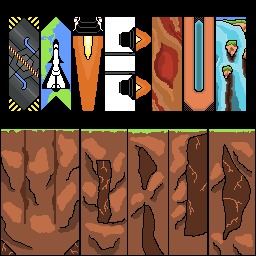
This is the logo for our VR game, Save Our World.
-
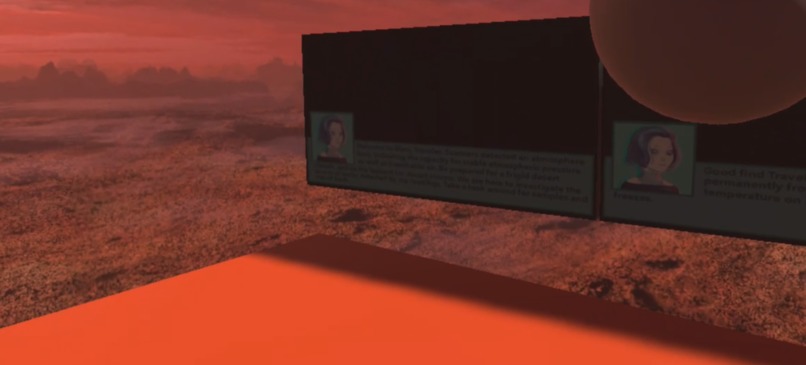
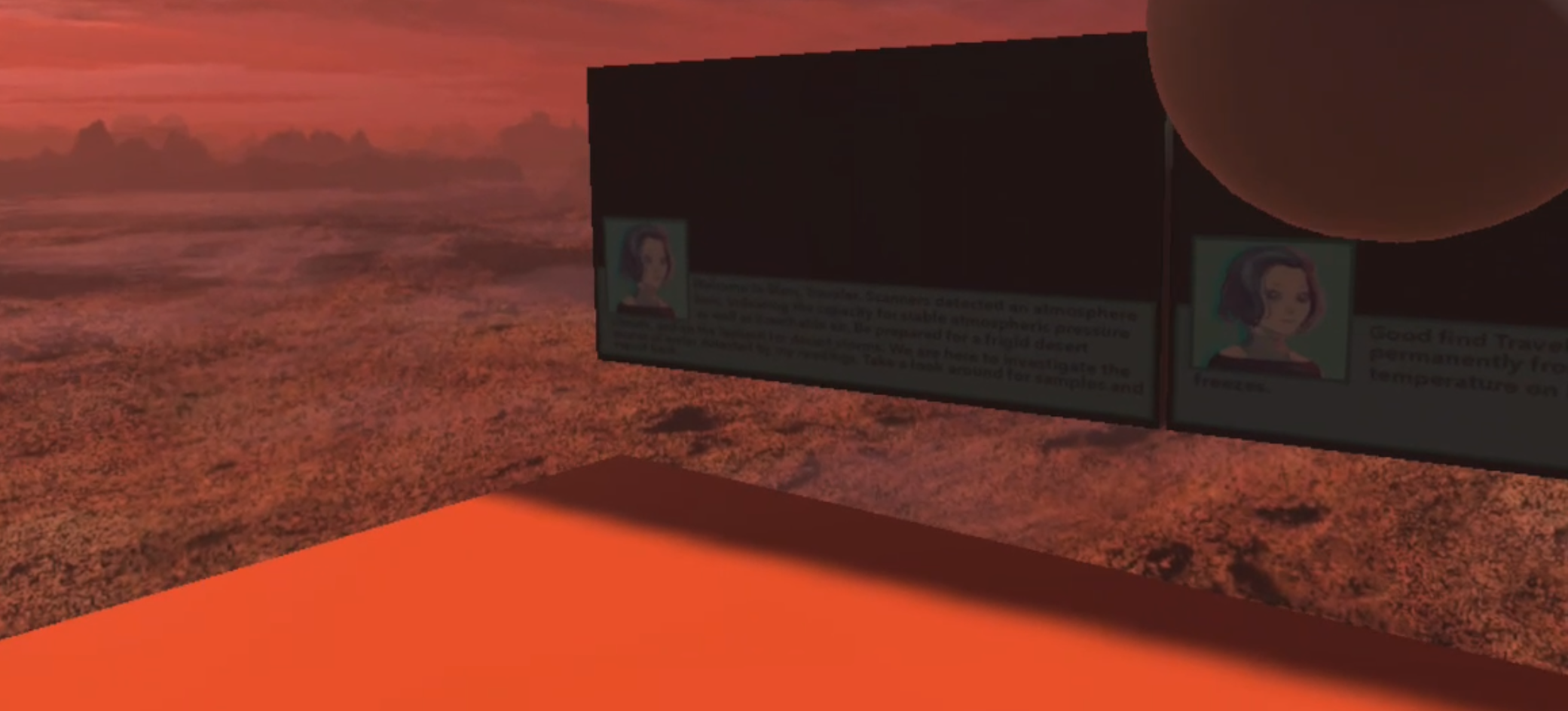
This is a picture of our Mars environment in the VR game.
-
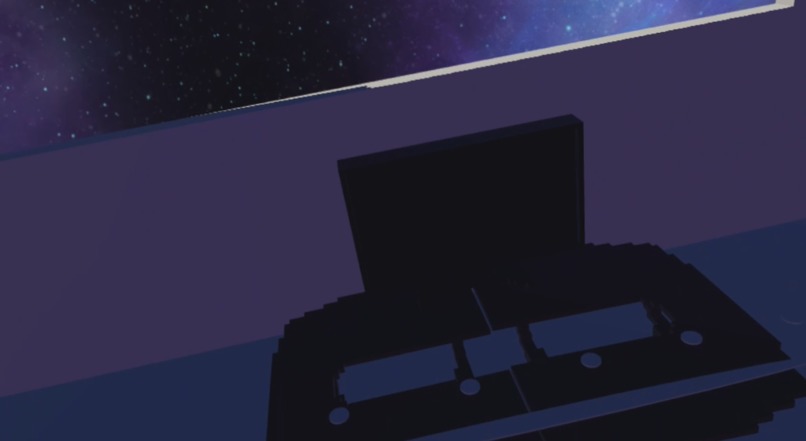
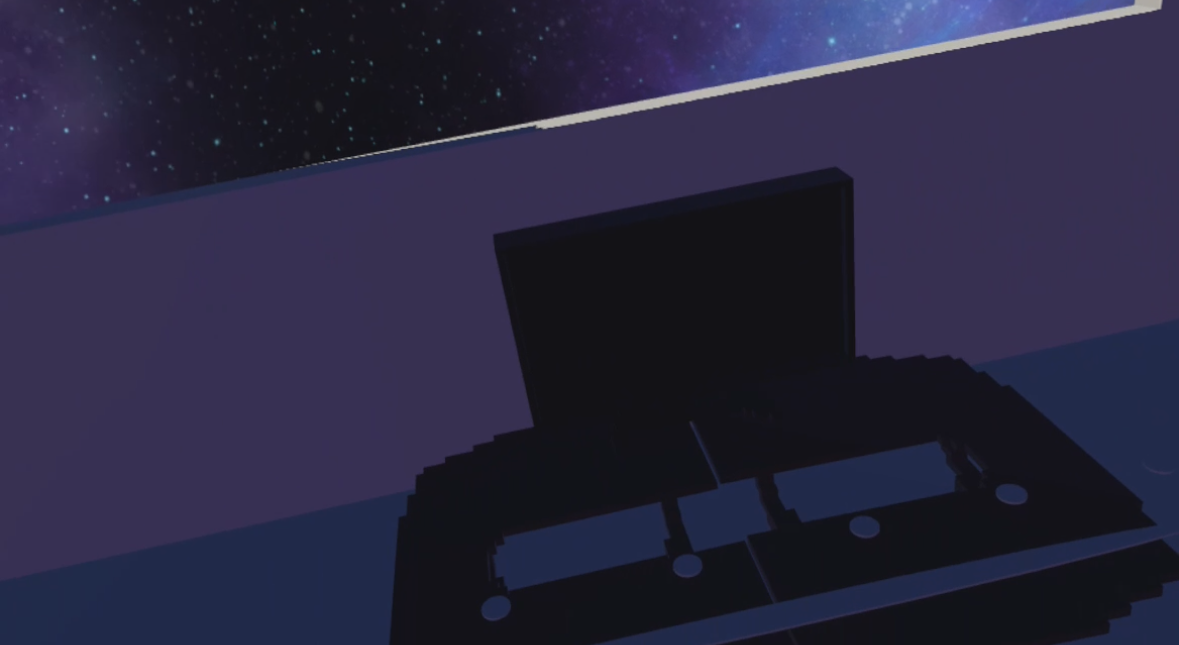
This is a picture of our lab environment, specifically the console in the player's ship.
Group Members
Nivedha Natarajan, Kelsey Sterner, Alexis Dogins, Leo Mikovenyi
Inspiration
Save Our World is a project built with the desire to cultivate a sense of awareness and responsibility within our community, encouraging individuals to actively participate in the uplifting cause of preserving Earth's environment. With a positive outlook, our initiative aims to inspire a collective commitment to nurturing our planet. Through engaging experiences presented by this virtual reality game, we seek to instill a sense of enthusiasm and hope, inviting everyone to play a constructive role in safeguarding the environment. By exploring the wonders of our Solar System in the game, users can discover the potential of planetary resources to contribute to Earth's restoration, while learning about Earth and the other planets in the Solar System. Through this game, we also help to inspire members of our community to get involved in space research and We aim to foster a spirit of shared responsibility and optimism as we embark on this journey together towards a greener and more sustainable future.
What it does
Save Our World is a virtual reality (VR) game that educates players on our Solar System and inspires people in the community to restore Earth’s environment. Players will embark on a journey through the planets in the Solar System, exploring the planetary resources on each planet to help us come up with a solution for Earth’s restoration. They will initially begin at their research lab on a spaceship, learn about their mission, and understand the goal of the game. After the initial prompt, they will travel to each planet and collect samples of planetary resources, such as soil and permafrost, to bring back to the lab for data collection and testing. In this project demo, we have modeled how the game will work for the planet Mars. After traveling to each planet, they will be prompted to learn more about the planet and the unique aspects of the resources available on each planet. At the end of collecting samples from every planet, the player will return back to their research laboratory to understand how they can use the information and samples they obtained to help restore Earth!
How we built it
We started our development process by brainstorming potential project ideas. We wanted to make an educational VR game because we believe that teachers are superheroes who help build future superheroes through their service of providing educational opportunities to people in the community. Given the nature of the theme of superheroes, we wanted to inspire others in the community through an interactive experience to become heroes in their community by helping restore Earth and learn about our Solar System. We determined the best outlet to achieve this goal was through virtual reality (VR). Developing a VR game was a learning curve for everyone in the group, as we had no prior game development experience, or specifically, VR game development experience. Through the help of various learning materials and active development of the project, every member of our team learned a lot about the game development process, such as how to use the Unity platform and how to interact with game objects using an Oculus VR headset. To make the game, the technologies we used include Unity to build the game using assets and C# programming, Oculus VR headsets to develop and test the game in the VR environment, Visual Studio Code to write the C# code for animations and scripts, and GitHub to efficiently manage the code files developed through this hackathon experience. As many members of our team were not familiar with the C# programming language prior to the hackathon, our team collectively learned a significant amount regarding the programming language and its applications with game development (ex. animations, scripts, VR connections). Towards the end of our development process, we worked with testing our game in the VR environment and enhanced the elements of our game to bring players the best gaming and learning experience.
Challenges we ran into
During the project, our group encountered major challenges, but we overcame each obstacle with teamwork and our desire to learn. One of the biggest challenges was that the group had little to no experience with creating VR games or using the Unity platform. This created a large learning curve that had to be rectified within a few hours. However, with the support of various learning resources found online, we were able to learn more about the game development process and how to develop games on Unity. Once we were able to obtain an Oculus VR headset, we had difficulty with setting up the Meta accounts because of certain policies involved with VR accounts; however, we were able to troubleshoot creating the account with teamwork and research on how to set up an account properly. Initially, learning the controls for the VR was another challenge because we had to code interactions for controls we were unfamiliar with; however, we learned how to code the controls remotely, which helped us learn about efficient code deployment processes and how animations and control-based functions work in the C# programming language. We also experienced issues with uploading large files to GutHib repositories, and in the process, we learned about the Git Large File System technology, which allows us to upload large files to GitHub (over 100 MB).
Accomplishments that we're proud of
Throughout the development process, we learned about a lot of new technologies and programming concepts, and we are very proud of the new concepts we learned and the accomplishments we made throughout this hackathon experience. Many of the members of our team had never explored game development or had not used Unity before this hackathon, so building a VR game using Unity was a beautiful learning experience for every member of our team. Some of the new technologies we learned were using an Oculus VR set, game development, the C# programming language, and Unity. With the help of every member of our team and various learning resources, we were able to efficiently learn all of these technologies and successfully create a narrative VR experience that will help inspire people in the community to become heroes and help Earth by learning how to improve environmental issues taking place around the world. By leveraging our individual strengths, such as art and programming, and our desire to learn and develop new skills and strengths, we are very proud to present Save Our World, our narrative VR game that inspires people in the community to become superheroes and save the environment!
What we learned
Through the process of building this project, we learned about the steps involved with game development, how to create a VR game in the Unity environment, and the software and hardware components behind building a VR game. Each obstacle we faced throughout this hackathon, such as setting up the connection between the VR environment and our 3D game, helped us learn a lot about new technologies, inspired us to learn more about game development and VR hardware, and how to efficiently complete the development and testing process. We also learned about how to leverage our individual strengths, including art, programming, and hardware support, to work together and build Save Our World.
What's next for Save Our World
Our current project demo covers the gameplay for players to explore the planet Mars, collect samples, complete research, and understand the results regarding how to restore Earth. The next steps for Save Our World include building the game further to give players the opportunity to explore all of the planets in the Solar System. We also hope to explore options on how to integrate this game into different platforms, such as browsers and mobile devices, to invite a wider audience of people we can inspire to take action on environmental restoration. With more exploration of the Unity platform and VR technologies, we hope to enhance the design of our game to provide an engaging and satisfying gaming and learning experience.


Log in or sign up for Devpost to join the conversation.