Inspiration
Many low-income families and newcomers to Canada struggle with high energy bills, often without realizing why their costs are so high. Small, everyday habits like running the laundry at peak hours, leaving lights or devices on, or using appliances inefficiently quietly add up and drive monthly bills higher than necessary. For households already under financial pressure, these unnoticed costs can make a real difference. On top of that, government rebate programs exist, but information is scattered and hard to understand.
What it does
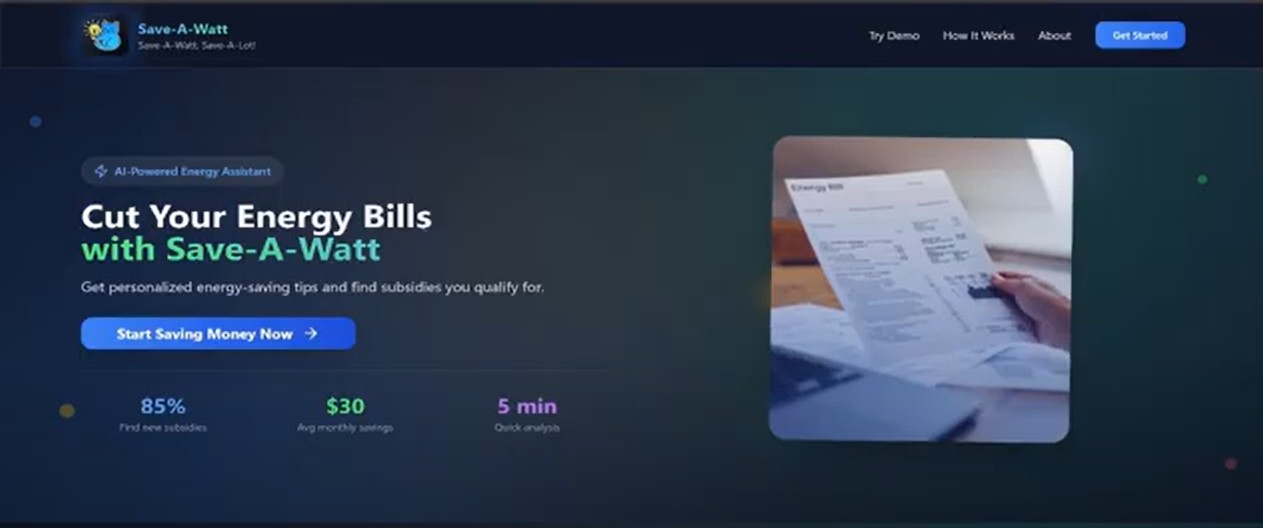
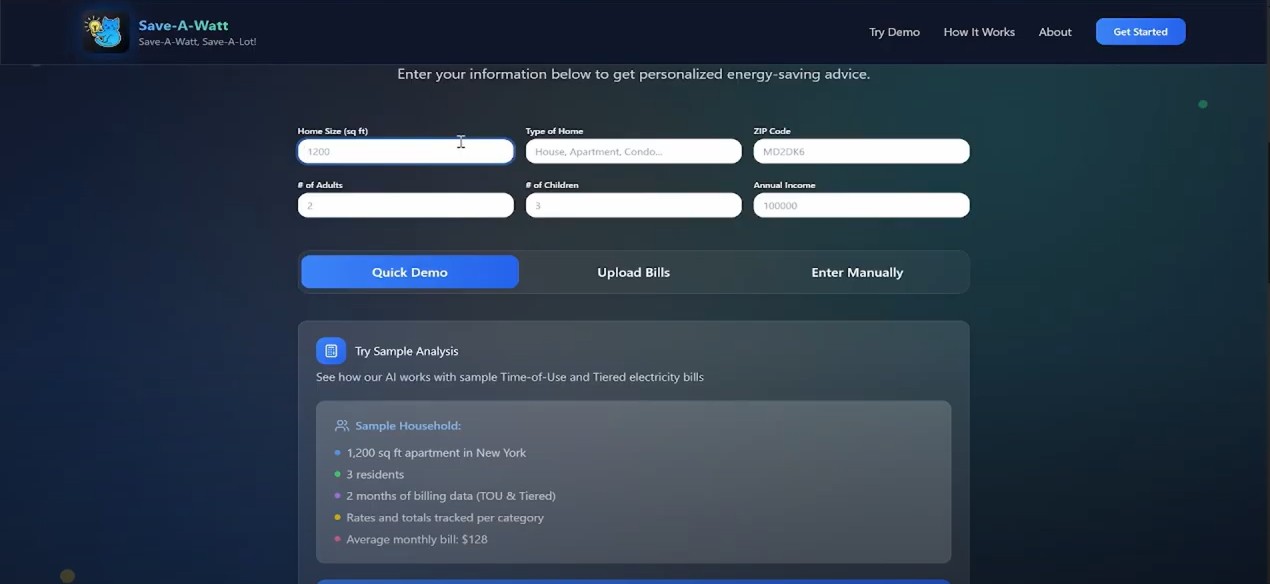
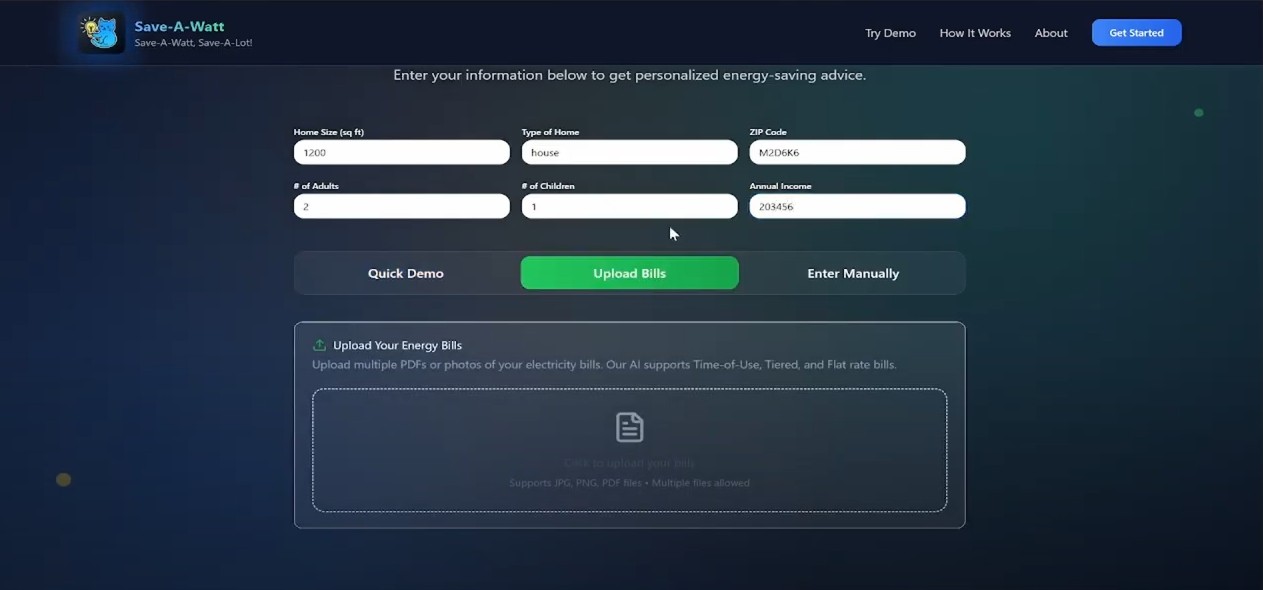
Save-A-Watt is a web app that helps low-income families and newcomers track, understand, and reduce their energy costs in a simple, visual way. The platform provides: Visual energy insights - showing when energy use is highest and which daily habits are costing the most. Practical recommendations - like running laundry or appliances at cheaper times of the day to save money. Access to subsidies and rebate programs - so users can take advantage of government support they might not know exists.
How we built it
We built Save-A-Watt using a combination of modern web technologies and collaborative design tools: Front-end: React and TailwindCSS for a clean, responsive, and easy-to-use interface. Back-end: Flask to manage data and support AI-powered recommendations AI Component: Gemini API to analyze user input to provide personalized energy-saving tips. ML Component: An ML model which takes into consideration multiple factors and gives an efficiency score based on which Gemini can advise better. Design & Collaboration: Figma was used for UI/UX design to ensure the site is visually appealing and accessible, while GitHub allowed the team to work on different parts of the project simultaneously and merge changes efficiently. The project was developed in Visual Studio Code, with each member focusing on different areas: front-end, back-end, and design.
Challenges we ran into
Data availability: Finding a single dataset with all the necessary information proved to be challenging. We ended up combining multiple online datasets, a lot of brainstorming and a simulated final dataset that can actually be used to train a model and return a proper output. Front-end development issues: There were several challenges with layout, spacing, and making the interface responsive and intuitive for all users. Integration difficulties: Connecting the front-end with the back-end and ensuring that AI recommendations displayed correctly was tricky, especially with limited time. AI token optimization: Our AI platform had a limited number of credits per prompt, so we had to carefully engineer prompts and manage token usage to produce accurate, consistent, and useful recommendations without wasting resources.
Accomplishments that we're proud of
We’re proud that we were able to successfully design and build a functional application that reflects our vision for Save-A-Watt. Our team managed to implement most of the key features and functionalities we set out to create, while keeping the interface simple, intuitive, and visually appealing. We put a strong focus on UI/UX design to make sure the platform is accessible and easy to use for anyone, especially users who might not be familiar with energy management tools. We're also proud of how well we collaborated, balancing design, development, and data challenges to bring everything together.
What we learned
Our team learned how to work collaboratively with code and data in a hackathon setting. Learned how to effectively combine "useless "multiple datasets into one useful synthetic dataset. Prompt Engineering, and due to the limit on tokens, we had to effectively leverage Gemini and be efficient about it. Learned how to use Figma and integrate it with React.
What's next for Save-A-Watt
Our team plans to get actual data from reliable sources instead of relying on synthetic datasets. We also hope to fine-tune the LLM (Gemini) more by using actual datasets over time. Our current application is only made for residential bills, but we could extend this to cover commercial bills for industries and save costs there. These improvements will help make Save-A-Watt even more useful and accurate for users trying to manage their energy usage and save money.


Log in or sign up for Devpost to join the conversation.