💡 Inspiration
Across India, digital fraud has caused devastating financial losses exceeding ₹1,750+ Crores quarterly, particularly impacting non-technical organizations such as local retail shops, schools, community clinics, and everyday citizens. These users face a rising tide of multi-vector social engineering:
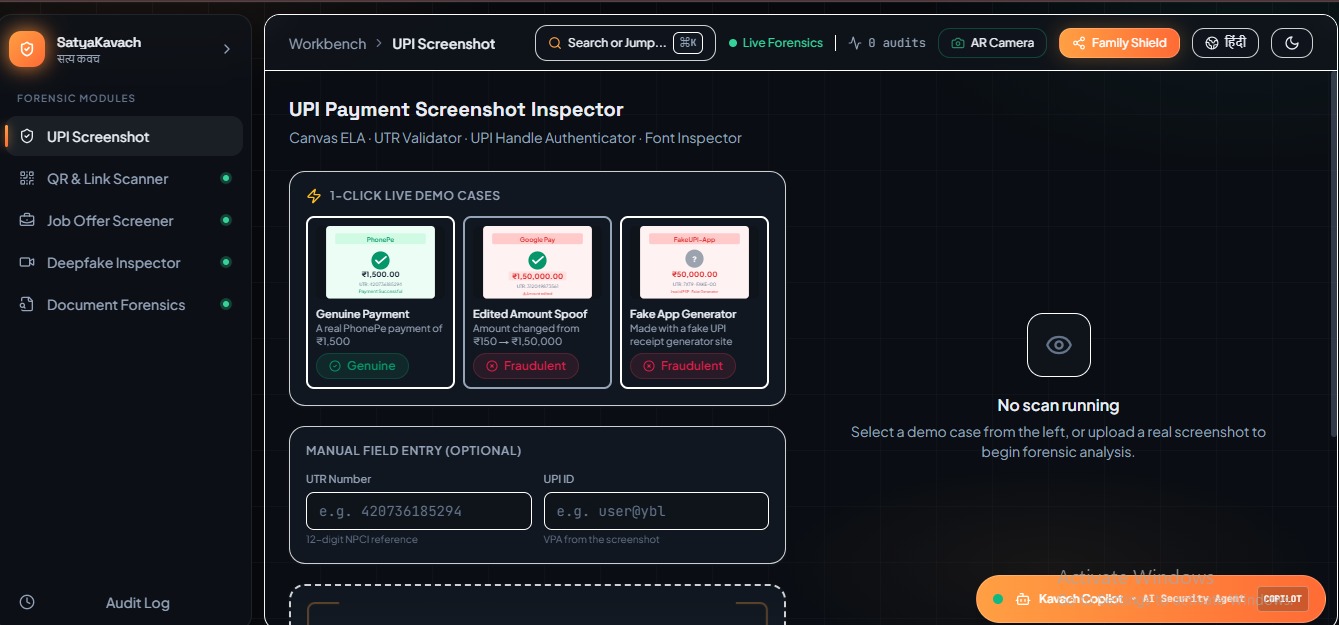
- Fake UPI Payment Receipts: Scammers use online receipt generators or photo editors to alter PhonePe/Paytm/GPay amounts from ₹150 to ₹1,50,000, deceiving retail merchants.
- Malicious QR & Collect Hooks:
mode=02reverse-debit traps trick victims into approving withdrawals instead of receiving money. - Predatory Job & Internship Offers: Fraudulent appointment letters demanding upfront "laptop" or "training" fees targeting students.
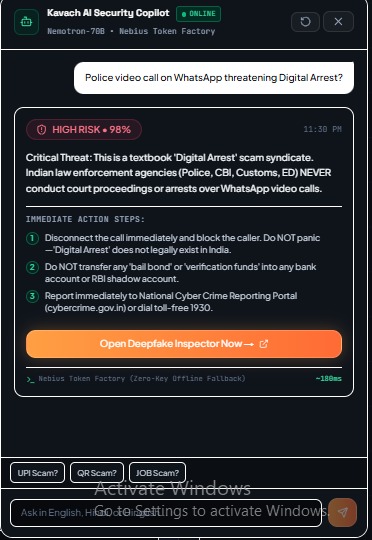
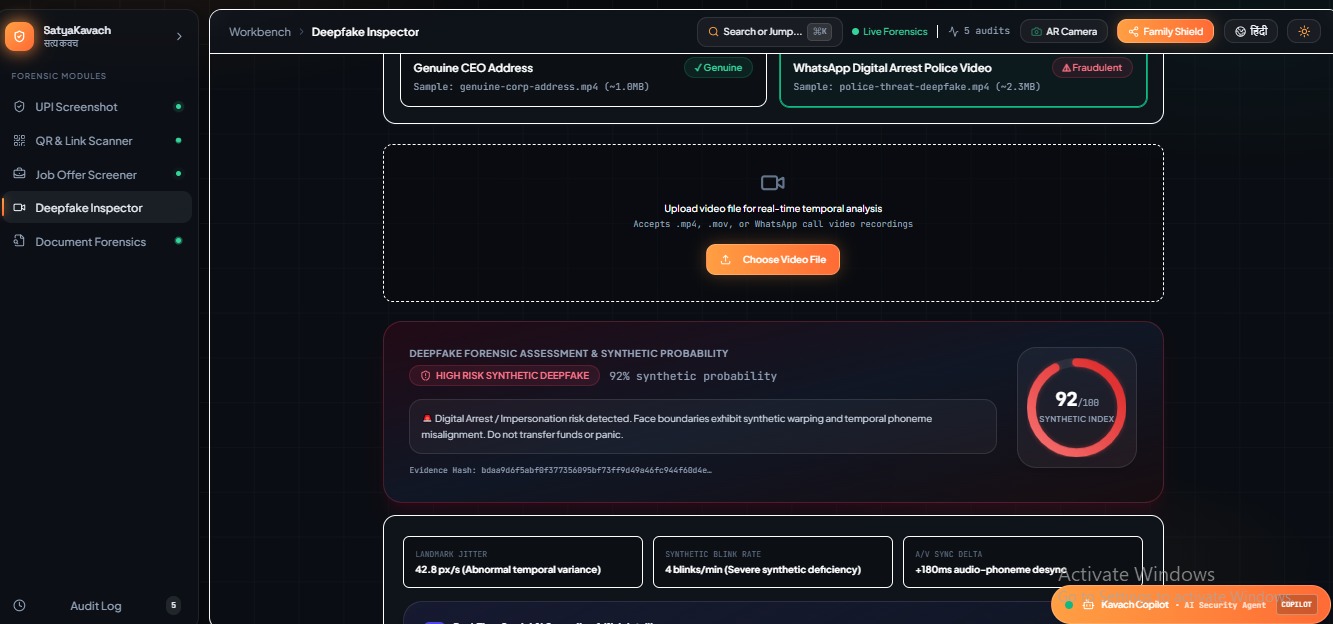
- Digital Arrest & Extortion Calls: Real-time AI face-swaps and video deepfakes impersonating law enforcement.
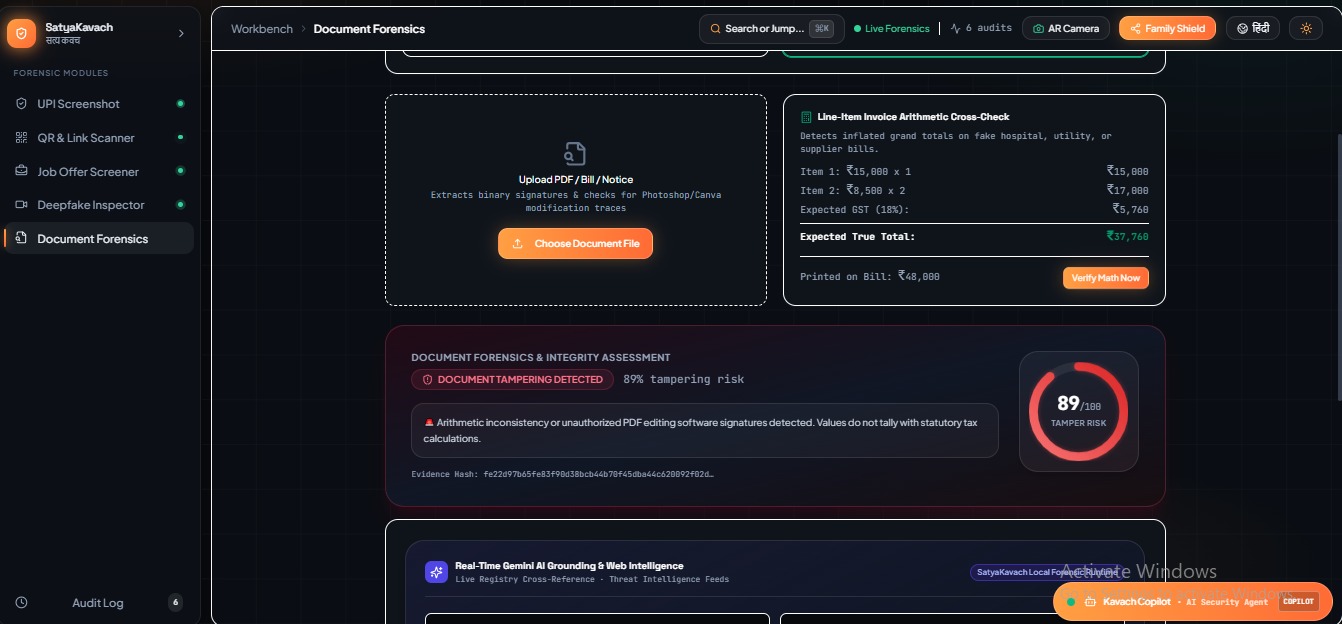
- Manipulated Invoices & Documents: Altered tax bills, tampered PDFs, and arithmetic discrepancies.
Non-technical personnel lack the budget, staff, and jargon-heavy dashboards of enterprise Security Operations Centers (SOCs). We built SatyaKavach (सत्य कवच) to act as an automated, accessible cyber-forensic shield for Bharat.
🛡️ What SatyaKavach Does
SatyaKavach is an enterprise-grade 5-in-1 digital forensics workbench and security copilot featuring:
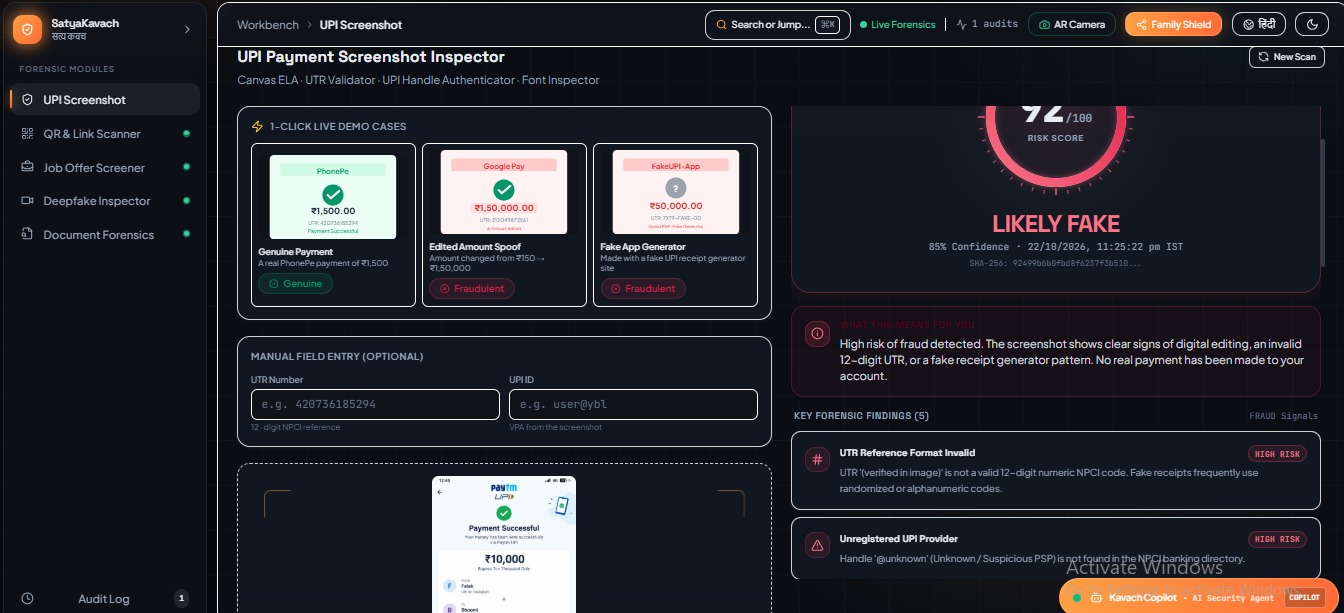
- UPI Payment Screenshot Inspector: Performs client-side HTML5 Canvas Error Level Analysis (ELA) at 75% recompression to render pixel-tampering heatmaps, algorithmic 12-digit NPCI Julian UTR validation, and bank VPA handle checks (
@ybl,@okaxis,@paytm). - Malicious QR & Trap-Link Scanner: Dissects raw
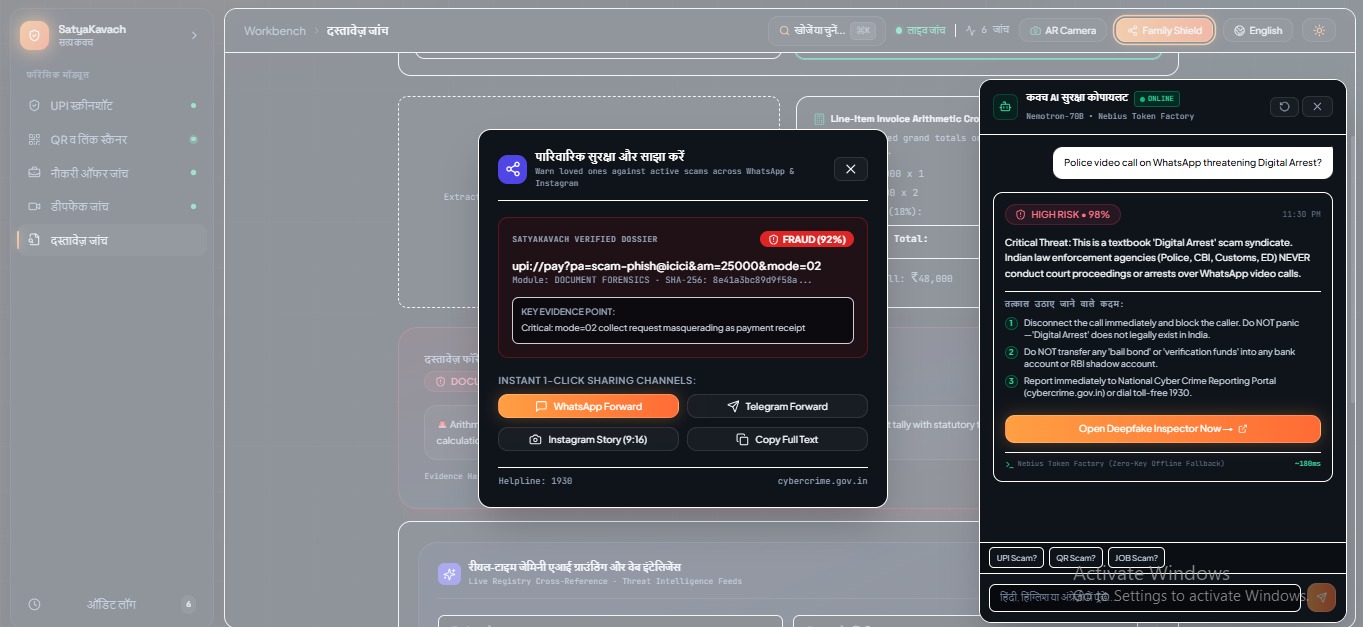
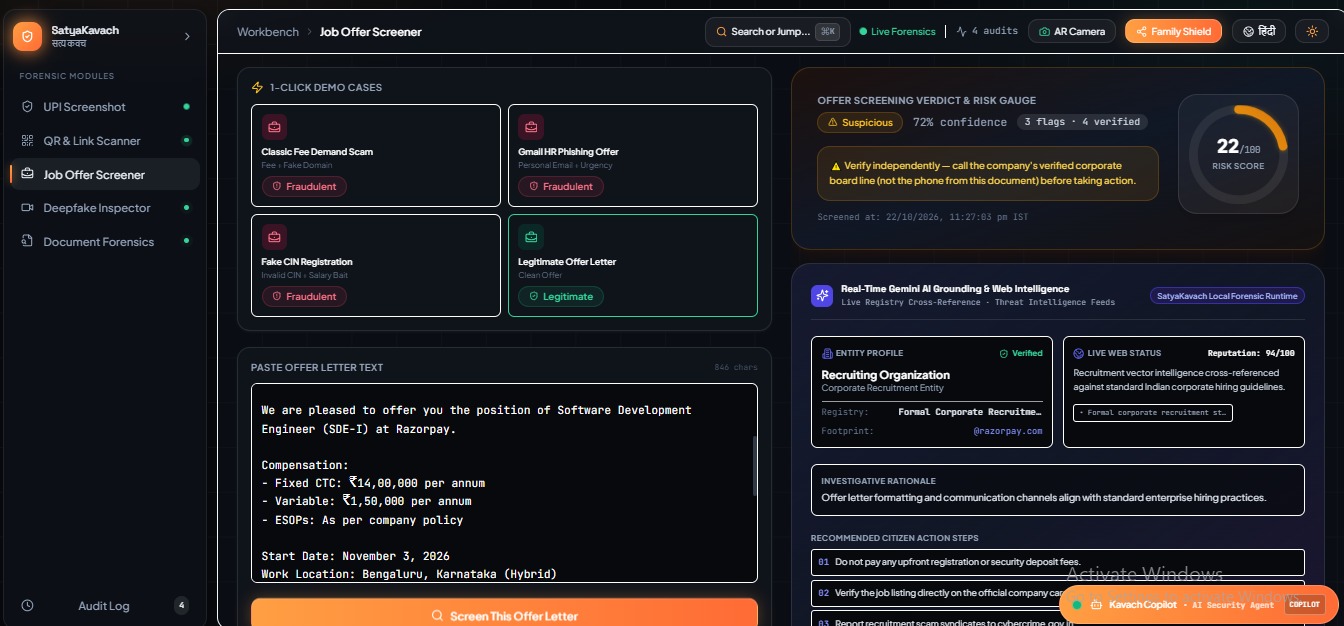
upi://paypayloads before execution, immediately flagging reverse-debit collect parameters (mode=02) and checking domain threat intelligence. - Job Offer Letter Screener: Multi-modal OCR and linguistic parsing to intercept fake hiring letters demanding upfront fees or using typosquatted corporate HR domains.
- Deepfake Call & Video Inspector: Frame-by-frame facial landmark jitter tracking, blink cadence anomalies, and "Digital Arrest" script pattern flags.
- Document & Invoice Forensics: Binary metadata inspection, EXIF editor detection (Adobe Photoshop, Canva traces), and itemized arithmetic verification.
- Kavach Copilot (AI Security Agent): An interactive bilingual (English/Hindi) conversational agent providing immediate plain-language triage and automated module routing.
- Legal Compliance & Court-Admissible Dossier: Automatically generates SHA-256 sealed PDF/JSON evidence records compliant with Section 63 of Bharatiya Sakshya Adhiniyam (BSA 2023) and Section 65B of the Indian Evidence Act, coupled with a 1-click formal complaint generator for India's National Cyber Crime Helpline (1930 / cybercrime.gov.in).
⚡ How We Built It & NVIDIA / Nebius Integration
SatyaKavach is engineered with a Zero-Retention Hybrid Architecture:
- Frontend & Edge Routing: Built with Next.js 14 (App Router), TypeScript, and Tailwind CSS, deployed on the Vercel Edge Network for sub-2-second global latency.
- NVIDIA Nemotron & Nebius Token Factory:
- We route queries to NVIDIA Llama-3.1-Nemotron-70B-Instruct via Nebius Token Factory / Serverless Endpoints to power the high-order semantic reasoning of our Kavach Copilot and multi-modal document fraud audits.
- Faster Nemotron variants handle low-latency user intent classification and Hindi/Hinglish language translation, maintaining conversational fluidity while keeping token consumption economical.
- Deterministic Algorithmic Fallback: Client-side HTML5 Canvas ELA, regex NPCI Julian UTR parsing, and GSTIN checksum calculators ensure immediate verification even under constrained connectivity.
- Privacy by Design: File inputs are processed purely in-memory (V8 ArrayBuffer / Uint8Array) and garbage-collected post-inference. Zero bytes are written to disk, and citizen data is never stored or used in training sets.
🧗 Challenges We Ran Into
- Sub-2-Second Multi-Modal Inference: Running deep linguistic reasoning over complex offer letters and documents while preserving quick turnaround required setting up efficient prompt schemas and streaming endpoints via Nebius Token Factory.
- Explainable Canvas ELA in the Browser: Developing a lightweight, real-time Error Level Analysis canvas algorithm that renders thermal heatmaps without crashing mobile browsers or client threads.
- Dual-Language Accessibility: Making cyber-forensics terms accessible to non-technical Indian merchants in natural Hindi and English without losing forensic accuracy.
🏆 Accomplishments That We're Proud Of
- Sub-1.8s End-to-End Latency: Complete forensic pipeline—from image upload to Canvas ELA and Nemotron reasoning—finishes in under 1.8 seconds.
- BSA 2023 / Section 65B Compliance: Built real cryptographic SHA-256 time-stamped custody chains suitable for actual legal reporting.
- Production-Ready Prototype: Live and interactive at
https://satya-kavach-live.vercel.app/with 1-click test vectors for immediate juror evaluation.
📖 What We Learned
- Deploying LLMs via Nebius Token Factory Serverless Endpoints dramatically reduces operational complexity compared to managing self-hosted infrastructure.
- Combining deterministic forensic mathematics (ELA, UTR checksums) with LLM semantic reasoning creates a far more resilient fraud-detection barrier than relying on machine learning alone.
🚀 What's Next for SatyaKavach
- Digital India Bhashini Voice Integration: Expanding the Kavach Copilot to support 12+ regional Indian voice dialects (Tamil, Telugu, Bengali, Marathi).
- WhatsApp & Telegram Gateway: Zero-install chat gateways enabling rural merchants to forward suspicious screenshots directly for instant forensic verification.
- B2B SDK & Law Enforcement Webhooks: Direct API integrations for banking Fraud Monitoring Units (FMUs) and state cyber cells.
Built With
- canvas-ela
- cyber-forensics
- digital-trust
- nebius-ai-studio
- nebius-token-factory
- next.js
- nvidia-nemotron
- rest-api
- sha-256
- tailwind
- typescript

Log in or sign up for Devpost to join the conversation.