-
-
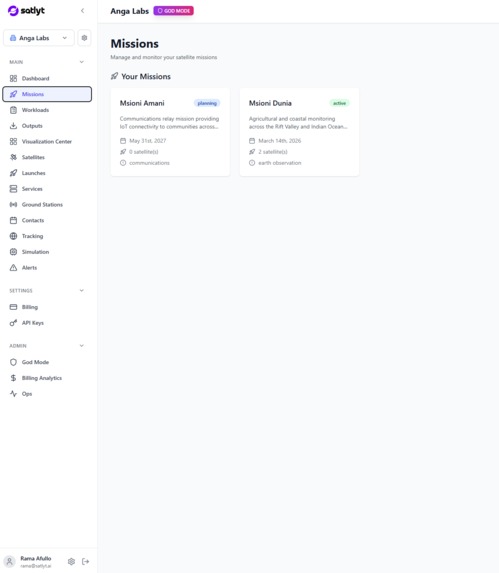
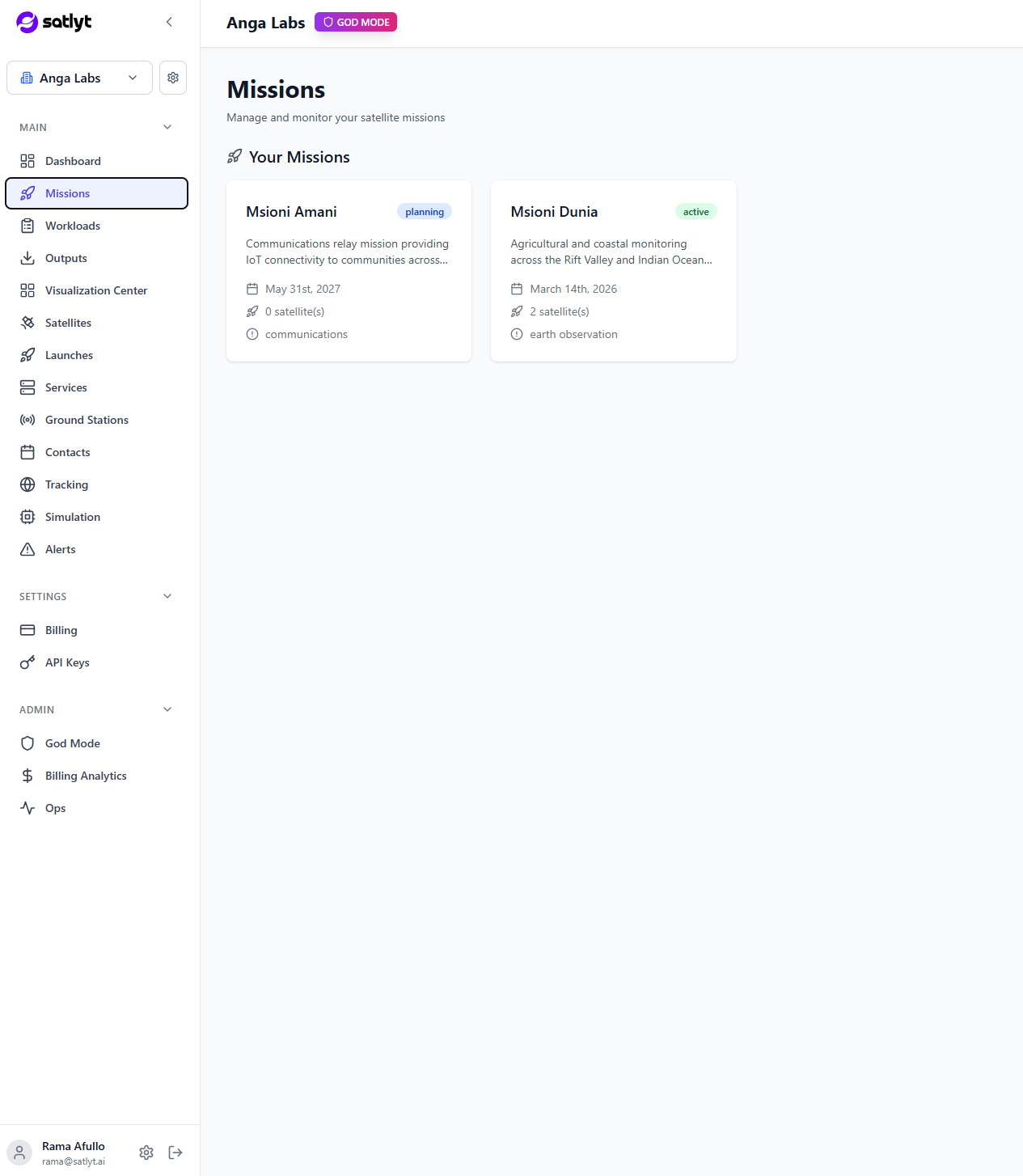
Mission portfolio view showing active and planned customer missions managed through Satlyt MissionOps.
-
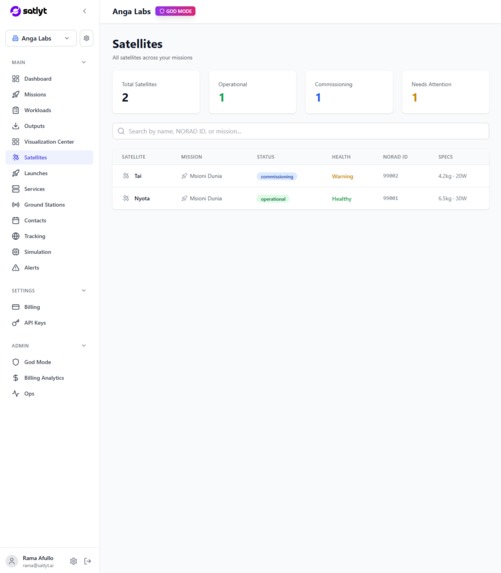
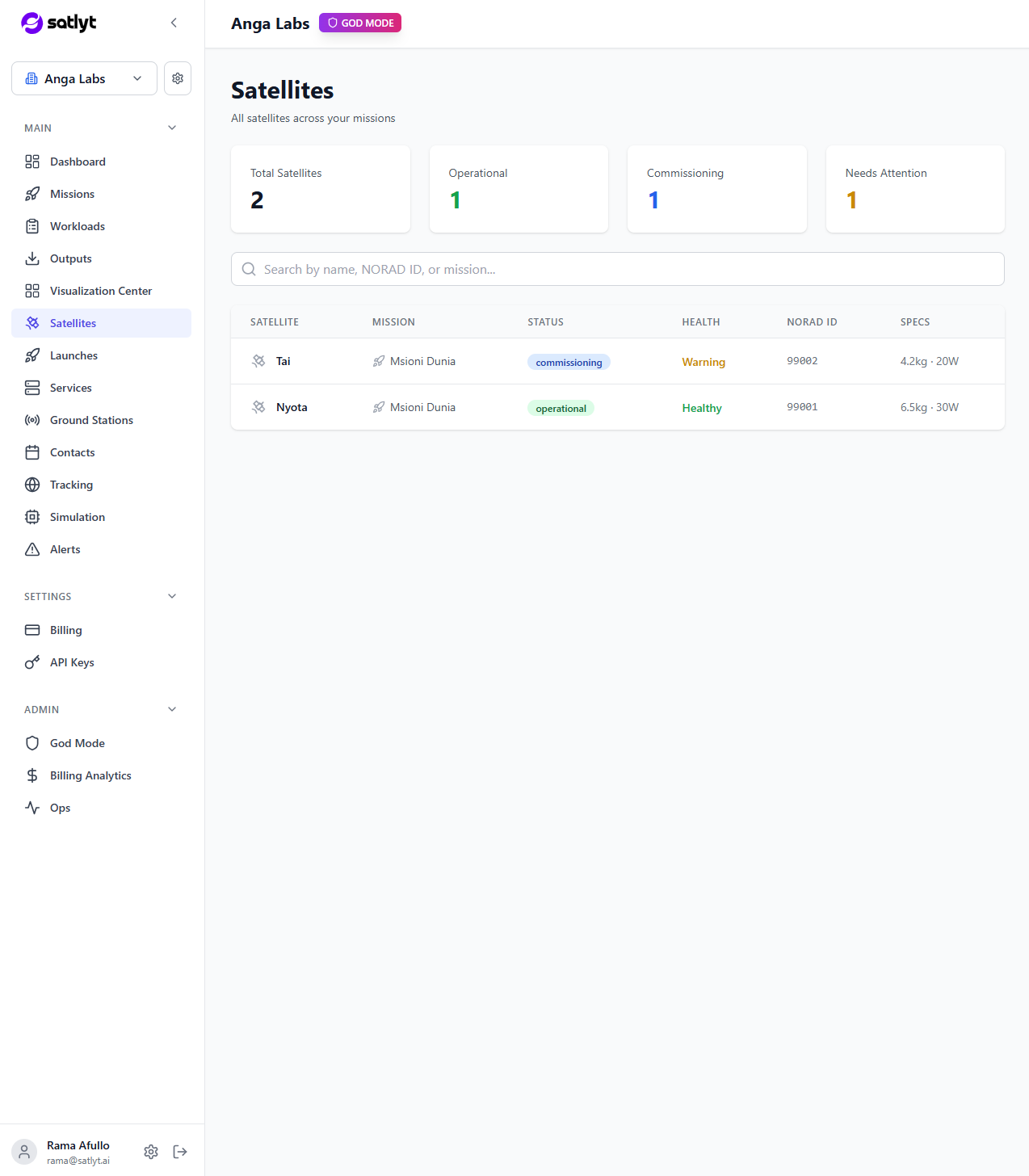
Fleet view showing satellite status, health, mission assignment, and operational readiness across deployments.
-
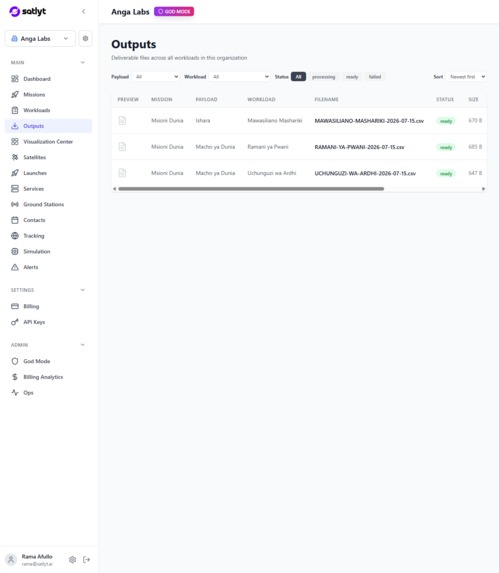
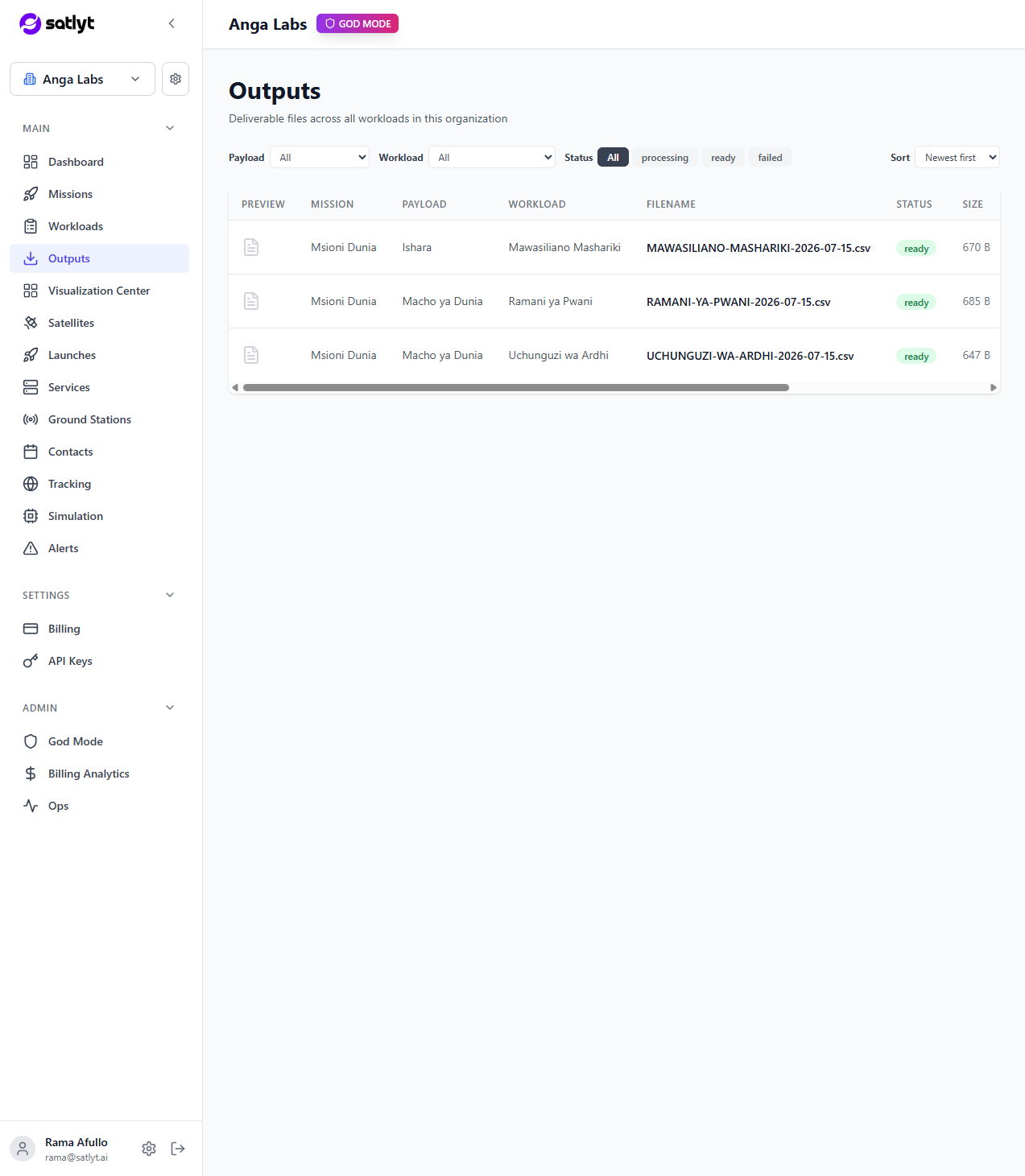
Mission outputs view centralizing customer deliverables generated across hosted workloads and mission executions.
-
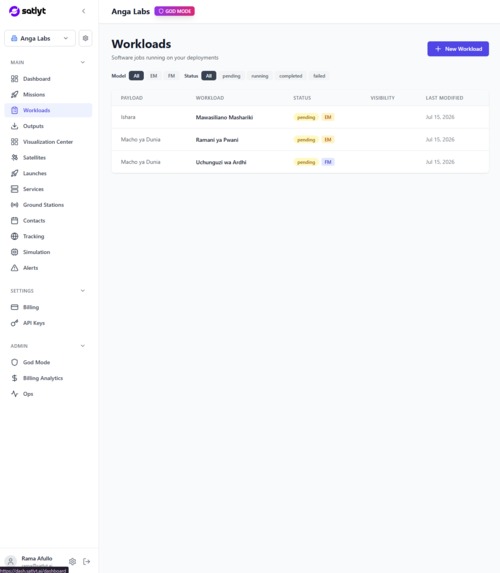
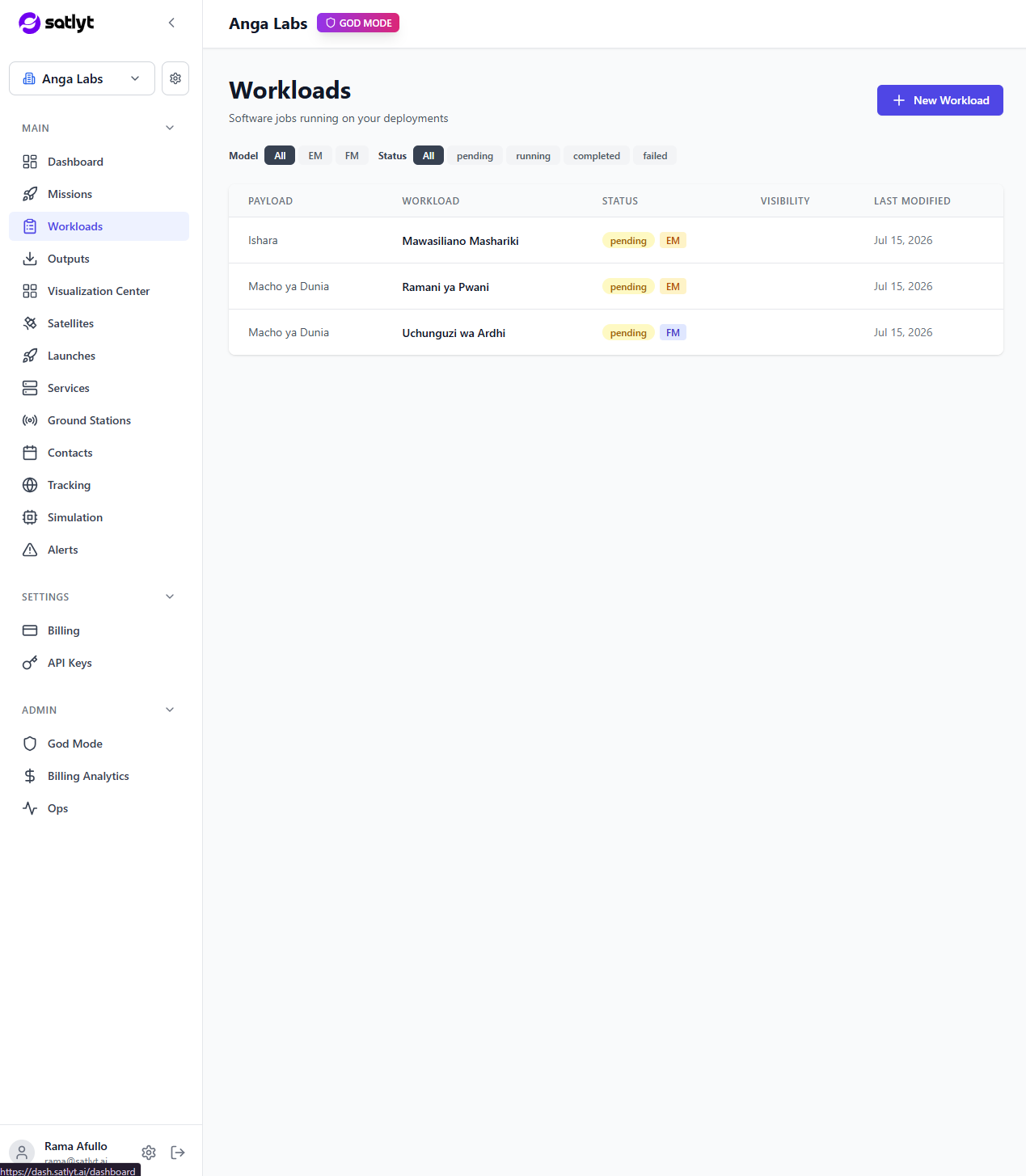
Hosted workload queue showing customer software jobs, execution models, and deployment status across missions.
-
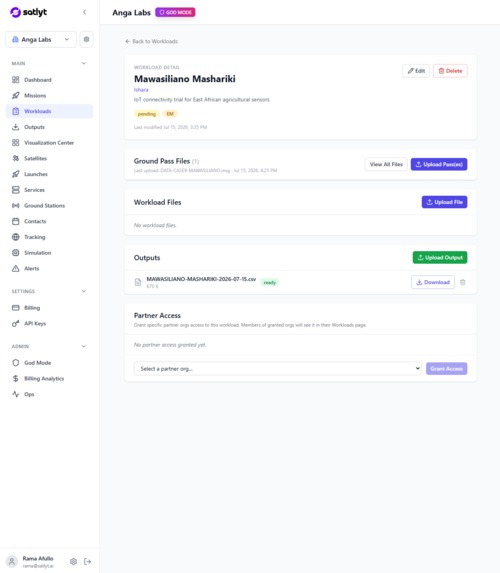
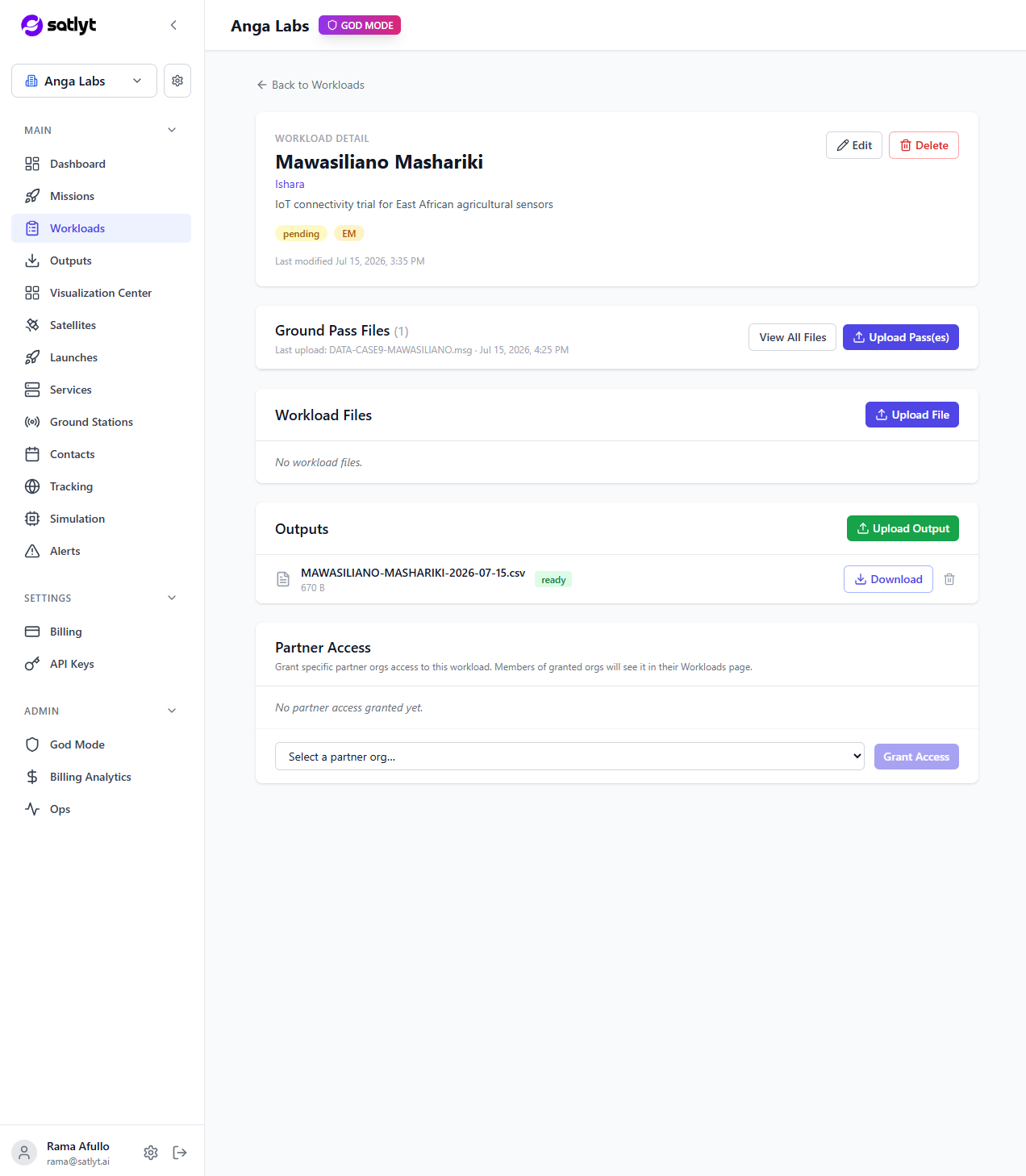
Hosted workload detail with ground-pass files, customer outputs, deployment status, and controlled partner access.
-
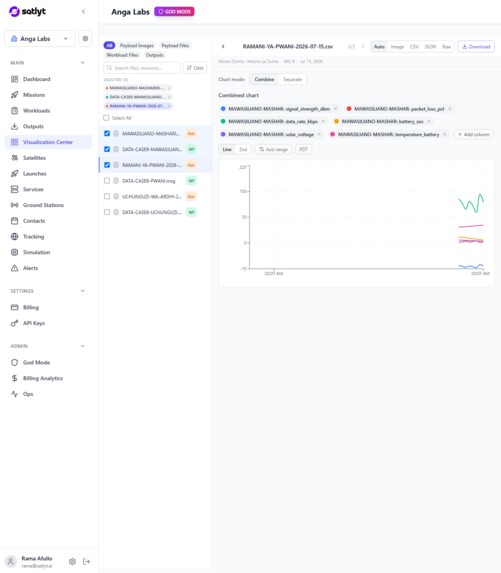
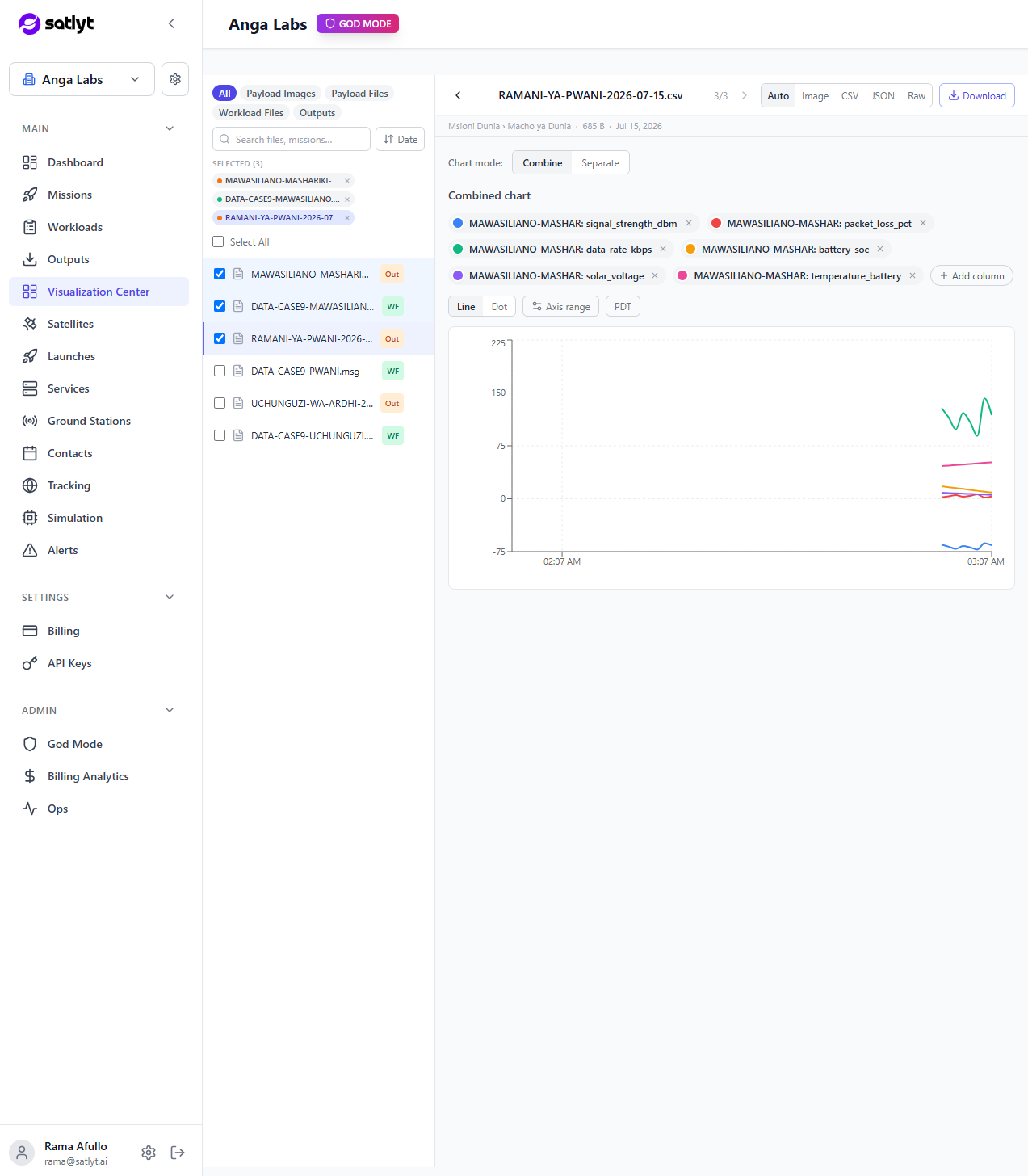
Visualization Center for inspecting and comparing telemetry, workload outputs, and mission data in one workspace.
-
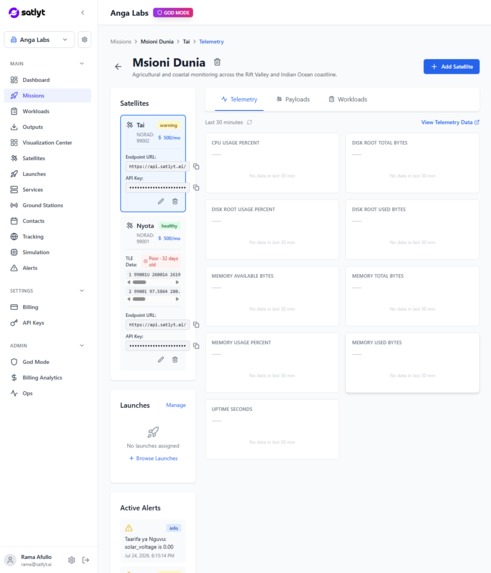
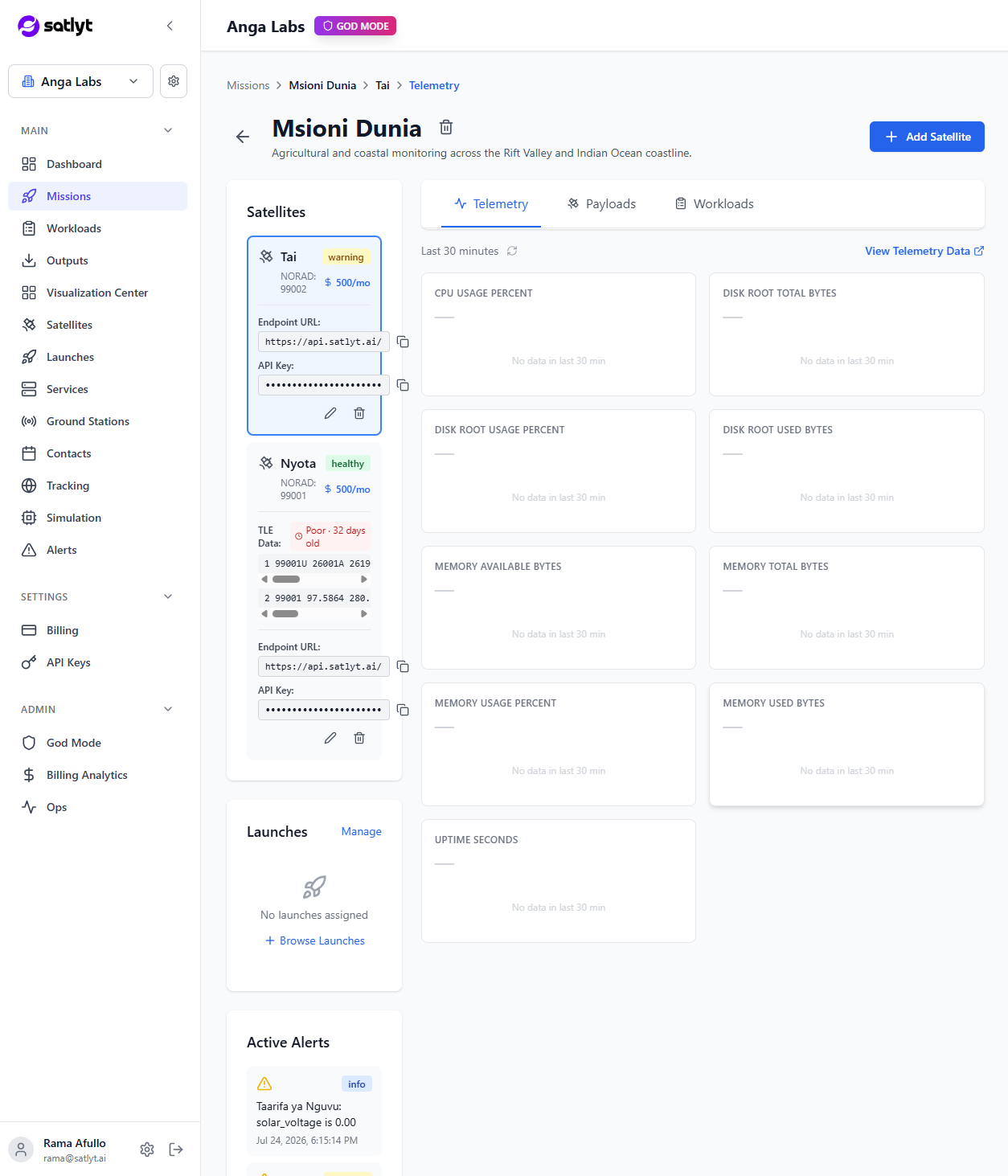
Satellite telemetry view for monitoring health, resource state, alerts, and mission context from one interface.
-
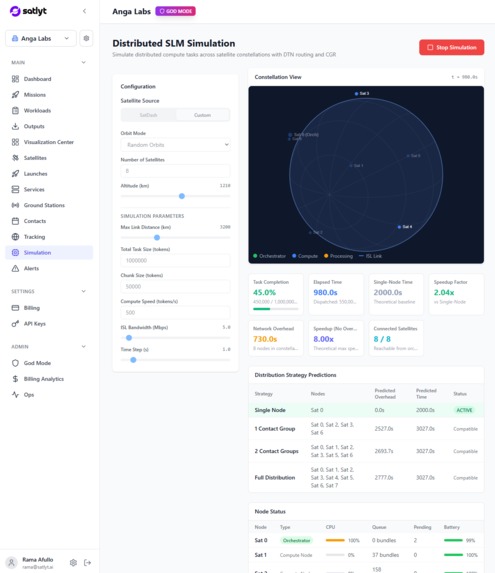
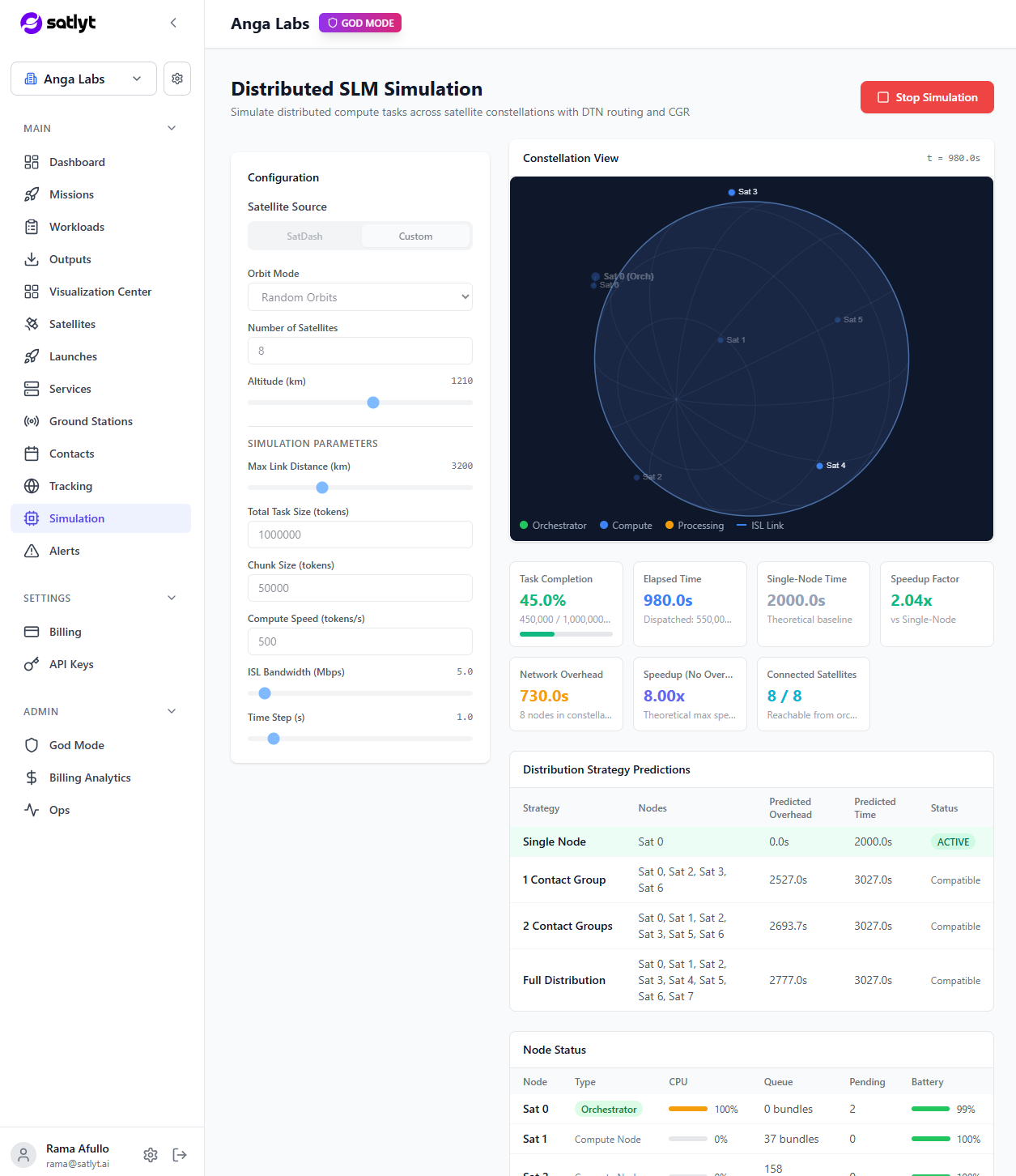
Live 8-satellite SLM simulation showing distributed task progress, orchestration speedup, connectivity, and node status.
-
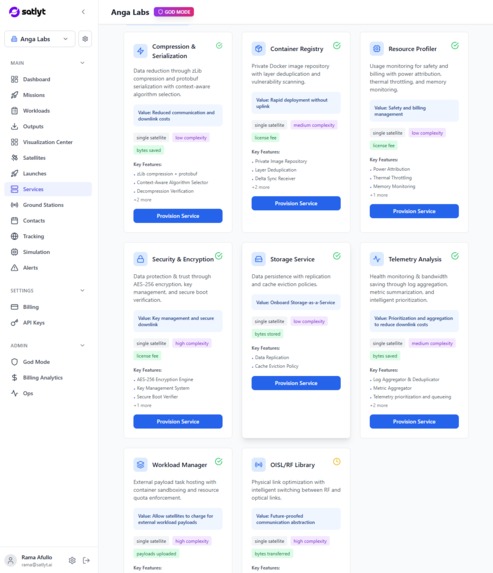
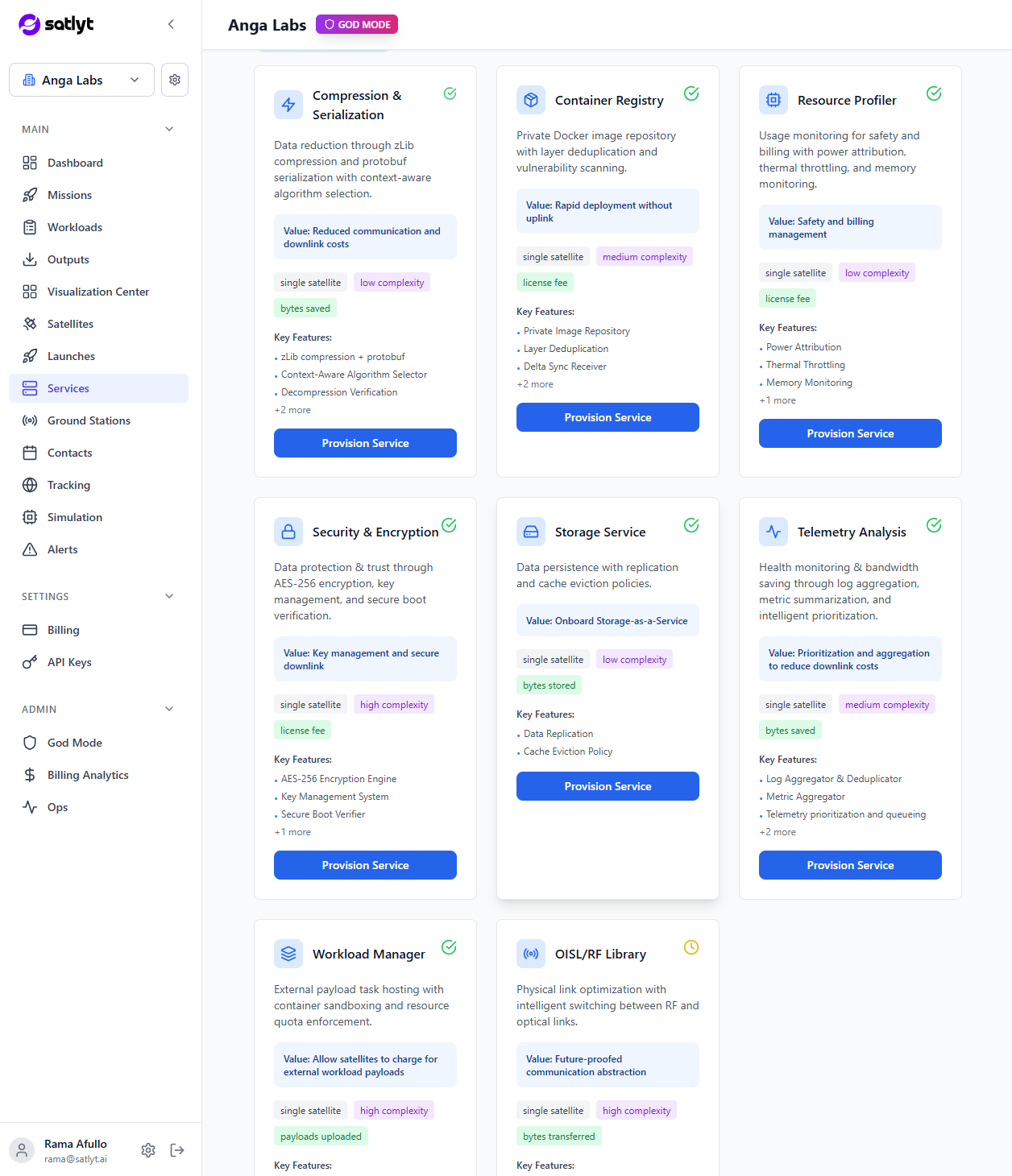
Provisionable mission services for compression, security, storage, telemetry analysis, workload management, and more.
-
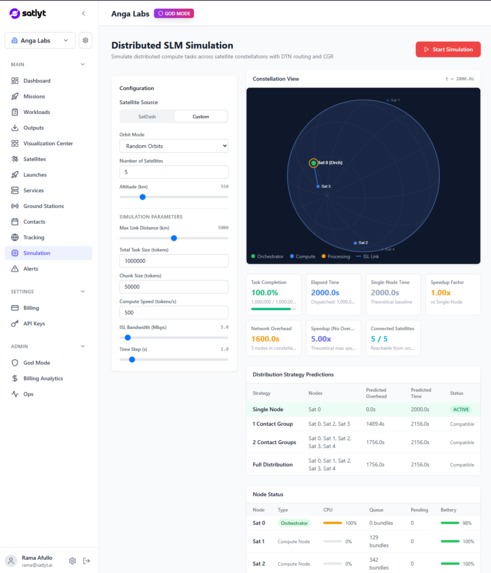
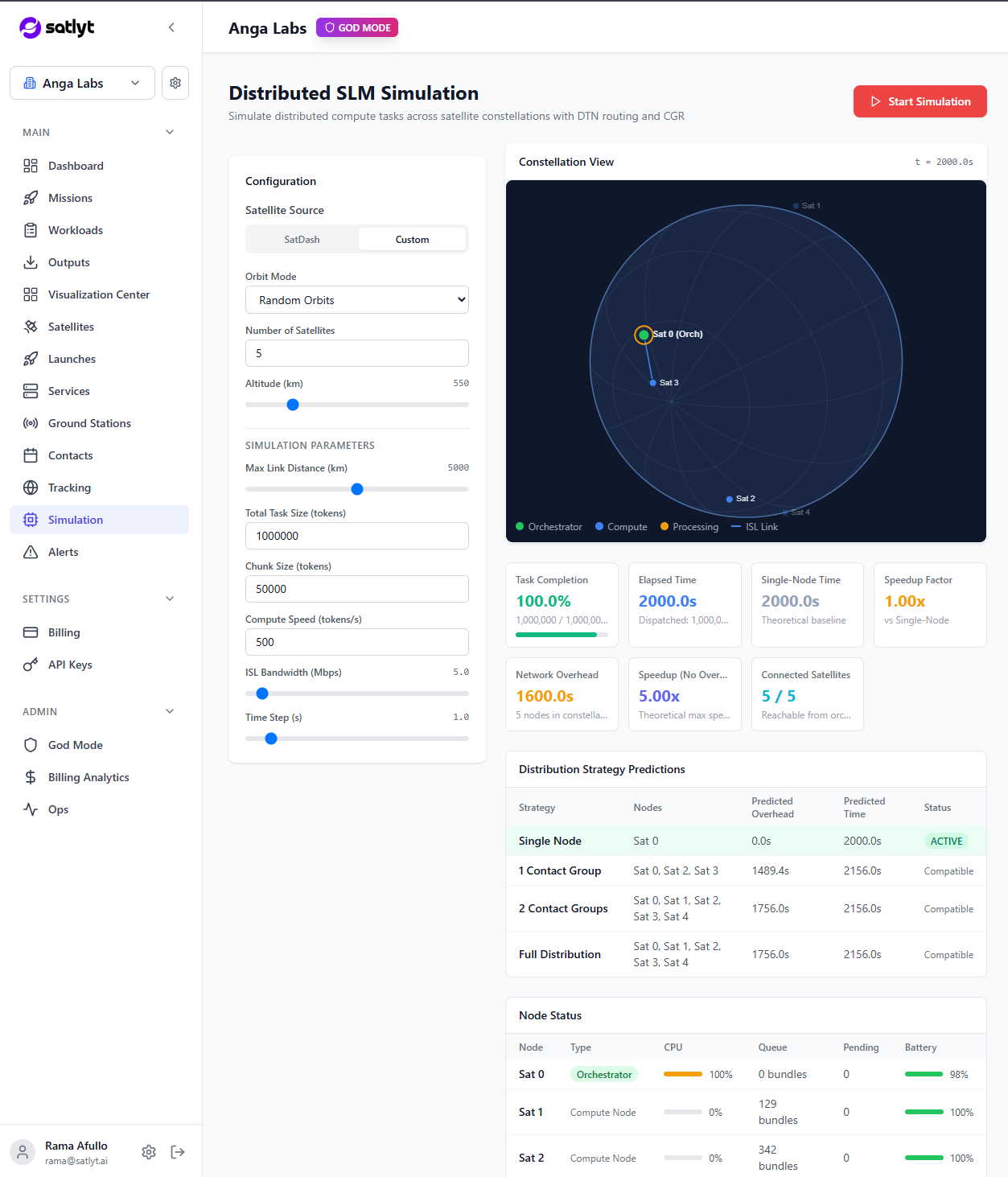
Distributed SLM simulation comparing orchestration strategies, task completion, network overhead, and constellation state.
-
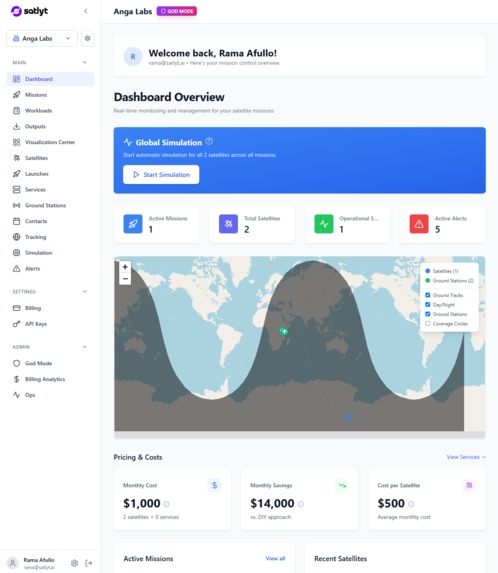
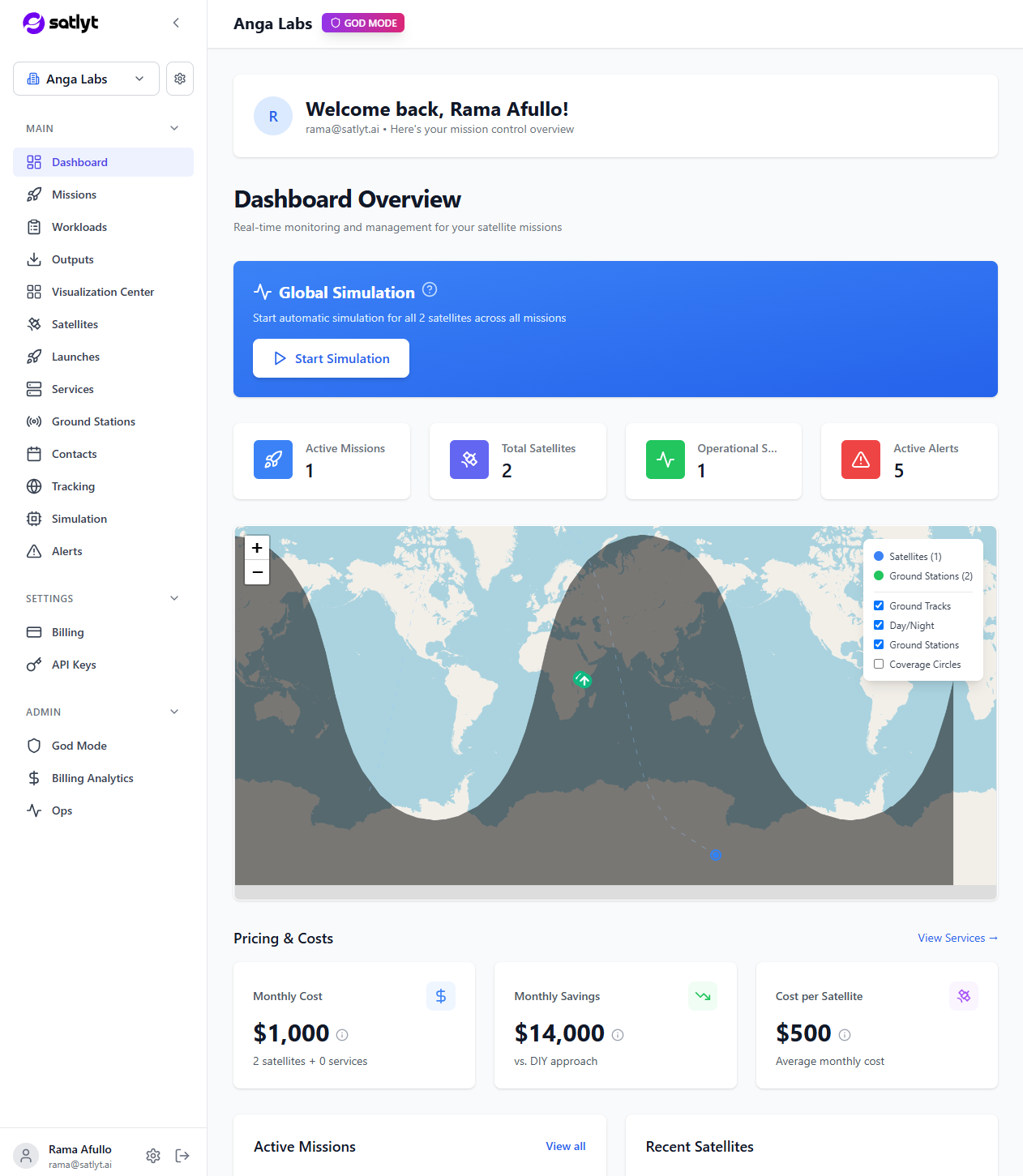
MissionOps dashboard: real-time mission, satellite, alert, ground-station, and cost visibility across hosted workloads.
Inspiration
Software companies can deploy applications to the cloud without building data centers. We believe they should eventually be able to deploy applications to space without building a satellite operations organization.
Today, getting software into orbit is still difficult. A company may need to navigate spacecraft integration, constrained compute, telemetry, intermittent connectivity, deployment pipelines, anomaly diagnosis, mission operations, and specialized engineering expertise before it can validate its application in space.
Satlyt had already built infrastructure for deploying and observing software on spacecraft, including SatDash, workload orchestration, telemetry handling, and edge-compute capabilities. During the Build with Gemini XPRIZE period, we began turning those foundations into a new managed business: Satlyt MissionOps.
The idea is simple:
Deploy your software to space without building your own mission-ops team.
What it does
Satlyt MissionOps is an AI-native managed service for companies that want to deploy and operate software in space.
Customers provide their application or container. Satlyt provides the infrastructure and operational layer required to integrate, deploy, monitor, and support that workload across compatible mission environments.
AI operates across two complementary layers.
Gemma at the edge supports local reasoning over spacecraft telemetry, system logs, stack traces, and software faults. This is valuable in environments where connectivity is intermittent, compute resources are constrained, and downlinking every raw diagnostic artifact is inefficient.
Gemini on the ground powers the MissionOps agent. It receives relevant mission context and diagnostic information, classifies incidents, investigates likely root causes, prioritizes issues, develops remediation recommendations, supports recovery verification, and generates structured operational reports.
Humans retain authority over mission constraints and consequential spacecraft actions.
The operating loop is:
monitor → diagnose → recommend → approve → remediate → verify → report
How we built it
Satlyt MissionOps was built during the XPRIZE period using Satlyt's disclosed pre-existing infrastructure as its technical foundation.
SatDash provides workload visibility, telemetry, observability, and mission execution context. Satlyt's existing runtime and orchestration infrastructure provide the mechanisms for deploying and managing hosted software workloads.
For local reasoning, we built on prior Satlyt work using Gemma on satellite-class hardware. Gemma has been used to analyze software errors, summarize stack traces, diagnose faults, and generate troubleshooting recommendations. Our ongoing Gemma 4 work extends that architecture toward telemetry reasoning on Jetson-class edge hardware.
For the new MissionOps layer, we integrated Gemini as the ground-side reasoning engine. Gemini receives structured operational context and produces outputs such as incident classification, root-cause analysis, remediation recommendations, and recovery assessments.
This creates a hybrid architecture in which edge and cloud AI perform different jobs rather than assuming every spacecraft has continuous high-bandwidth connectivity.
Challenges we ran into
The hardest problem was not simply identifying anomalies. It was determining what AI should be allowed to do after identifying one.
Spacecraft are constrained and consequential systems. A plausible AI recommendation is not sufficient justification for blindly issuing a command.
We therefore designed MissionOps around graduated autonomy.
AI can continuously analyze, diagnose, prioritize, and prepare remediation. Humans remain in the loop for actions where mission safety, customer policy, or mission-partner constraints require approval. Operational decisions can be recorded so an operator can understand what the system observed, why it recommended an action, and what happened afterward.
A second challenge was deciding where reasoning should happen.
Running everything in the cloud assumes reliable connectivity. Running everything locally limits model capability. Our architecture therefore combines local Gemma reasoning with more capable Gemini reasoning on the ground.
Accomplishments that we're proud of
The most important accomplishment is that Satlyt MissionOps is being built around a commercial workflow that already has a paying customer.
During the XPRIZE period, an external commercial space software company entered into a hosted deployment engagement with Satlyt to deploy and operationally support its proprietary software workload.
That engagement includes workload onboarding, deployment support, workload visibility, telemetry handling, mission execution monitoring, execution logs, and operational reporting.
This provides early evidence that software companies will pay for the ability to access orbital infrastructure without building the entire operational stack themselves.
We are also building on real technical validation. Satlyt has already tested Gemma-based analysis of spacecraft-class software faults, logs, and stack traces and generated compact diagnostic and troubleshooting outputs.
The XPRIZE project connects those capabilities into a broader AI-native MissionOps workflow.
What we learned
Our biggest lesson was that the opportunity is larger than an AI feature for satellites.
The real bottleneck is operations.
A software company may have an excellent application for Earth observation, cybersecurity, scientific processing, communications, or another orbital use case, but deploying that application requires an entirely different set of capabilities.
AI can change the economics of providing those capabilities as a service.
Traditionally, supporting more hosted applications means adding more engineers to monitor telemetry, investigate failures, interpret logs, determine corrective actions, and prepare reports.
If AI can reliably perform increasing portions of those workflows, a MissionOps team can support many more applications.
Humans shift toward mission policy, supervision, customer relationships, and high-consequence decisions. AI handles more of the continuous operational analysis.
That is how MissionOps can evolve from engineering-intensive services into a scalable software and infrastructure business.
What's next for Satlyt MissionOps
Our next objective is to move from the first commercial hosted workload toward a repeatable platform serving many software companies across multiple spacecraft and mission environments.
We plan to expand MissionOps across deployment readiness, continuous health monitoring, anomaly triage, remediation planning, recovery verification, automated reporting, and increasingly autonomous workflows where mission constraints permit.
Commercially, we expect the business to combine deployment fees, recurring MissionOps subscriptions, and usage-based infrastructure charges.
Our broader vision is straightforward:
Software companies should be able to build for space without becoming satellite operators.

Log in or sign up for Devpost to join the conversation.