-
-
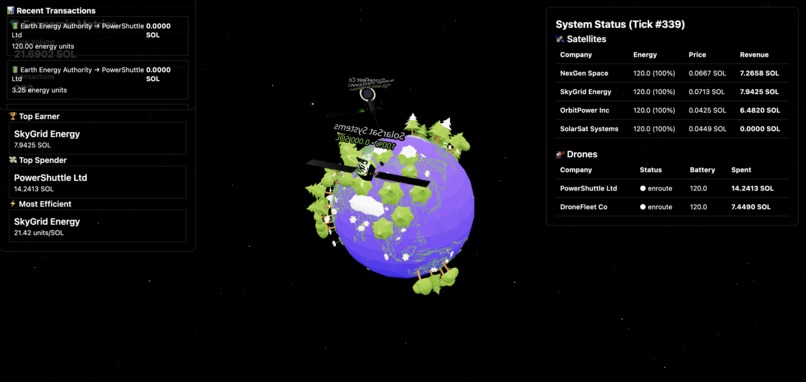
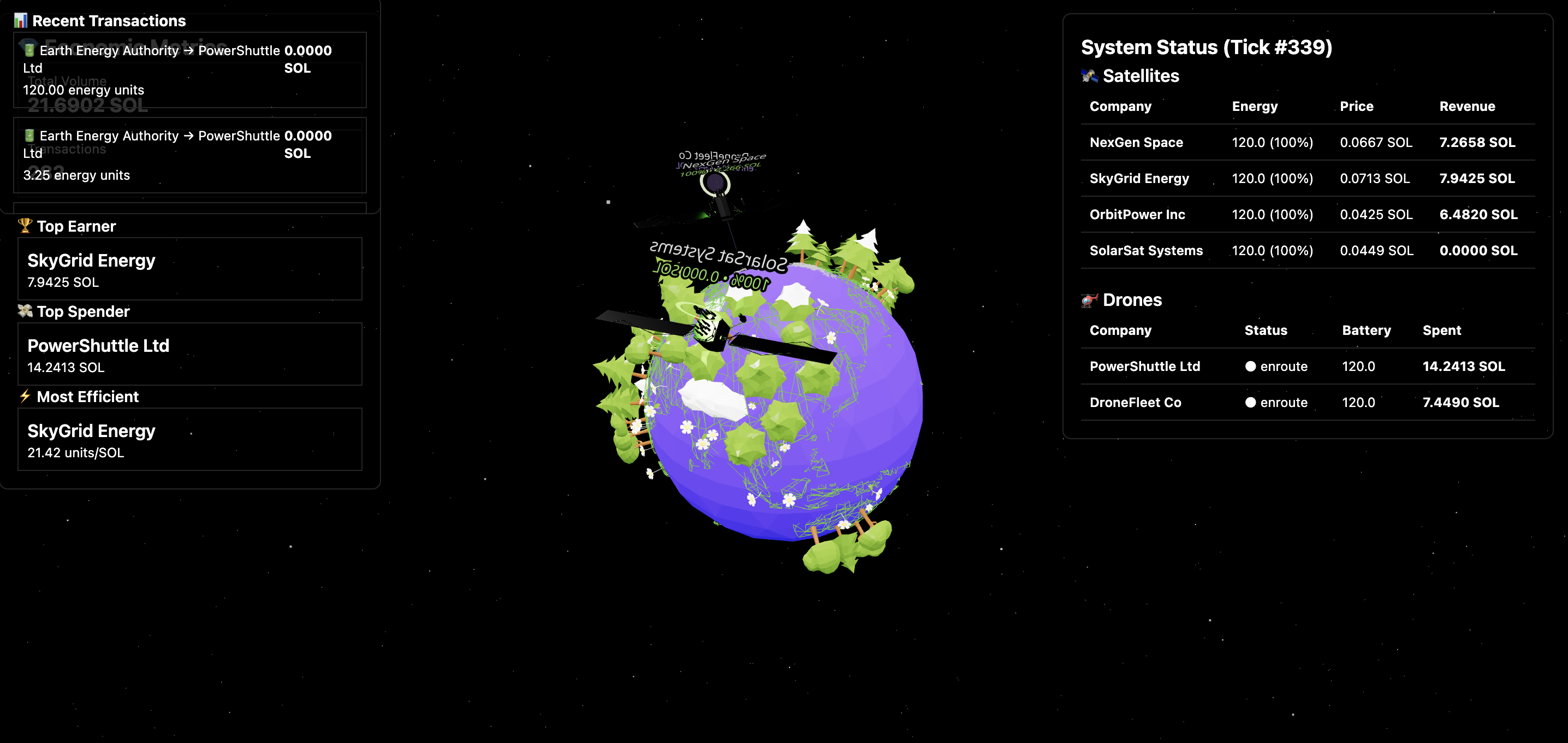
Simulation
-
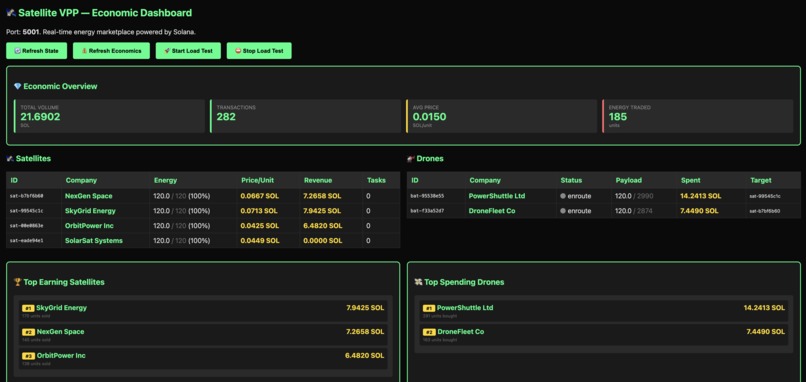
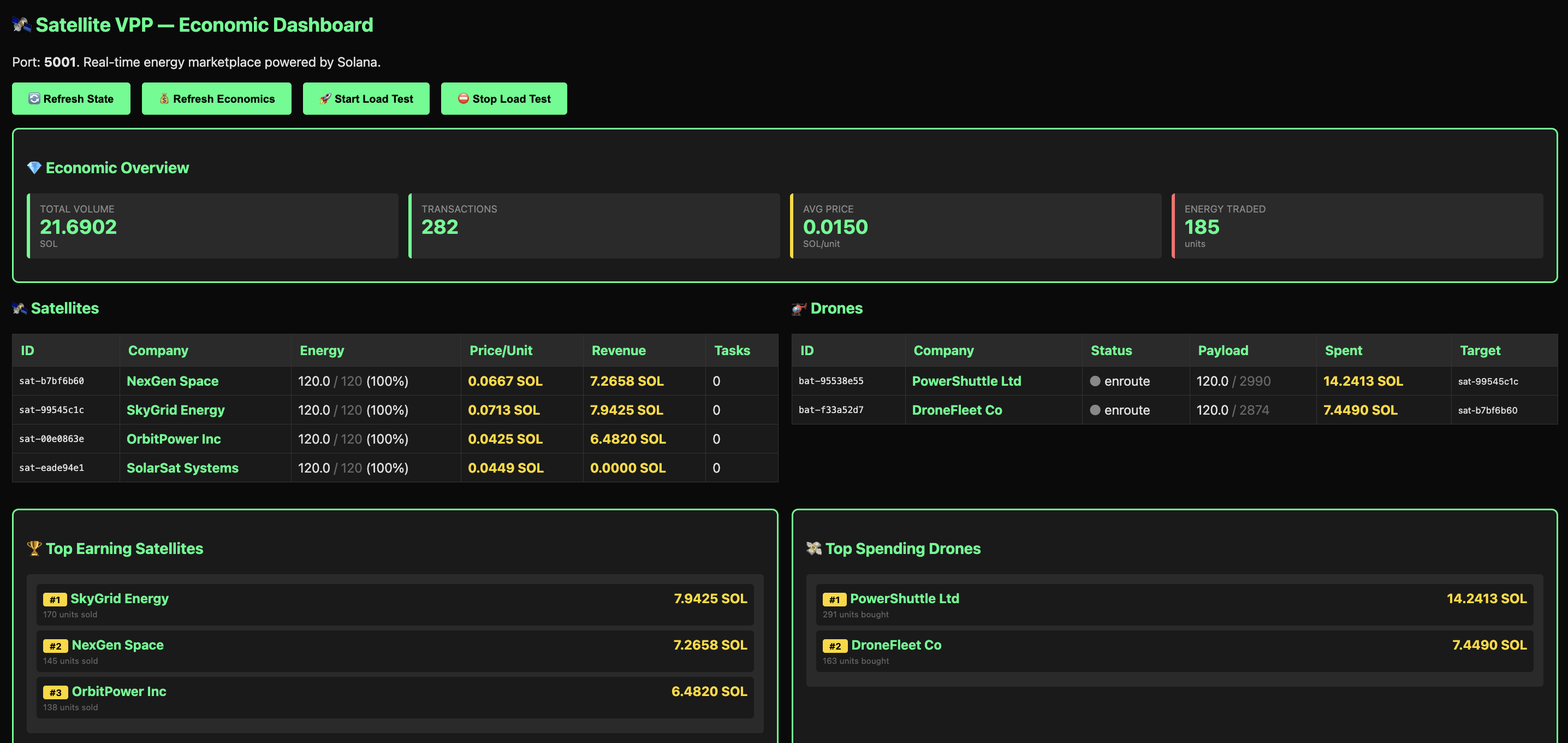
Dashboard
Satellite Virtual Power Plant (VPP) with Solana Economics
Inspiration
The idea came from learning that companies are starting to put GPUs into space to create datacenters capable of processing queries in orbit.
In space, cooling is not a major issue, which makes it an ideal environment for high-performance computation.
During my internship at EverBright, a Nextera Subsidiary, I also learned about Virtual Power Plants (VPPs), intelligent energy networks that distribute renewable energy between connected systems.
I decided to merge both ideas: an orbital GPU network that autonomously balances energy through solar power and blockchain-based trading.
What it does
Satellite VPP simulates a decentralized, autonomous network of satellites equipped with solar panels and GPUs.
Each satellite monitors its energy level, processes computational tasks, and interacts with autonomous drones that transfer power between nodes.
All energy transactions are tokenized using Solana SPL tokens, creating an on-chain record of orbital energy trading.
The system visualizes:
- Real-time drone movement between satellites
- Energy flow across the network
- Blockchain transactions that represent energy exchanges
How we built it
Backend: Python Flask with a custom simulation engine for satellites, drones, and power transfers.
Includes routing logic, energy forecasting, and automated drone dispatch.Frontend: React with Three.js for 3D visualization.
Displays Earth, orbiting satellites, and live energy transfers.Blockchain Integration: Solana Devnet via
solana-py.
Each satellite is assigned a wallet that can send and receive a custom token called SOLAR whenever energy is traded.Real-time Updates: Flask-SocketIO was used to stream live events, while long polling was used as a fallback for stability.
Challenges we ran into
- Balancing WebSocket and long polling performance for smooth frontend updates.
- Designing reliable drone dispatch logic, ensuring only one drone can claim a satellite at a time.
- Preventing drones from getting stuck in transit or entering infinite charge-harvest loops.
- Coordinating energy trading events with Solana transactions while maintaining simulation speed.
- Synchronizing multiple state updates (energy, tasks, blockchain) without race conditions.
Accomplishments that we're proud of
- Built a fully autonomous and self-regulating orbital energy simulation from scratch.
- Integrated real blockchain transactions (Solana Devnet) to represent tokenized energy economics.
- Created a live 3D environment showing real-time drone movement, satellite power flow, and token exchanges.
- Developed a stable backend architecture capable of handling concurrent drone and satellite activity.
What we learned
- How to apply Virtual Power Plant principles to distributed, autonomous systems.
- How to synchronize real-time backend processes with complex frontend visualizations.
- How blockchain networks like Solana can represent real-world energy markets.
- Techniques for improving simulation stability through event-driven and timeout-based logic.
The most important technical takeaway was understanding how to balance simulation logic and visualization in real time while keeping the system deterministic and stable.
What's next for Satellite Virtual Power Plant w/ Solana Economics
- Integrate a predictive AI dispatcher that launches drones preemptively based on energy trend forecasting.
- Simulate solar weather events such as flares or eclipses that impact energy generation.
- Expand the Solana integration to support on-chain governance and dynamic pricing.
- Develop an interactive control dashboard for mission planning and replay analytics.
- Deploy the project to the cloud for public access and real-time visualization.
Developed by Aridsondez Jerome for MDC Hackathon 2025.


Log in or sign up for Devpost to join the conversation.