-
-
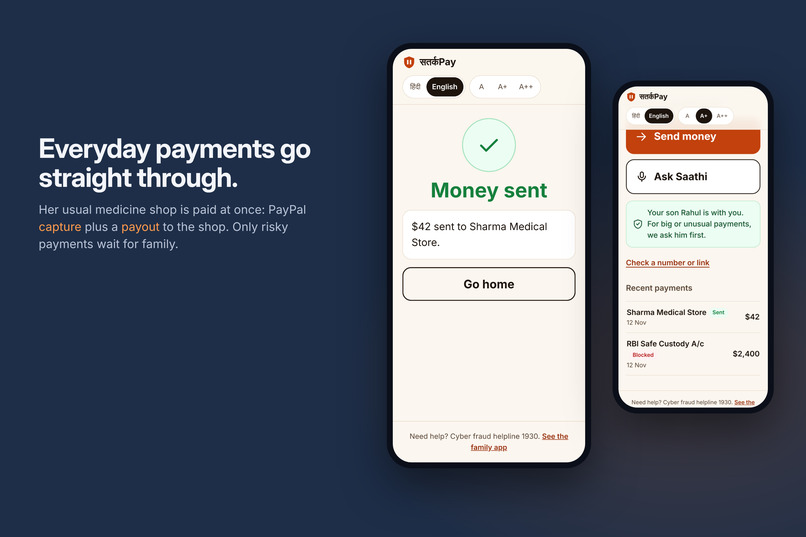
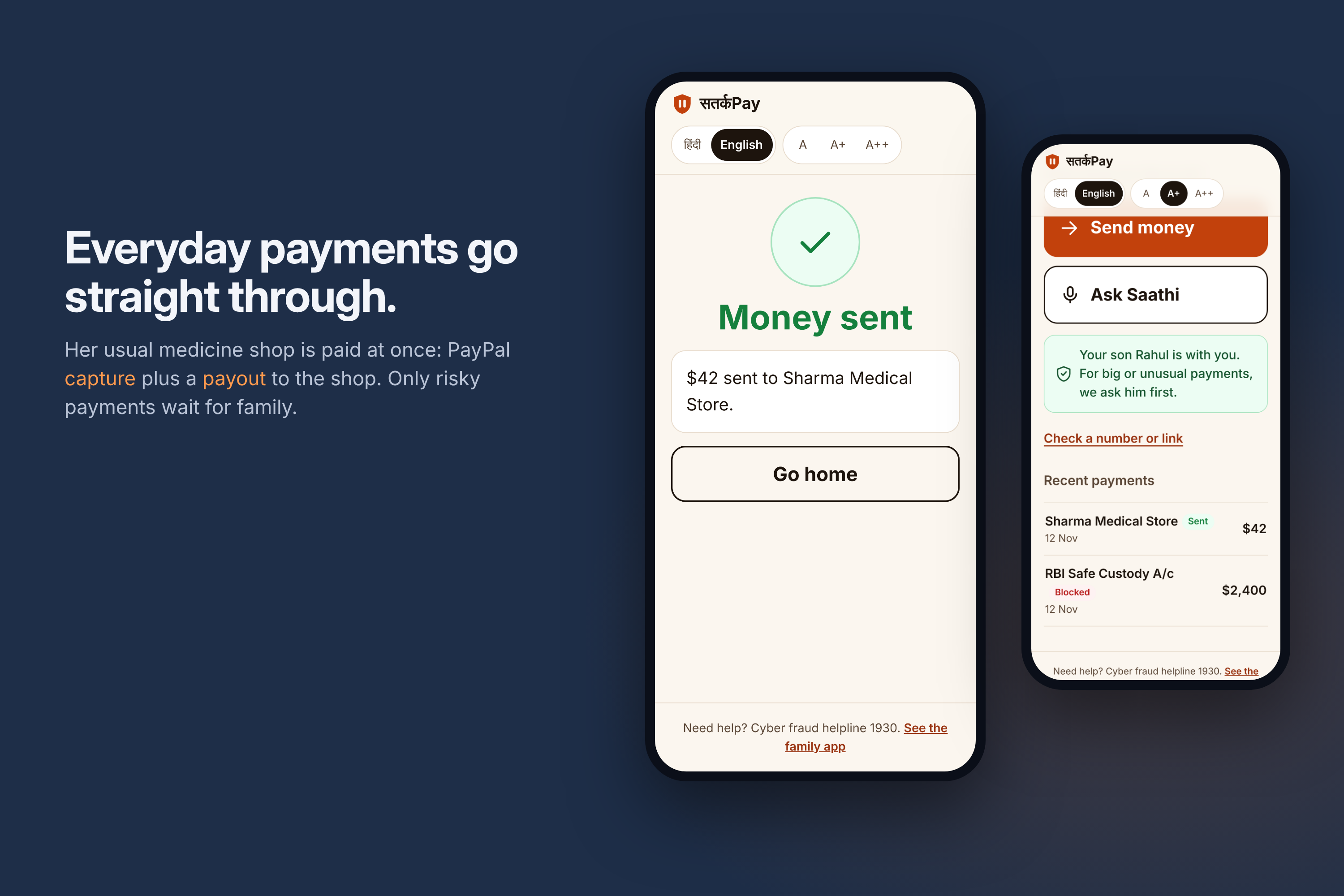
Everyday payments like her $42 medicine bill go straight through with PayPal capture and payout.
-
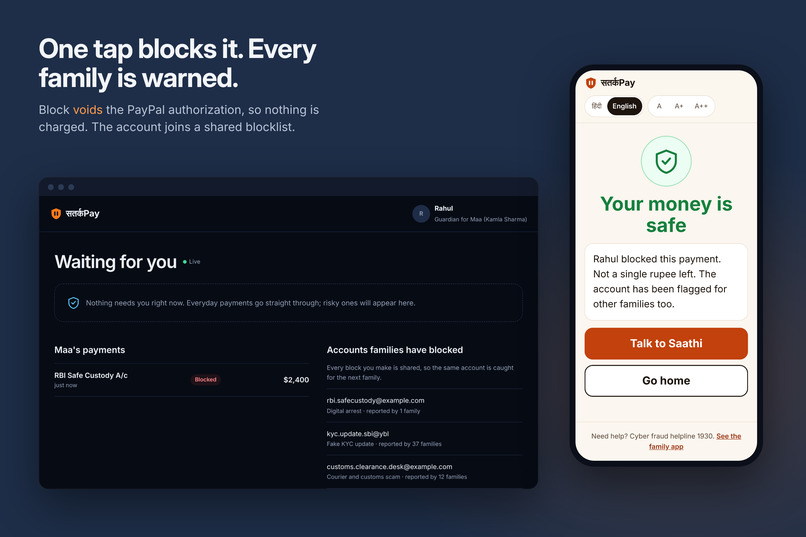
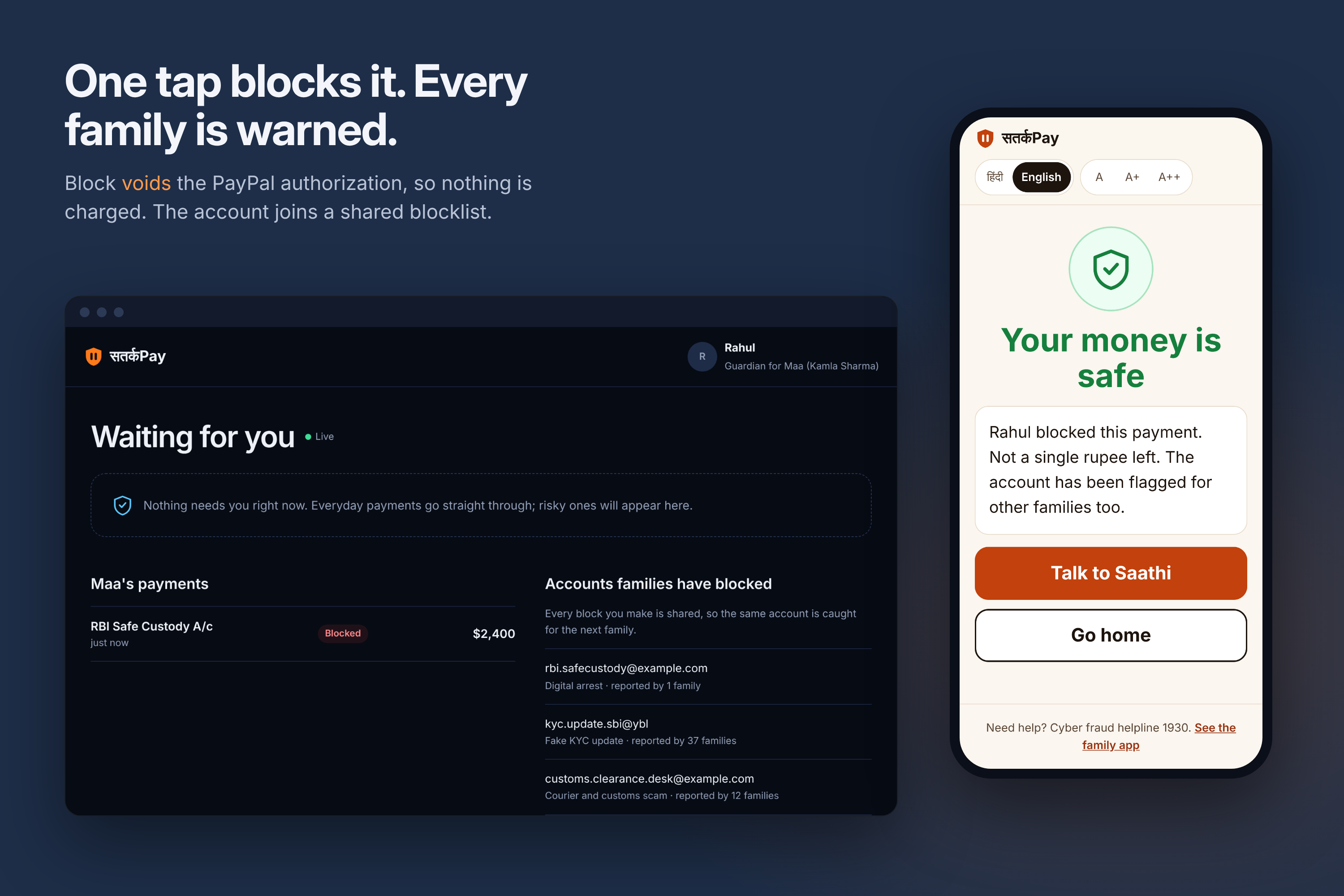
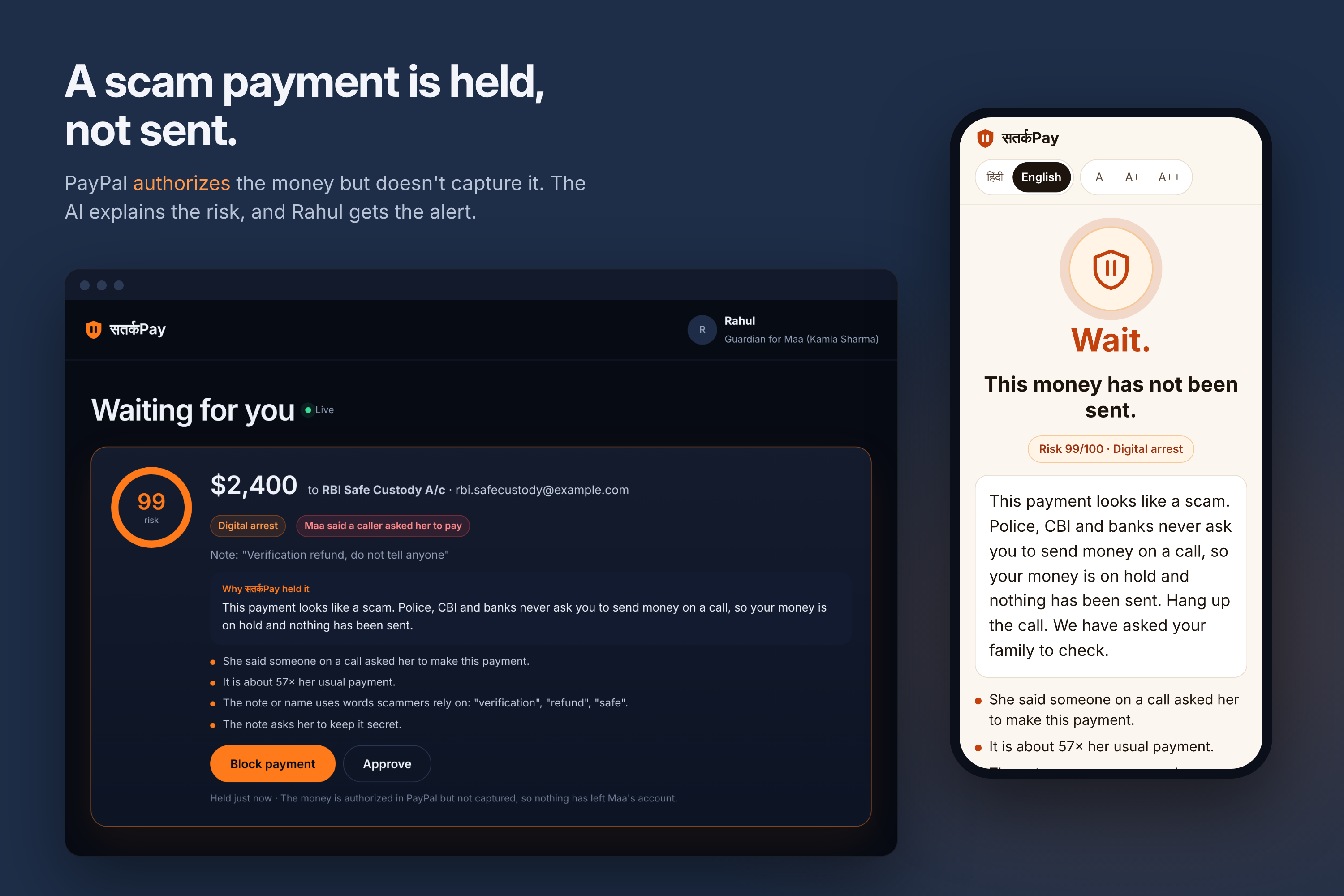
Rahul taps Block, the PayPal authorization is voided, and the scam account joins a blocklist every family shares.
-
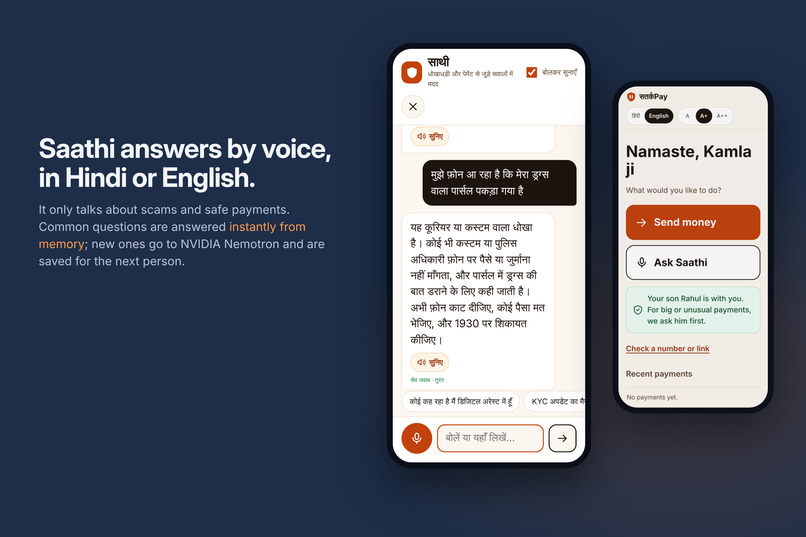
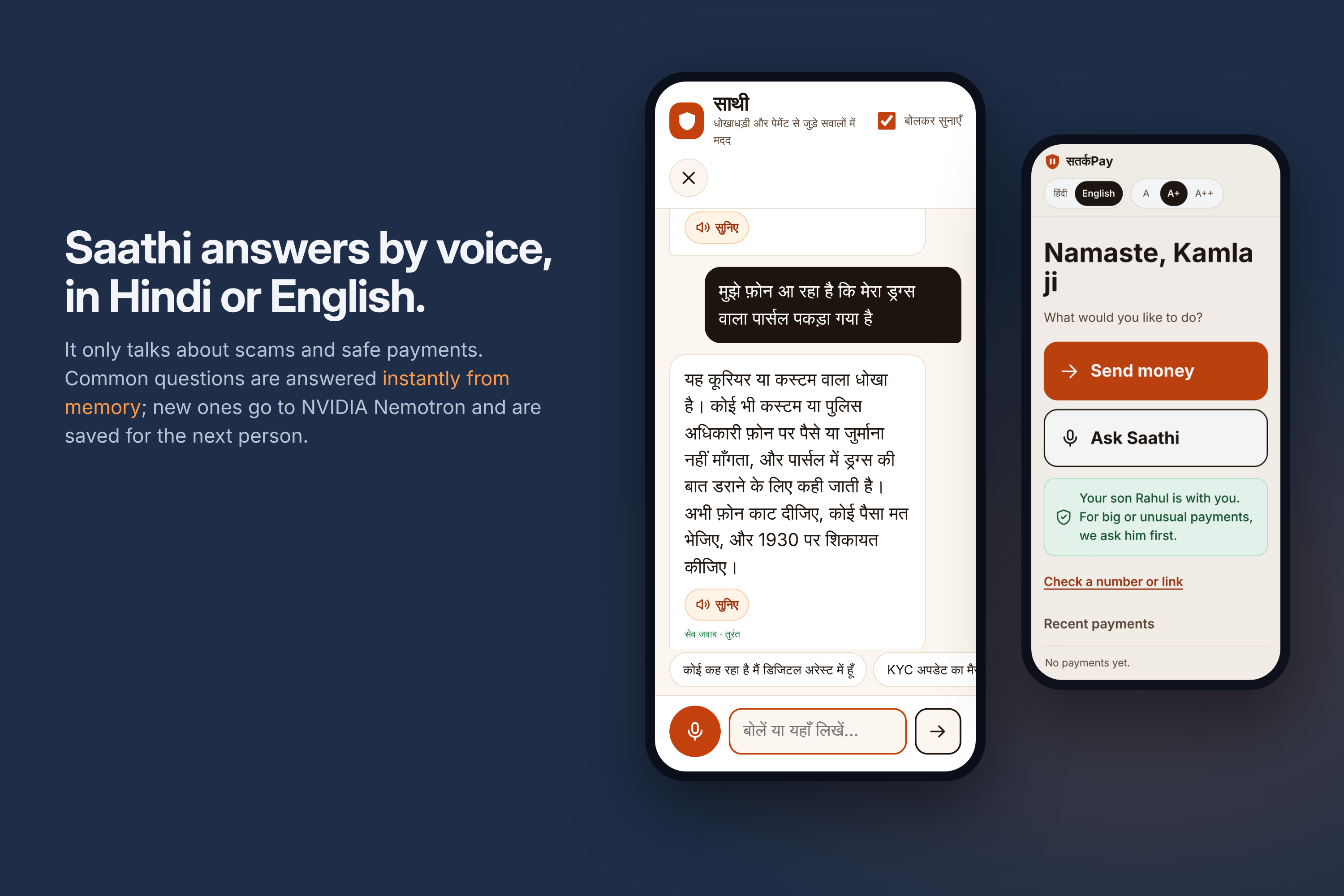
Saathi answers scam questions by voice in Hindi or English, instantly from memory for common questions.
-
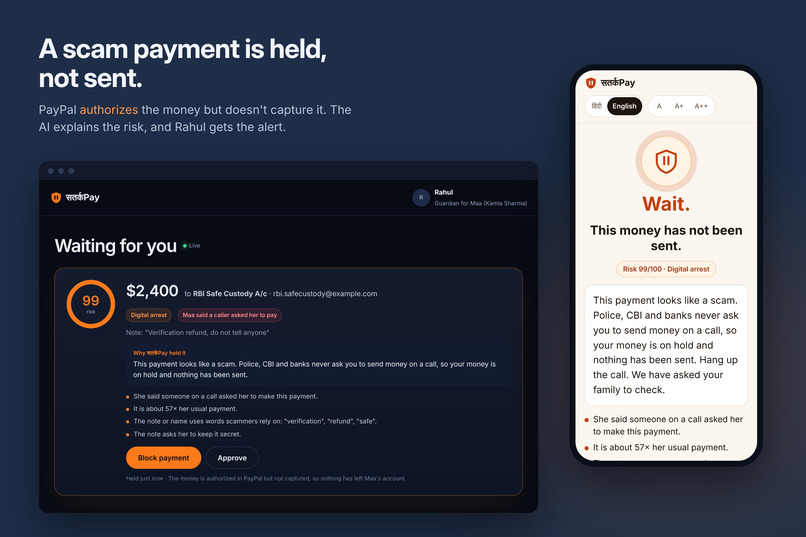
A $2,400 “RBI Safe Custody” payment is authorized in PayPal but held at risk 99/100, while Rahul gets the alert.
-
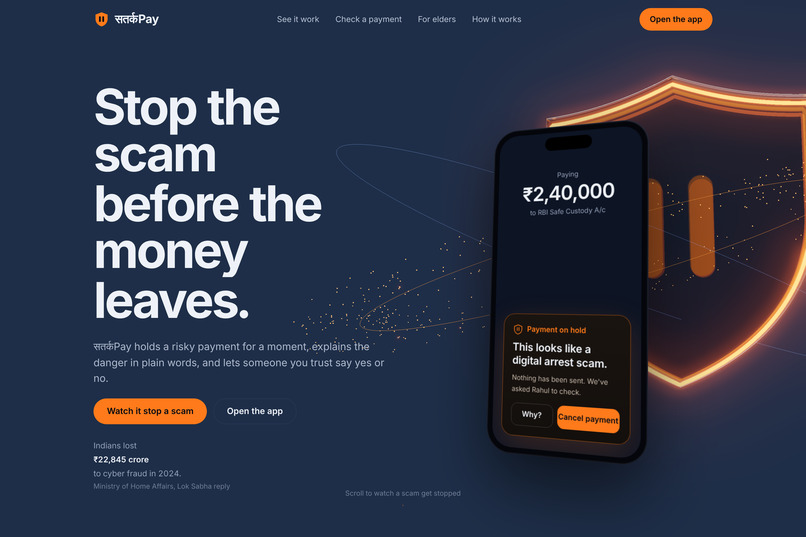
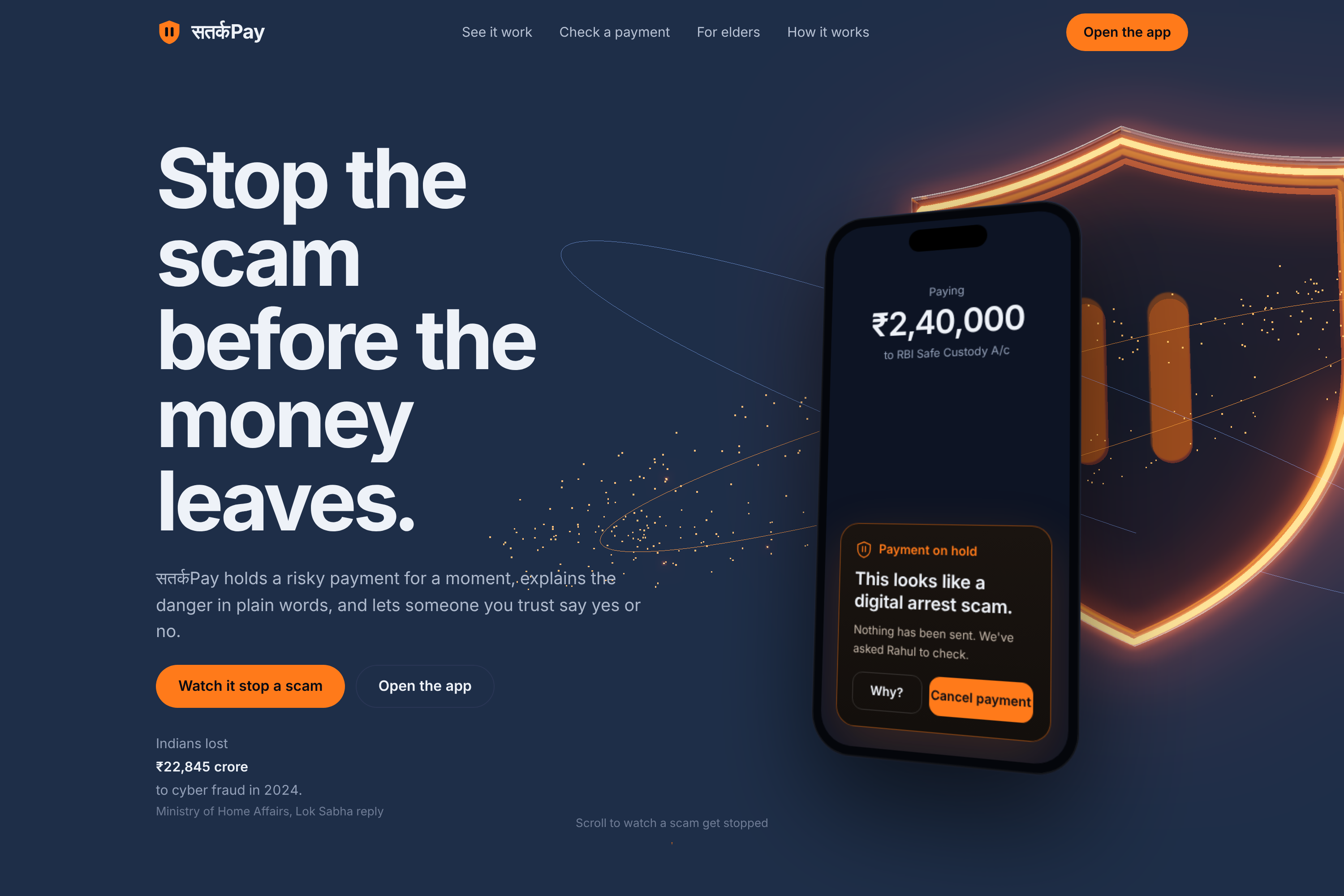
SatarkPay holds a risky payment, explains the danger in plain words, and lets family decide before money leaves.
Inspiration
In 2025, senior citizens in India filed 103,488 cyber-fraud complaints and lost ₹4,005 crore, as the Ministry of Home Affairs told the Rajya Sabha on 5 August 2026 (source). The scripts barely change: a fake police or CBI officer announces a "digital arrest", a courier says a parcel held drugs, a bank asks for a KYC update. Each one works the same way. The victim is frightened, told to pay now, and told to tell no one.
Banks and apps warn people after the money is gone. We wanted a pause before it leaves, with someone the elder trusts in the loop.
What it does
SatarkPay is a payment app for older people, built on PayPal, with three parts that work as one flow:
- The elder app (
/app). Large text, Hindi or English, three text sizes. Kamla ji enters who she is paying and why, and says whether someone on a call asked her to pay. She approves in PayPal as usual. - The AI check. Before any money moves, SatarkPay scores the payment from clear signals: a new payee, an amount far above her usual, words like "refund" or "custody", someone posing as an authority, a request for secrecy, a caller asking her to pay, and accounts other families have already blocked. An AI model explains the risk in plain Hindi and English, and the app reads it aloud.
- The family guardian (
/family). Risky payments are held, not sent. Her son Rahul sees the amount, the scam type and the reasons, and taps Approve or Block. If he blocks it, the money never leaves and the account joins a shared blocklist, so the next family is protected too.
Saathi is a voice and text helper that only talks about scams and safe payments. Ask it "someone says I'm under digital arrest" by voice in Hindi, and it answers in a few calm, spoken sentences with one next step, such as calling 1930. Saathi learns: every new question it answers is saved, so common questions are answered instantly.
How we built it
PayPal is the core of the flow, not a checkout bolted on:
- The elder approves with the PayPal JavaScript SDK. The order is created with Orders v2,
intent: AUTHORIZE, so the money is reserved but not taken. - The server scores the payment, and NVIDIA NIM (Nemotron 3.5) writes the explanation and a small score adjustment as JSON. If the AI is slow, a written explanation is used, so a payment is never stuck waiting.
- Low risk: Payments v2 capture, then a Payouts v1 payout to the recipient, at once.
- High risk: the payment is held. Approve runs the same capture and payout. Block calls Payments v2 void, so the authorization is cancelled and nothing is charged.
The backend is Node.js and Express, deployed on Render. Saathi uses Nemotron 3.5 on NVIDIA NIM, with a memory of answered questions that matches reworded questions, Hindi spelling variants and synonyms (ओटीपी / OTP). Voice uses the browser's Web Speech API in Hindi and English. The landing page tells the story as a scroll journey built with Three.js, GSAP and Lenis.
Amounts run in USD because the PayPal sandbox is used. The story is set in India, where these scams are most common.
Challenges we ran into
- Free AI models kept failing. Several free-tier models were retired or took 30 to 40 seconds to answer, far too slow for a frightened user. We wrote a script that tests NVIDIA's models on a real Hindi scam question and picks the fastest one that replies in Hindi, and added Saathi's answer memory so common questions never wait for a model.
- Respectful Hindi. Some models addressed elders in the informal "तू" form. We chose the model by the quality of its Hindi, not only its speed.
- Holding money safely. Authorize, then capture or void, let us put a pause in the middle of a real payment without holding funds outside PayPal.
Accomplishments that we're proud of
- The flow works end to end in the PayPal sandbox: authorize, hold, capture plus payout, or void.
- A scam payment is caught, explained aloud in Hindi and blocked by family in under a minute.
- Saathi answers common questions instantly and gets better with every new question.
What we learned
Scams win on urgency, so the most useful thing software can give an elder is time, and someone to ask. AI matters most when it explains a decision in her own language, not when it makes the decision alone.
What's next for SatarkPay
- WhatsApp and push alerts for guardians, and more than one guardian per family.
- Moving hold-and-release to PayPal's multiparty setup, which a live product holding payments for others needs.
- A shared, moderated blocklist across families and partners, with a way to appeal a wrong report.
- More Indian languages for Saathi.
SatarkPay was built from scratch during the hackathon submission period.
Built With
- css3
- express.js
- gsap
- html5
- javascript
- nemotron
- node.js
- nvidia-nim
- paypal
- paypal-javascript-sdk
- paypal-payouts
- paypal-rest-api
- render
- three.js
- web-speech-api

