-
-
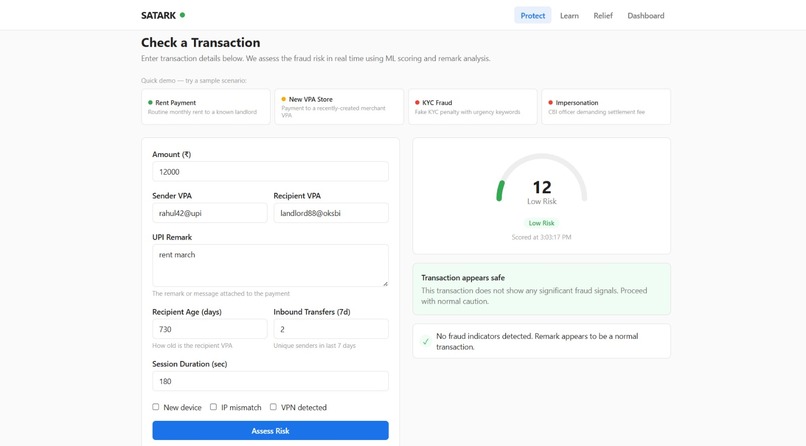
UI of Compliance Officer
-
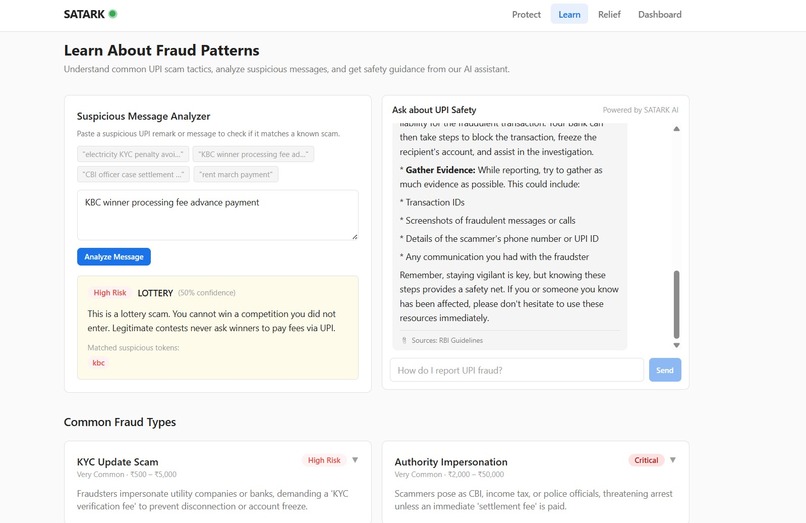
UI ofUser
SATARK — Our Story
Inspiration
India loses over ₹2,000 crore annually to UPI fraud, with nearly 65–70% attributed to social engineering. While researching existing solutions like DPIP and MuleHunter,
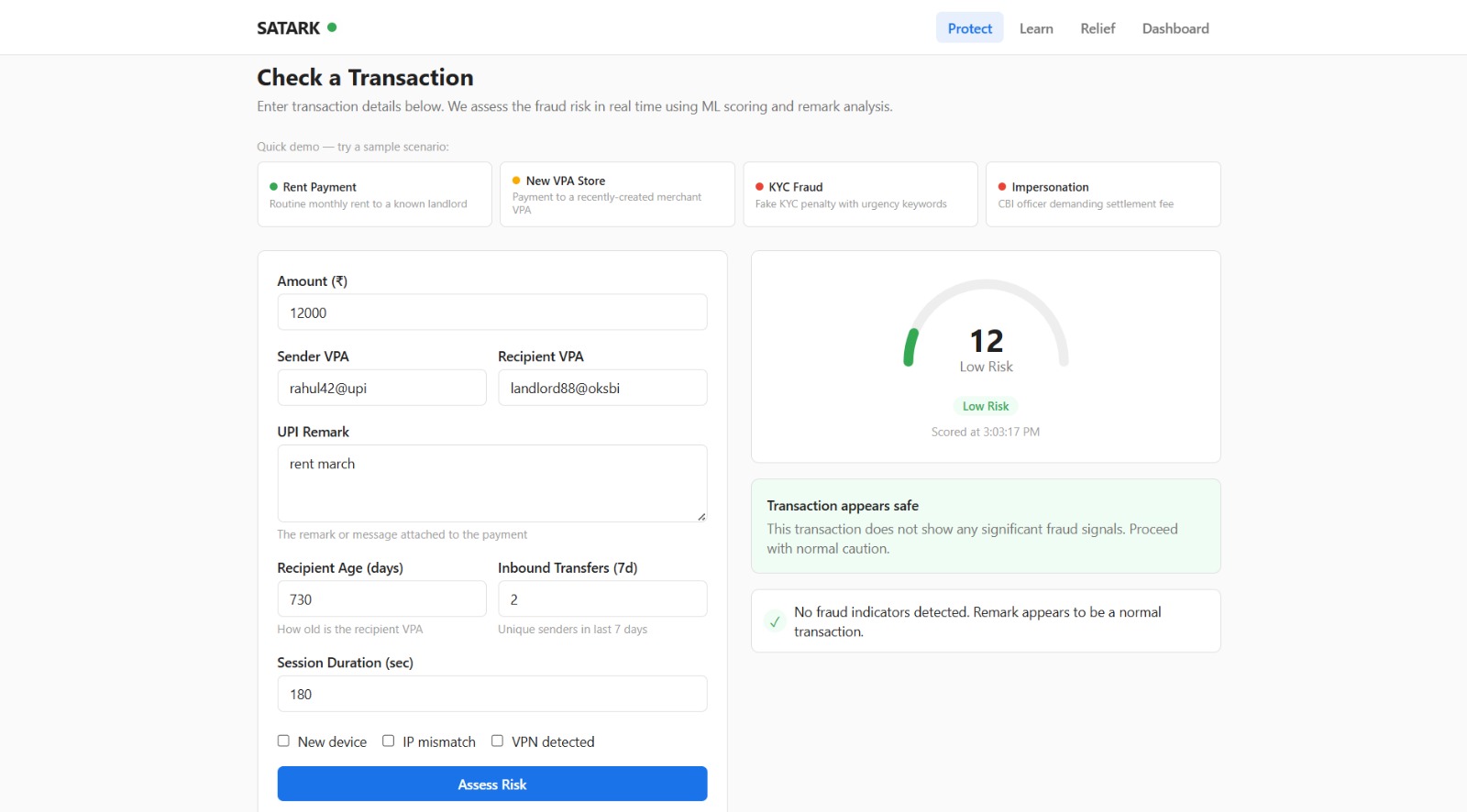
we noticed a glaring blind spot — nobody was reading the UPI remarks field and nobody was trying to prevent the transaction fraud before it went through, so we analyse a lot of features like senders VPA , receiver's VPA, IP mismatch, VPN detection and UPI remarks field as an added to identify and rate fraudulent transactions . This realization became SATARK
What it does
SATARK is a prevention-first UPI fraud intelligence platform. It analyzes the relevant features and fields for a upi transaction, combines it with behavioral anomaly detection and recipient graph signals, and generates a fraud probability score before financial damage occurs. It also provides:
- SATARK AI Assist — a compliance officer chatbot trained on RBI, NPCI, and CERT-In documentation, grounded in live Gold and Silver Delta tables
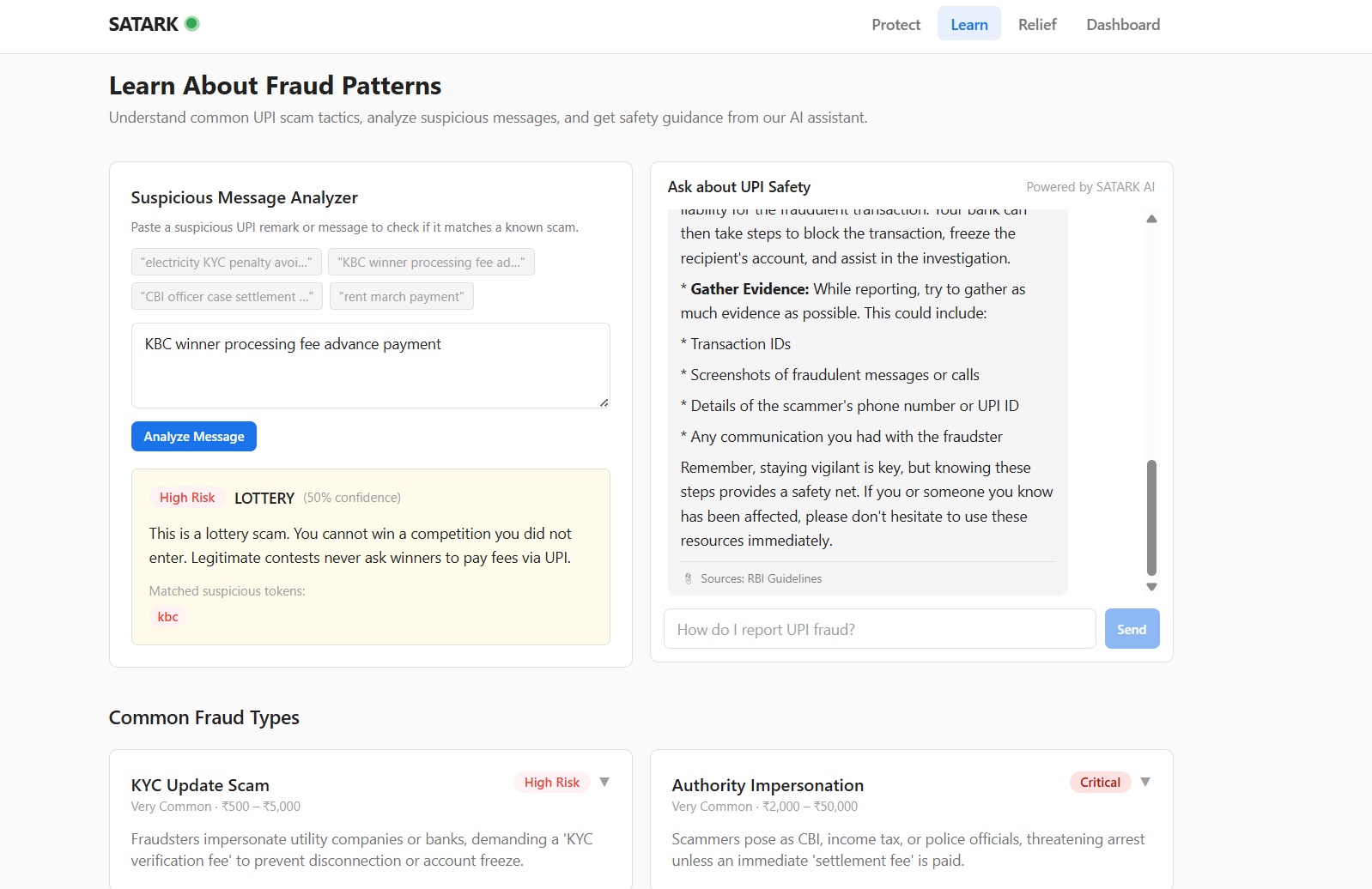
- A RAG-powered user assistant — guiding fraud victims through available legal provisions and dispute mechanisms post-fraud
How we built it
We built SATARK on a Bronze → Silver → Gold Delta Lake architecture hosted on Databricks, with an externally deployed frontend. The ML pipeline consists of three models:
- Remark scam classifier across 8 fraud categories
- Isolation Forest — behavioral anomaly detection
- XGBoost — final risk scorer combining all signals
The final risk score is computed as a weighted ensemble:
$$R = w_1 \cdot S_{\text{remark}} + w_2 \cdot S_{\text{anomaly}} + w_3 \cdot S_{\text{graph}}$$
All models are tracked via MLflow, achieving \(AUC \approx 0.93\) and \(F_1 \approx 0.81\) on synthetic data. PII is masked using SHA-256 hashing at ingestion, ensuring no plaintext VPA data ever enters the lakehouse.
Challenges we ran into
The biggest challenge was keeping the entire pipeline feasible on Databricks Free
Edition — CPU-only, limited RAM, and no external infrastructure. Running IndicTrans2
for multilingual support live was infeasible, so we pre-translated SHAP reason templates
offline and served them as Delta table lookups. Balancing the heavily skewed dataset
— with a \({\approx}7\%\) fraud rate — required careful tuning of scale_pos_weight
in XGBoost. Building the RAG pipeline and AI Assist chatbot on top of dense regulatory
documents, while keeping responses accurate and grounded, was equally demanding.
Accomplishments that we're proud of
- Identified and operationalized a fraud signal that no existing public system exploits
- Built a fully explainable pipeline using SHAP, making every fraud flag auditable and regulator-ready
- Delivered SATARK AI Assist, a regulation-aware chatbot grounded in RBI, NPCI, and CERT-In knowledge
- Achieved end-to-end implementation on Databricks Free Edition with no external data dependencies
What we learned
The most powerful signals are often the most overlooked ones. Building responsibly — masking PII, tracking models, and explaining predictions — is not optional overhead; it is what makes a system trustworthy enough for regulators to adopt. We also deepened our understanding of RAG architecture and learned how grounding LLMs in domain-specific documents dramatically improves reliability in high-stakes contexts.
What's next for SATARK
- Integration with live NPCI transaction feeds via Kafka
- Expanding the remark classifier with real complaint data to improve generalization
- Multilingual RAG support for regional language users
- Formal pilot with a partner bank to validate real-world \(AUC\) regression
- Submitting SATARK's architecture as an open standard to RBI's regulatory sandbox

Log in or sign up for Devpost to join the conversation.