-
-
Cover Page
-
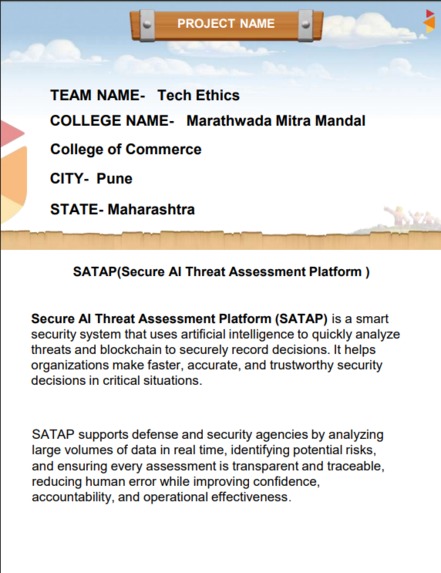
Project Name
-
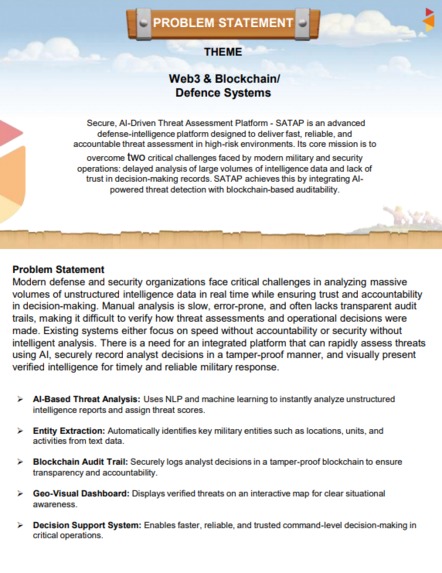
Theme
-
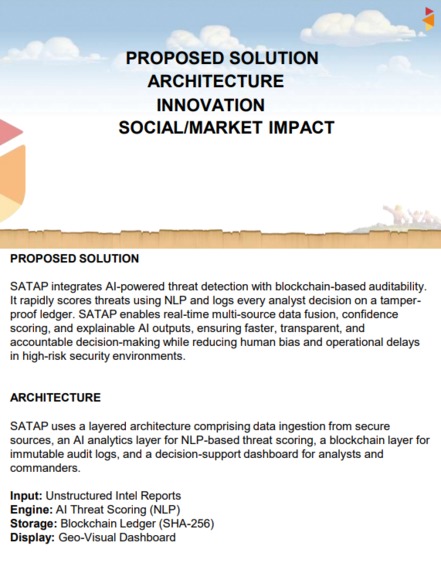
Proposed Solution & Architecture
-
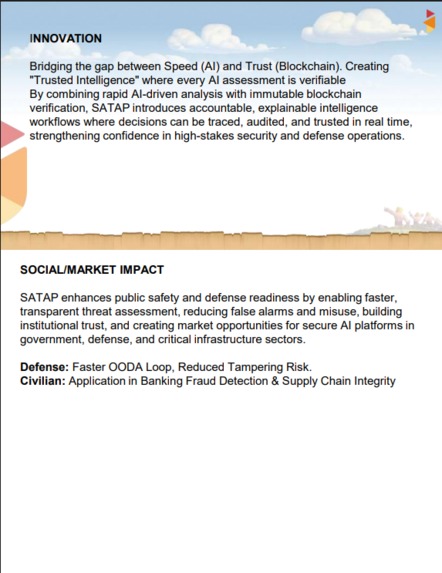
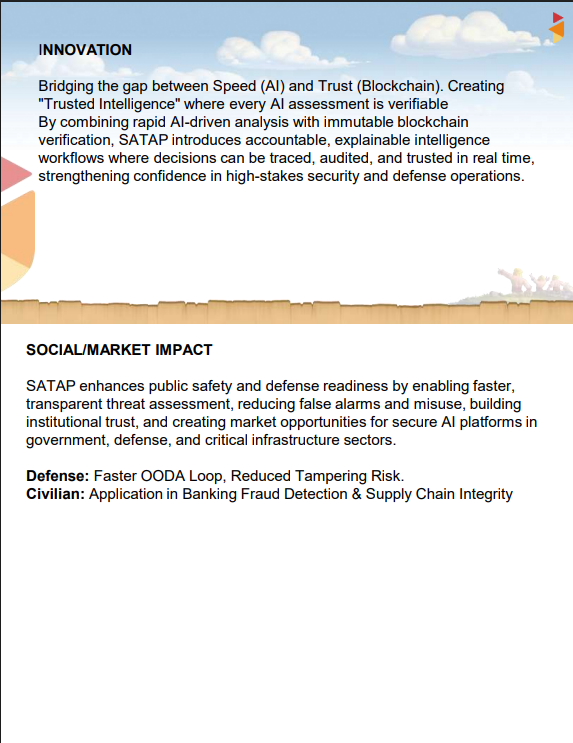
Innovation & Social/Market Impact
-
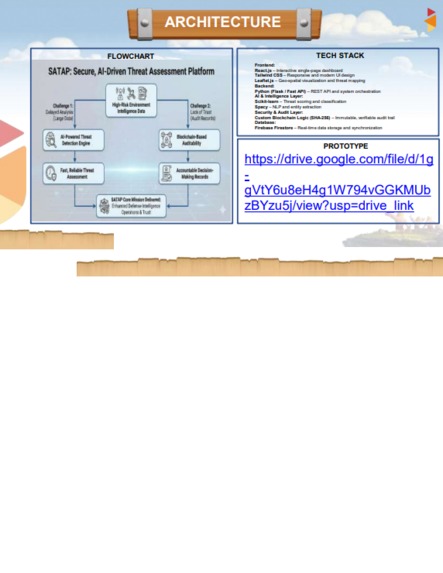
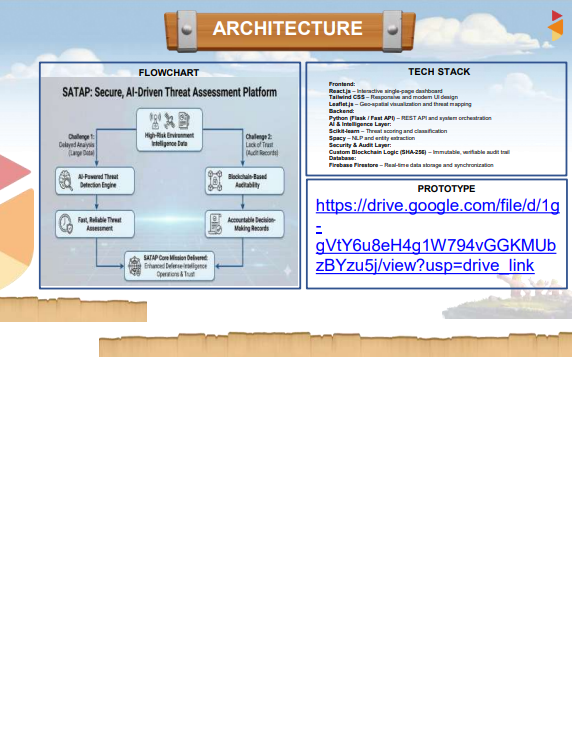
Architecture (Flowchart, Techstack and Prototype)
-
Thank You (Team Info)
-
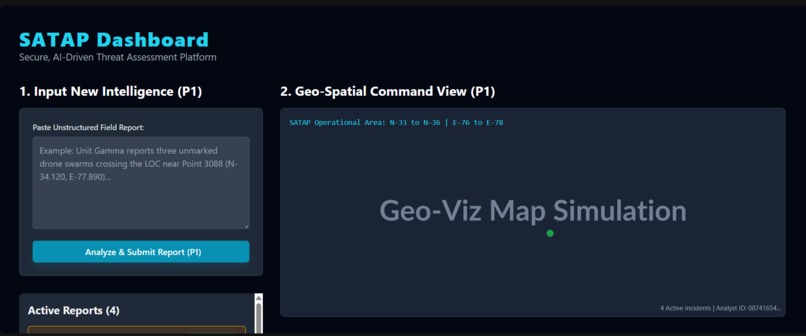
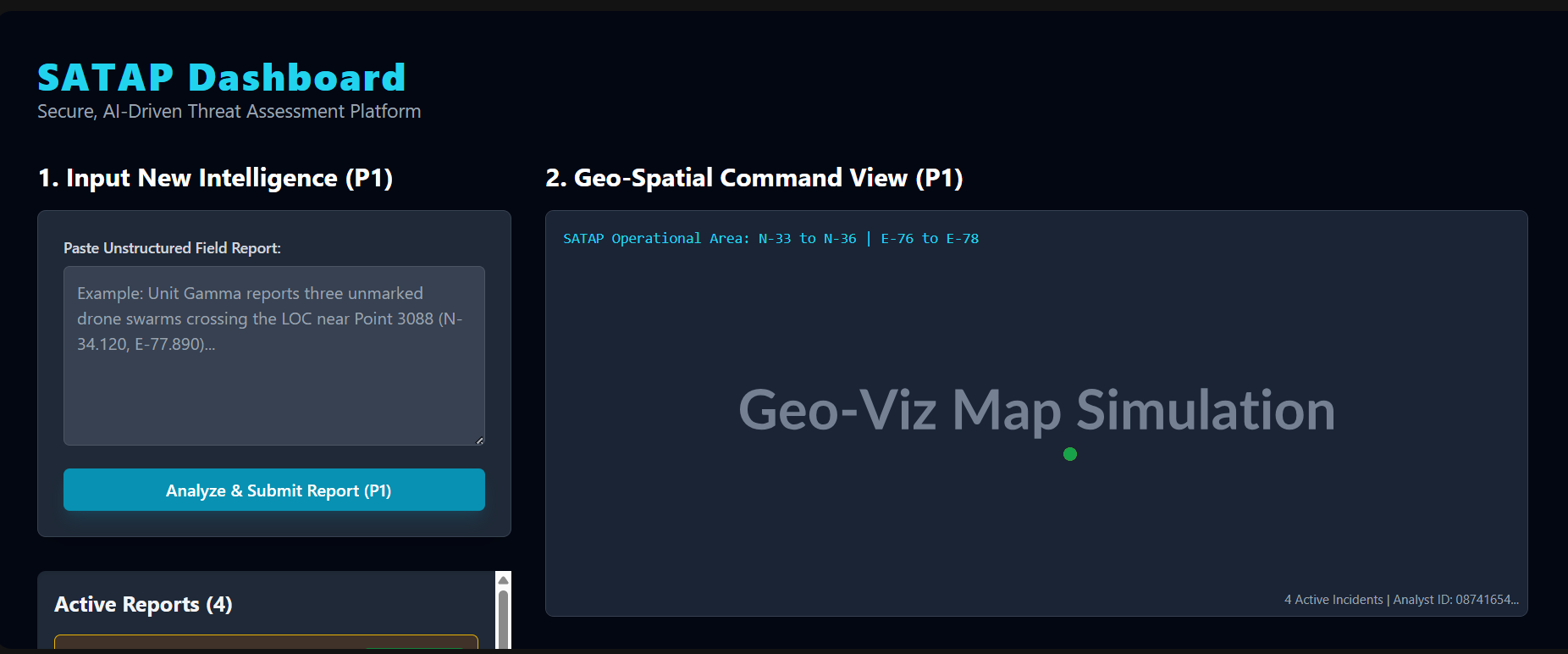
Raw Data Input and Map Visualization
-
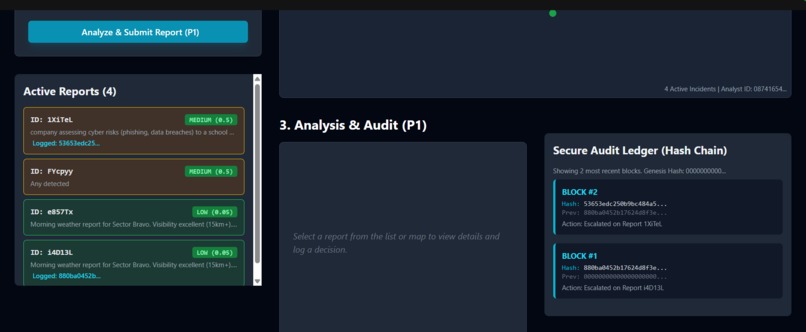
Secure Blockchain Ledger

Project Story: SATAP
Inspiration
SATAP was born from a simple but serious question: What happens when critical military decisions depend on slow, manual analysis of overwhelming data?
In modern warfare, especially information warfare, commanders are flooded with unstructured intelligence—field reports, intercepted communications, situation logs—often under extreme time pressure. Manual analysis not only slows response time but also creates room for uncertainty, bias, and lack of accountability.
Our motivation was not just to make intelligence analysis faster, but more trustworthy. We wanted to build a system that ensures every decision can be **explained, verified, and audited—what we define as true accountability (A²: Accountability + Auditability).
What SATAP Does
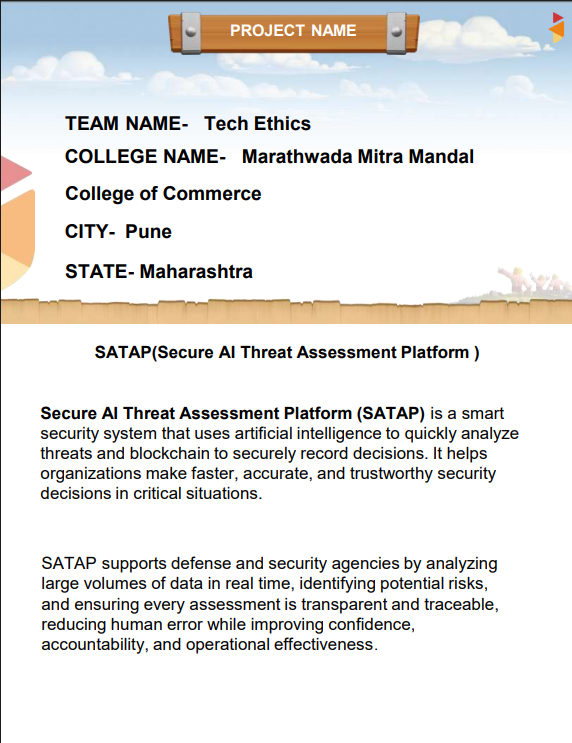
SATAP (Secure, AI-Driven Threat Assessment Platform) is a unified intelligence-support platform with two core capabilities:
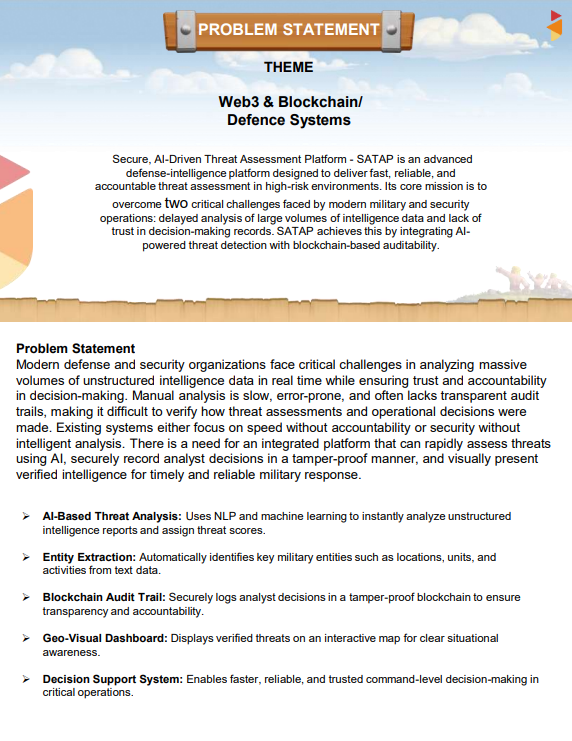
- Rapid Threat Assessment (AI/ML)
SATAP ingests unstructured text reports such as field logs or intercepted communications and processes them using NLP techniques. The system generates a numeric Threat Score (Sₜₕᵣₑₐₜ) that categorizes reports into LOW, MEDIUM, or HIGH risk, allowing commanders to instantly prioritize attention where it matters most.
- Verifiable Intelligence Audit (Blockchain)
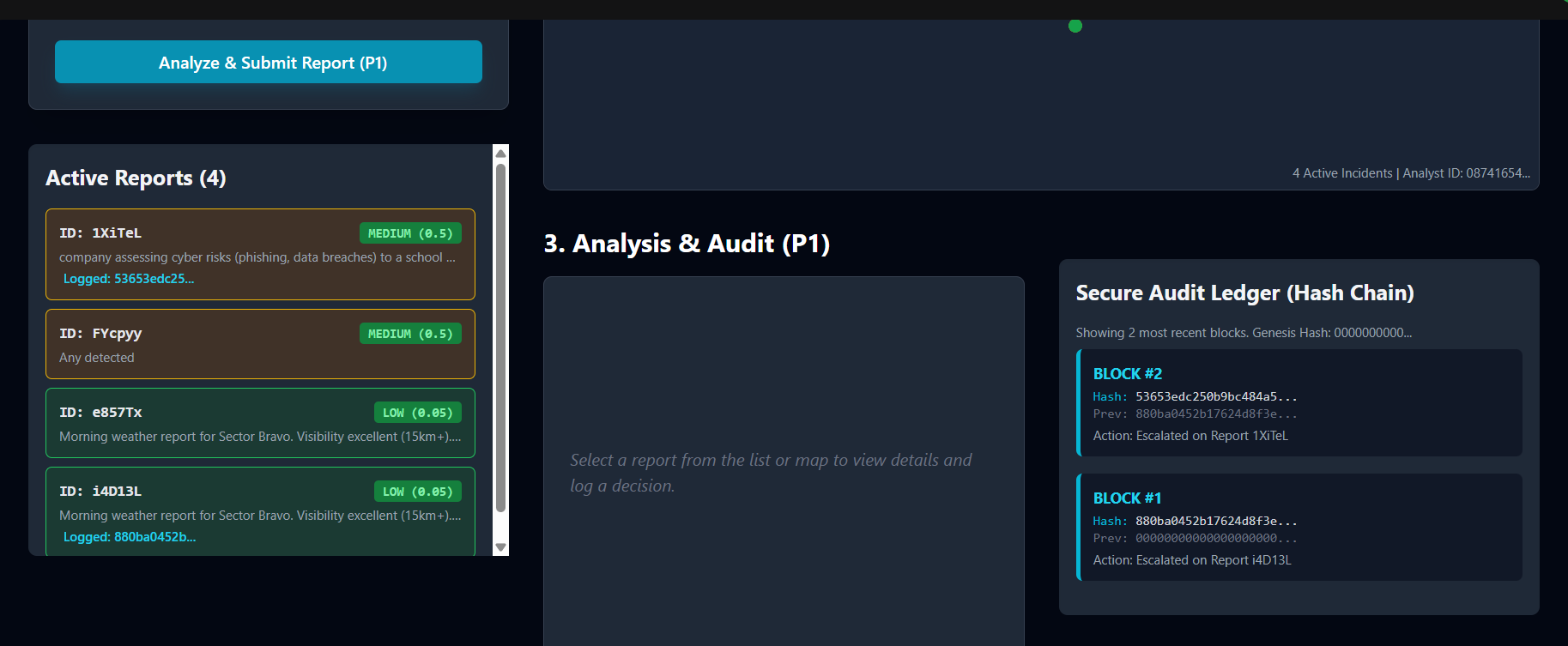
Every final decision made by a human analyst—whether to Escalate or Dismiss a report—is permanently recorded on an immutable ledger. This prevents retrospective manipulation and guarantees a transparent decision trail for future audits or investigations.
How We Built It
We designed SATAP using a modular three-pillar architecture:
Pillar 1: AI Threat Engine
- Built using Python with Scikit-learn
- Applied TF-IDF vectorization to convert text reports into numerical features
- Trained a Logistic Regression classifier on carefully crafted synthetic intelligence data
- Outputs a final Threat Score (Sₜₕᵣₑₐₜ) for each report
Pillar 2: Secure Ledger
- Implemented a custom lightweight blockchain in JavaScript / React
- Each block is cryptographically linked using SHA-256 hashing:
[ \text{Hash}{n} = H(\text{Data}{n} + \text{Hash}_{n-1}) ]
- Block data includes Analyst ID, Report ID, and Decision
- Ensures tamper-proof and verifiable records
Pillar 3: Geo-Visualization Dashboard
- Built using React.js, styled with **Tailwind CSS
- Displays AI-generated threat scores in real time
- Extracted location entities are plotted on a Leaflet.js interactive map for clear situational awareness
Challenges We Faced
Domain-Specific Data
Real military intelligence data is classified, so creating realistic synthetic training data was our biggest challenge. We manually crafted hundreds of intelligence-style reports using realistic jargon and operational scenarios to ensure meaningful AI training.
Cryptography Dependency Issues
We initially faced build and compatibility issues with an external cryptography library (crypto-js).
This was resolved by switching to the native Web Crypto API (crypto.subtle.digest), improving reliability and reducing external dependencies.
Real-Time Synchronization
Coordinating seamless updates between report input, AI scoring, decision logging, and the dashboard required careful orchestration using Firebase Firestore real-time listeners.
Accomplishments We’re Proud Of
The “Trust Wrapper”: Successfully combining AI and blockchain to create a compact yet fully verifiable intelligence system Performance: Achieved end-to-end threat assessment in ≤ 5 seconds, meeting real-world operational constraints Cross-Domain Integration: Delivered a single solution spanning Defence Systems, AI/ML, Web3, and Cybersecurity
What We Learned
This project taught us that technology choices matter early—native, stable dependencies significantly improve long-term reliability.
More importantly, we learned that cryptography isn’t just for finance. When applied correctly, it becomes a powerful tool to build trust, accountability, and transparency in AI systems—transforming AI from a black-box assistant into a verifiable teammate.
What’s Next for SATAP
LLM Integration Upgrade the AI engine using Large Language Models for deeper reasoning, summarization, and multilingual intelligence analysis.
Production Readiness Add Role-Based Access Control (RBAC) and integrate a scalable Flask backend for handling real-world data volumes.
Sensor Fusion Integrate simulated IoT and drone data streams to enable proactive threat prediction rather than reactive analysis.


Log in or sign up for Devpost to join the conversation.