💡 Inspiration
Financial crime is a multi-trillion-dollar global problem, yet the compliance analysts fighting it are burdened with outdated tools. During our research for the Barclays Hack-O-Hire, we discovered that investigators spend hours manually piecing together transaction histories and drafting Suspicious Activity Reports (SARs) by hand. We wanted to build a modern, high-fidelity platform that treats compliance analysts like first-class citizens, combining advanced Machine Learning for anomaly detection with Generative AI to do the heavy lifting, allowing analysts to focus on stopping financial crime.
⚙️ What it does
SARGENERATOR is a next-generation Enterprise Anti-Money Laundering (AML) platform that handles the entire lifecycle of a compliance investigation:
- Algorithmic Alert Triage: Ingests transaction streams and scores them dynamically using an ensemble Machine Learning model to evaluate multidimensional risk vectors.
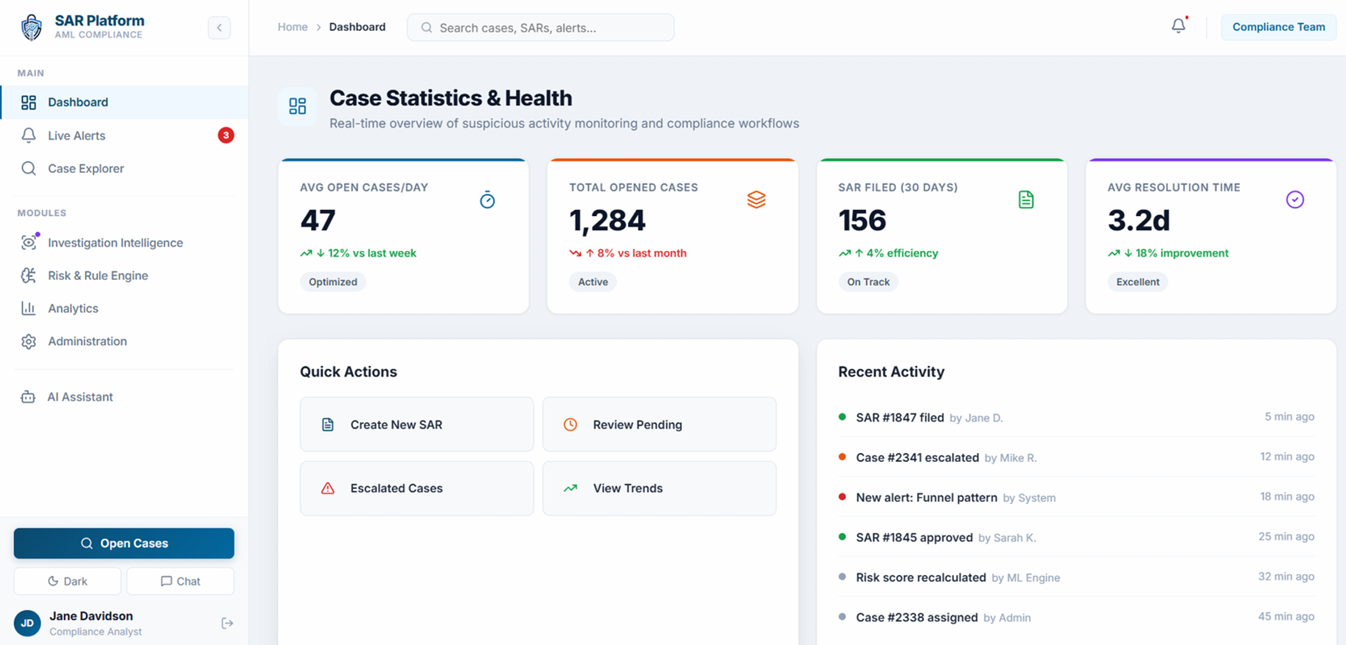
- Deep-Dive Investigation: Provides analysts with a rich Case Explorer featuring interactive network graph visualizations for entity resolution and automated typology identification (e.g., "Structuring", "Funnel Accounts").
- AI-Assisted SAR Drafting: The crown jewel of the platform. Instead of typing reports from scratch, our backend pipeline passes structured transaction matrices to a Generative AI engine (LLM) which synthesizes a fully FINCEN-compliant SAR narrative.
- Immutable Audit Trails: Automatically logs every analyst action, AI generation iteration, and manager approval to ensure strict, zero-trust regulatory compliance.
🛠️ How we built it
We architected the platform to balance a heavy analytical backend with a lightning-fast, enterprise-grade user experience:
- Machine Learning & Backend Engine: The core logic is driven by a Python/Flask microservice architecture. For anomaly detection, we utilized Scikit-Learn and Pandas to process financial datasets (like the IBM HI-Small dataset). We implemented feature engineering to detect velocity anomalies and transaction structuring, assigning probabilistic risk scores to individual entities.
- Data Synthesis: To train and test our models, we built a custom
generate_dummy_data.pyscript that creates highly realistic synthetic transaction graphs containing hidden ML laundering typologies. - Frontend Architecture: We used React 18 and Vite to build a highly responsive Single Page Application (SPA). We built a bespoke global design system using vanilla CSS variables to ensure a scalable, premium look without relying on bloated UI libraries.
- UI/UX Engineering: We engineered reusable components like
KPICards,DataTables, and slide-over panels. Complex data visualizations are powered by Recharts, with iconography provided by Lucide React.
⚠️ Challenges we ran into
One of the biggest technical hurdles was translating complex ML probabilistic outputs into deterministic, explainable UI components. Regulators require "explainable AI" (XAI), so we had to ensure our risk scores weren't just a black box—the UI actively highlights why a model flagged a transaction (e.g., velocity rules, threshold structuring). Additionally, prompt-engineering the Generative AI to output a highly rigid, compliant SAR narrative without hallucinating transaction amounts required significant fine-tuning of the context window.
🏆 Accomplishments that we're proud of
- Engineering a Python ML backend capable of identifying complex laundering typologies through multidimensional transaction analysis.
- Building a complete, end-to-end design system from scratch that legitimately looks and feels like a multi-million-dollar enterprise banking tool.
- Bridging the gap between predictive ML (anomaly detection) and Generative AI (NLP report drafting) in a single, cohesive workflow.
📚 What we learned
We gained a massive appreciation for the mathematical complexity of regulatory compliance and Anti-Money Laundering entity resolution. We learned how to optimize feature sets for financial anomaly detection, how to structure complex frontend states for real-time dashboards, and how to effectively design interfaces for human-in-the-loop AI systems where trust, accuracy, and explainability are paramount.
🚀 What's next for SARGENERATOR
This prototype proves the concept, but our roadmap for production scaling is aggressive:
- Live LLM Endpoint Integration: Wiring the SAR generation pipeline directly to GPT-4/Claude 3 APIs for dynamic, token-optimized narrative generation.
- Graph Database Migration: Implementing Neo4j to power our network visualizer for deep-tier entity resolution across millions of nodes, moving beyond relational data constraints.
- Real-Time Data Streaming: Upgrading the Flask backend to ingest live Kafka streams and pushing alerts to the React frontend via WebSockets. ```
Built With
- artificial-intelligence
- css3
- flask
- html5
- javascript
- machine-learning
- pandas
- python
- react
- recharts
- scikit-learn
- vite

Log in or sign up for Devpost to join the conversation.