-
-
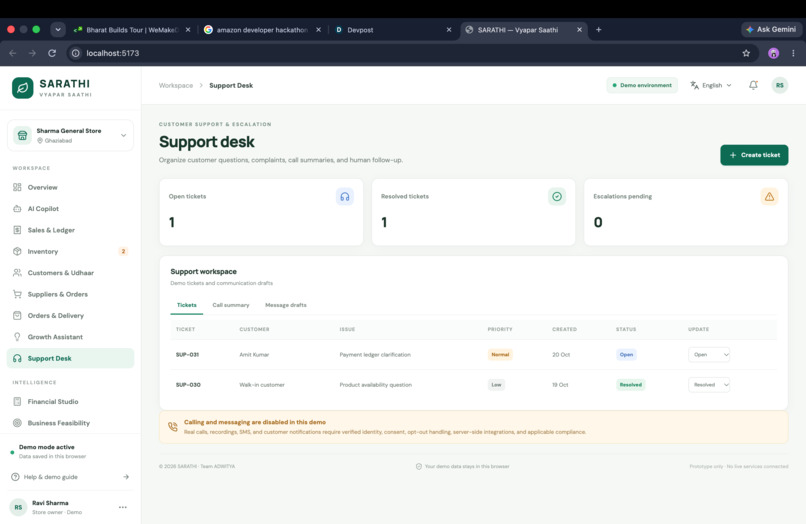
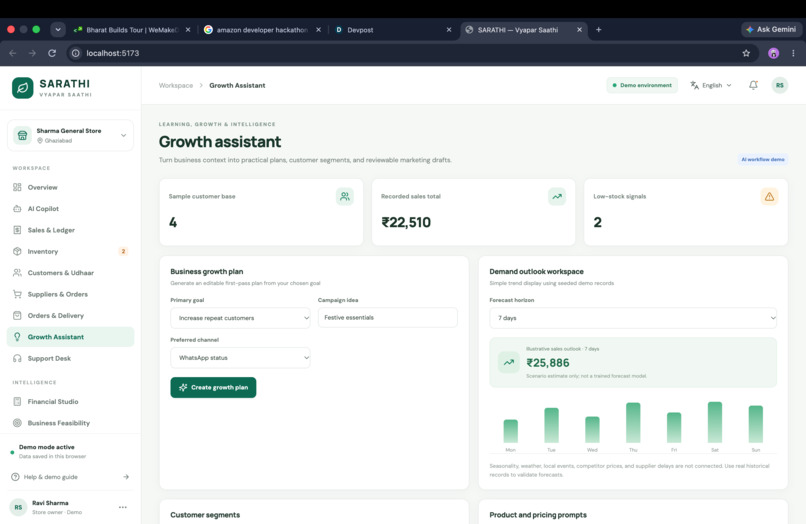
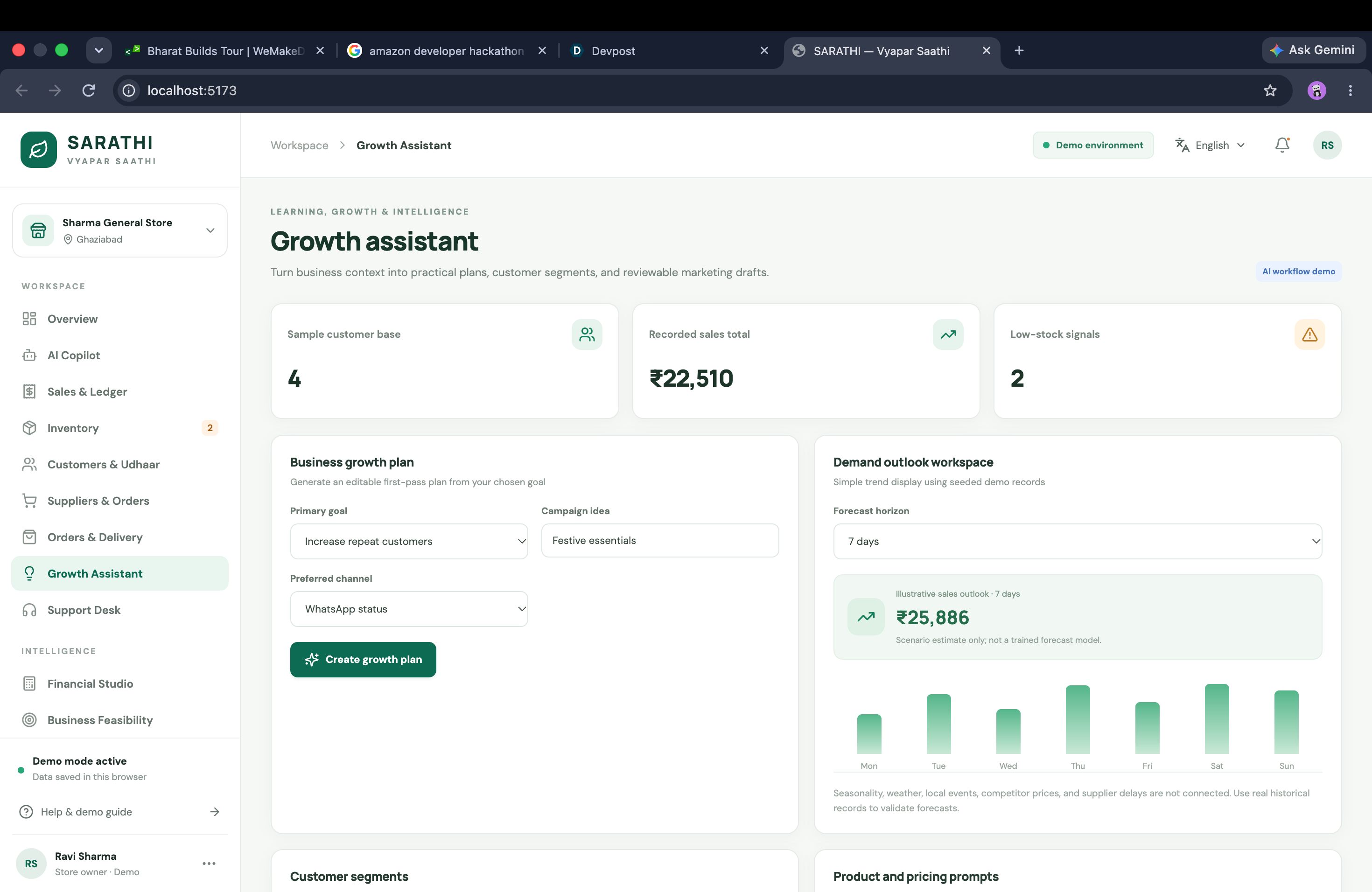
Growths & Assistent
-
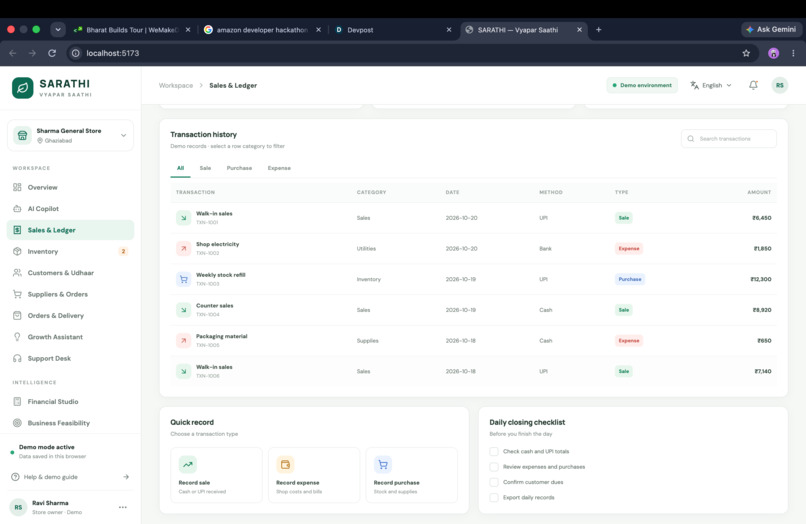
Sales & Ledger
-
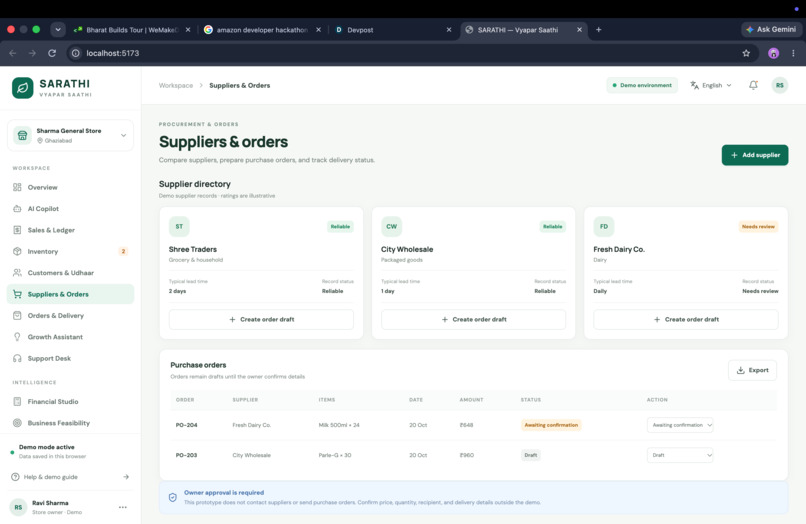
Suppliers & Order
-
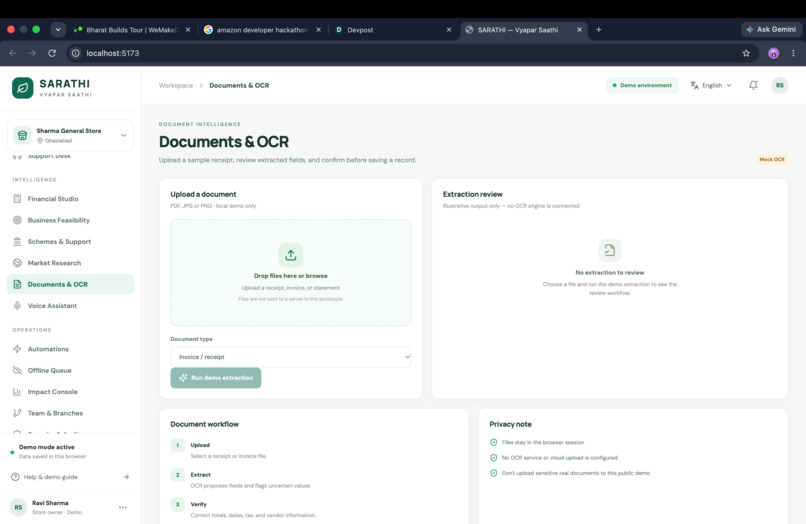
Scheme and support
-
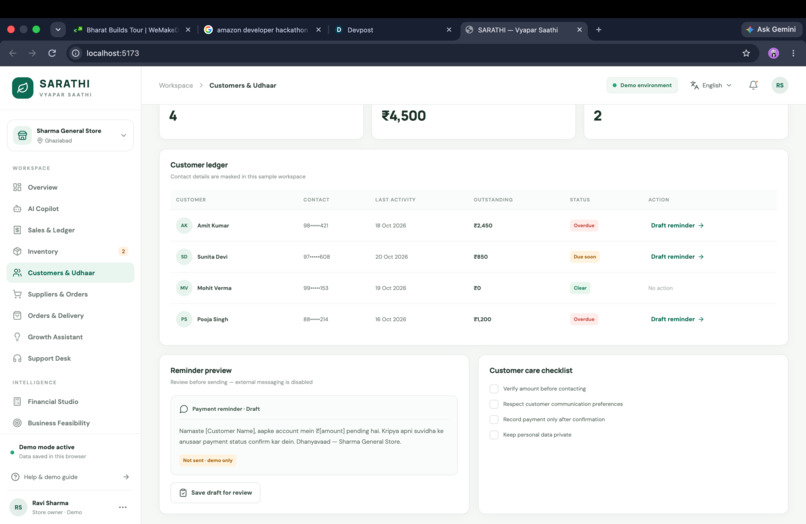
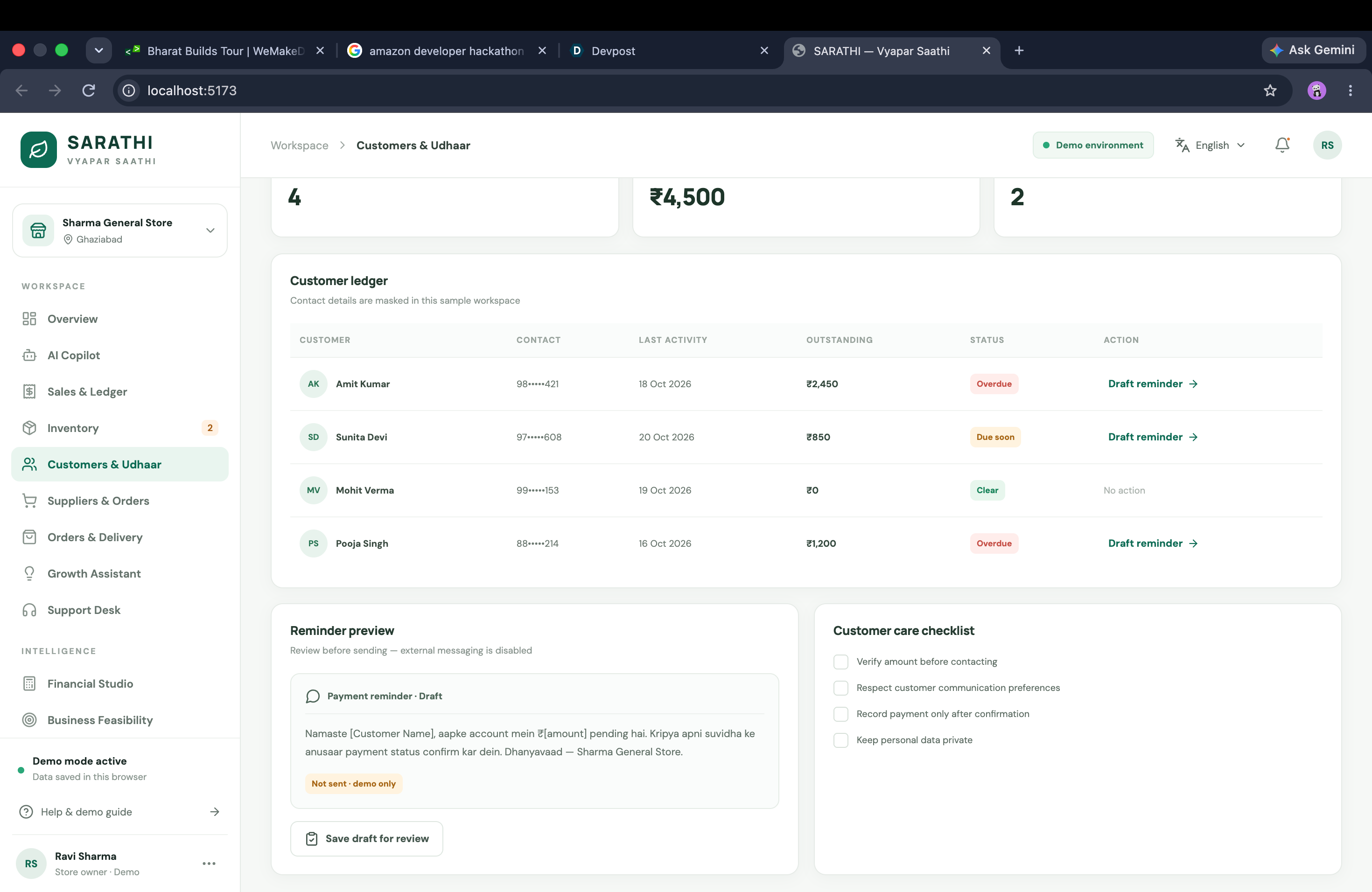
Customer
-
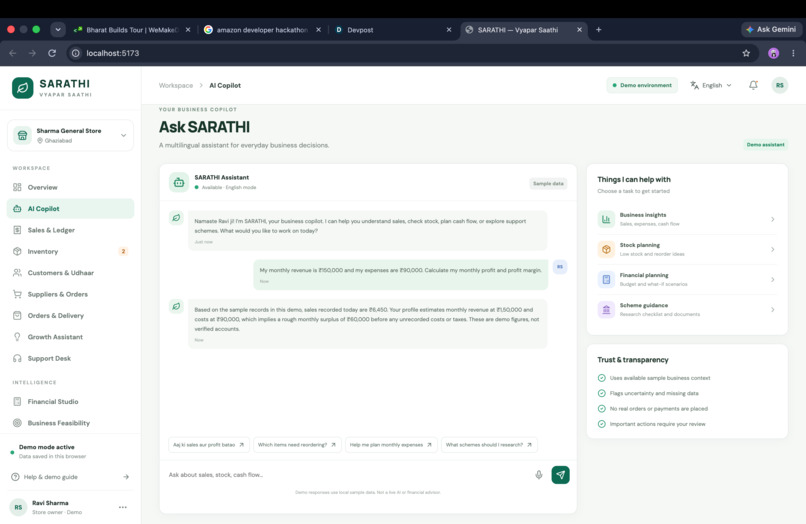
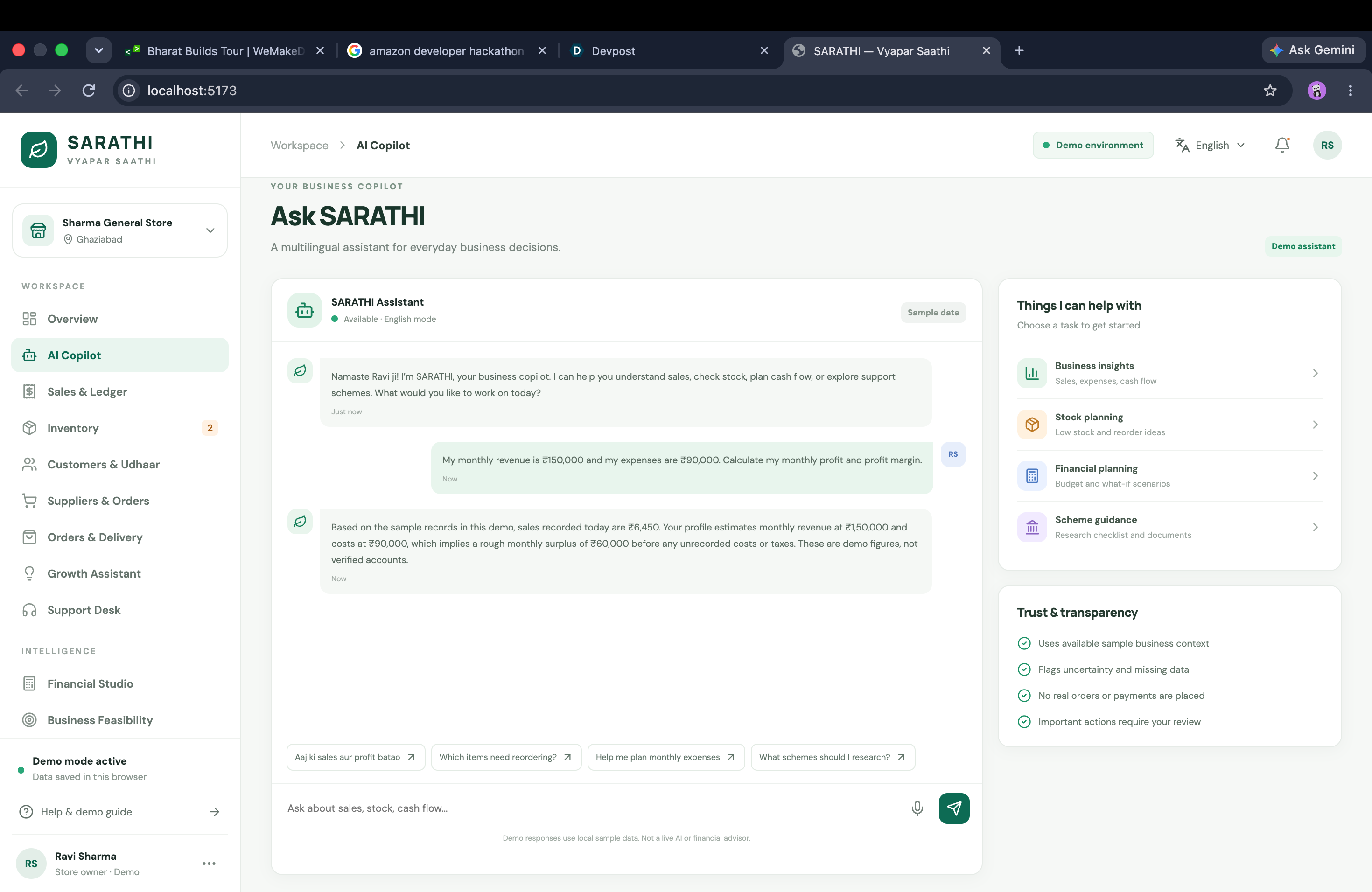
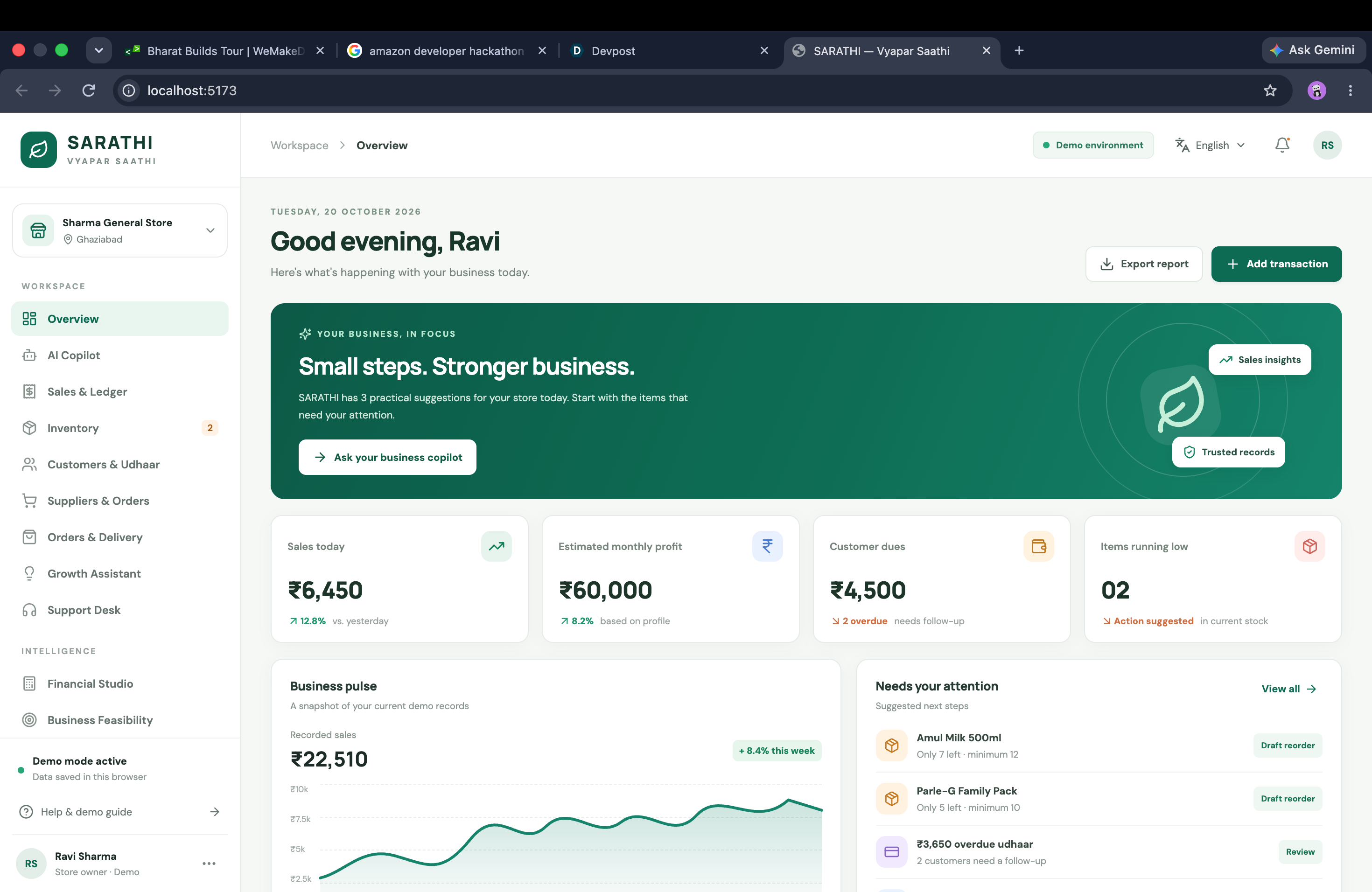
AI Copilot
-
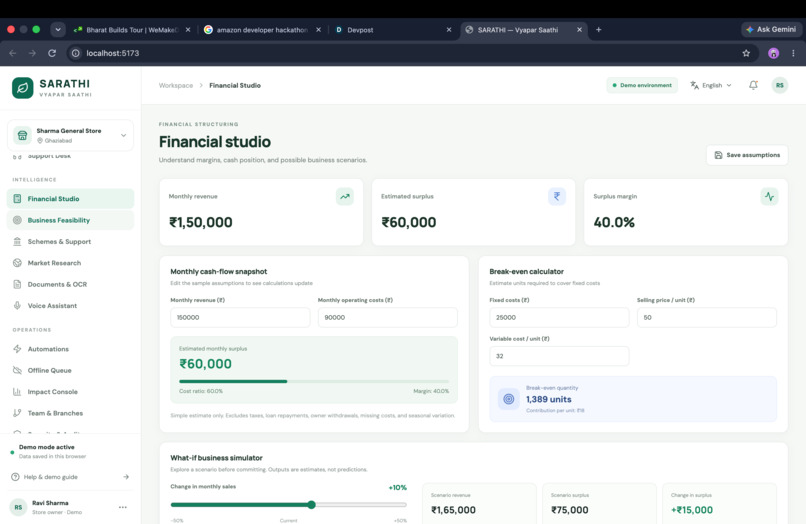
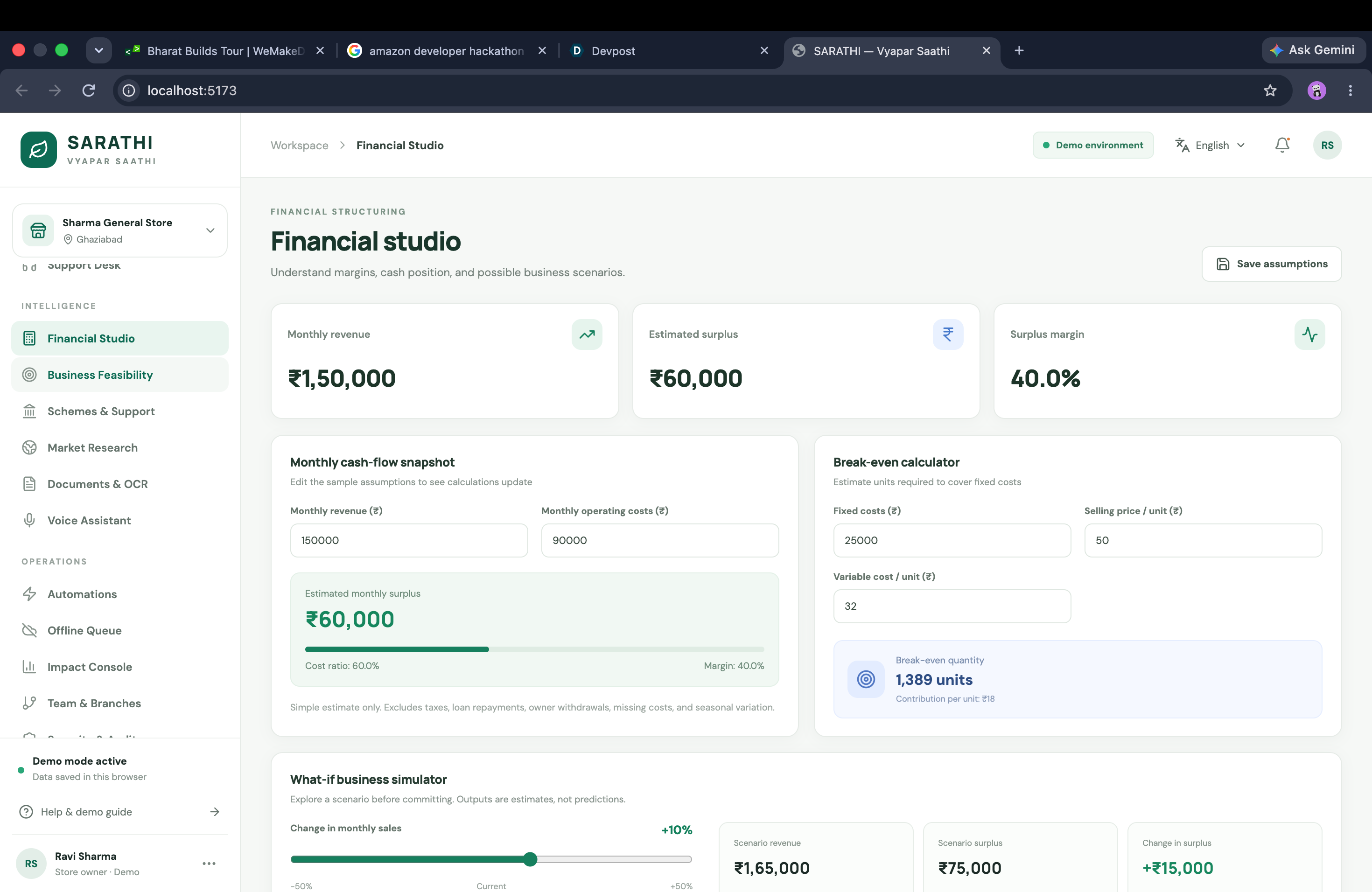
Finencial Studio
-
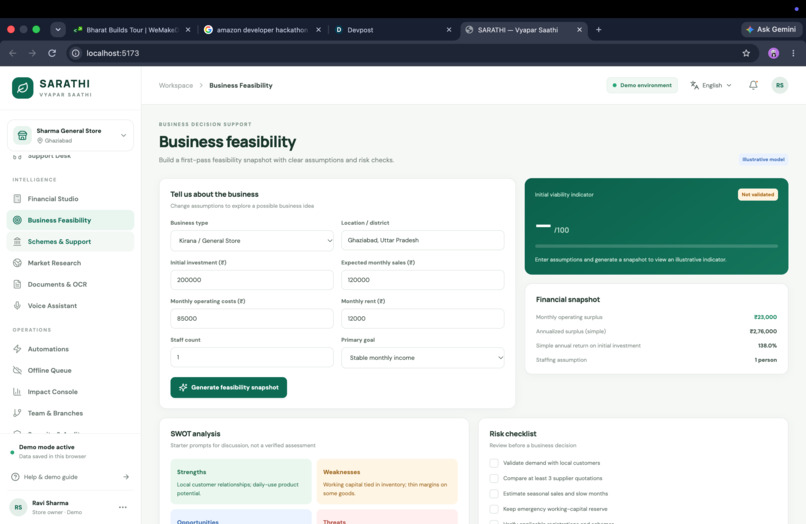
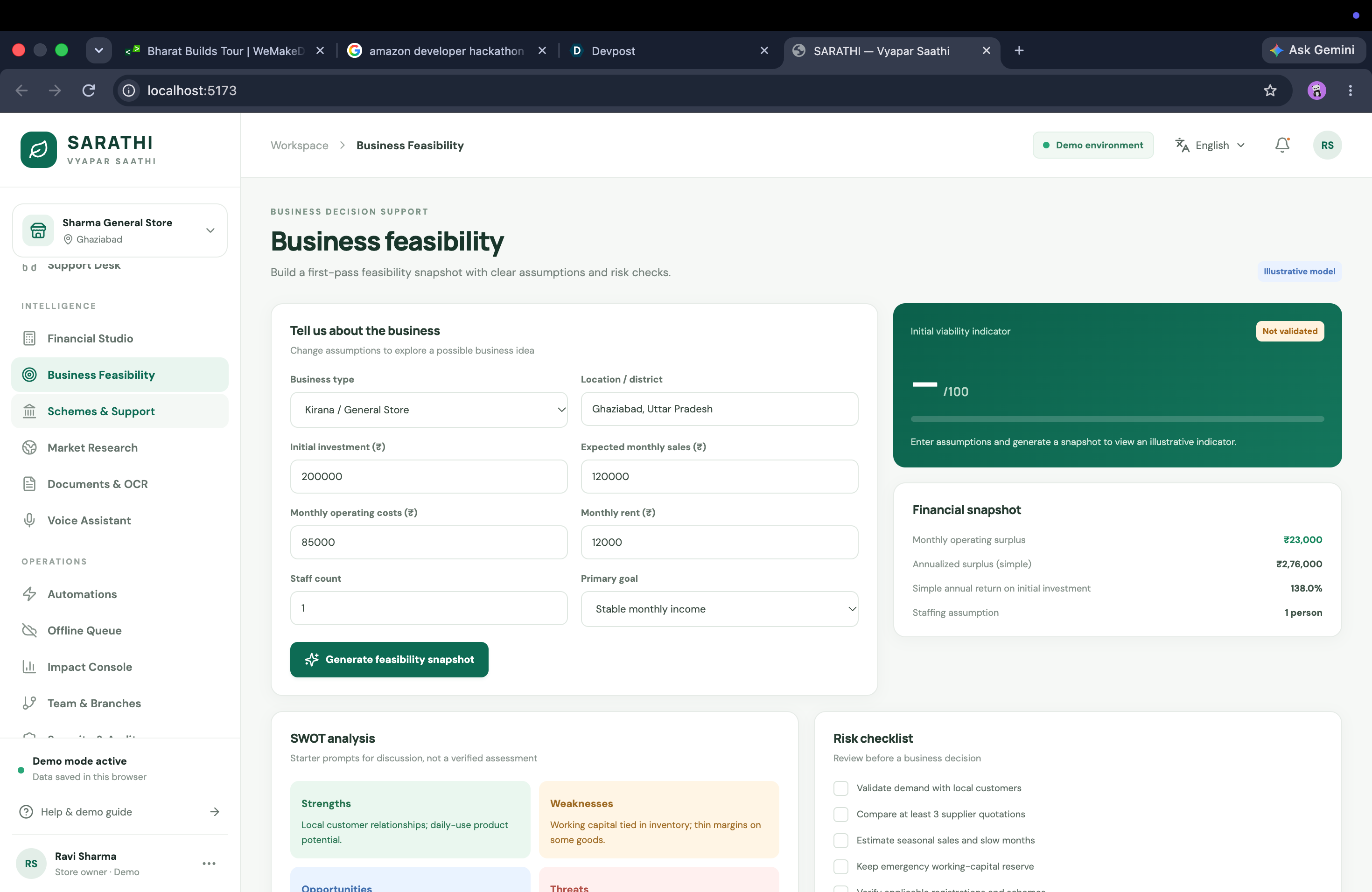
Business Feasiability
-
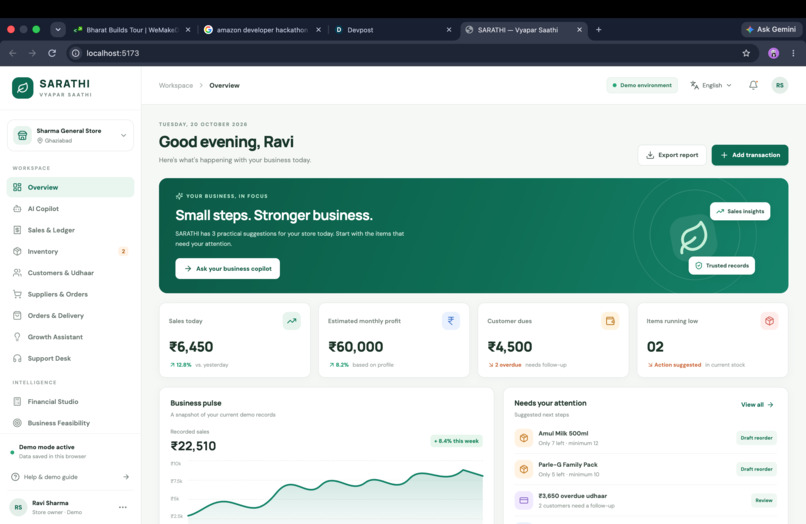
Dashboard
-
Market and research
-
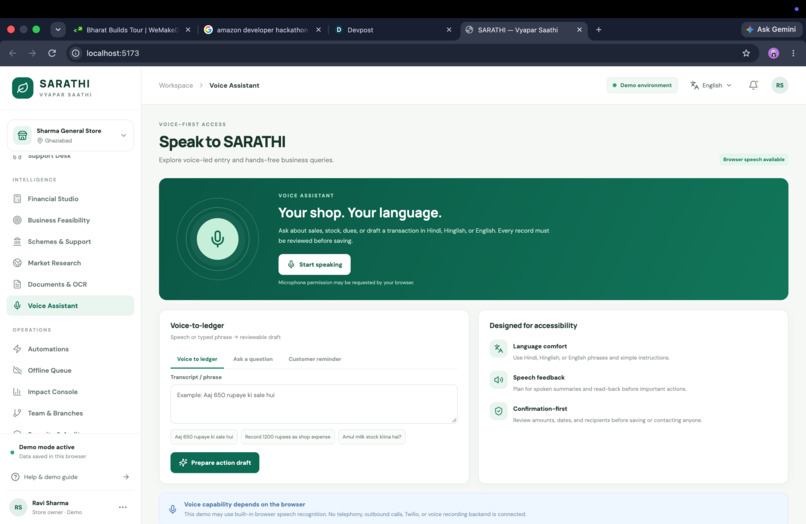
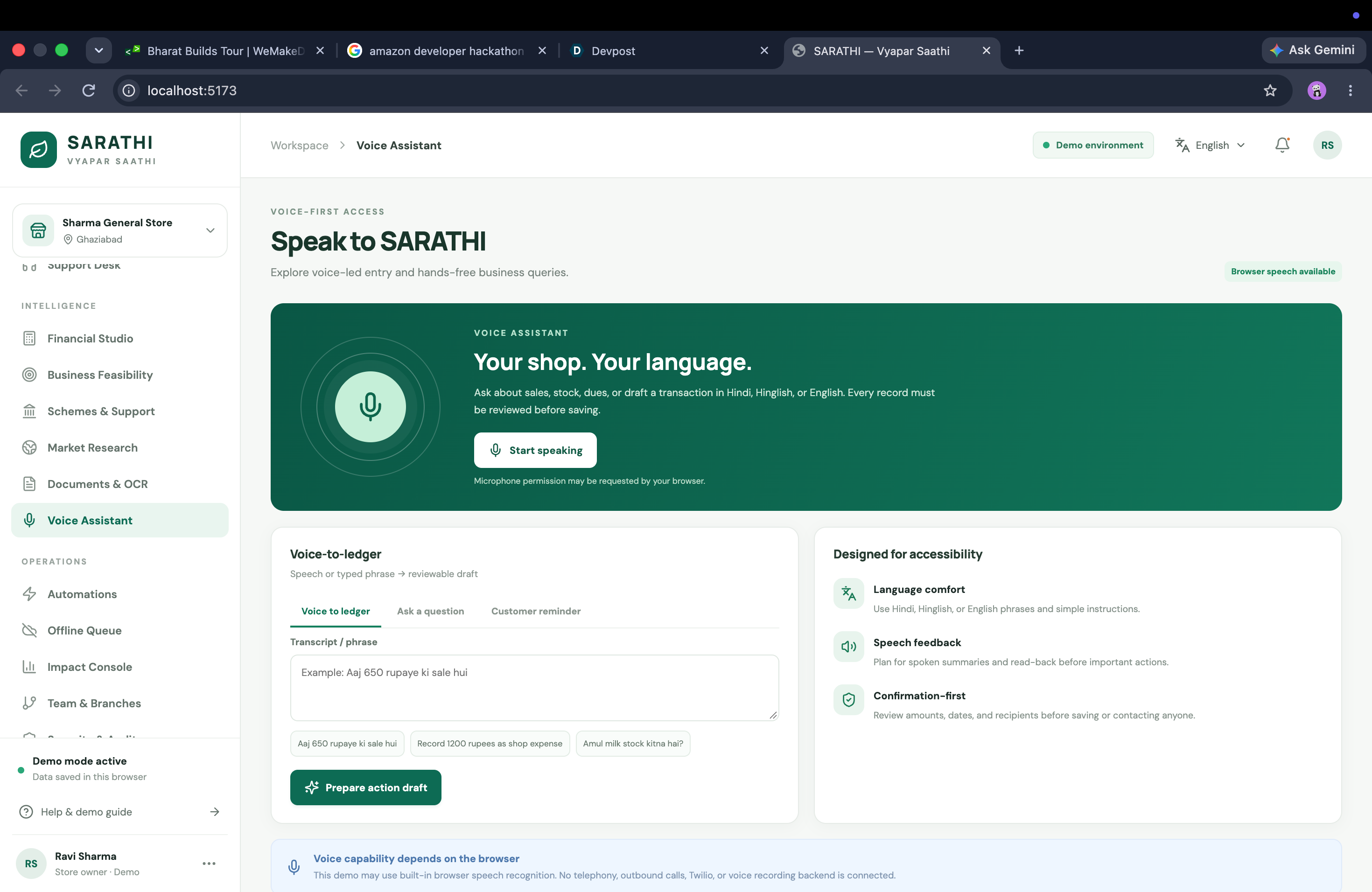
Voice assistent
-
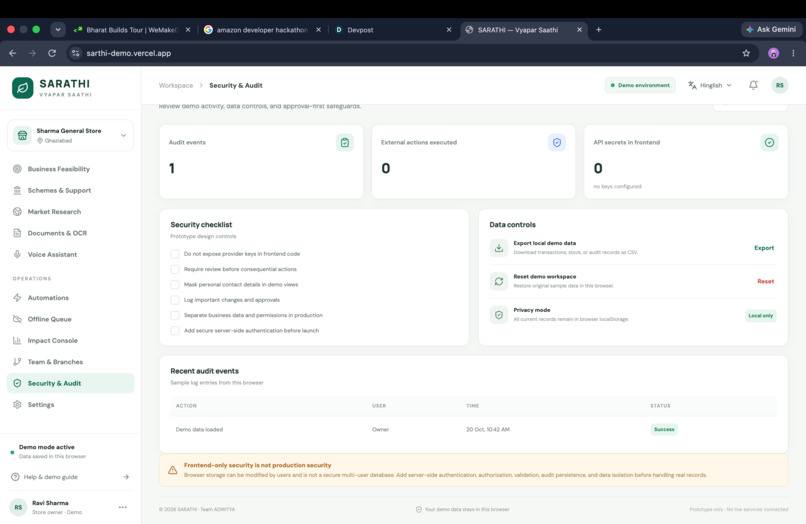
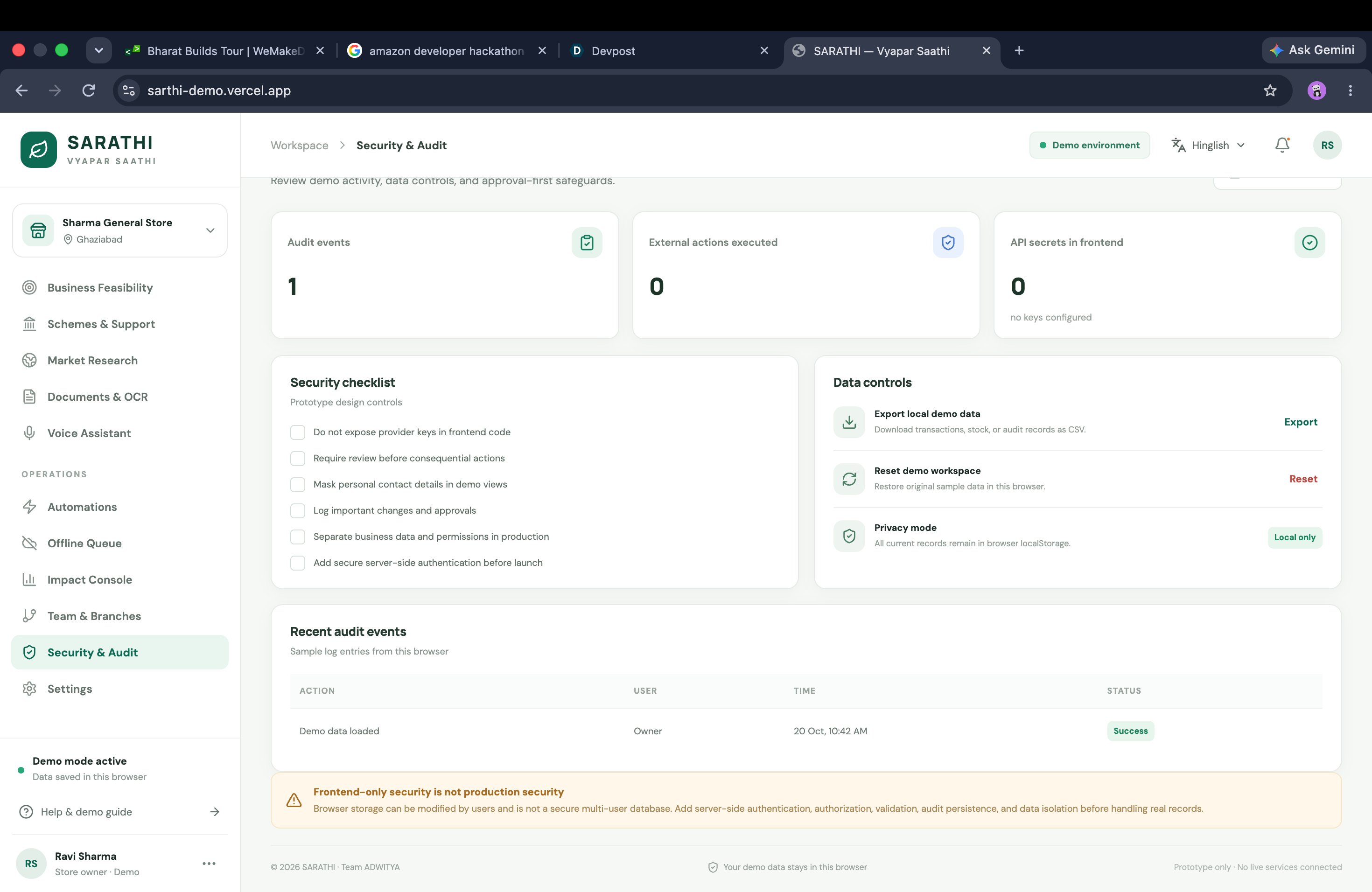
Security
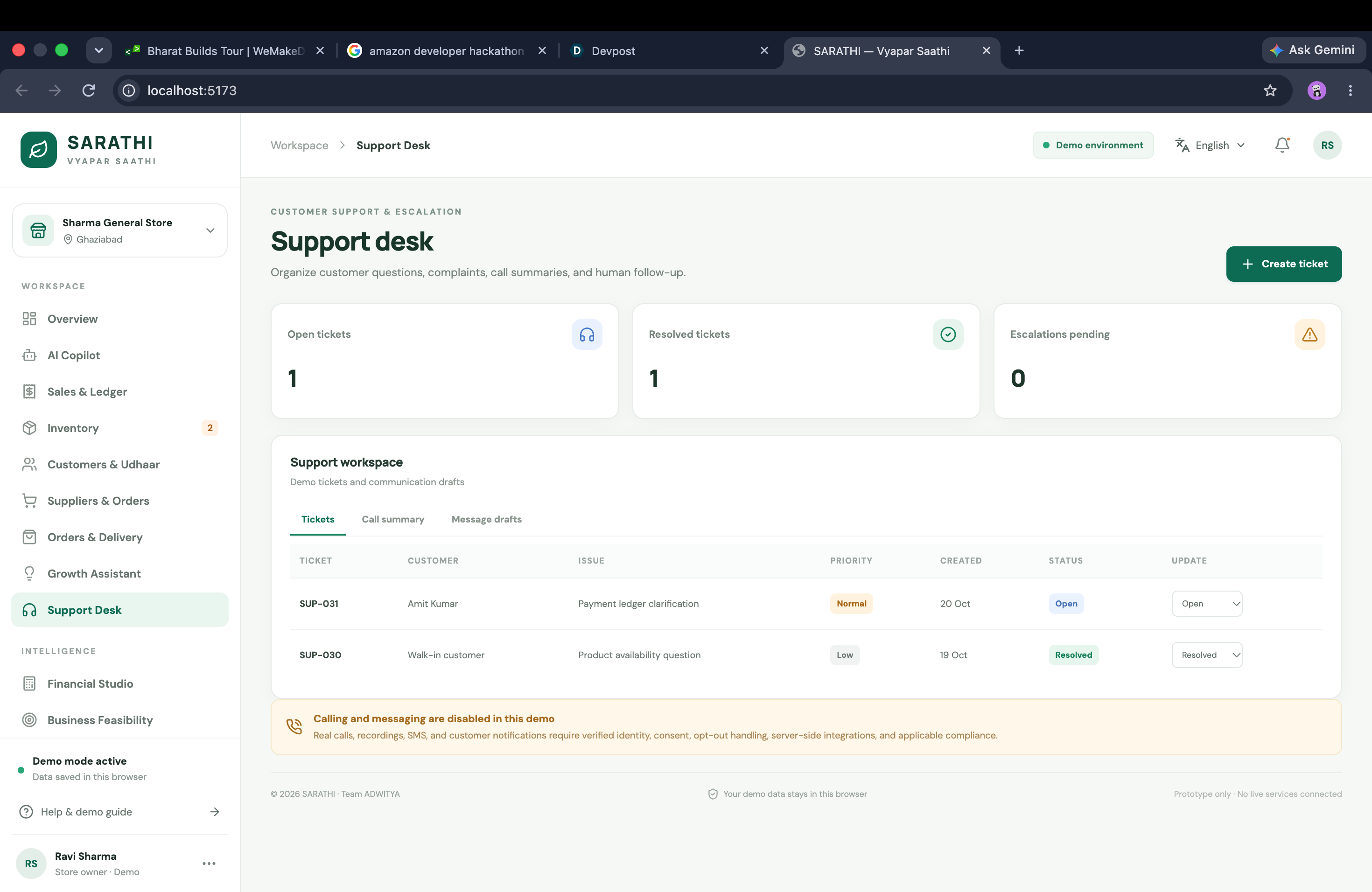
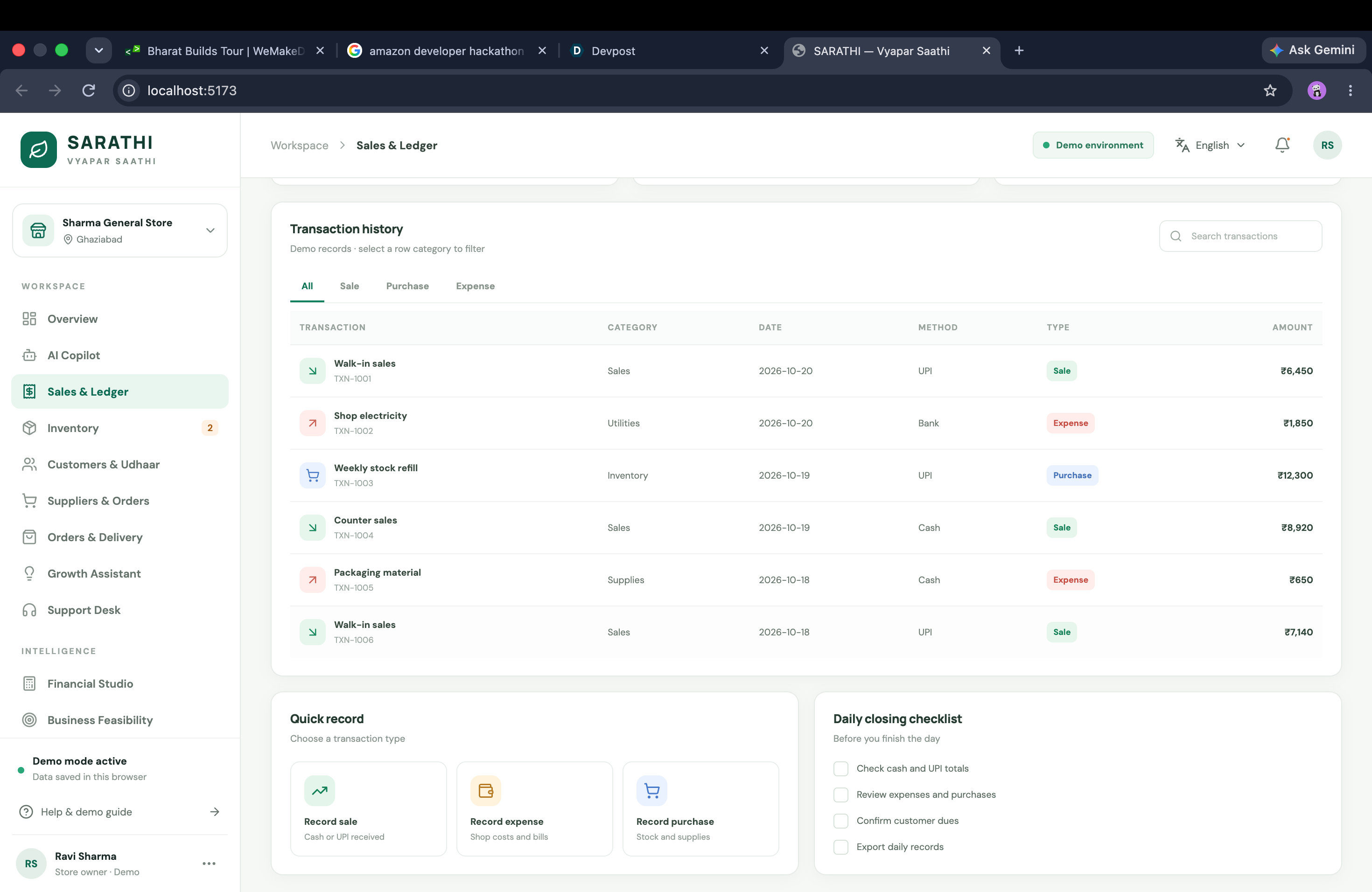
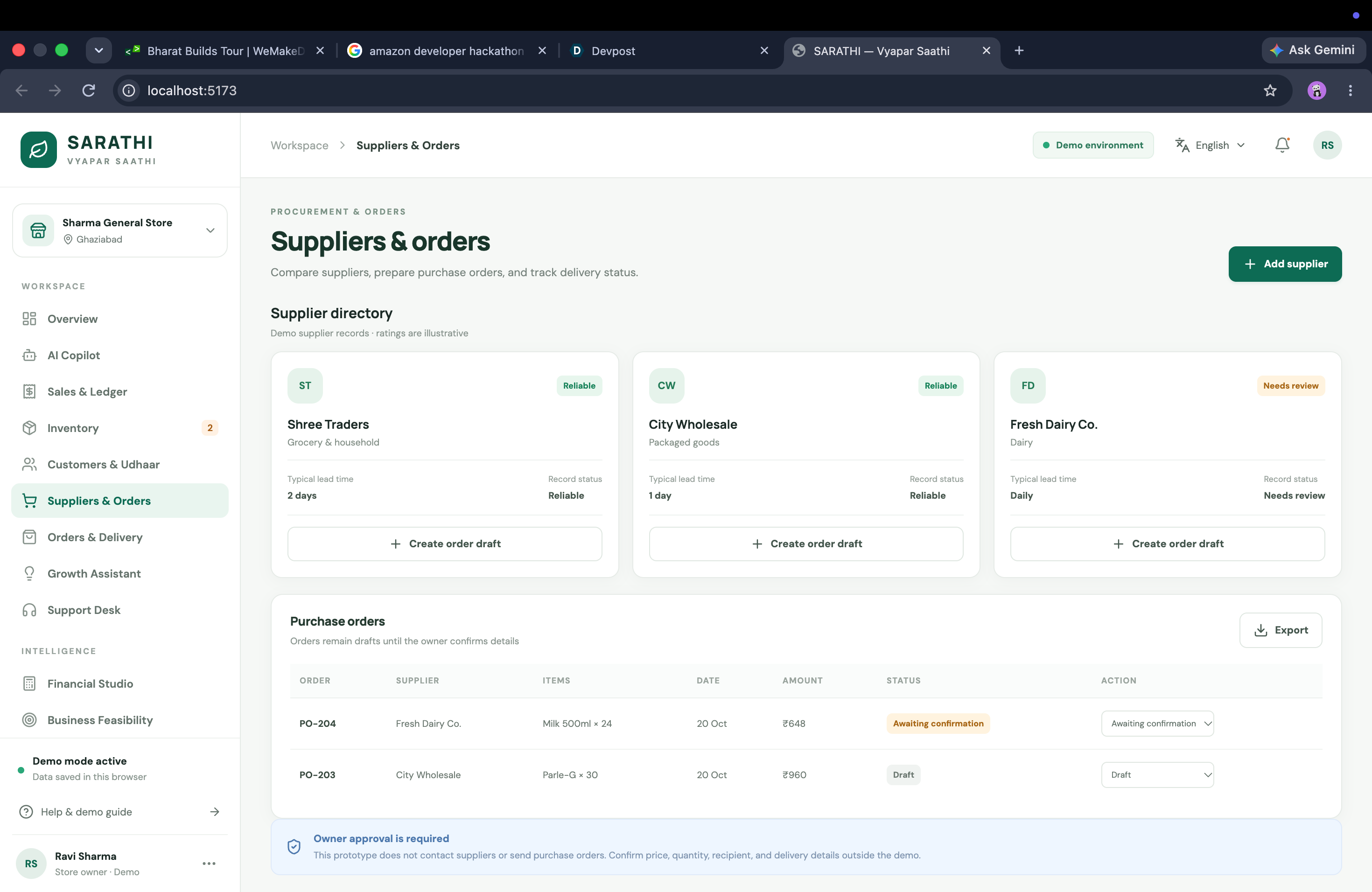
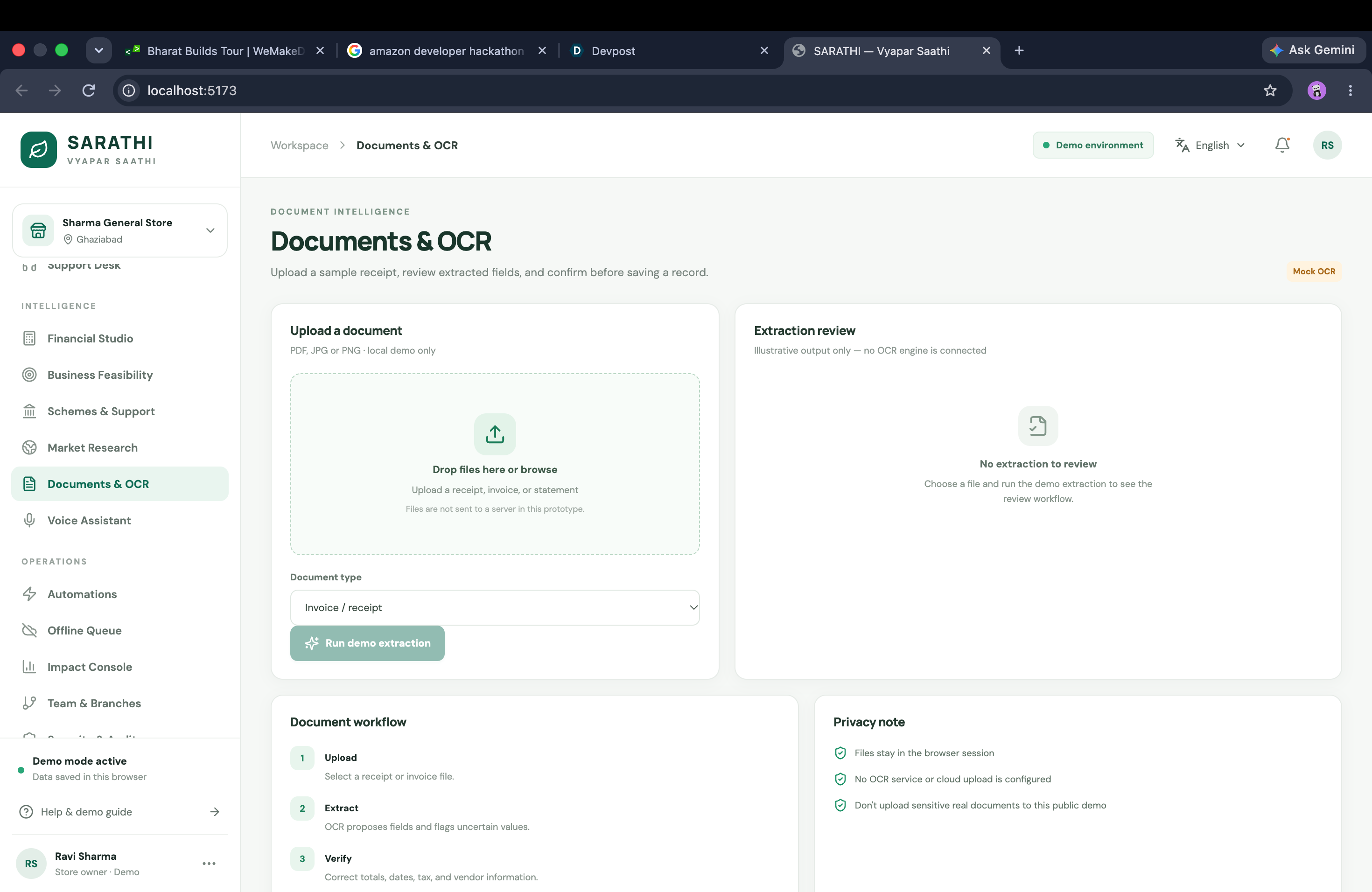
Inspiration
India has millions of micro-entrepreneurs who run businesses with limited access to structured financial guidance, government schemes, market intelligence, and digital tools. Many important decisions are made based on experience or fragmented information collected from different sources.
We wanted to build a digital Vyapar Saathi — a practical AI companion that understands a business owner's context and helps them make better decisions.
That idea led us to SARATHI, an AI-powered, hyper-local business advisory platform designed for Indian micro-entrepreneurs.
What it does
SARATHI brings multiple business-support capabilities into one platform:
- AI Business Copilot — answers business questions using the user's business context.
- Financial Structuring — helps users understand revenue, expenses, budgets, and cash flow.
- Government Scheme Discovery — helps identify potentially relevant schemes and programs.
- Market Intelligence — provides relevant market and business information.
- Supplier and Opportunity Discovery — helps entrepreneurs explore suppliers and business opportunities.
- Hyper-local Guidance — provides recommendations based on business type and location.
- Multilingual Interaction — designed for Hindi, Hinglish, and English users.
- OCR Support — helps extract useful information from uploaded documents.
Our goal is to make the experience feel less like using a complicated financial platform and more like having a knowledgeable digital business partner.
How we built it
SARATHI is a full-stack web application built using the following technologies:
- Frontend: React 19 and Vite
- Backend: Node.js and Express
- Database: SQLite
- AI: Groq-powered large language model
- Authentication: Twilio OTP and guest/demo access
- Web Intelligence: TinyFish
- Document Processing: OCR APIs
- Communication: REST APIs
The application uses structured business context, including business type, revenue, expenses, and budget, to make AI responses more relevant and personalized.
We designed the AI workflow around responsible information handling. SARATHI is instructed not to fabricate government schemes, eligibility criteria, prices, competitors, or other business-critical information. When reliable information is unavailable, the system should communicate that limitation instead of confidently guessing.
Challenges We Ran Into
One of our biggest challenges was combining multiple technologies into a single, reliable workflow.
Integrating AI, authentication, OCR, web research, databases, and external APIs introduced several potential failure points. APIs could become unavailable, requests could be invalid, authentication could fail, and external information could be incomplete.
Another major challenge was AI reliability. A response can sound convincing even when its underlying information is incorrect. We focused on prompt design, structured business context, validation, and clear boundaries for what the AI should and should not claim.
We also needed to keep the interface simple. Our target users should not need technical knowledge to benefit from SARATHI. The complexity should remain behind the scenes while the experience stays accessible and practical.
Accomplishments That We're Proud Of
We are proud to have transformed a real-world business problem into a full-stack AI advisory prototype rather than building just another generic chatbot.
Our key accomplishments include:
- Building an end-to-end AI-powered business advisory platform.
- Integrating multiple services into a unified application workflow.
- Developing business-context-aware AI interactions.
- Designing multilingual interactions for Hindi, Hinglish, and English.
- Bringing financial guidance, scheme discovery, market intelligence, supplier exploration, and document processing into one platform.
- Supporting authentication alongside a low-friction guest/demo experience.
- Prioritizing responsible AI behavior for business-critical information.
- Designing an extensible architecture that can support additional data sources and capabilities.
Most importantly, we are proud that SARATHI is designed around the everyday needs of micro-entrepreneurs instead of forcing users to adapt to a complicated technology stack.
What We Learned
Building SARATHI taught us that developing a useful AI product requires much more than connecting a large language model to a frontend.
We learned how to design AI systems around real-world problems, build context-aware prompts, integrate multiple APIs, handle authentication and validation, and manage failures across interconnected services.
We also learned the importance of responsible AI design. Business recommendations can influence real financial decisions, so unsupported claims and fabricated information must be treated seriously.
Another important lesson was the need to test complete user journeys. Individual APIs may work correctly while the overall application still fails when different components interact. Building a reliable product requires testing the complete workflow, handling edge cases, and continuously improving the user experience.
What's Next for SARATHI
Our next goal is to evolve SARATHI from a prototype into a more reliable and production-ready platform.
We plan to introduce:
- Advanced business analytics and forecasting.
- Automated expense and invoice understanding.
- Improved financial planning and cash-flow forecasting.
- Verified government-scheme information with eligibility matching.
- Real-time local market and supplier intelligence.
- More precise location-aware recommendations.
- Voice-based interaction in Hindi and Hinglish.
- A mobile-first experience for entrepreneurs who primarily use smartphones.
- Stronger security, privacy, and production-grade authentication.
- Personalized business growth recommendations based on historical business data.
Our long-term vision is to make SARATHI a trusted digital business companion for India's micro-entrepreneurs, helping them move from fragmented information and intuition toward more informed, accessible, and data-driven business decisions.
Built With
- ai-chatbot
- artificial-intelligence
- css3
- express.js
- financial-technology
- generative-ai
- groq
- html5
- javascript
- language
- large-language-models
- natural
- node.js
- ocr
- react
- rest-api
- sqlite
- tinyfish
- twilio
- vite
- web-application


Log in or sign up for Devpost to join the conversation.