-
-
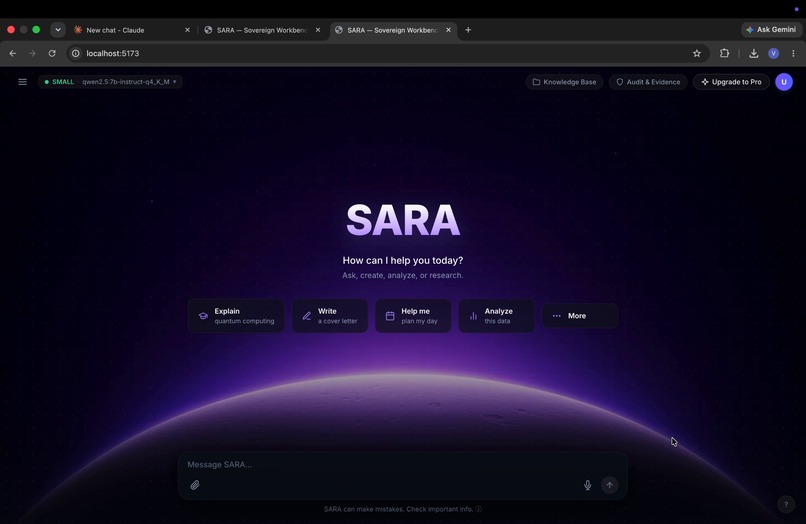
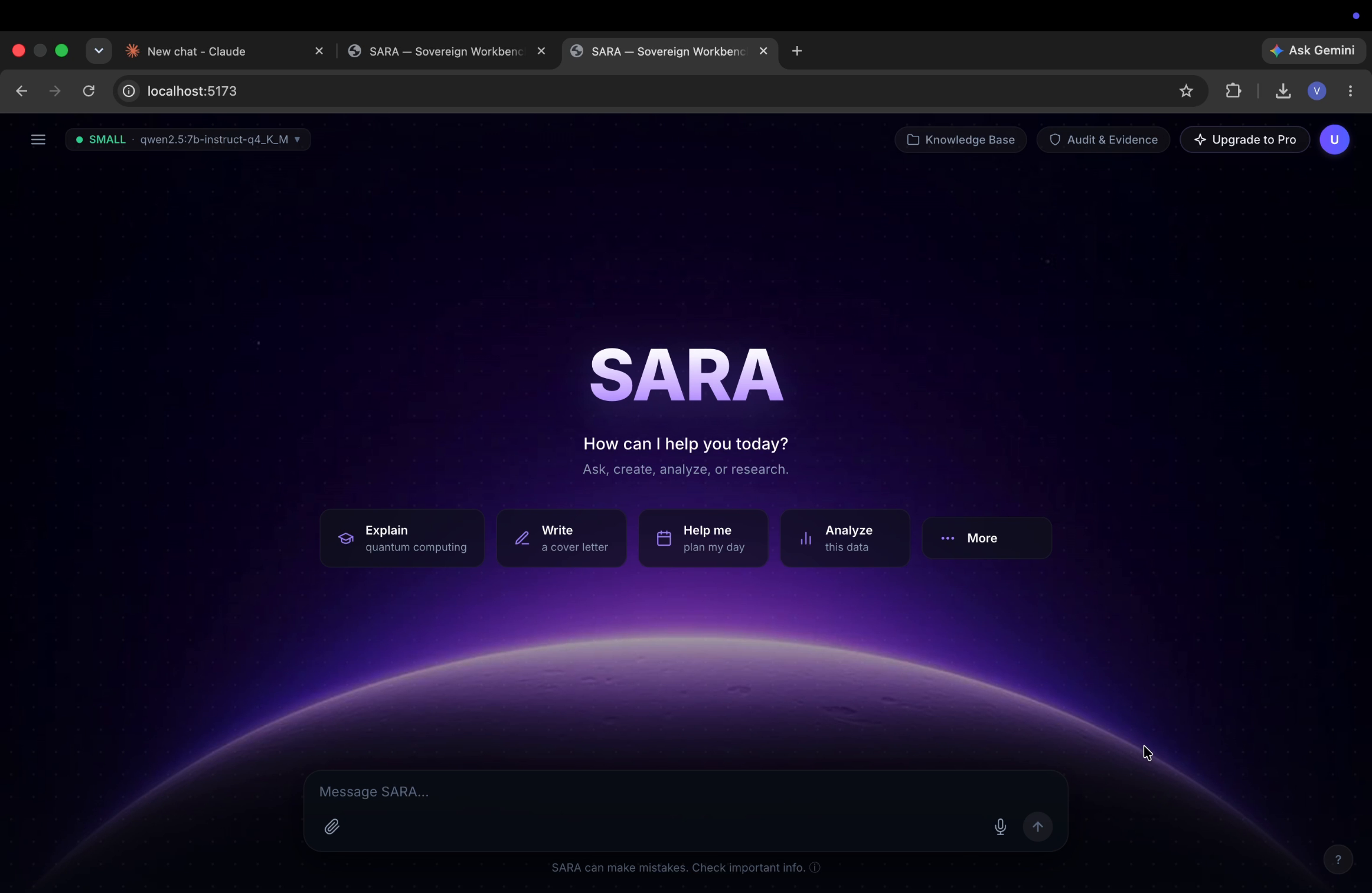
Clean SARA landing screen with quick-action prompts: Explain, Write, Help me, Analyze, More.
-
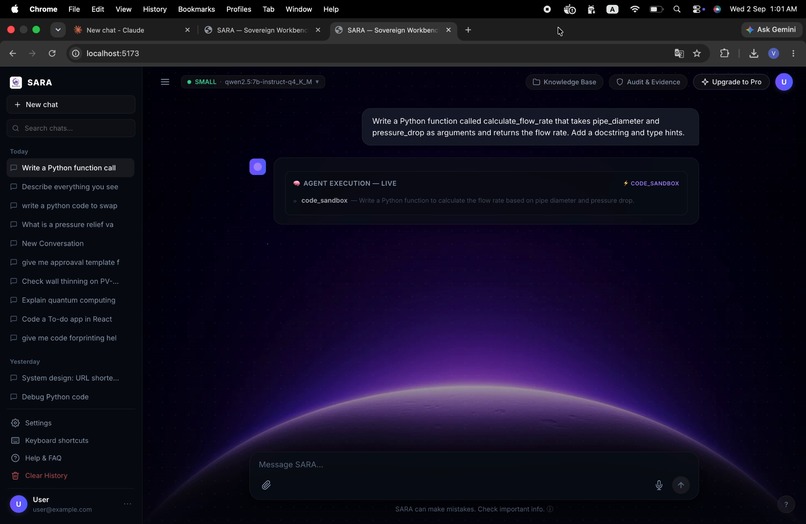
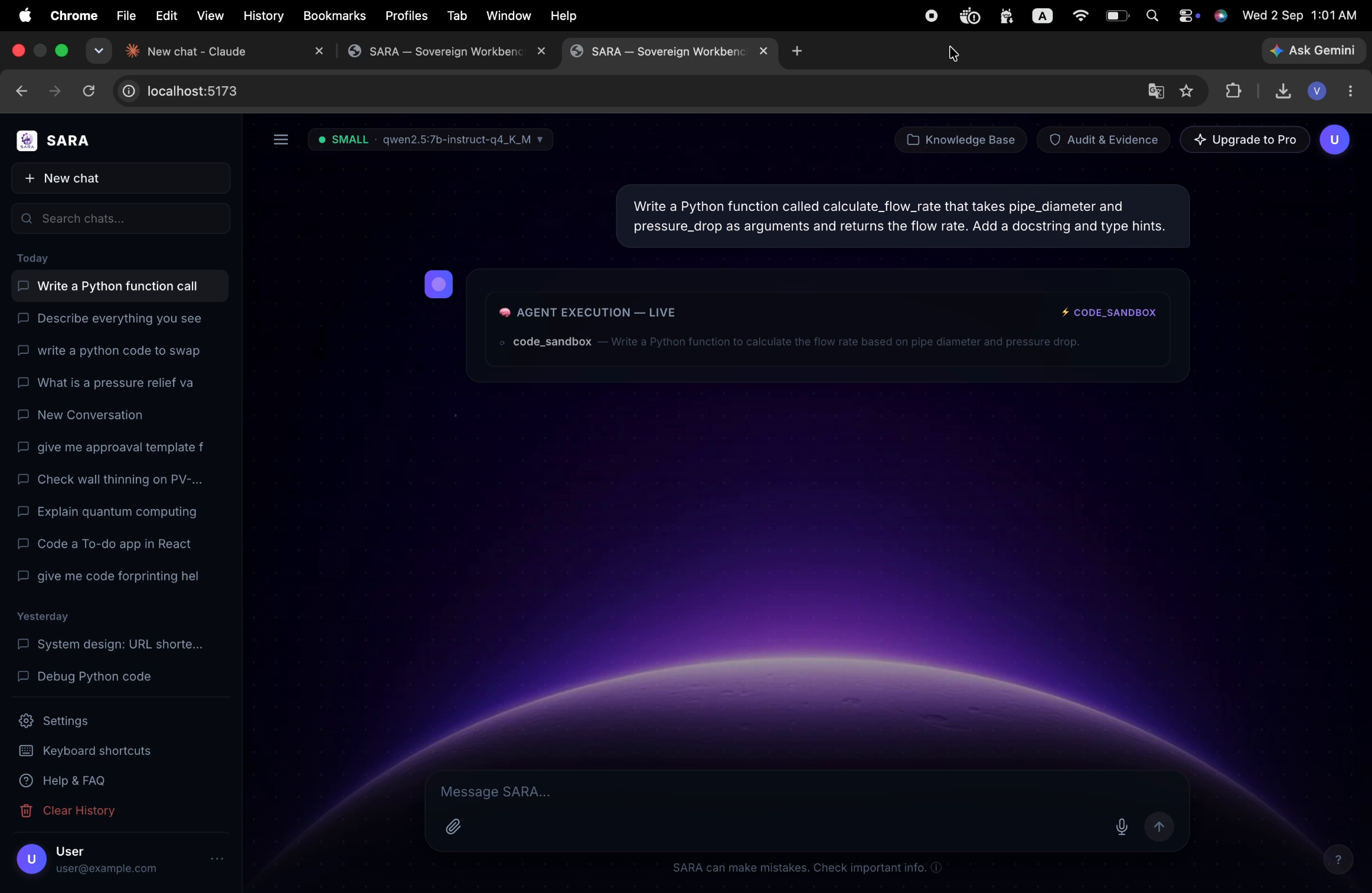
User's coding request instantly routes to the CODE_SANDBOX agent for live execution.
-
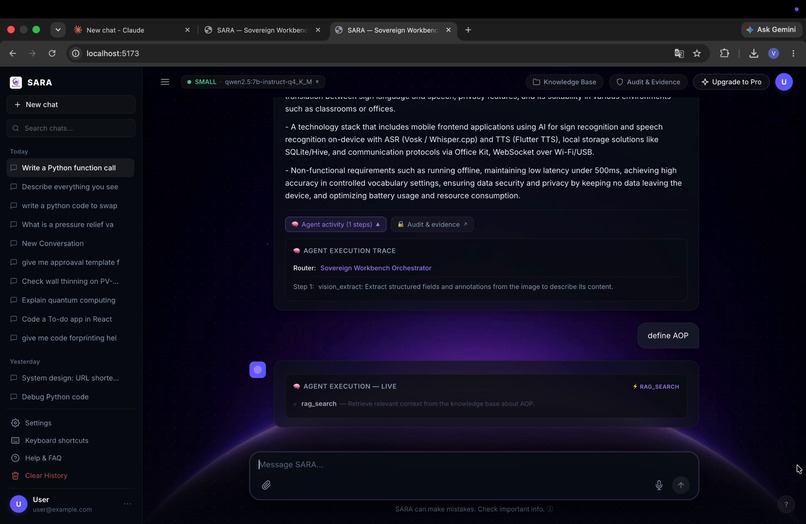
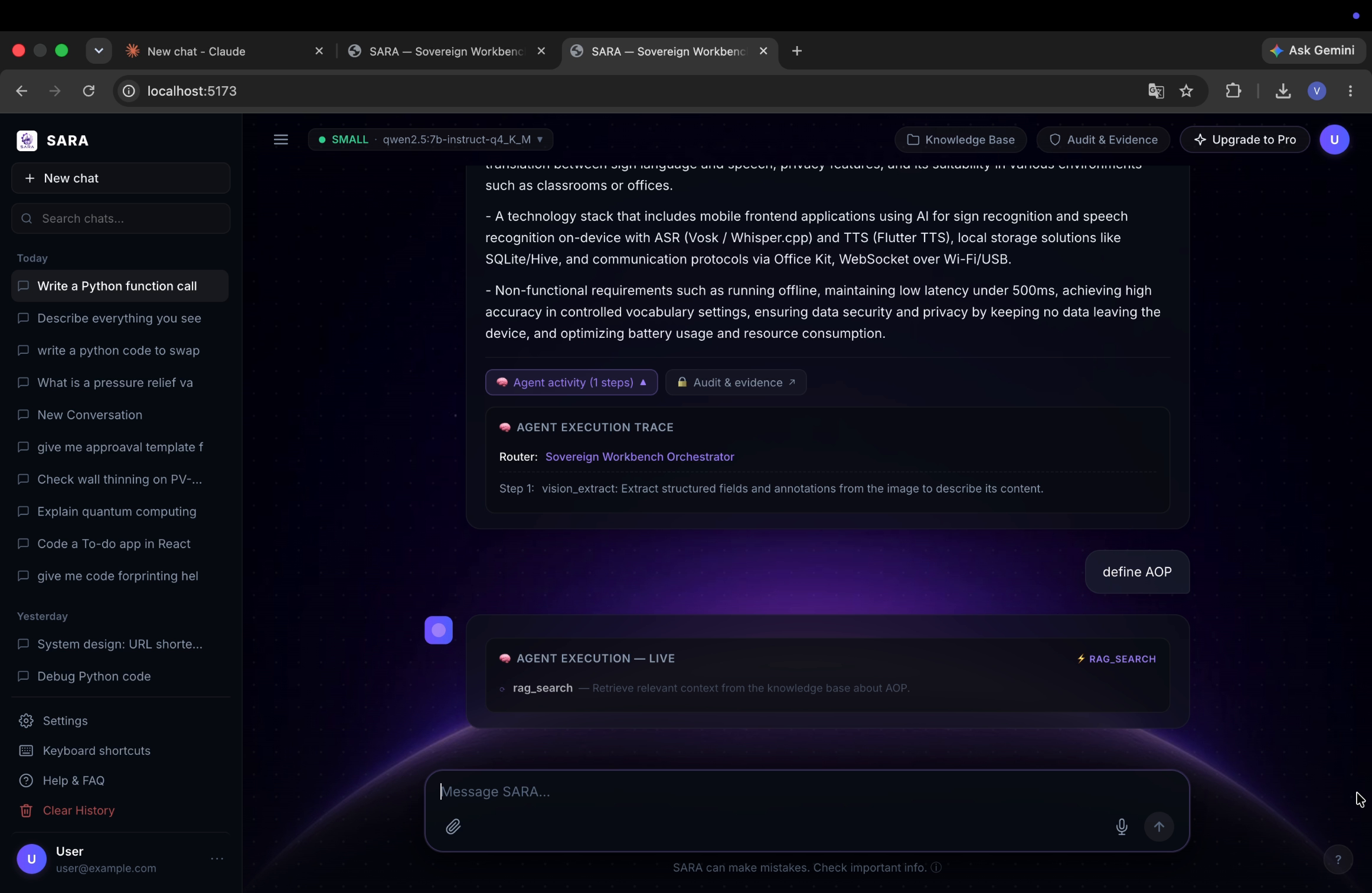
Query "define AOP" triggers the RAG_SEARCH agent to retrieve knowledge base context live.
-
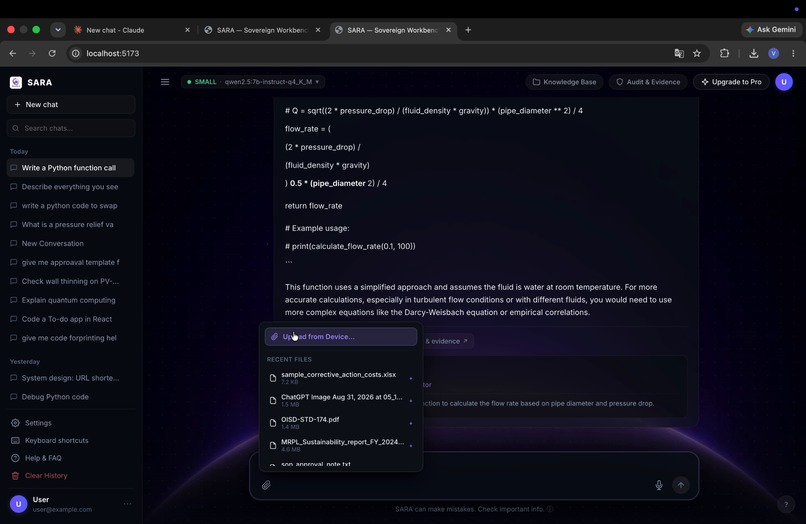
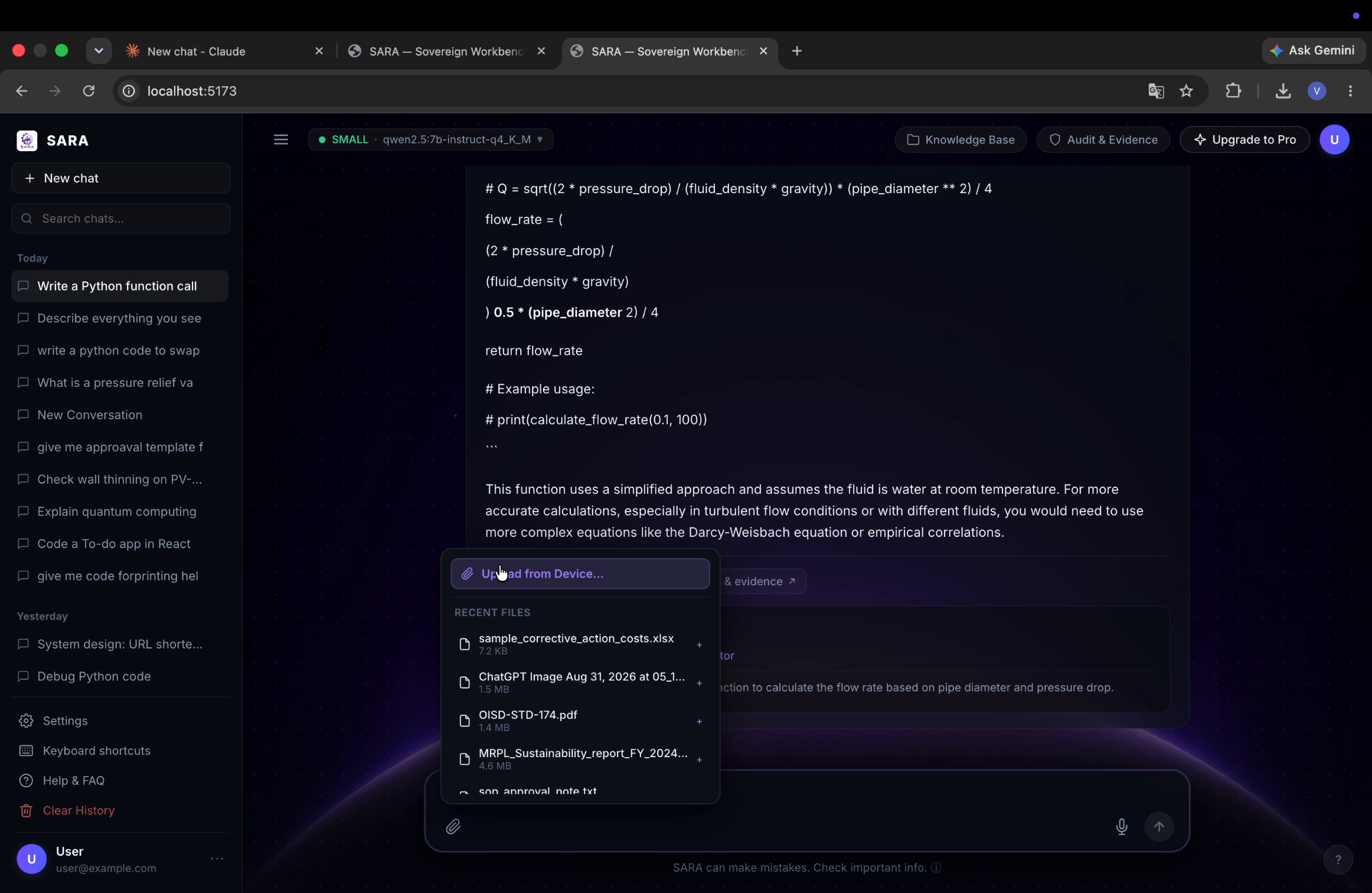
File picker showing industrial documents ready for upload: PDFs, spreadsheets, and images.
-
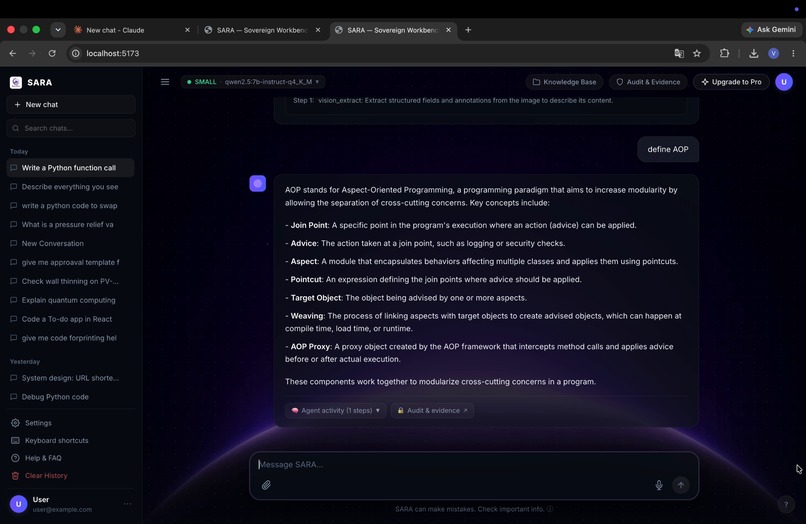
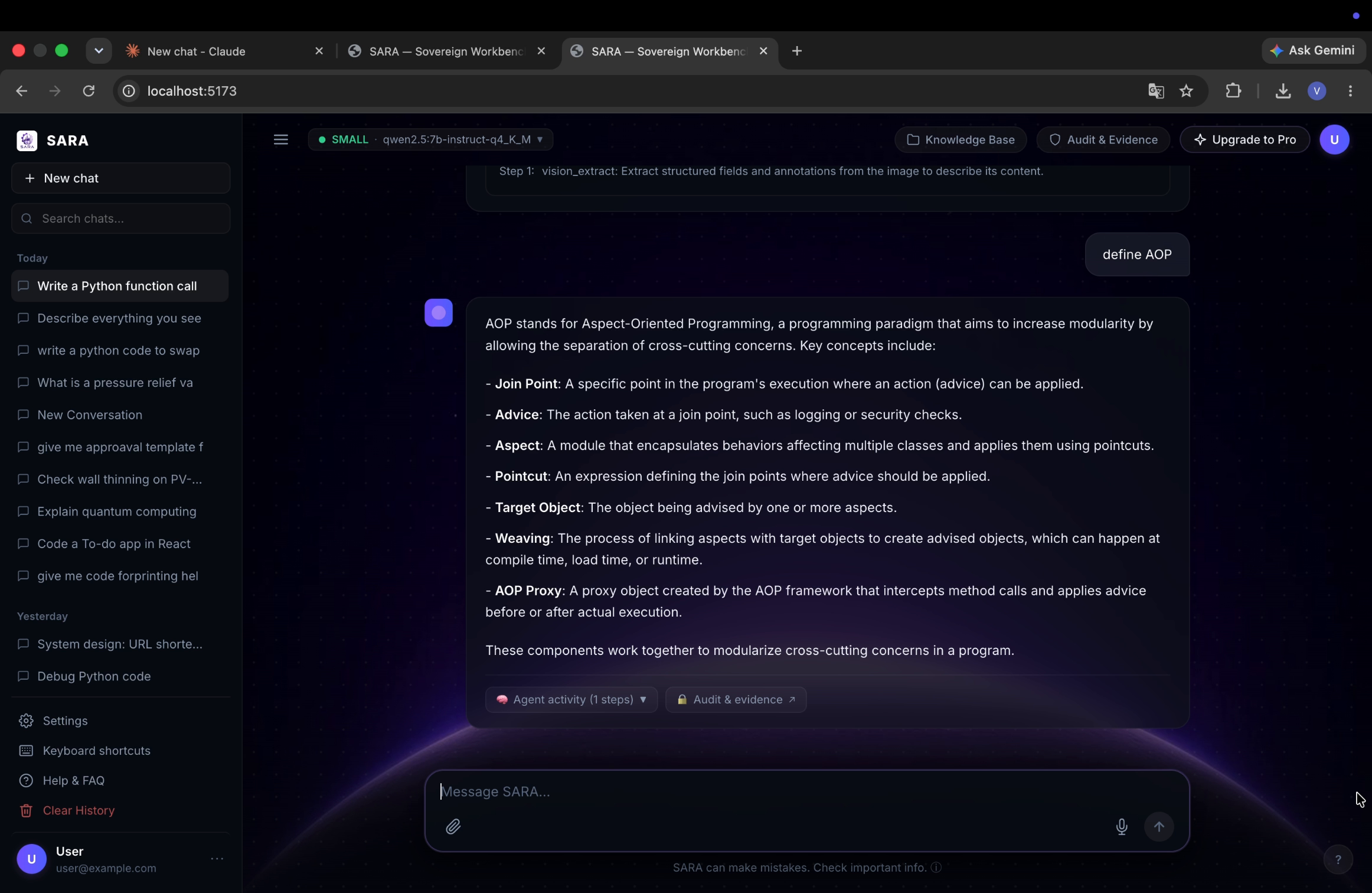
Full AOP definition answer plus the router's execution trace showing the RAG search step.
-
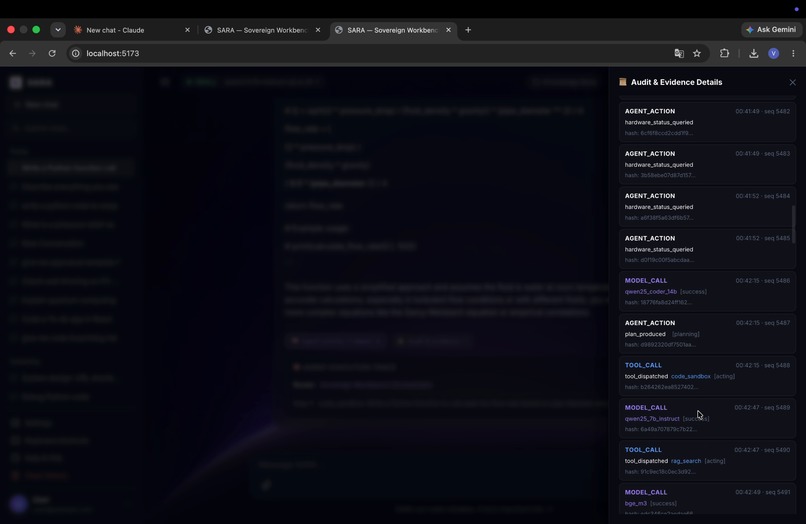
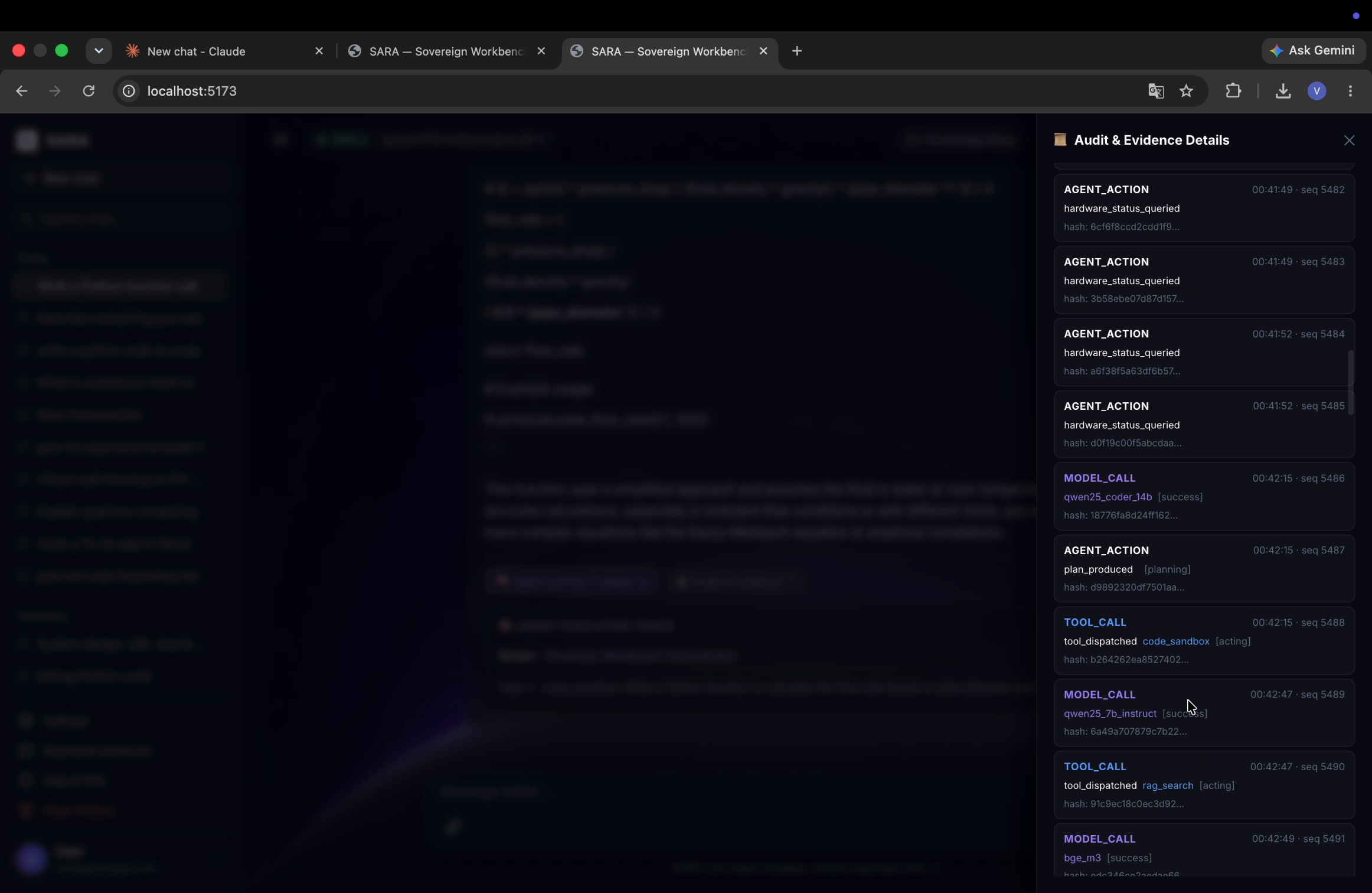
Full audit trail: Agent Action → Model Call → Tool Call, mirroring the router-to-response flow.
-
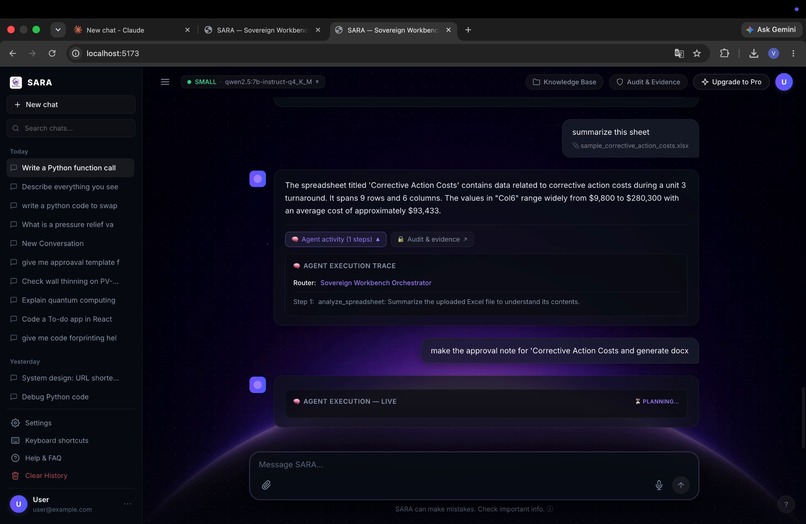
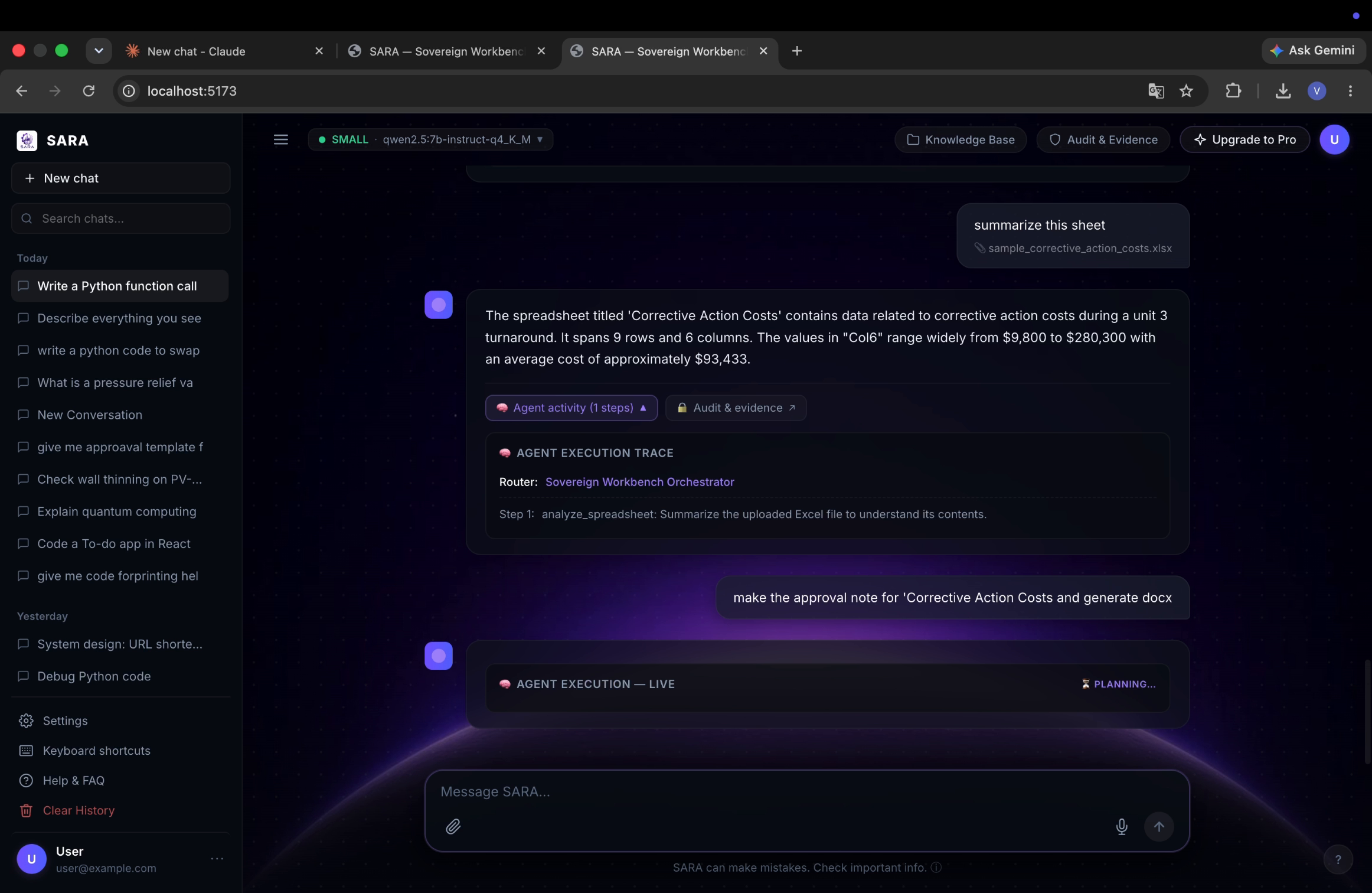
User asks SARA to draft an approval note and export it as a downloadable Word document.
-
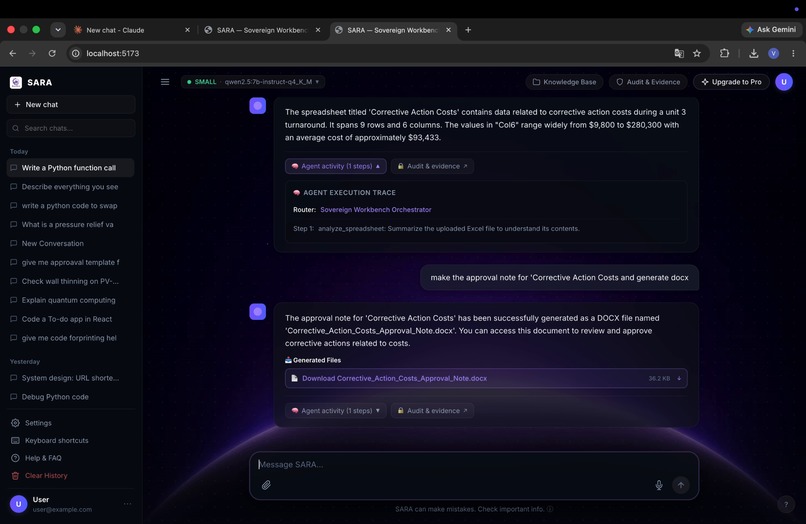
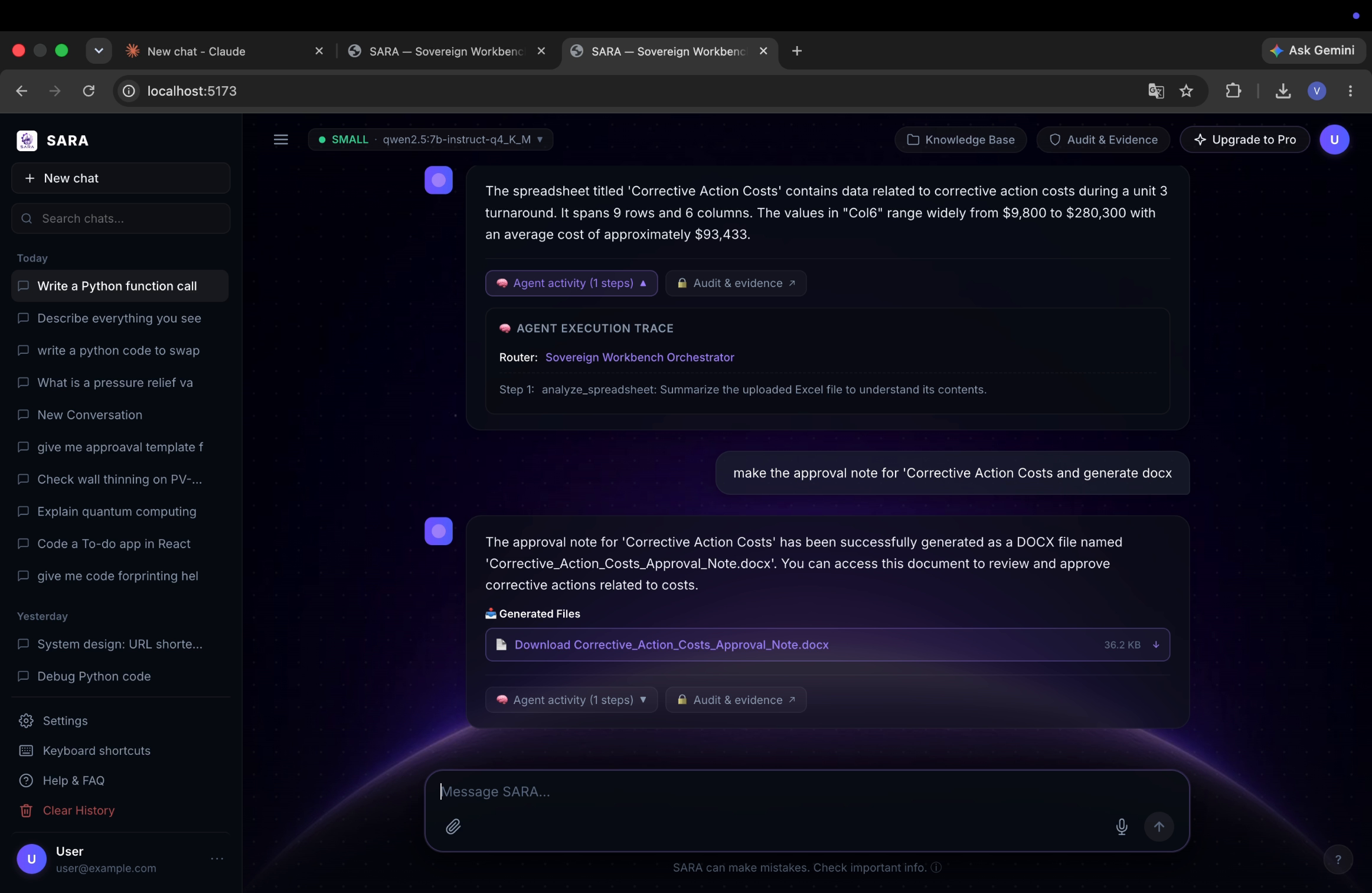
Completed DOCX approval note appears with a direct download link and file size shown.
-
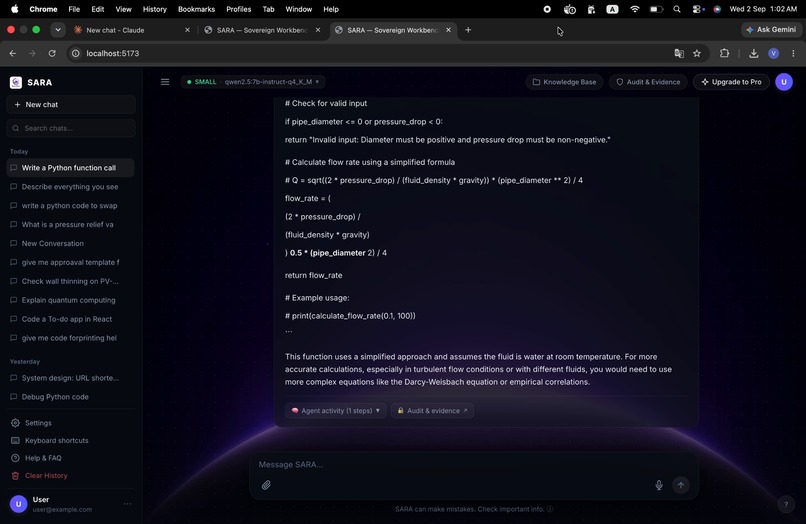
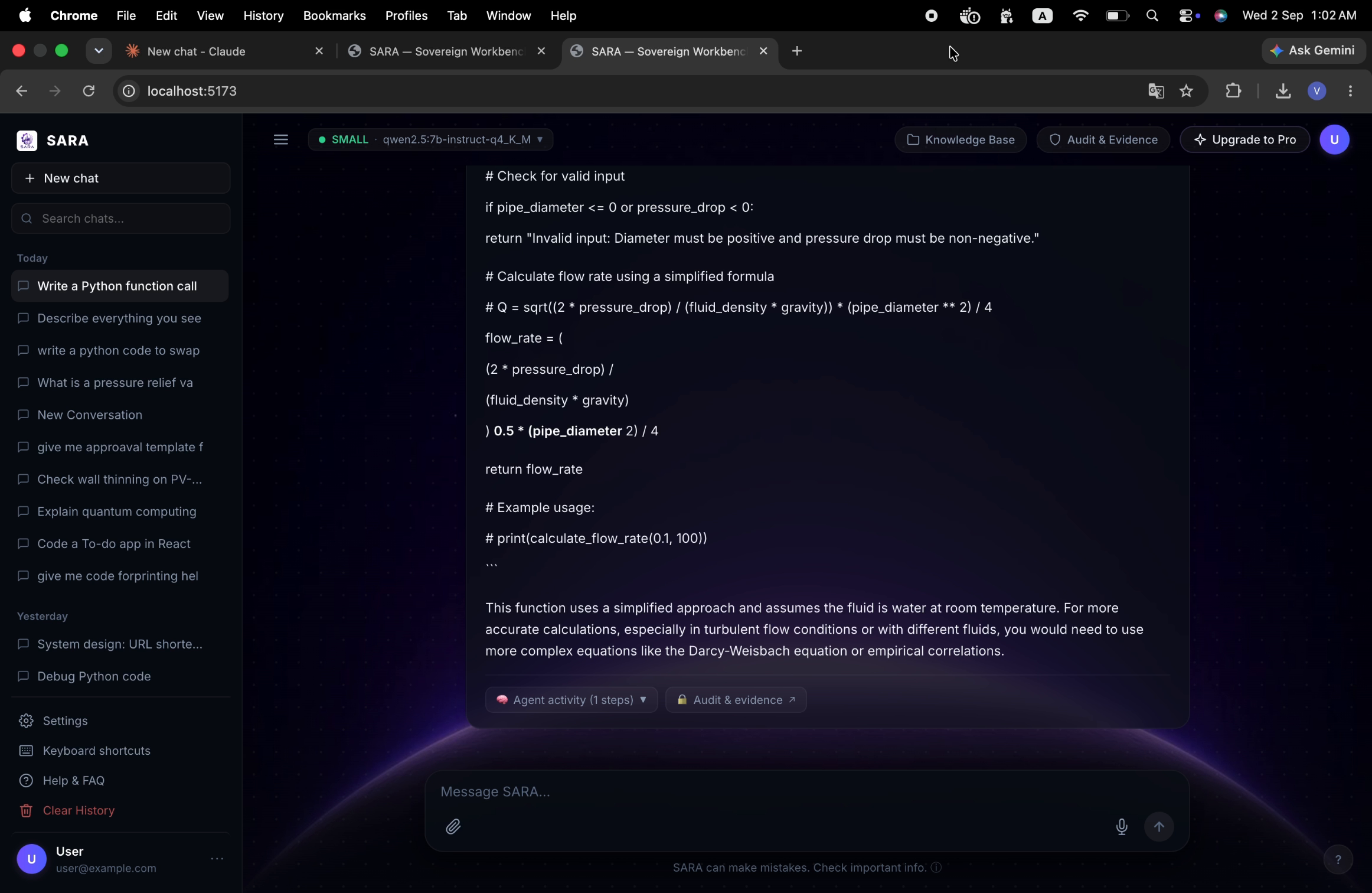
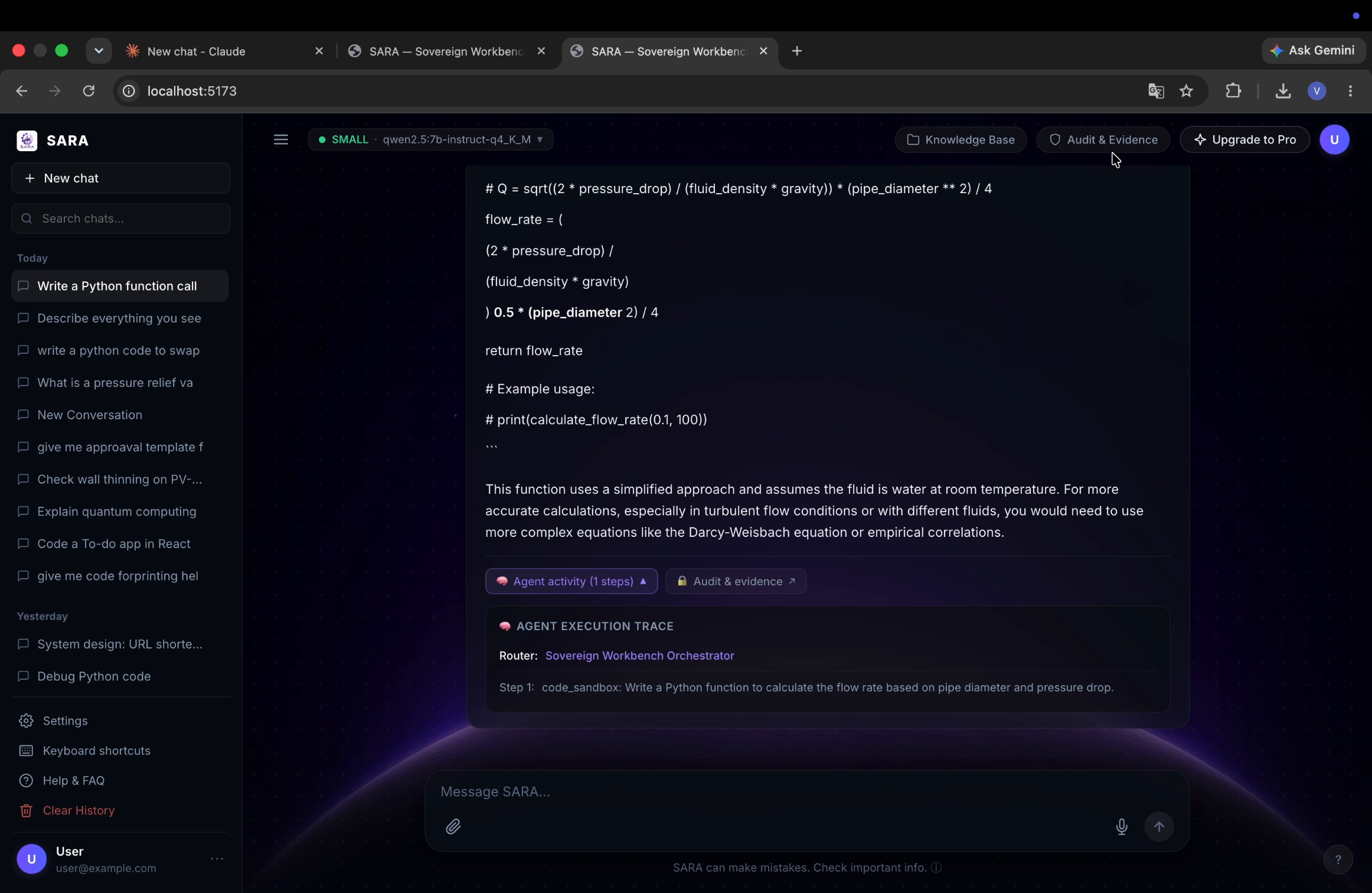
User's Python function request kicks off the code_sandbox agent in a live execution view.
-
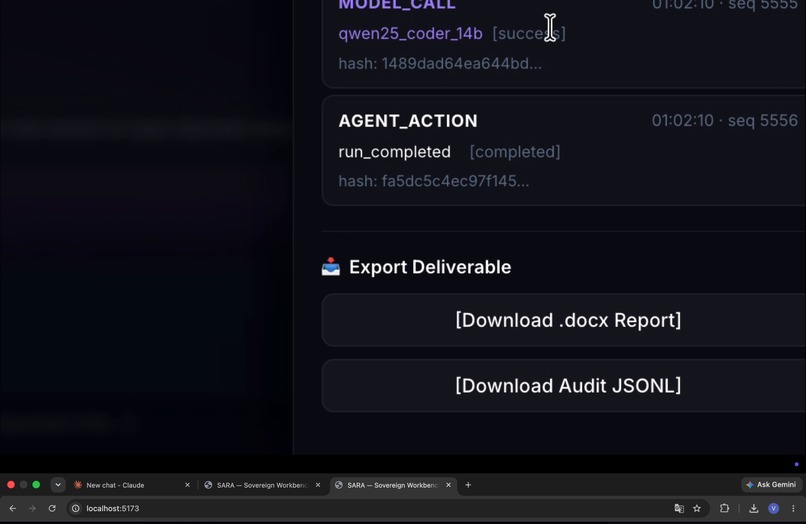
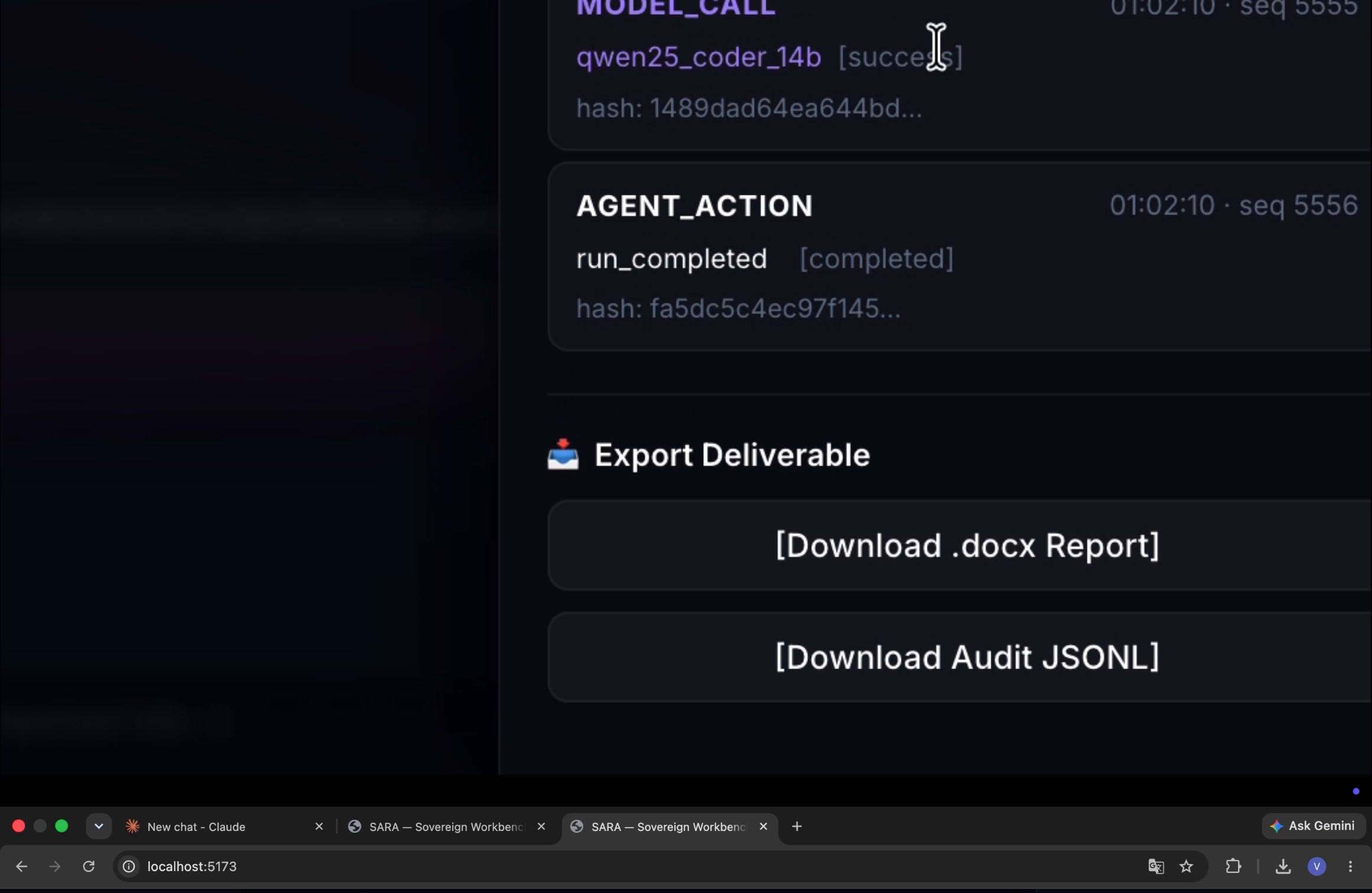
Model call success and run-completed status, plus export options for report and audit JSONL.
-
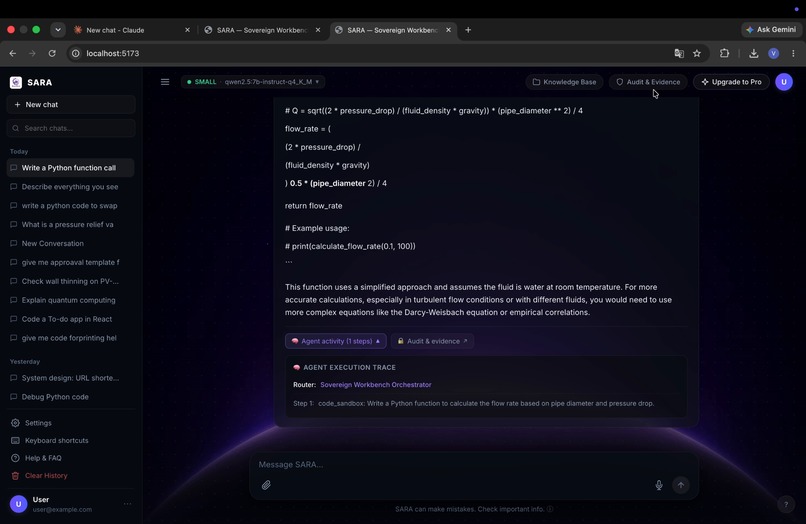
Detailed router trace showing the code_sandbox step assigned to fulfill the coding request.
-
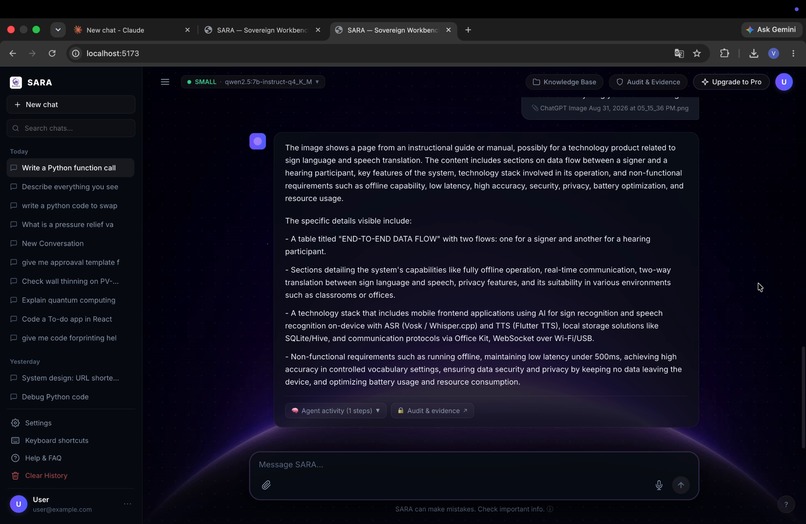
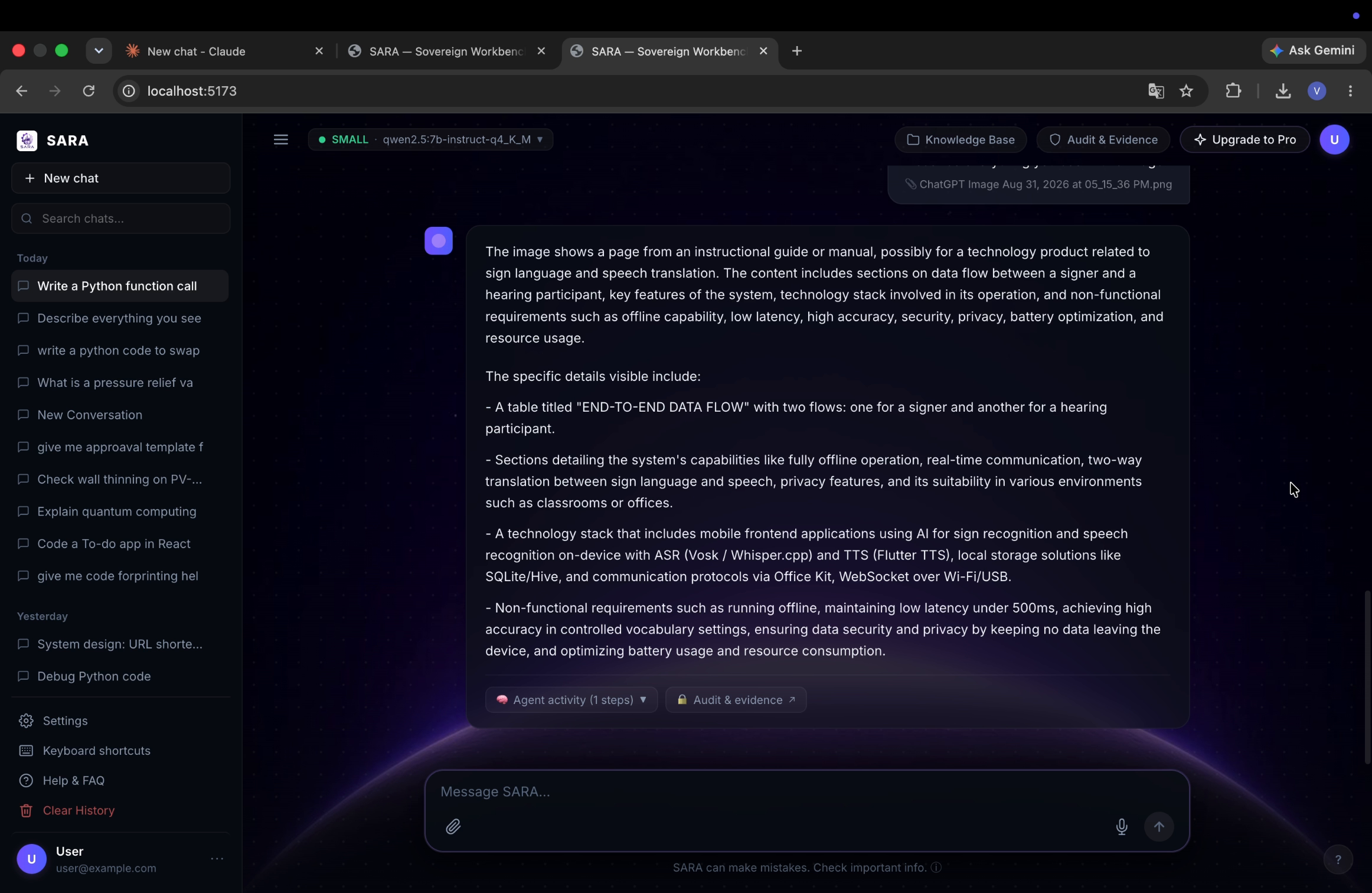
SARA extracts and describes detailed structured content from an uploaded technical image.
-
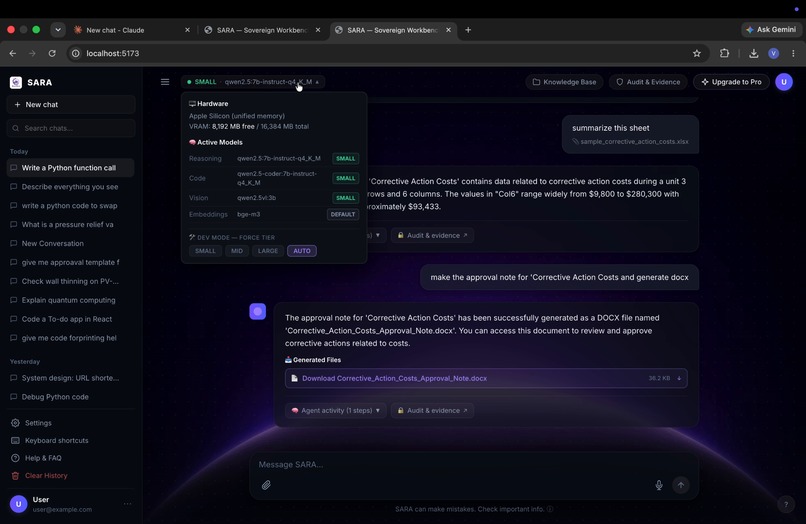
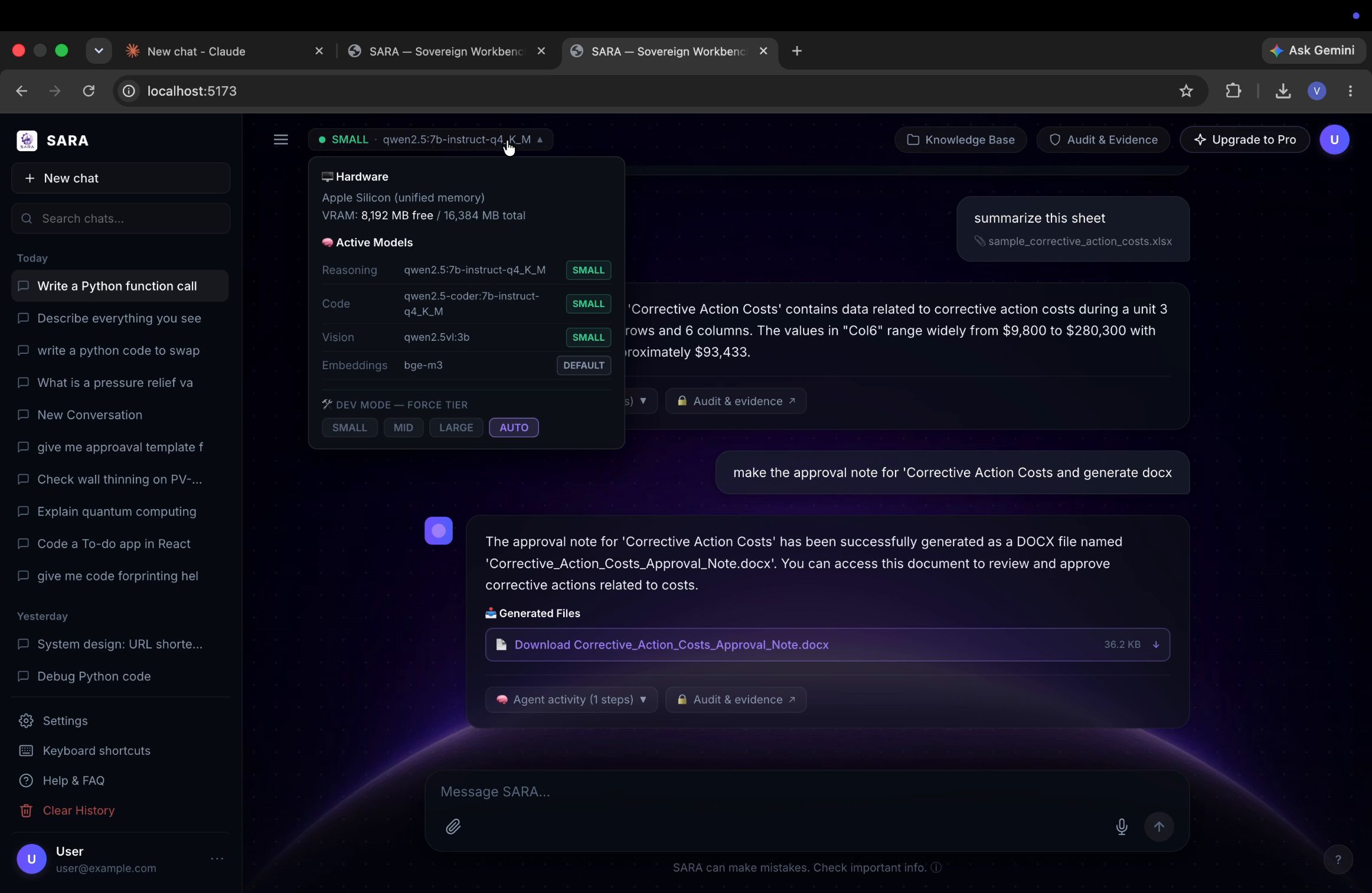
Local hardware panel shows Apple Silicon, VRAM usage, and active on-device model sizes.
-
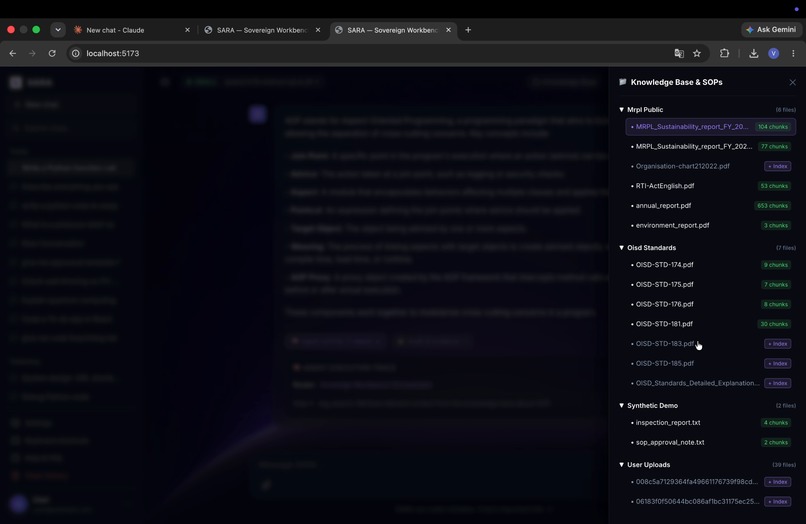
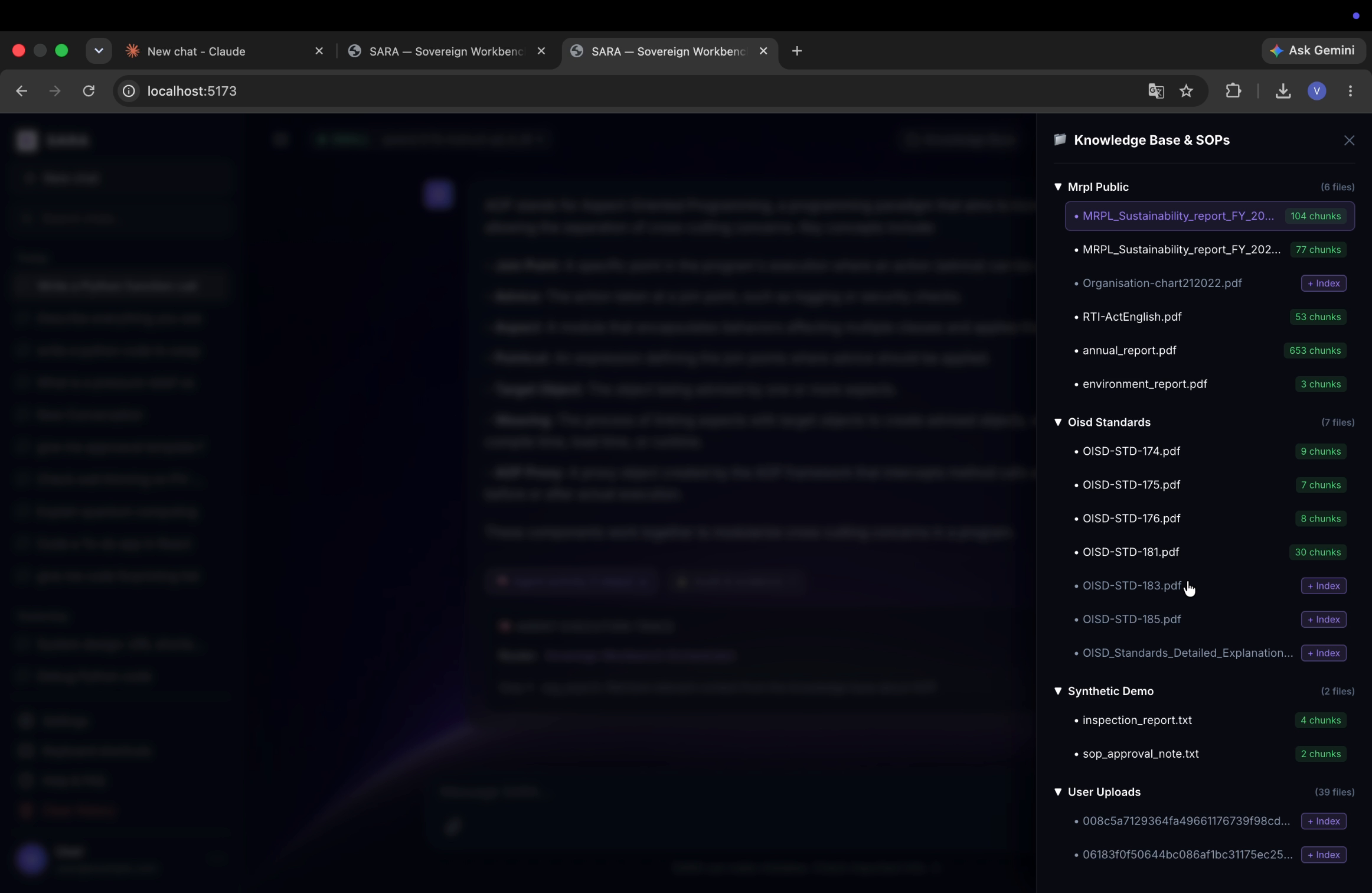
Folder-organized documents with per-file "+ Index" buttons to ingest into the RAG store.
Inspiration
AI is becoming powerful enough to analyze documents, write content, generate code, and automate workflows. However, organizations working with sensitive industrial information often cannot send their confidential documents and data to external cloud AI services.
We wanted to explore a different approach: What if organizations could have the capabilities of modern AI while keeping complete control of their data?
This led us to build SARA (Sovereign AI Reasoning Assistant) — Sovereign AI Workbench, an on-premise Agentic AI platform designed for confidential environments such as oil & gas, manufacturing, and other regulated industries.
Our goal was not to build another chatbot, but an AI system that can understand the user's intent, decide what action is required, use the appropriate tools, and produce a useful result — while keeping sensitive data within the organization's infrastructure.
What it does
SARA is an on-premise Agentic AI Workbench that combines an open-weight LLM with RAG, intelligent routing, document generation, and secure code execution.
When a user submits a request, SARA analyzes the intent and determines the appropriate capability instead of treating every request as a simple question-answering task.
Depending on the request, SARA can:
- Search and reason over confidential enterprise documents using RAG
- Provide grounded answers based on retrieved information
- Route requests to the appropriate AI capability
- Generate structured documents when required
- Execute generated code inside an isolated sandbox
- Handle different tasks through a unified AI workspace
The core workflow is:
User → Intelligent Router → Agent/Tool → Knowledge or Execution → Final Response
The system is designed to operate on-premise or in air-gapped environments, reducing the need to transfer sensitive information to external AI services.
How we built it
We designed SARA as a modular architecture where the LLM acts as the reasoning layer and different capabilities act as tools.
For document-based questions, documents are processed into chunks and stored in a searchable knowledge base. The RAG pipeline retrieves the most relevant context for a query and provides it to the local LLM so that responses are grounded in organizational knowledge.
An intelligent routing layer analyzes the user's request and predicts the appropriate next action. Depending on the intent, the request can move toward document retrieval, document generation, or code execution.
For code-related tasks, SARA sends the generated code to an isolated sandbox endpoint. The sandbox executes the code with controlled resources and returns the output, errors, exit status, and execution duration instead of allowing arbitrary code to run directly on the host environment.
The platform uses open-weight models and local infrastructure, with the architecture designed around privacy, controllability, and extensibility.
Challenges we ran into
One of our biggest challenges was making SARA genuinely agentic instead of just a collection of AI features. The system needed to determine what the user was asking for and select an appropriate capability without unnecessarily triggering tools.
Building reliable RAG was another challenge. Retrieving information is not enough — the retrieved context needs to be relevant enough for the LLM to generate useful and grounded responses.
We also had to think carefully about code execution security. Allowing an AI-generated program to execute directly on the host could introduce serious risks. This led us to design a separate sandbox with controlled execution and timeout handling.
Finally, building for on-premise environments required us to think beyond model performance and consider infrastructure, privacy, resource limitations, and the overall reliability of the system.
Accomplishments that we're proud of
We are proud of turning the idea of a private AI assistant into a functional agentic workbench rather than stopping at a basic chatbot or RAG prototype.
Some of our key accomplishments include:
- Building an on-premise Agentic AI architecture
- Integrating an open-weight LLM into the workflow
- Implementing RAG for confidential documents
- Developing intelligent request routing
- Connecting AI reasoning with practical tools
- Implementing document-generation capabilities
- Building a controlled code-execution sandbox
- Designing the system with data sovereignty and privacy as core principles
- Creating a foundation that can be extended with additional agents and enterprise tools
The biggest accomplishment for us is demonstrating that useful AI workflows can be built while keeping sensitive organizational information under organizational control.
What we learned
This project taught us that building an effective AI system involves much more than selecting a powerful model.
We learned how RAG, LLM reasoning, agents, tools, routing, and execution environments can work together as a complete system.
We also gained practical experience with local LLM deployment and learned about the challenges of building AI for environments where cloud connectivity cannot be assumed.
Most importantly, we learned that enterprise AI needs to balance intelligence with security, reliability, controllability, and privacy.
What's next for SARA Sovereign AI Workbench
SARA is designed to grow beyond its current capabilities.
Our next goal is to introduce a more advanced multi-agent architecture, where specialized agents can collaborate on complex tasks instead of relying on a single reasoning flow.
We also plan to improve document understanding for multimodal industrial content such as tables, diagrams, scanned documents, and technical drawings.
Future versions could include additional enterprise tools, stronger permission and access controls, audit trails, better evaluation of RAG responses, and more sophisticated agent planning.
Our long-term vision is to make SARA a secure sovereign AI platform for organizations that need advanced AI capabilities without giving up control of their data.
Built With
- agentic-ai
- ai-automation
- code-sandbox
- data-sovereignty
- docker
- document-generation
- document-intelligence
- industrial-ai
- intelligent-routing
- javascript
- knowledge-retrieval
- large-language-models
- multi-agent-systems
- node.js
- ollama
- on-premise-ai
- open-weight-llm
- python
- rag
- react
- rest-api
- retrieval-augmented-generation
- typescript
- vector-database


Log in or sign up for Devpost to join the conversation.