-
-
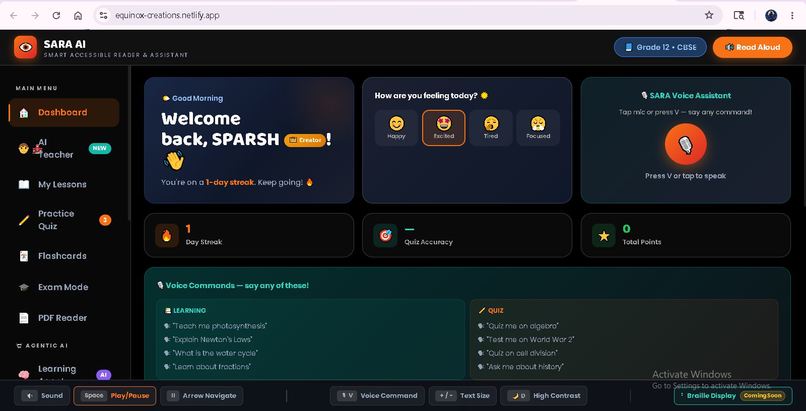
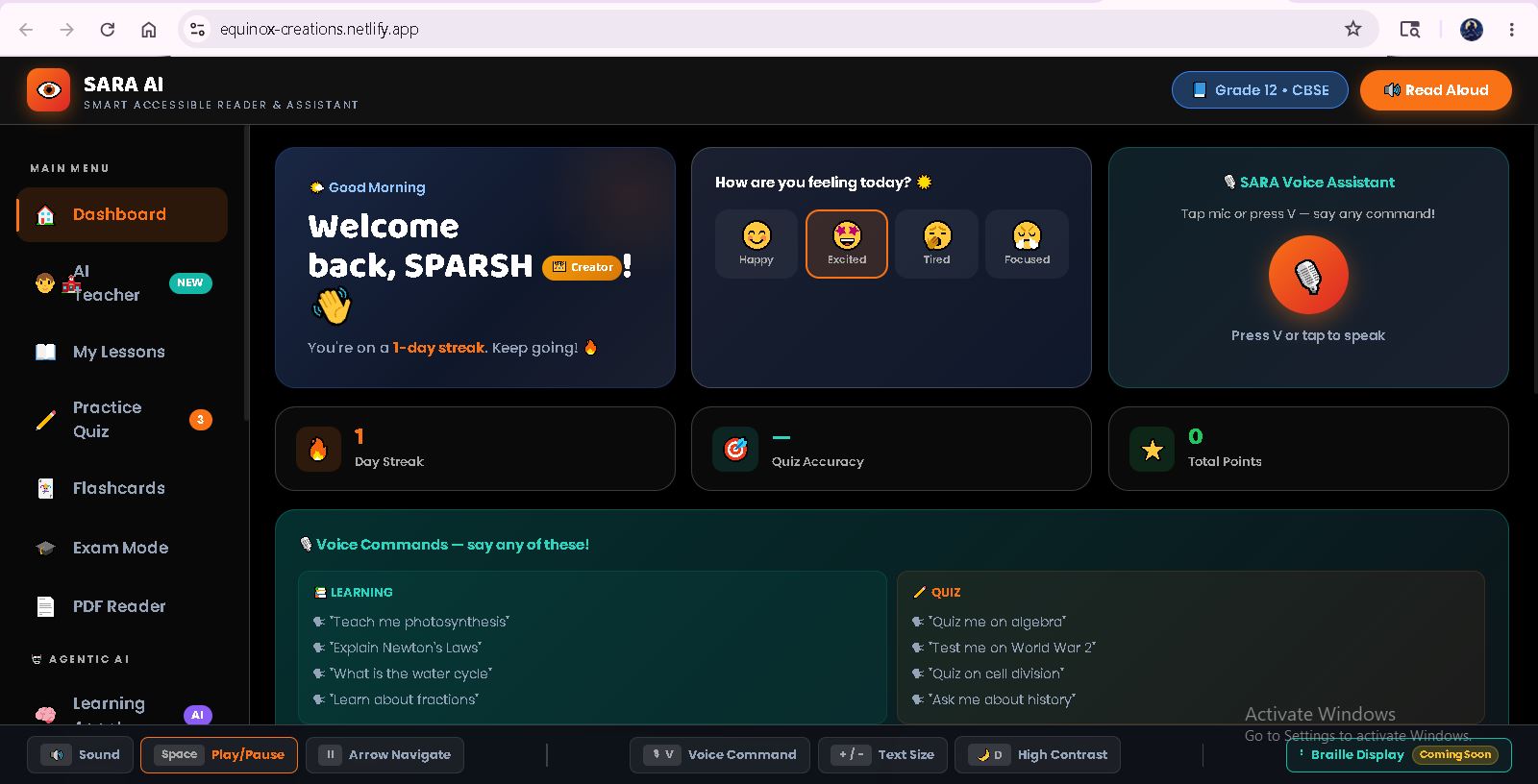
USER INTERFACE
## Inspiration
Artificial Intelligence is rapidly transforming education, but most AI learning tools are designed for students who can easily read screens, navigate visual menus, and type commands. For visually impaired students and students with dyslexia, this creates a major accessibility gap.
Most existing educational platforms depend heavily on visual interaction. Even voice assistants today are usually limited to reading text aloud instead of actually teaching, guiding, adapting, and helping students learn independently.
As students ourselves, we realized that accessibility should not be treated as an extra feature. It should be the foundation.
This inspired us to ask a powerful question:
Can AI become a true study companion for students who cannot rely on visual interfaces?
That question became the beginning of SARA AI — Smart Adaptive Resource Assistant.
SARA AI is an Agentic AI-powered voice study assistant built specially for visually impaired K–12 students and students with dyslexia, helping them learn through natural voice interaction instead of complex visual navigation.
## What it does
SARA AI transforms studying into a fully interactive voice experience.
Students can simply speak naturally to:
- Learn topics through structured AI-generated lessons
- Ask academic questions
- Take voice-based quizzes
- Receive spoken explanations
- Track learning progress
- Scan exam timetables using OCR
- Get reminders and study guidance
Unlike a traditional chatbot, SARA AI acts like a personalized study companion that can teach, guide, motivate, and adapt according to each student’s needs.
The system is designed to make learning:
- More accessible
- More independent
- More engaging
- More inclusive
At its core, SARA AI follows this idea:
$$ \text{Human Voice} \rightarrow \text{AI Understanding} \rightarrow \text{Accessible Learning} $$
## How we built it
We combined multiple modern AI and accessibility technologies to create SARA AI.
| Technology | Purpose |
|---|---|
| Claude API | Personalized AI explanations & intelligent responses |
| Web Speech API | Full hands-free voice interaction |
| Tesseract.js | OCR for extracting text from timetables & study materials |
| HTML / CSS / JavaScript | Browser-based accessible interface |
The entire application runs directly inside the browser with no installation required, making it lightweight and accessible for students everywhere.
We focused heavily on:
- Accessibility-first design
- Real-time voice interaction
- Dyslexia-friendly UI
- Natural conversational AI
- Smooth learning experience
The platform is approximately 99% voice-controlled, allowing students to study with minimal dependence on keyboards or visual interfaces.
## Challenges we ran into
Building SARA AI came with several technical and design challenges.
Voice Recognition Accuracy
Different accents, speech speeds, pronunciation styles, and background noise affected recognition quality. We had to continuously improve speech handling for smoother interaction.
Accessibility Design
Designing for visually impaired students and students with dyslexia required us to rethink traditional UI design completely.
Natural AI Conversations
Making the assistant feel supportive and educational instead of robotic was one of our biggest challenges.
OCR Processing
Extracting clean text from uploaded timetables and documents using OCR required multiple optimizations and testing.
Performance Optimization
Balancing AI response speed with real-time voice interaction was technically demanding, especially within a browser-based environment.
## Accomplishments that we're proud of
- Built a fully voice-controlled AI learning assistant
- Created an accessibility-first educational platform
- Integrated AI-powered teaching, quizzes, OCR, and progress tracking
- Designed a system specifically focused on visually impaired and dyslexic students
- Achieved strong real-time voice interaction directly in the browser
- Successfully demonstrated how AI can create inclusive education
- Became 2nd Runner-Up at the ASTE + ISTE Innovator Challenge
One of our proudest moments was realizing that SARA AI was not just a technical project, but a solution that could genuinely help students learn more independently and confidently.
## What we learned
Through this project, we learned:
- How AI can solve real accessibility challenges
- The importance of inclusive technology design
- Real-world implementation of voice AI systems
- OCR and speech recognition integration
- UI/UX design for accessibility-focused applications
- Team collaboration, innovation, and problem-solving
Most importantly, we learned that technology becomes truly powerful when it empowers people who are often overlooked by traditional systems.
## What's next for SARA AI
We plan to expand SARA AI with:
- Full multilingual voice support
- Emotion-aware AI interaction
- Personalized learning plans
- Offline accessibility features
- AI-generated notes and summaries
- Advanced progress analytics
- Better support for low-vision students
- Integration with schools and smart classrooms
Our long-term vision is to create a future where every student, regardless of visual or learning challenges, can access high-quality education through AI.
Team
| Role | Name |
|---|---|
| Creators | Aditya Rai & Sparsh Ruhela |
| School | Shaheed Rajpal DAV Public School, New Delhi |
| Mentor | Vineeta Garg |
Final Note
SARA AI began as a school project, but its mission is much larger.
We believe AI should not only make education smarter. It should make education accessible to everyone.
Made with dedication by Aditya Rai & Sparsh Ruhela.
Built With
- accessibilityfirst
- agenticai
- browserbasedai
- claudeapi
- css3
- edtech
- html5
- javascript
- ocr
- speechrecognition
- tesseractjs
- texttospeech
- voiceai
- webspeechapi

