Inspiration
What it does
How we built it
Challenges we ran into
SAPOR was inspired by a simple observation: most people do not make unhealthy choices because they want to, but because they lack clear, practical information. In low-income communities, food decisions are driven by affordability, habit, and availability—not by nutrition awareness. Health advice often feels abstract, expensive, or judgmental. We wanted to build something that explains everyday food choices in a human, non-intimidating way and empowers communities with understanding rather than rules.
What it does
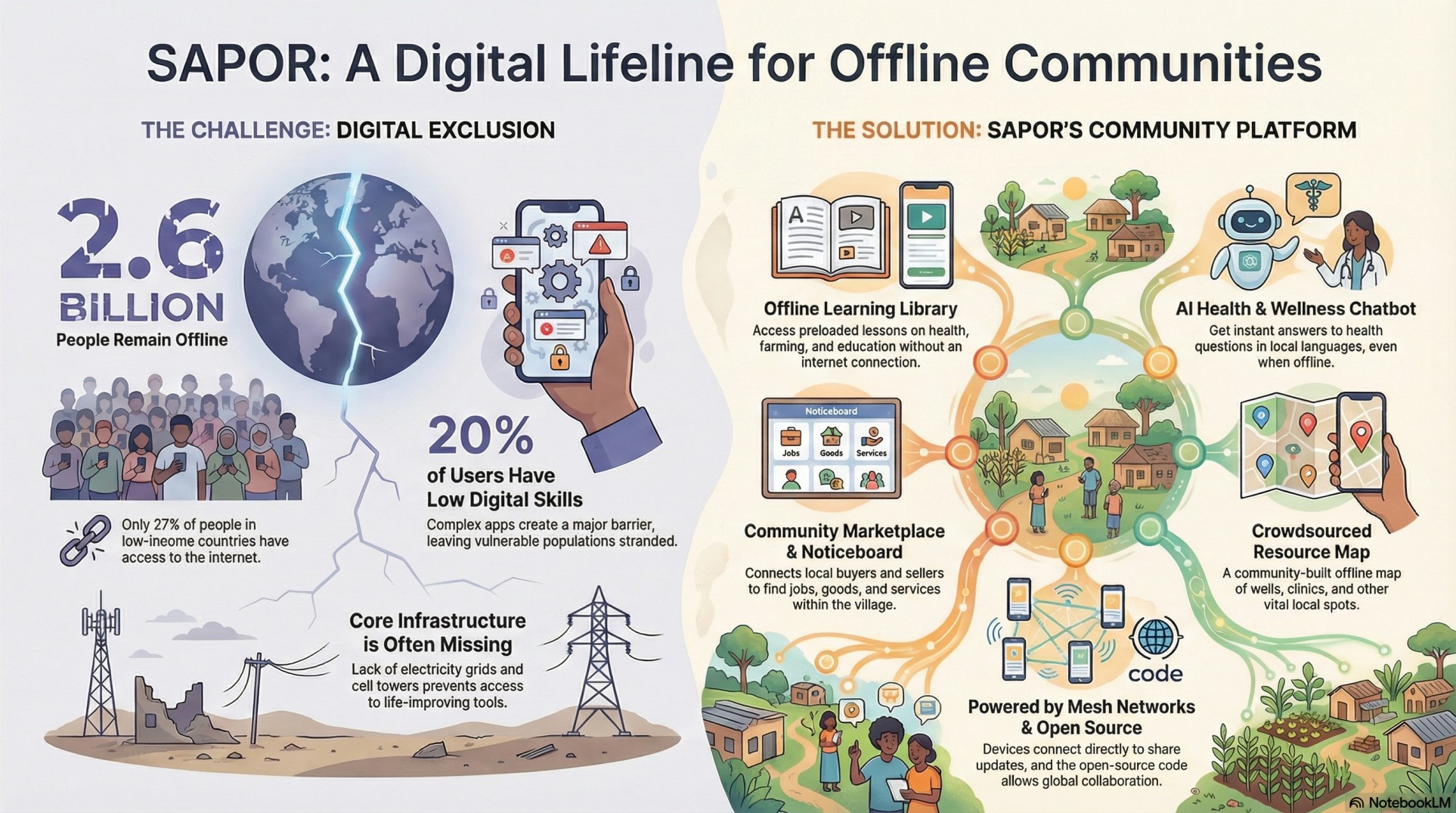
SAPOR (Social Access Platform for Opportunity and Resilience) is a conceptual, open-source, AI-powered nutrition and well-being platform. It analyzes everyday meals and identifies unhealthy nutritional patterns, then explains them in simple language. Instead of prescribing strict diets, SAPOR suggests affordable, realistic improvements using locally available food. It is designed to work in low-bandwidth or shared-community environments and can be adopted by NGOs, schools, and community centers as a public-health support tool.
How we built it
SAPOR was designed as a system, not just an app. Conceptually, it treats meals like structured data and applies pattern analysis to detect nutritional risks such as excess sugar, sodium, or unhealthy fats. The platform follows an offline-first, low-complexity design philosophy with a simple UI and human-readable explanations. The entire system is imagined as open-source to allow communities and developers to adapt it for local needs.
Challenges we ran into
One major challenge was avoiding the trap of becoming “just another food app.” Nutrition tools are common, but few focus on explanation and accessibility. Another challenge was balancing accuracy with simplicity—making insights useful without overwhelming users. Designing for low-income communities also required rethinking assumptions around internet access, literacy, and device capability.
Accomplishments that we're proud of
We are proud of reframing nutrition as a learning problem rather than a discipline problem. SAPOR emphasizes dignity, choice, and understanding. We also successfully aligned technology, social good, and open-source principles into a single coherent vision that can scale beyond individuals to entire communities.
What we learned
We learned that impactful social-good technology is not about advanced features, but about empathy and clarity. Explaining why something matters is more powerful than telling people what to do. We also learned that open, community-driven systems have greater long-term potential than closed, consumer-focused apps.
What's next for SAPOR (Social Access Platform for Opportunity and Resilience)
Next steps include refining the core nutrition intelligence model, validating assumptions with community stakeholders, and designing pilot deployments with NGOs or schools. Long-term, SAPOR can expand into a broader resilience platform—integrating food literacy with health guidance, local resource mapping, and community knowledge sharing to strengthen overall well-being.

Log in or sign up for Devpost to join the conversation.