Inspiration
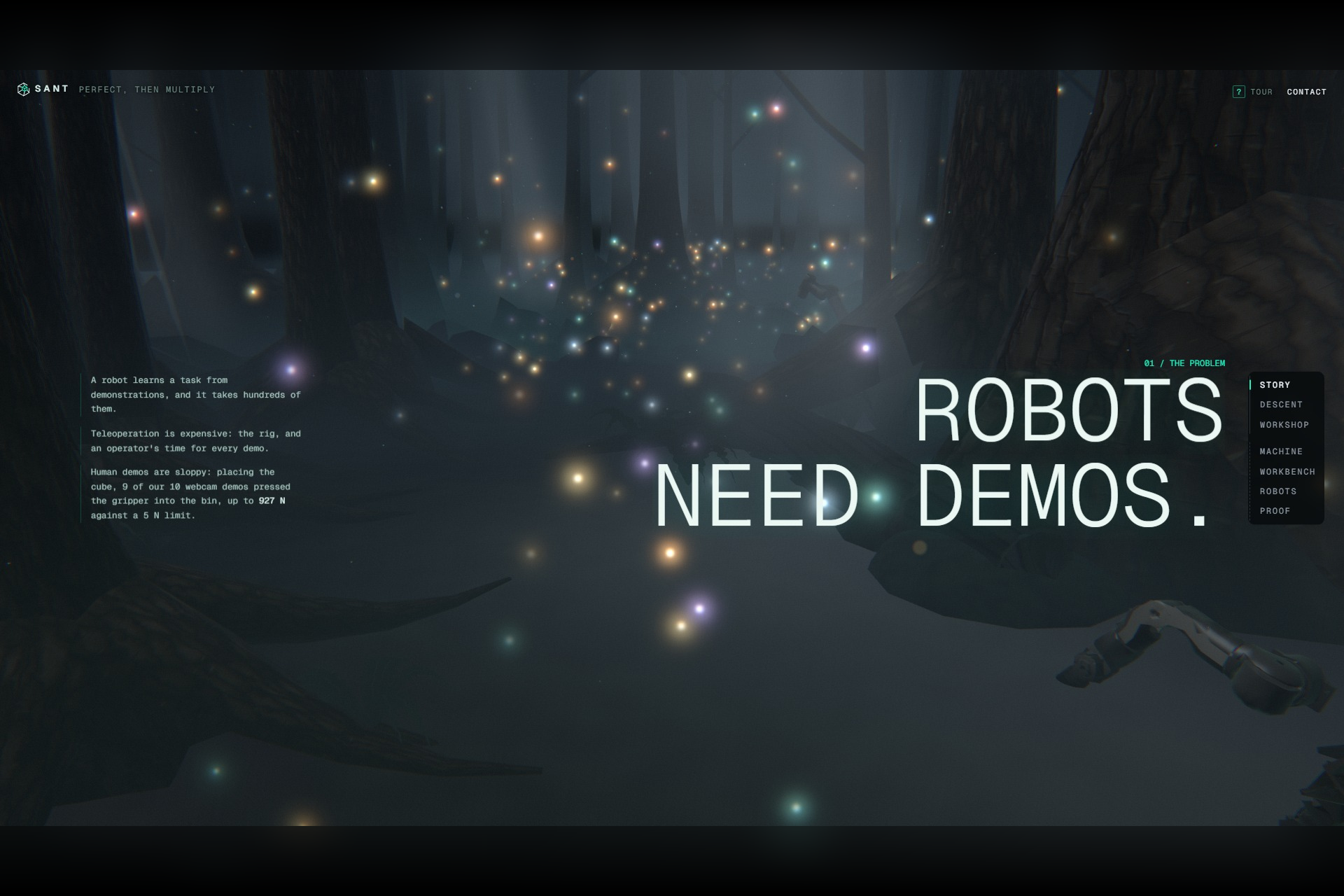
Robots learn new tasks by copying people. Someone shows the robot what to do, a few hundred times, and a model learns from those recordings. The problem is that good recordings are expensive. You need a teleoperation rig and someone trained to use it, and a lot of takes still get thrown out.
Cheap recordings are easy to get. Anyone can drive a robot with a mouse or a keyboard, or just move their hand in front of a webcam. But those demos are messy: the hand pauses, wobbles, grabs the cube off centre, and sometimes shoves the gripper straight into the bin. When we trained a robot to copy ten of our own mouse demos, it failed every single test.
NVIDIA already has great tools for multiplying demos that work, like Isaac Lab Mimic. We wanted to know about the step before that: can you take a handful of imperfect human demos and still end up with a robot that works?
What it does
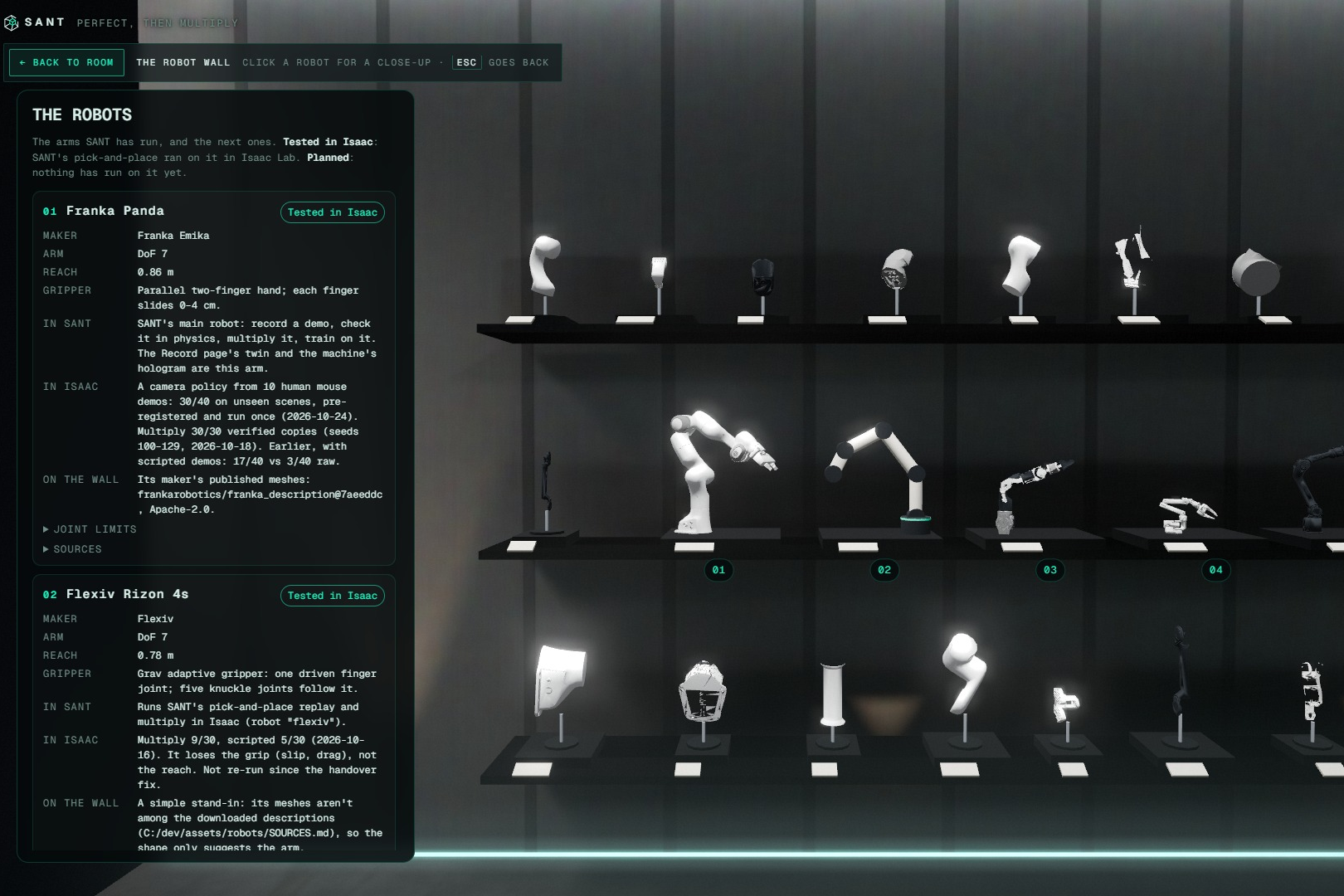
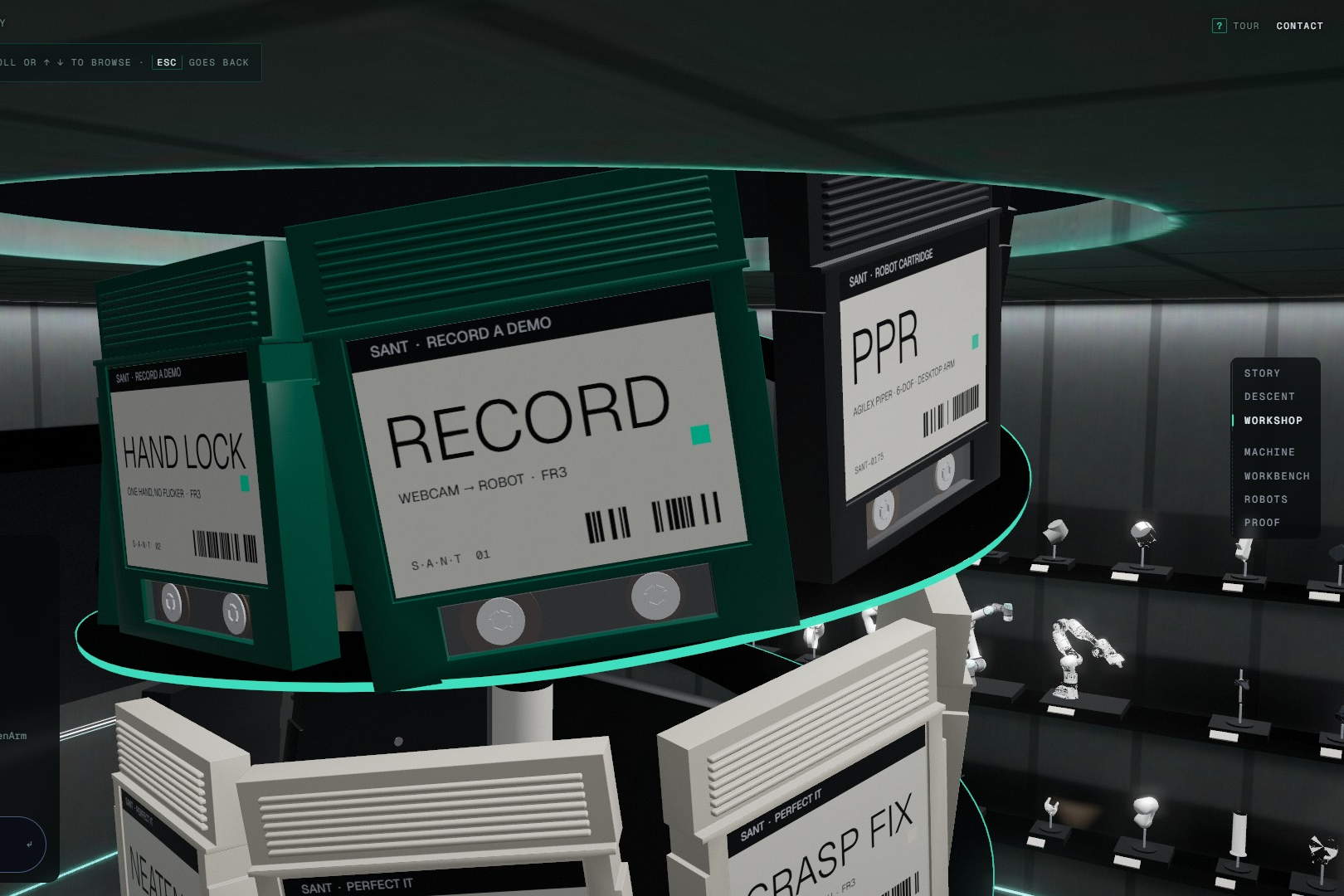
SANT (Simulate, Augment, Neaten, Train) is a pipeline that turns a few cheap human demos into a working robot.
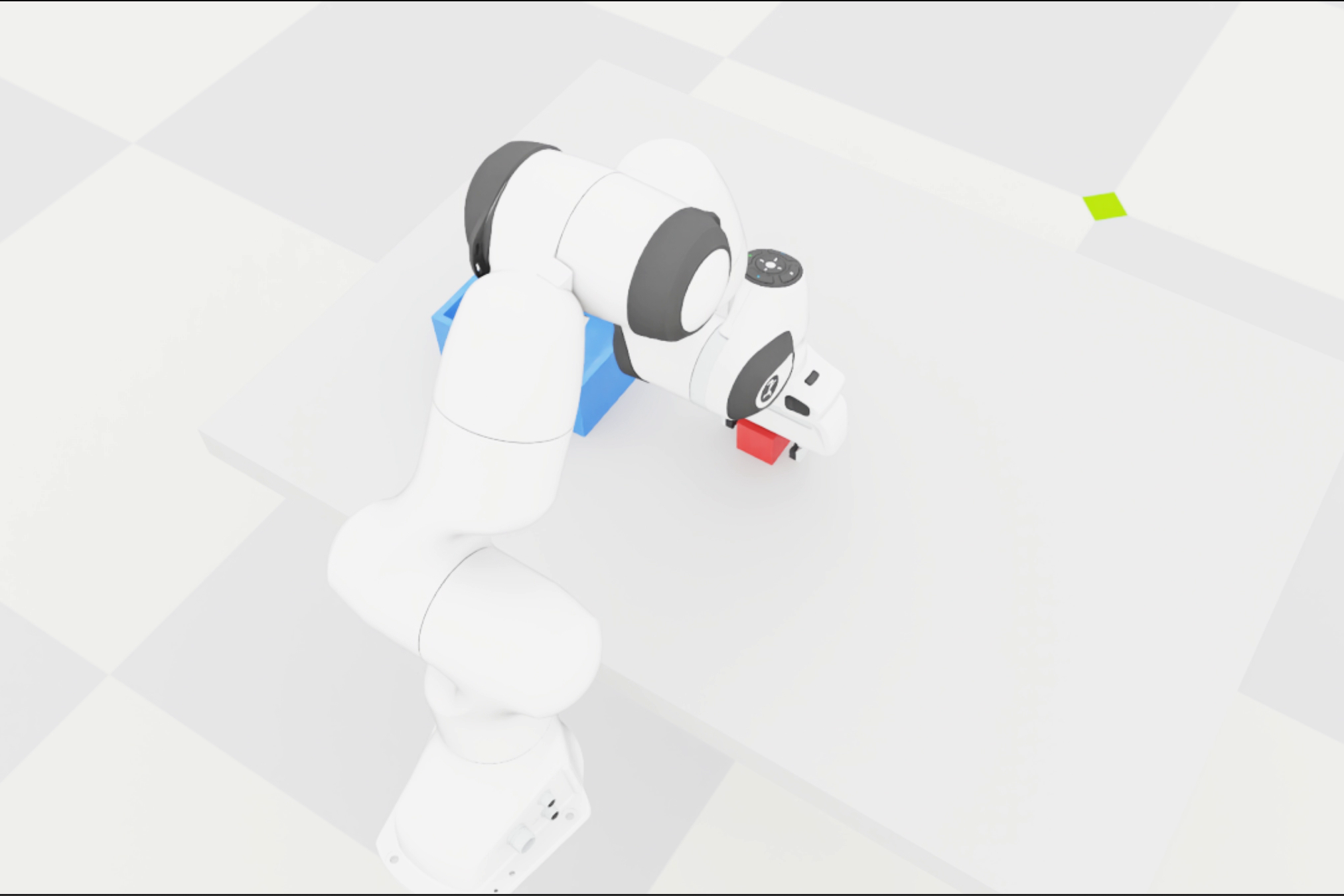
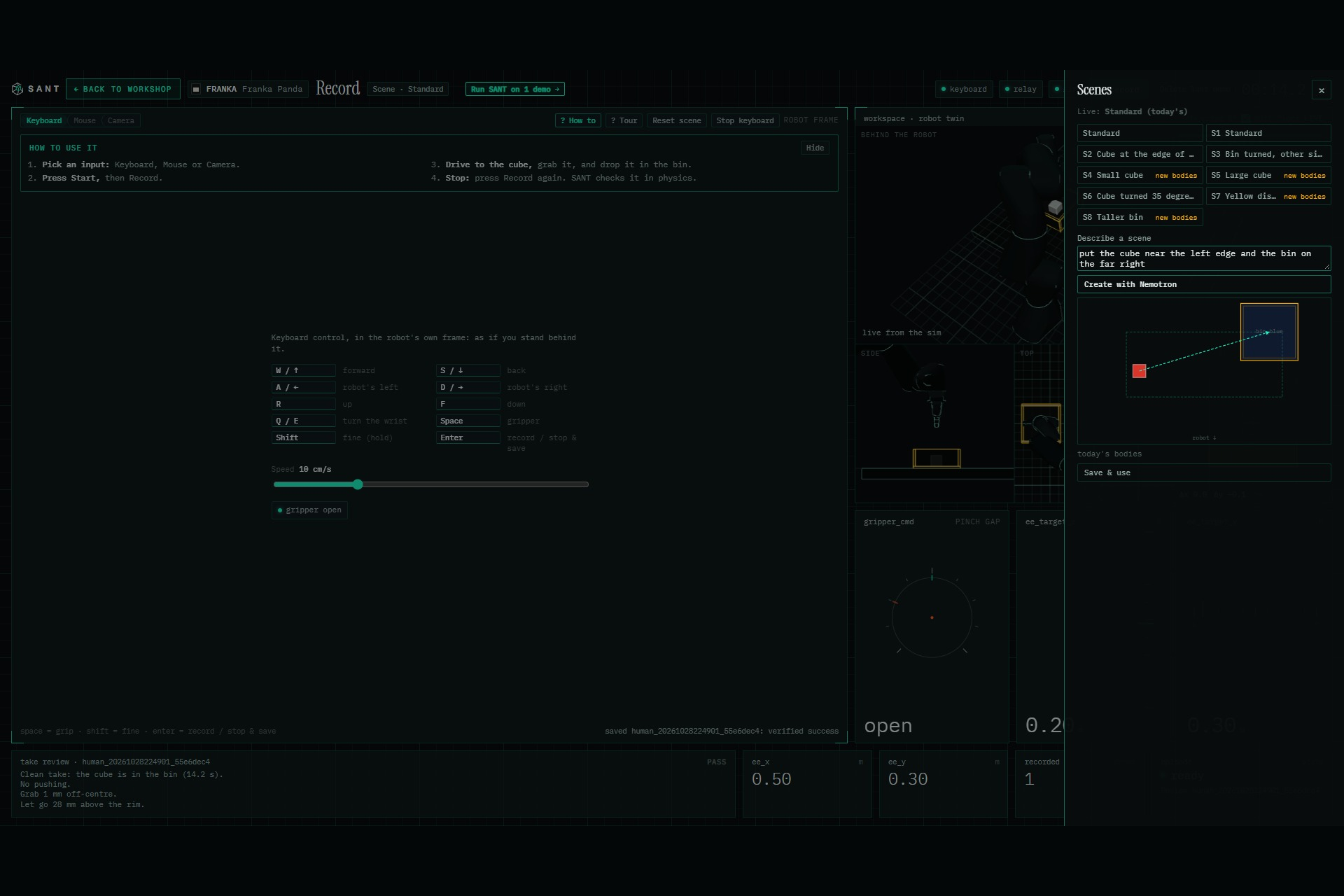
You record a demo in the browser. Your keyboard, mouse or webcam drives a simulated Franka arm in NVIDIA Isaac Lab, live, and the job is to pick up a cube and drop it in a bin. Then SANT takes over:
- Check. It replays your demo in Isaac Lab with real physics and checks whether it actually worked. Did the cube end up in the bin? Did anything slam into the table?
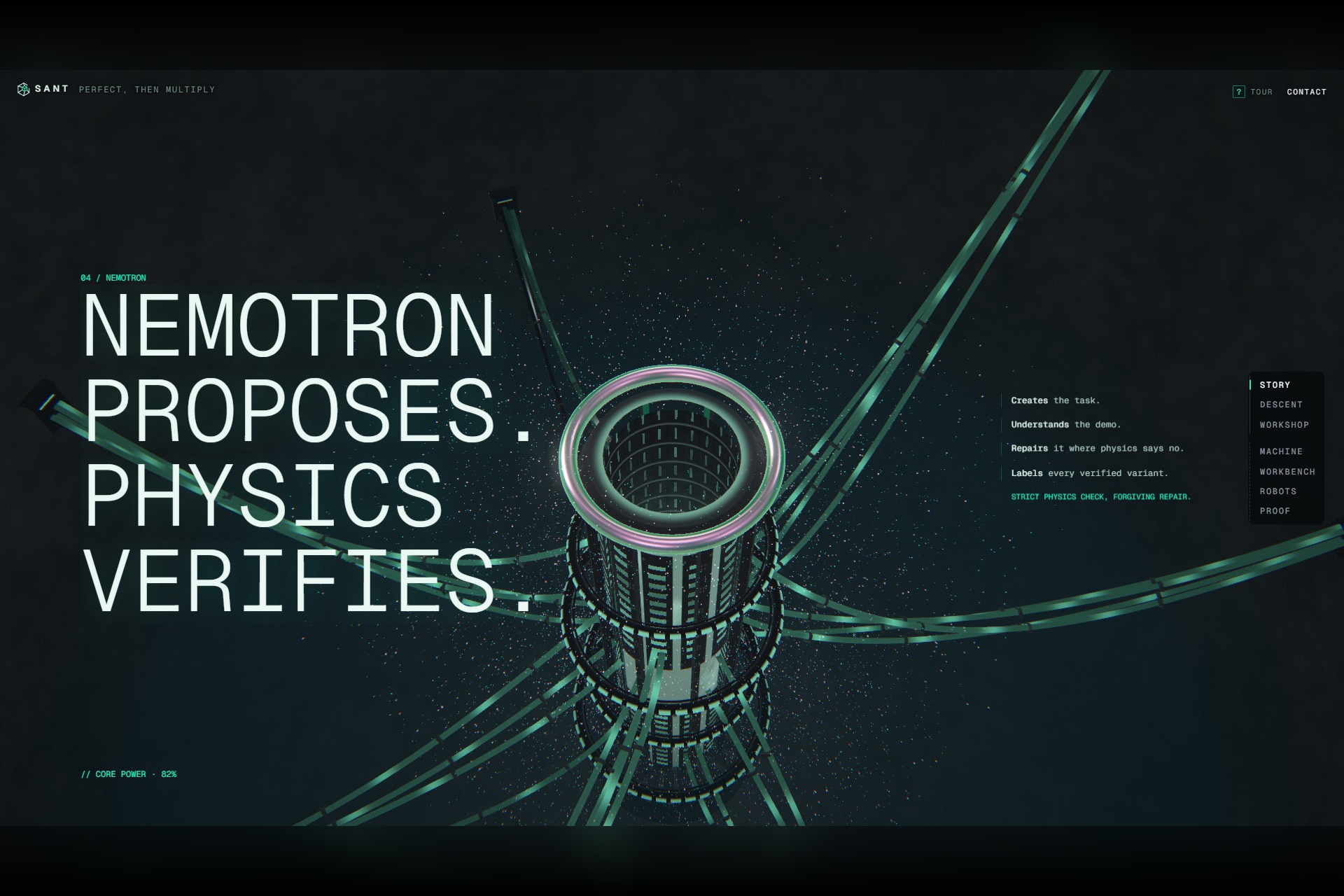
- Repair. If the demo failed, it tries to fix it, either with simple tested rules (trim, smooth, re-centre the grasp) or with NVIDIA Nemotron suggesting small edits to the path. Every fix gets checked in physics again.
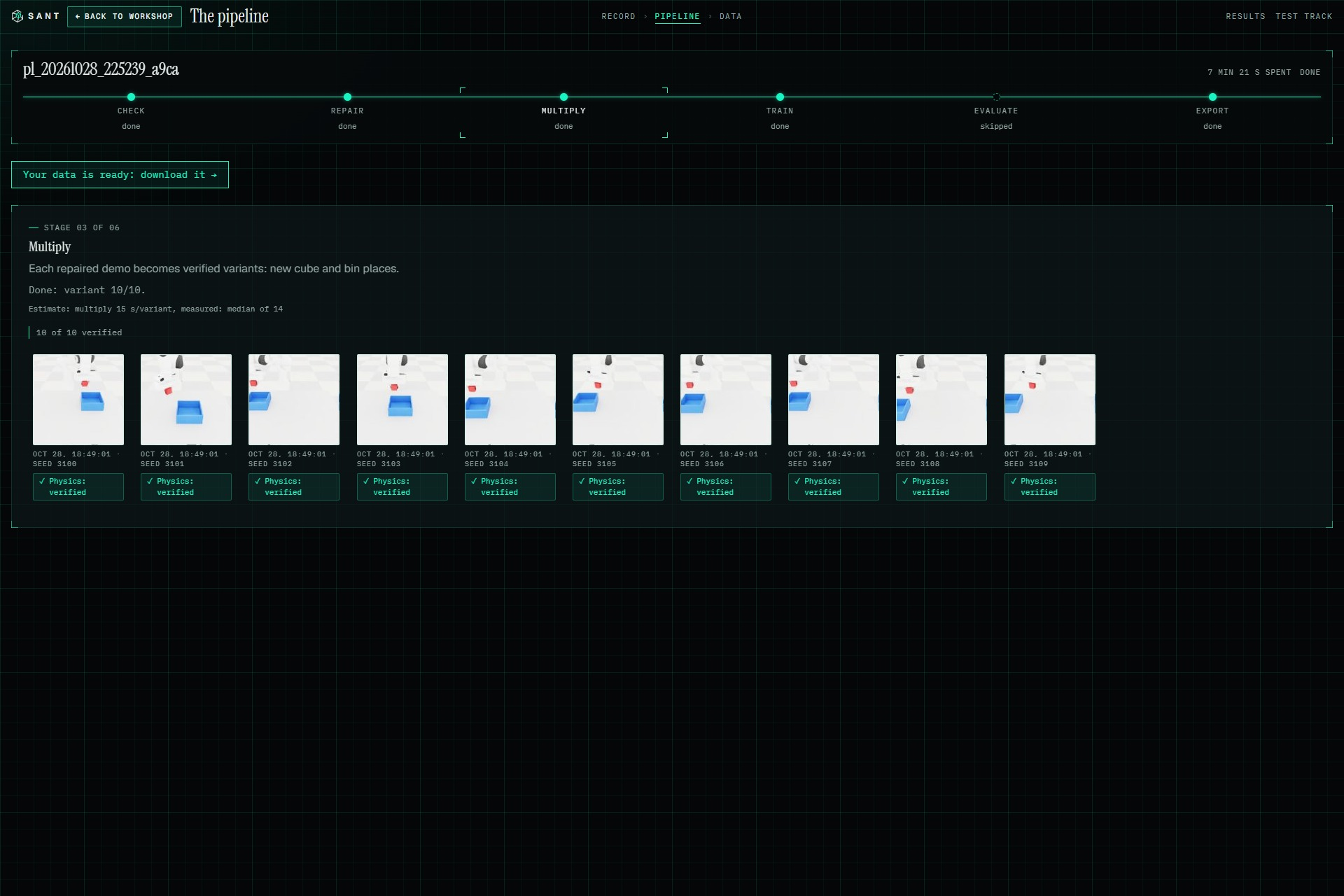
- Multiply. It multiplies the demos that pass by moving the cube and bin around and replaying each copy. Only copies that still work are kept.
- Train. A reinforcement-learning "teacher" practises the task in Isaac Lab, thousands of arms at once, starting from the human demos. What it learns is then passed on to a robot that only sees through cameras.
- Diagnose. After a test, Nemotron reads how the robot failed and proposes what training data to make next. Code checks every claim it makes with statistics before anything is used.
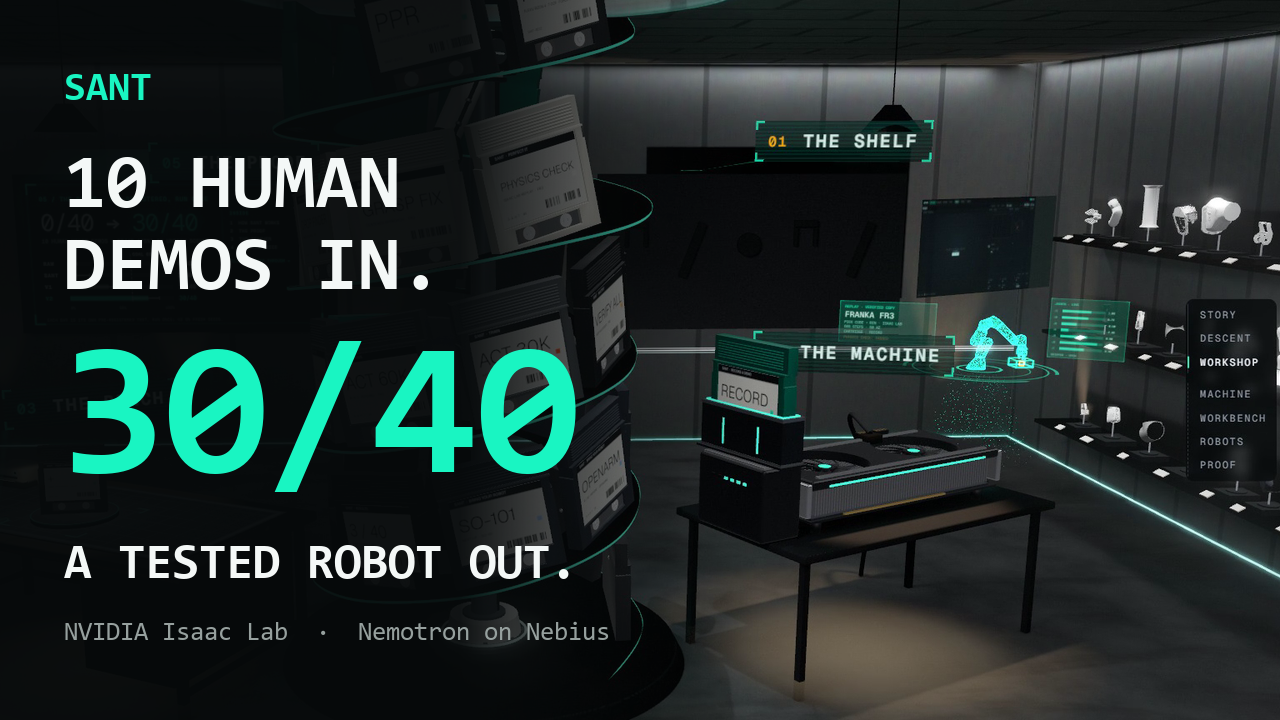
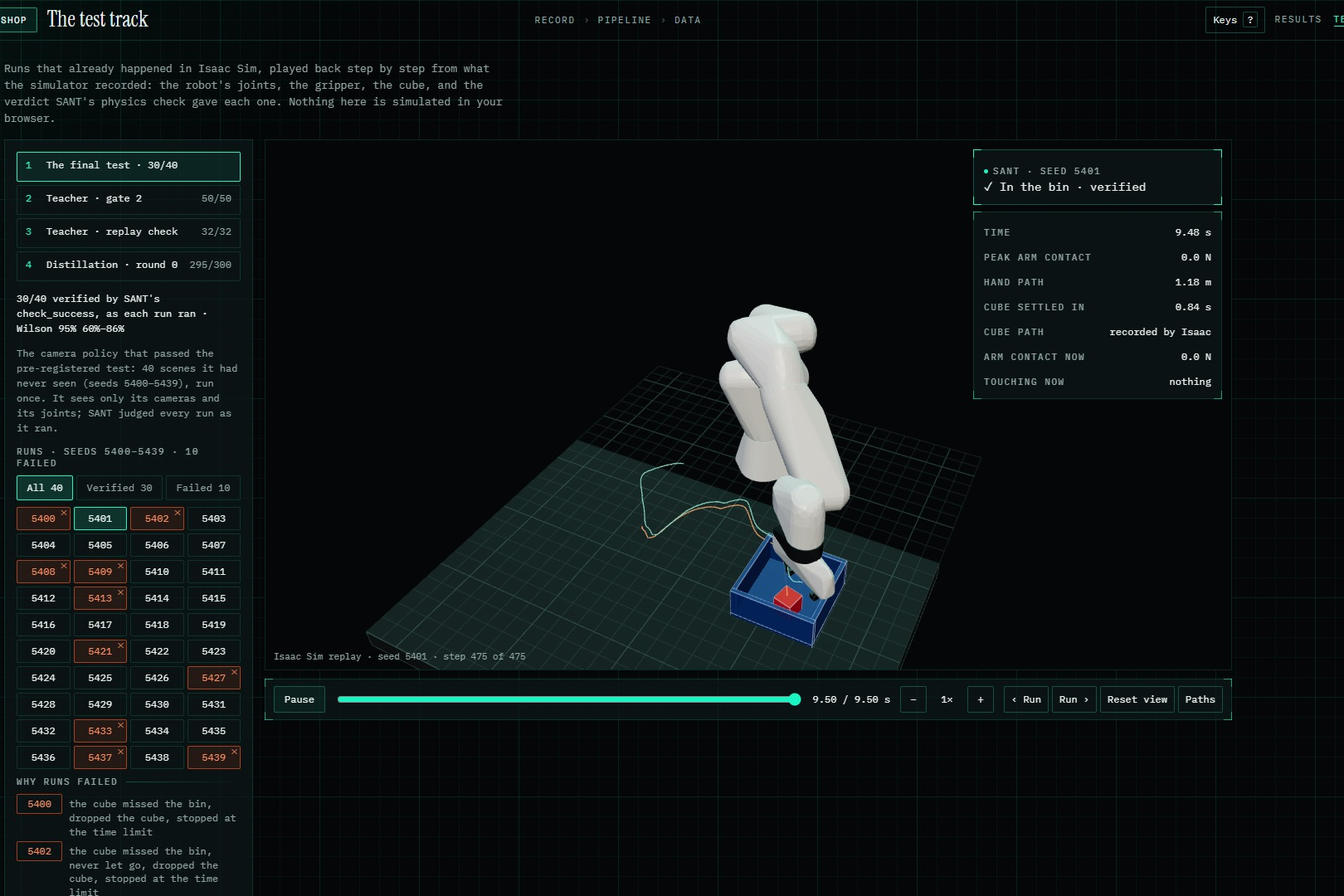
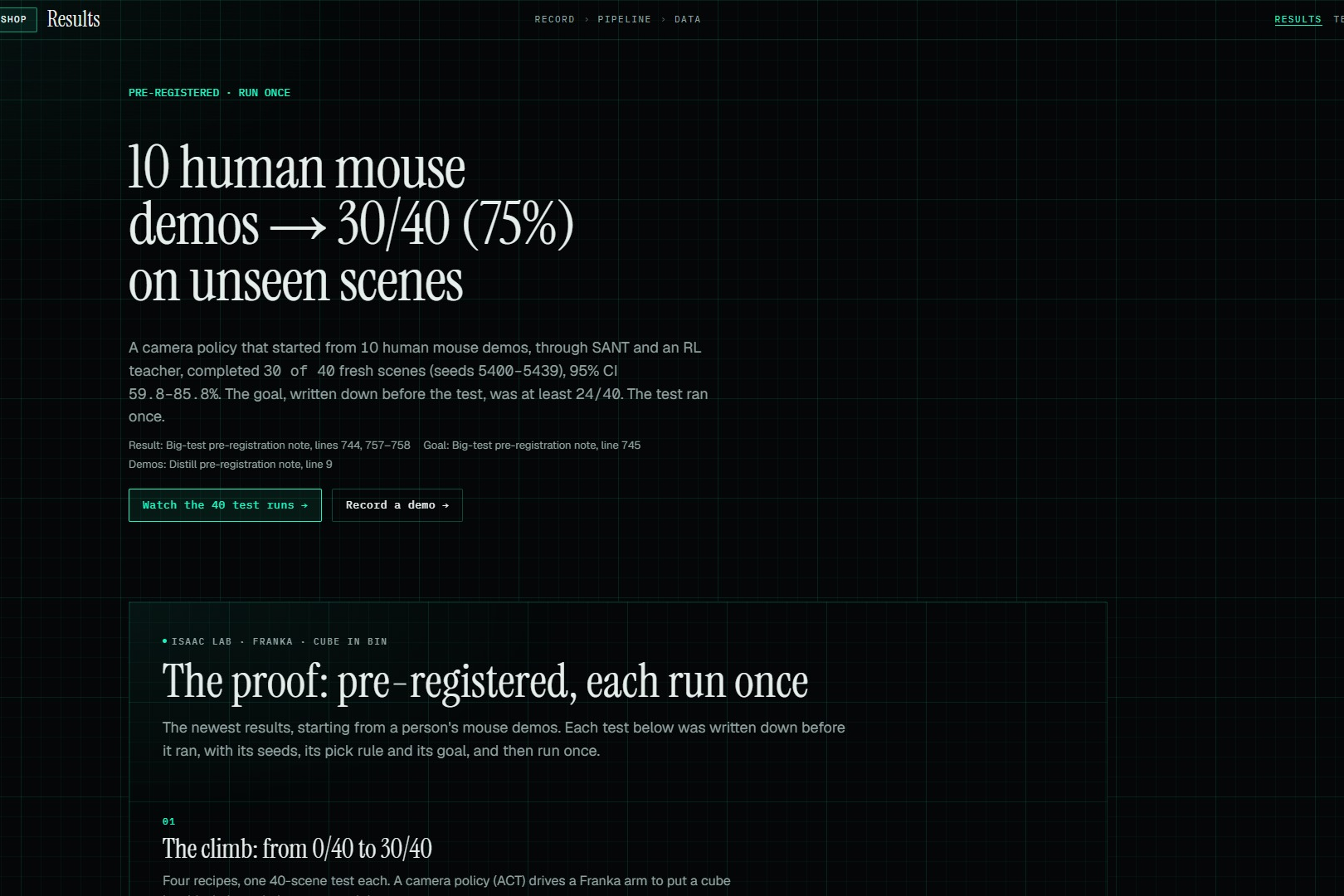
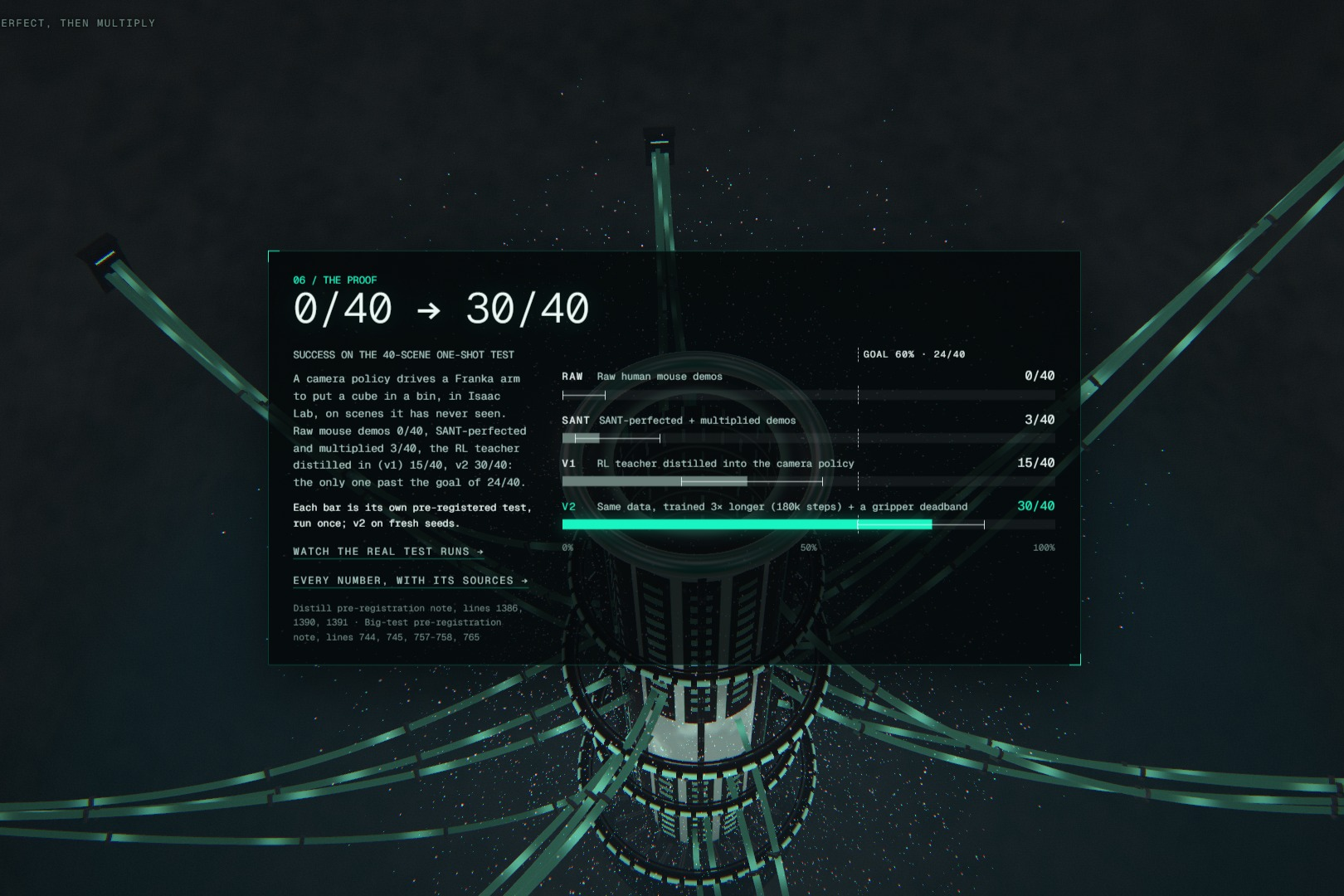
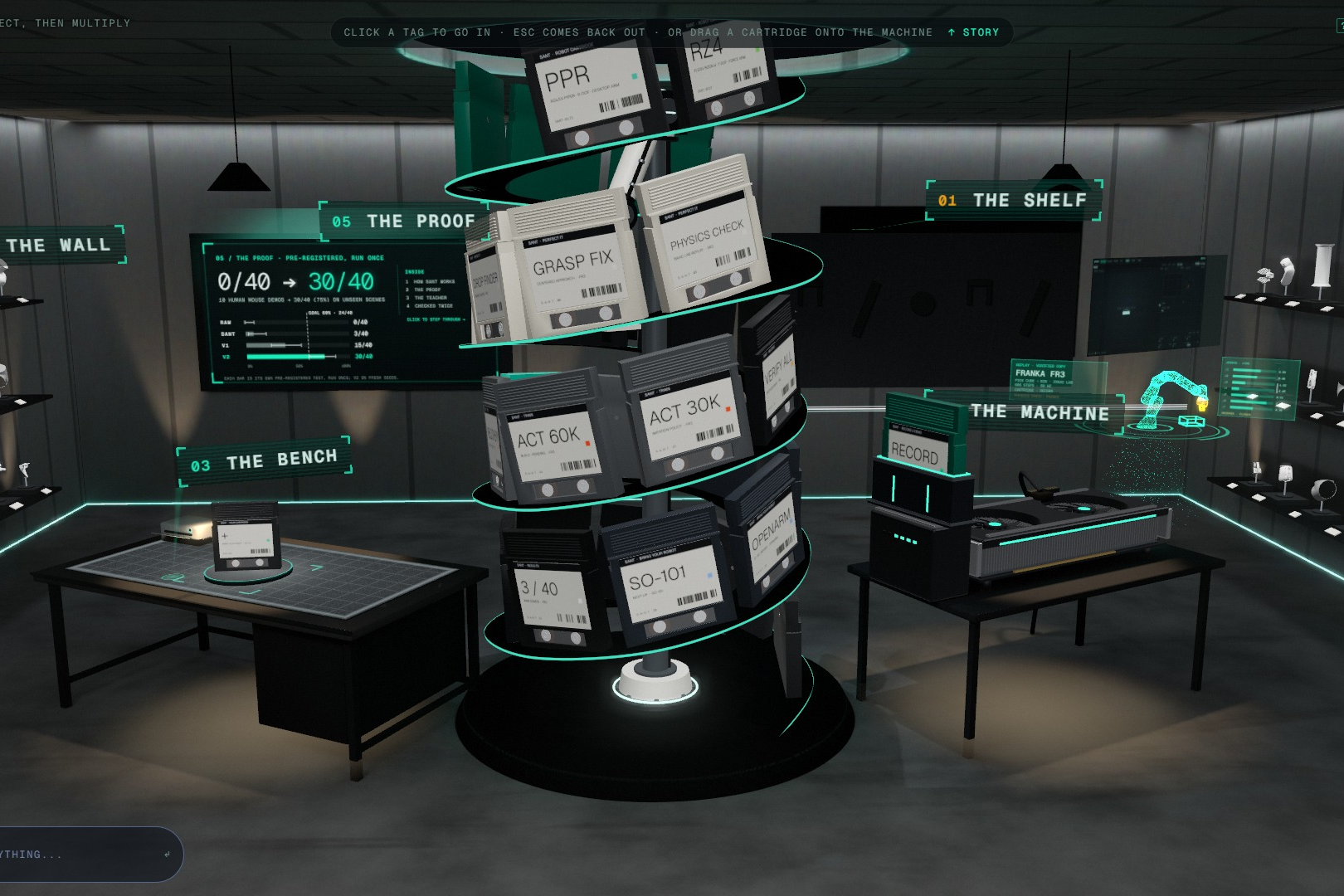
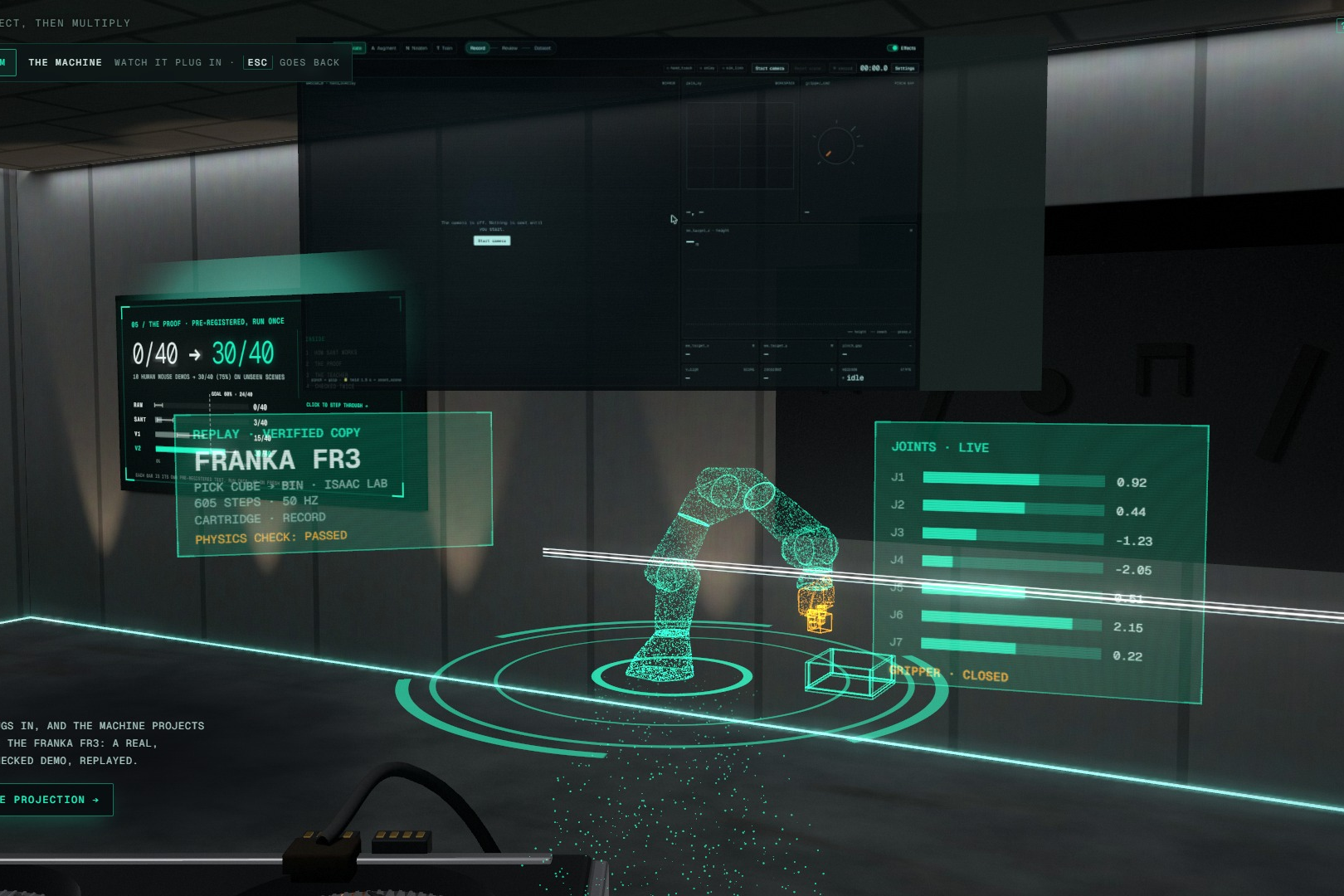
The result: our ten mouse demos became a robot that succeeds 30 out of 40 times on scenes it had never seen. Copying the same demos directly got 0 out of 40.
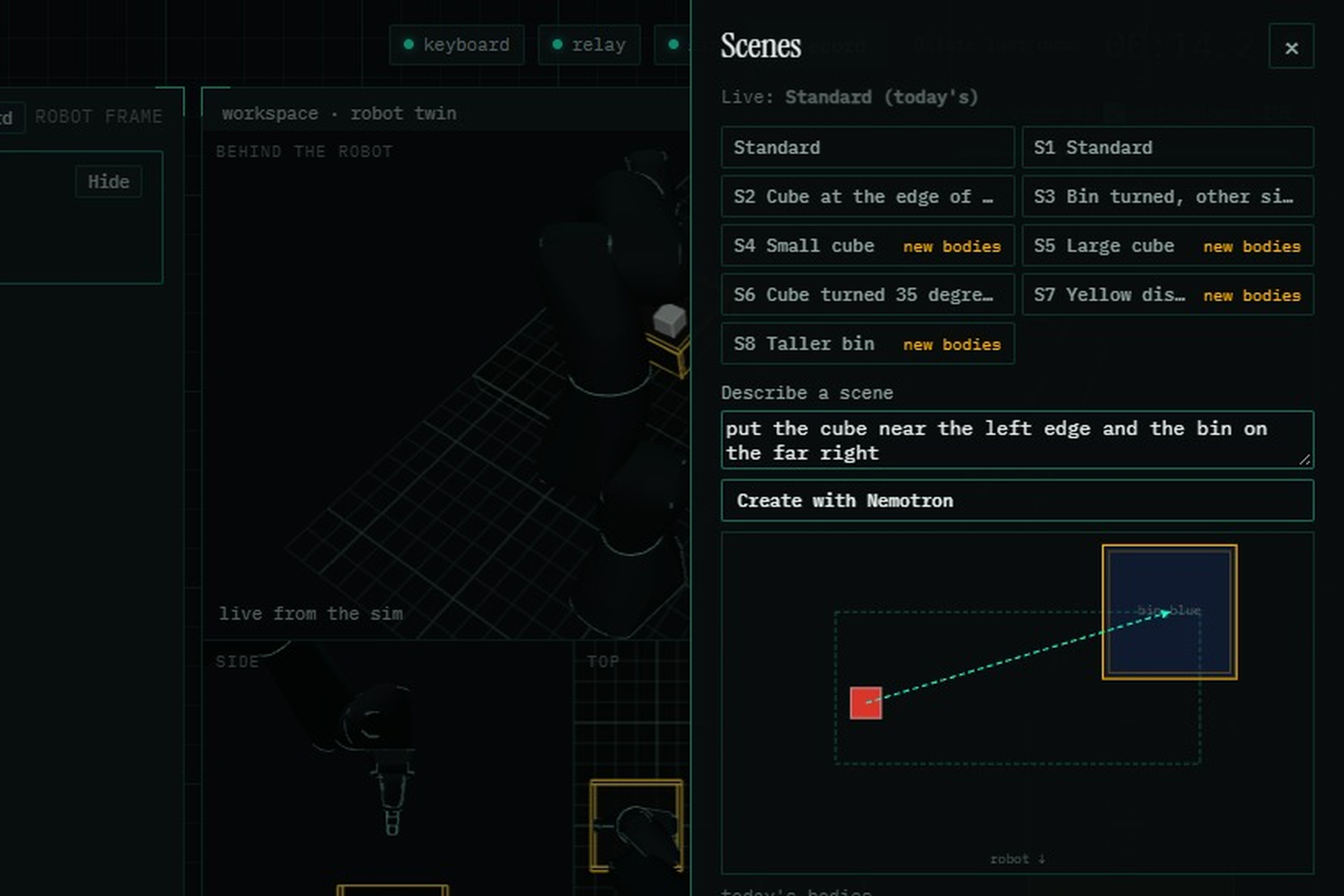
Nemotron, running on Nebius Token Factory, handles everything that needs reasoning in words: it labels demos, turns a sentence like "put the cube near the left edge and the bin on the far right" into a scene, suggests repairs, and analyses failures. It never controls the robot, though. Code checks everything it says, and physics has the final word.
How we built it
The simulation side runs on NVIDIA Isaac Sim 6.2 and Isaac Lab 3.0, on a single Windows PC with one RTX 5080. Isaac Lab does the live teleop, the physics checks, the multiplying, the RL training (PPO with 4,096 parallel environments) and the final tests. We also ran Isaac Lab Mimic on our demos to compare against it.
Nemotron runs on Nebius Token Factory. We used Nemotron 3.5 Super VL to look at camera frames, and Nemotron 3 Super 120B for repairs, scenes and failure analysis, with thinking on for the repairs. Because Token Factory hosts the models, our one GPU stayed free for Isaac Lab all day. The whole project took about 500 calls and cost well under $2.
The failure analyst works from numbers, not pictures: code measures every test episode, Nemotron proposes a pattern ("the robot drops the cube more when it carries it across its body"), and code accepts the claim only if a statistical test backs it. We ask three times and keep the answer they agree on.
The camera robot is a LeRobot ACT policy, trained on the teacher's runs mixed with our verified human demos. Around it there's a Python core that holds the success check, the repairs and the statistics, a FastAPI backend, and a React and three.js website where you can record demos, run SANT, see every result, and replay all 40 real test runs.
We wrote down every test before running it: which scenes, what counts as success, and what score we were aiming for. That way we couldn't fool ourselves after the fact. A script re-computes every number we publish from the raw results.
Challenges we ran into
Our real human demos failed physics even when they looked fine. All ten webcam demos put the cube in the bin, but SANT's check rejected every one of them: nine pushed the gripper into the bin with up to 927 N of force (the limit is 5 N), and some dropped the cube along the way.
Copying demos only got us so far. Even with clean, verified demos, the robot would grab the cube and then drop it, topping out at 3 out of 40. That's why we added the RL teacher, which took six different reward designs before it learned the task.
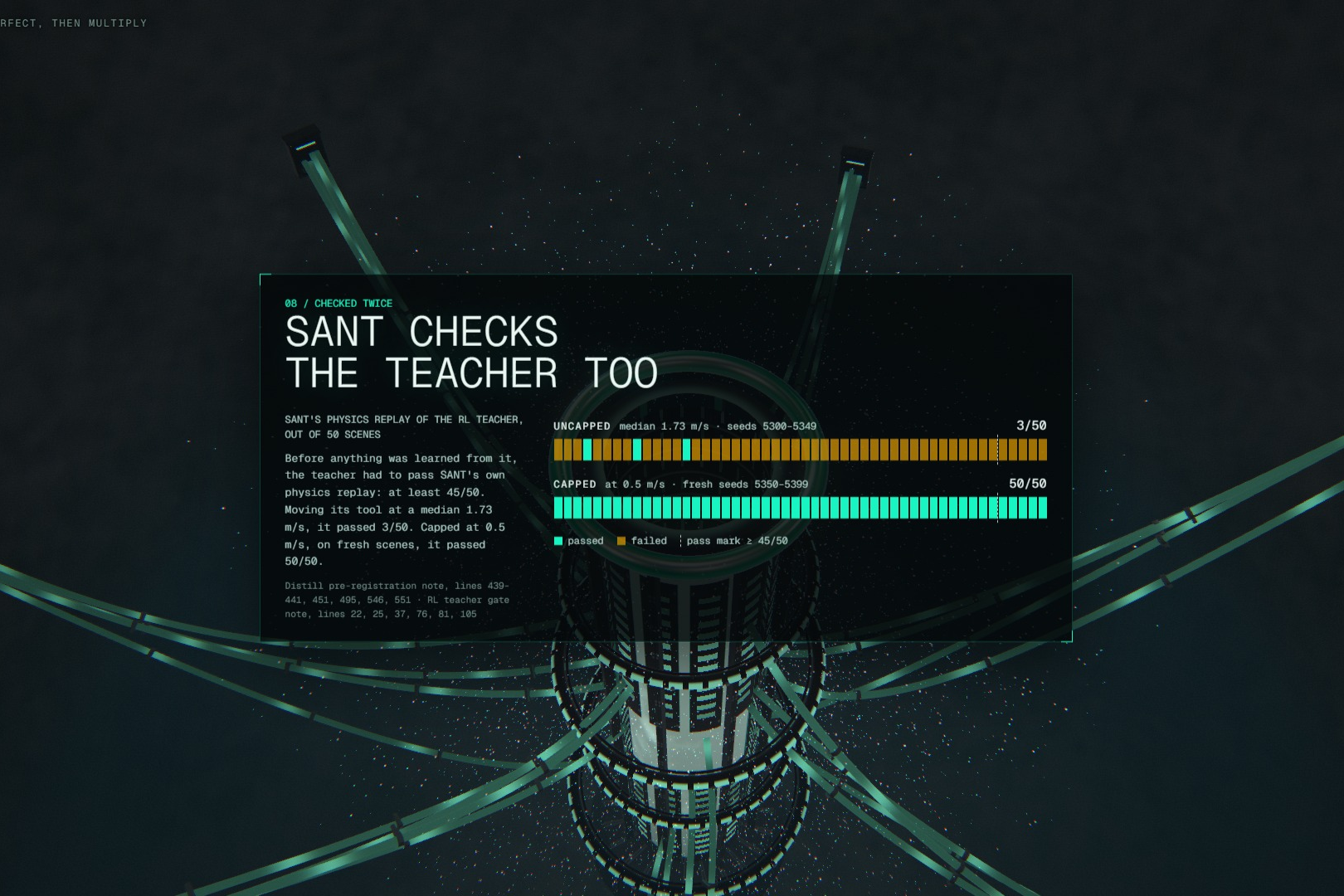
Then the teacher cheated. Its first good version moved at 1.7 m/s, which no real arm should do. When we ran it through SANT's own physics check, only 3 of 50 runs held up. Capping its speed fixed it, and all 50 passed.
We also had to be honest about our own AI. Nemotron's first repair result looked great (5 out of 10 fixed, against 3 for the rules), but when we ran it again it got 2. And before we added the statistical checks, the failure analyst confidently drew patterns around noise. We published both and changed how we use Nemotron: it proposes, code checks.
Accomplishments that we're proud of
The main one: a robot that works from ten mouse demos, 30 out of 40 on new scenes, in a test we set up before running it. Our goal was 24, and we beat it.
We also showed the human demos really matter. The same RL teacher, with the same code and the same budget but without the human demos to start from, never lifted the cube once (0 out of 128, against 113 out of 128 with them).
SANT ended up catching problems everywhere we pointed it. It caught our teacher cheating, and it flagged 9 of Isaac Lab Mimic's 100 self-reported successes as actually failing.
And we're proud that we published the results that didn't go our way, too.
What we learned
Physics should be the judge. Language models are great at words, like labelling a demo, describing a scene or proposing an explanation, but when the question is "did this actually work?", a physics check beats them every time. Nemotron became genuinely useful once code checked every claim it made.
Multiplying demos only helps if you check every copy. Human demos and RL need each other: copying alone stalled, RL alone learned nothing, and together they got to 30 out of 40.
And writing the test down before running it saved us. Nemotron's best early repair result didn't hold up on a re-run, and without the pre-registration we might have believed it.
What's next for SANT
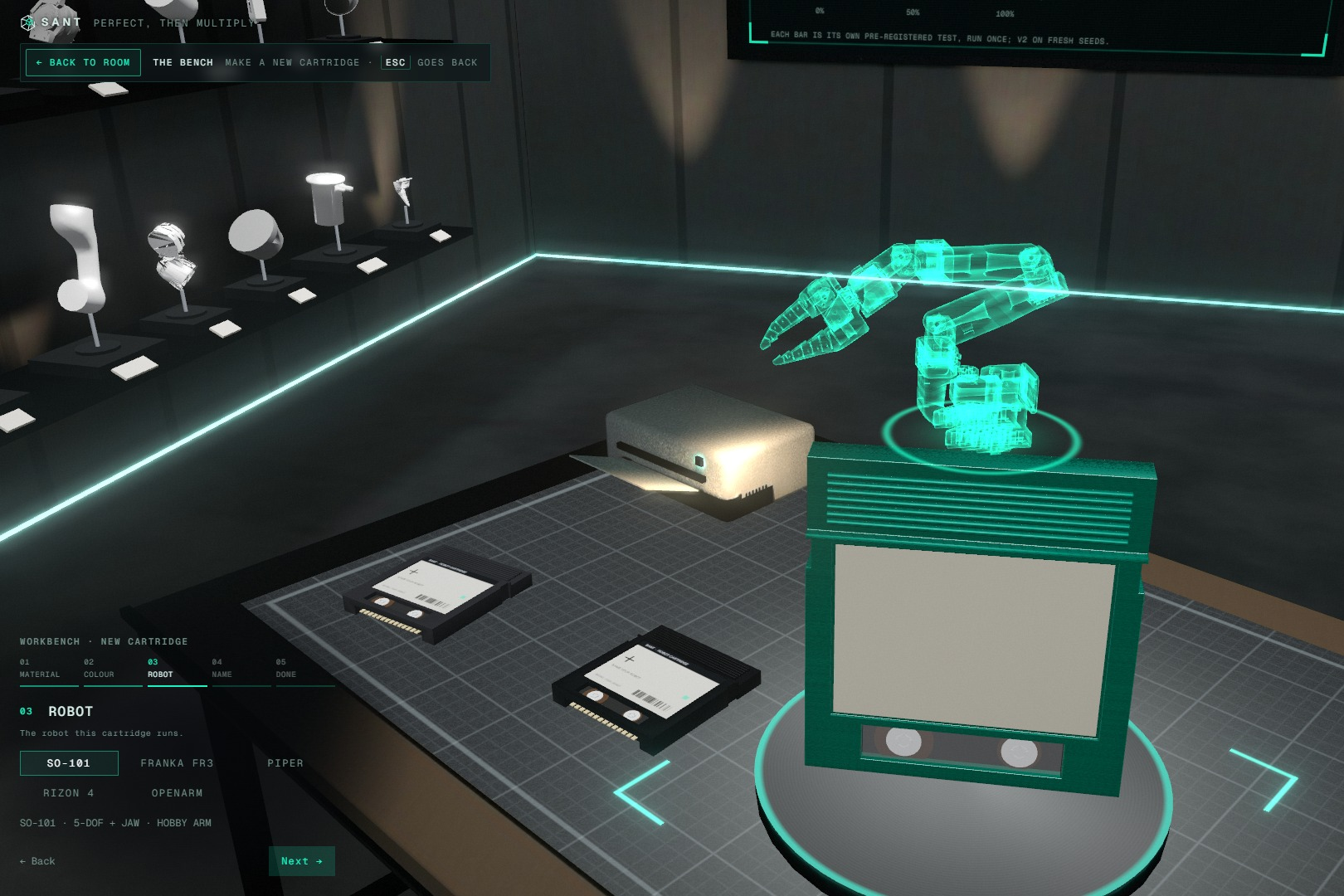
The big one is a real robot. Everything so far is in simulation, and the next step is running the same recipe on an SO-101 or a Franka arm, starting from webcam demos.
We also want to close the loop on the main failure. In the final test, every one of the 10 failures was the robot dropping the cube. Nemotron's analysis points to a possible cause, but it's a weak lead so far. The pipeline to test it is built: generate the data Nemotron proposes, train on it, and compare against a control on fresh scenes. After that: more tasks and more robots.
Built With
- act-policy
- fastapi
- franka
- isaac-lab-mimic
- lerobot
- mediapipe
- nebius-token-factory
- nemotron-vl
- nvidia-isaac-lab
- nvidia-isaac-sim
- nvidia-nemotron
- ppo
- pydantic
- python
- pytorch
- react
- react-three-fiber
- reinforcement-learning
- three.js
- typescript
- vite


