-
-
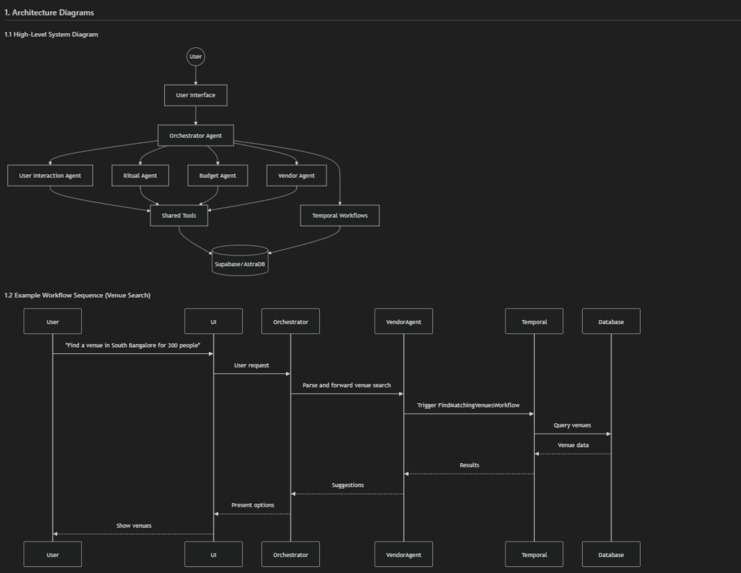
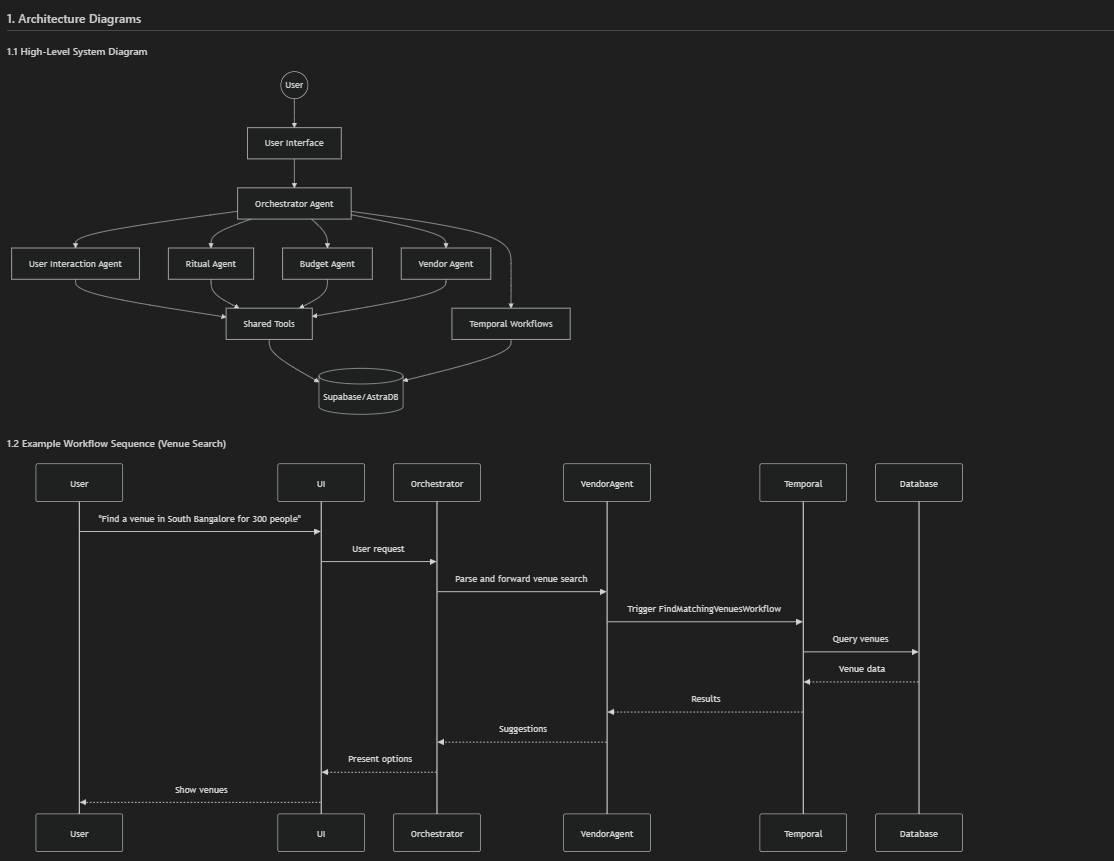
architecture_diagram
Inspiration
After witnessing the immense stress and logistical chaos during my own brother's wedding, my co-founder and I had a deep discussion. We saw firsthand how a joyous, sacred event can become an exhausting, time-consuming ordeal for families, with the true essence of traditions often lost in the process. We were inspired to create a solution that restores the joy and meaning to wedding planning, and after many iterations, SanskaraAI emerged from our desire to blend ancient wisdom with intelligent, modern technology.
What it does
SanskaraAI is an AI-powered virtual wedding planner, specializing initially in the rich traditions of Hindu weddings. Our platform helps couples navigate the entire planning journey by offering: Intelligent Ritual Guidance: Demystifying ancient traditions and their significance. Comprehensive Planning Tools: Unified management for tasks, budgets, guest lists, and timelines. AI-Driven Personalization: Assistance in finding vendors and visualizing event aesthetics that align with the couple's unique style and cultural needs. The core of our platform is an AI assistant, built using Google's generative AI models via their SDKs, designed to understand natural language requests and interact with all application features, acting as a true co-planner for the user.
How we built it
We are building SanskaraAI with a modern, scalable tech stack, leveraging the power of Google's AI ecosystem: Frontend: The user-facing application is developed using Next.js and TypeScript, ensuring a fast, responsive, and type-safe user experience. We've used Tailwind CSS for rapid and clean UI development. Backend: Our backend infrastructure is built on Node.js with Express.js, designed for reliability and seamless API communication. Database: We are using Supabase, a PostgreSQL-based backend-as-a-service, for its robust data management, real-time capabilities, and authentication features. AI Core: The heart of our AI assistant is powered by Google's generative AI models, integrated directly using the Google AI SDKs. We are designing a system of specialized AI agents that can handle different tasks – from providing ritual information to searching for vendors – and interact with our backend via defined API tools. Deployment: We plan to deploy our application on Google cloud for the frontend and a scalable cloud provider for the backend services.
Challenges we ran into
Our biggest challenge has been twofold: Architecting the AI for Cultural Nuance: Moving beyond generic AI responses to create a system that truly understands the deep context, emotional weight, and diverse regional variations of Indian wedding rituals. This required significant research and a thoughtful approach to structuring our knowledge base and prompting strategies for the AI. Bridging AI and Application Logic: Designing a robust system where our AI agent can reliably understand a user's intent and then accurately call the correct backend API tools (e.g., 'find_vendor', 'update_checklist') has been a complex but exciting challenge in system design and prompt engineering.
Accomplishments that we're proud of
We are incredibly proud of several key accomplishments at this early stage: Developing a functional user-side interface that provides a clear and tangible vision of the SanskaraAI user experience. Building a near-complete vendor-side backend, laying the critical groundwork for our two-sided platform. Conducting deep, on-the-ground market research, including traveling to understand diverse cultural traditions (like Christian weddings,hindu weddings), which has given us invaluable, authentic insights. Securing initial positive reception from vendors in our target pilot area (LB Nagar, Hyderabad), with multiple appointments scheduled to discuss onboarding, validating the need for our solution from the supply side.
What we learned
This journey has reinforced several key learnings: The "Why" is Everything: The tech is exciting, but our most powerful moments have come from understanding the deep human need for meaning and clarity in a stressful process. This user-centric, problem-first approach is now our guiding principle. AI is a Co-pilot, Not Just a Tool: The true potential lies in creating an AI that feels like a collaborative partner, augmenting the user's decision-making rather than just automating tasks. The Immense Value of Primary Research: Talking directly to couples, families, and vendors has provided insights far more valuable than any secondary data, shaping our product roadmap in profound ways.
What's next for SanskaraAI
Our immediate next steps are focused on launching a successful pilot and validating our core product: Finalize & Launch Pilot Program (LB Nagar, Hyderabad): Onboard our first cohort of 20-30 diverse local vendors and acquire our first 100-200 pilot users (couples) to gather real-world data. Refine the Core AI Engine: Use feedback from the pilot to continuously improve our Google AI-powered assistant's accuracy, cultural intelligence, and ability to interact with platform tools. Secure Pre-Seed Funding/Grants: Leverage our progress and pilot data to secure funding (like the WTF Fund we've applied to) to accelerate development and expand our team. Phased City Expansion: Based on the success of the pilot, we will create a playbook for expanding SanskaraAI to other Tier 1 cities in India.
Built With
- cloudflare
- google-adk
- google-cloud
- google-gemini
- langchain
- langflow
- livecat
- mcp
- pipecat
- postgresql
- python
- raspberry-pi
- react
- supabase
- tailwind-css
- tavily
- twilio
- typescript
- vite

Log in or sign up for Devpost to join the conversation.