-
-
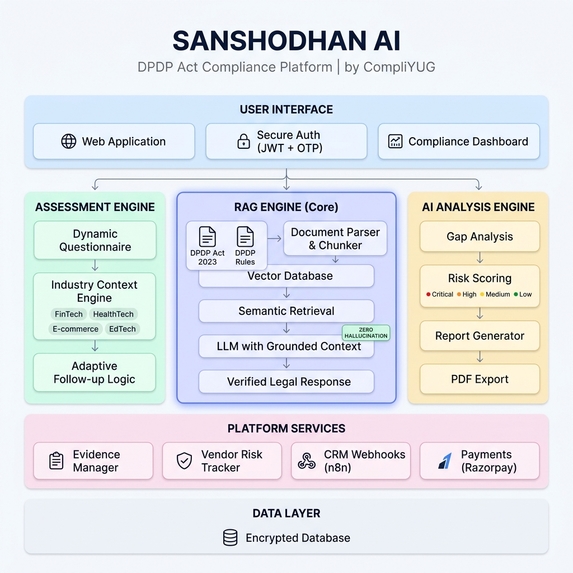
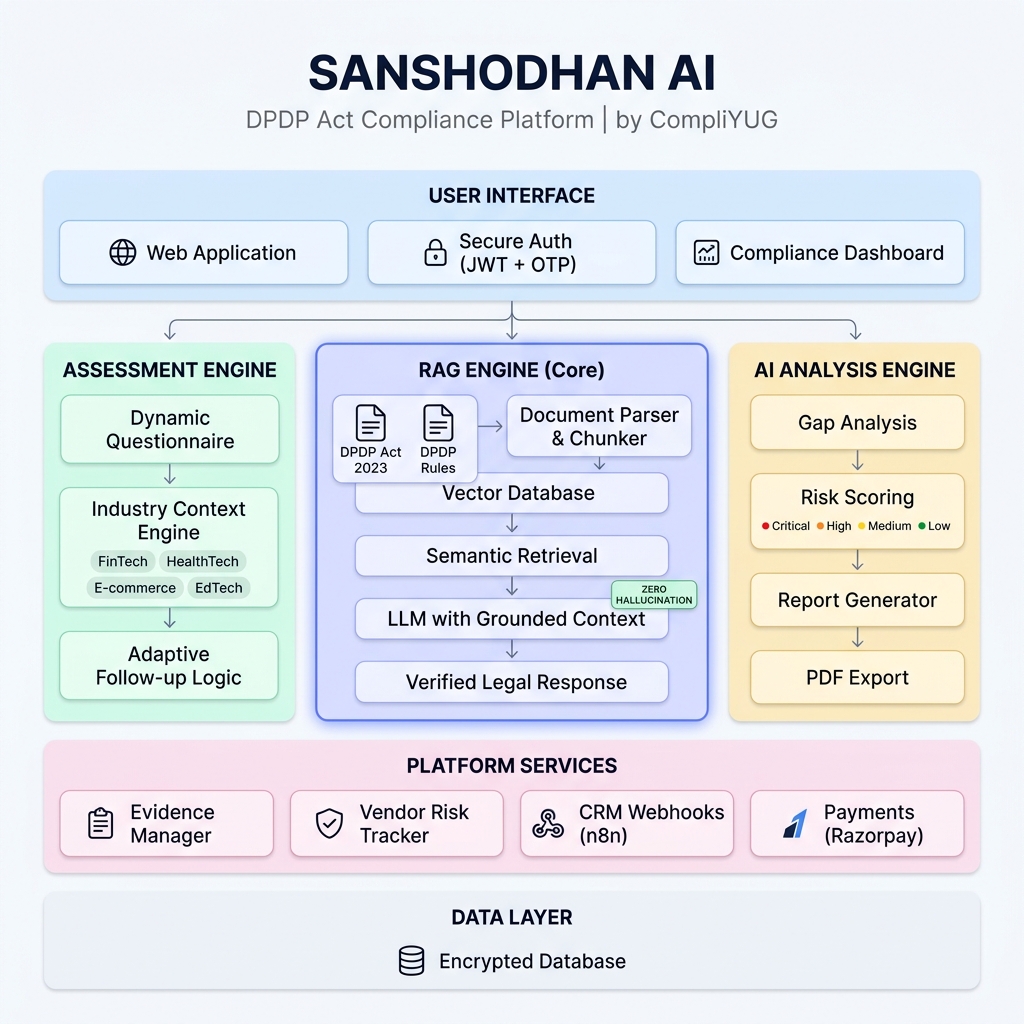
Architecture diagram
-
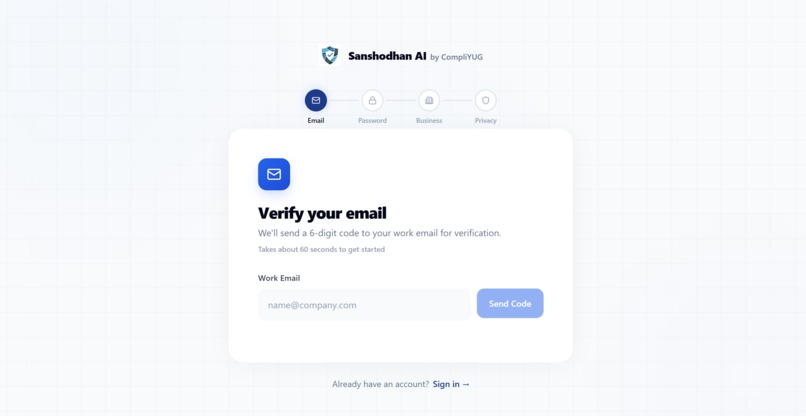
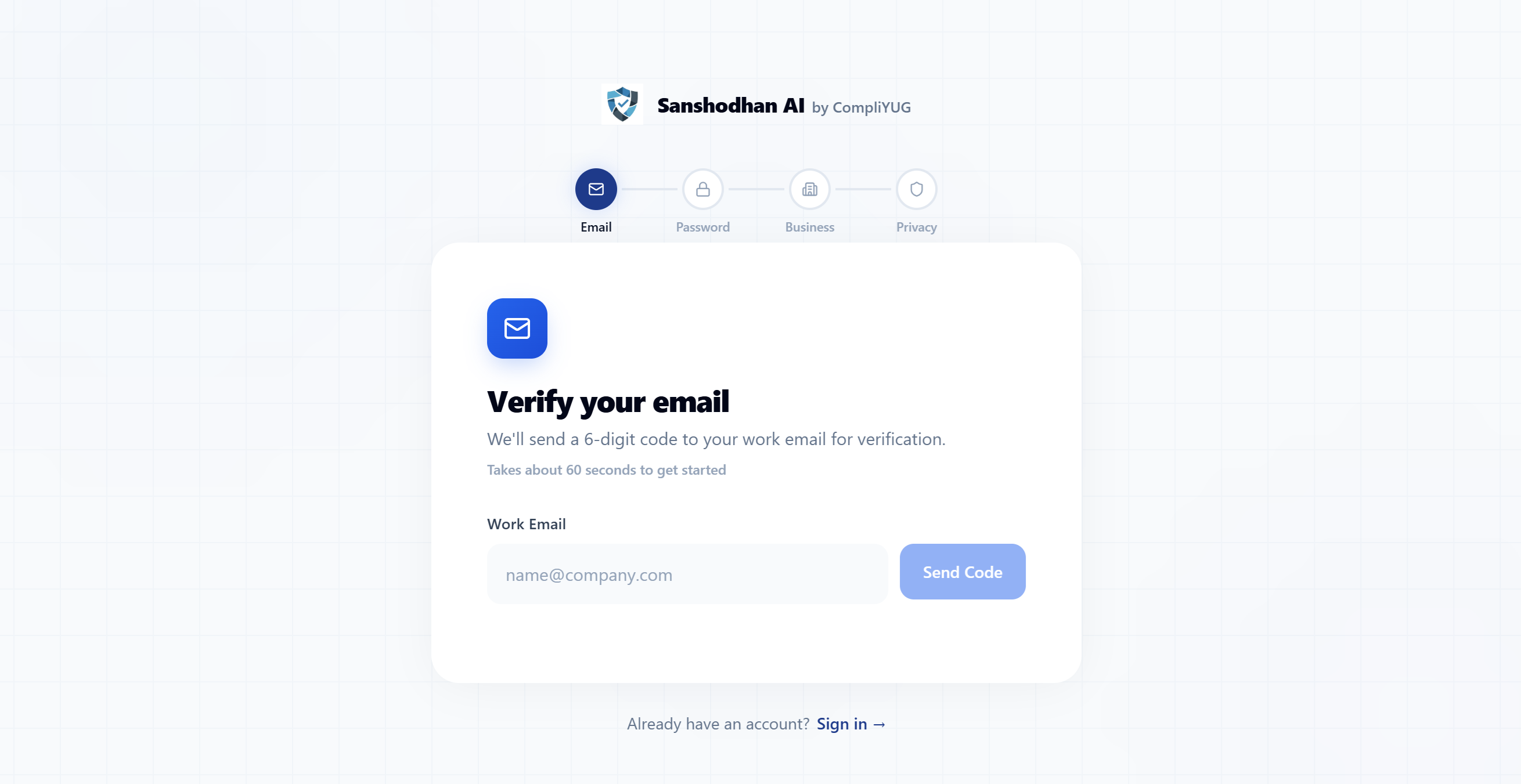
Secure sign-up.
-
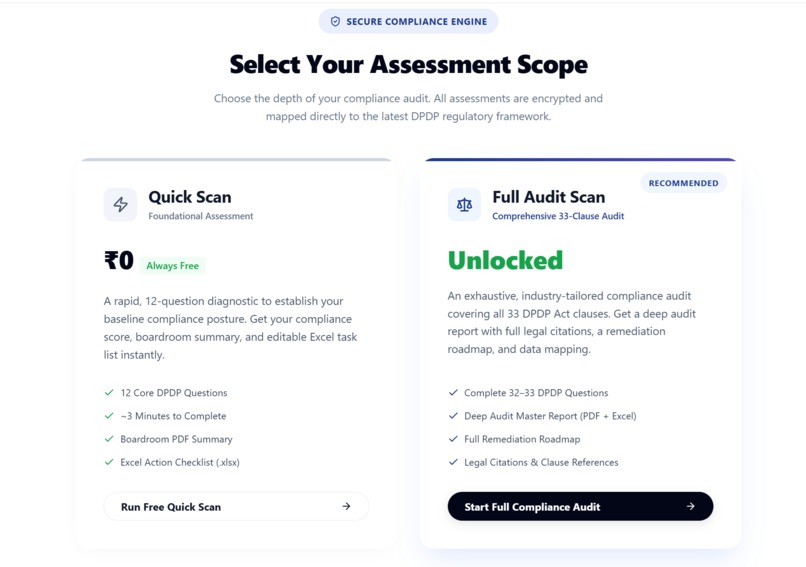
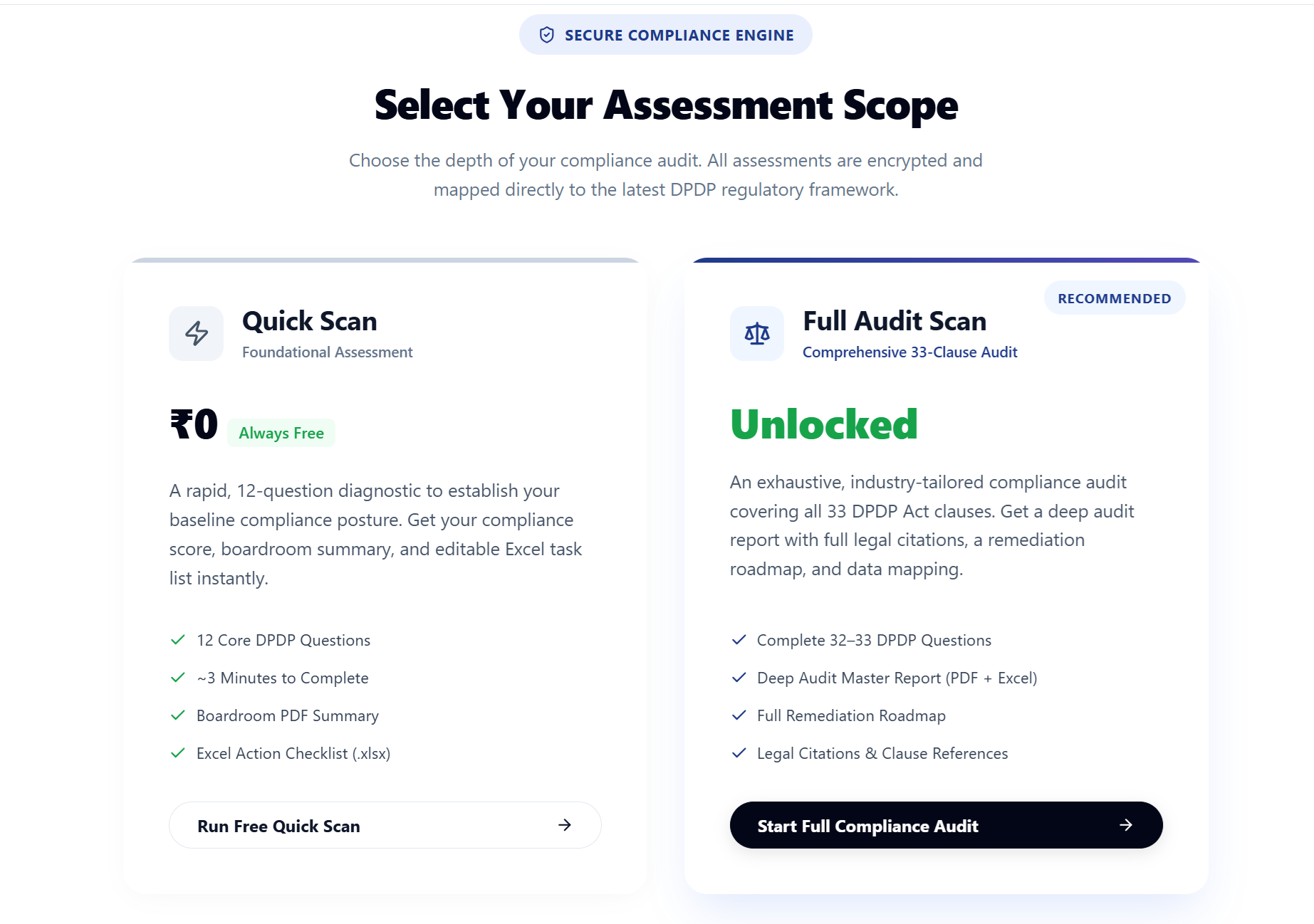
Quick scan and full scan option available.
-
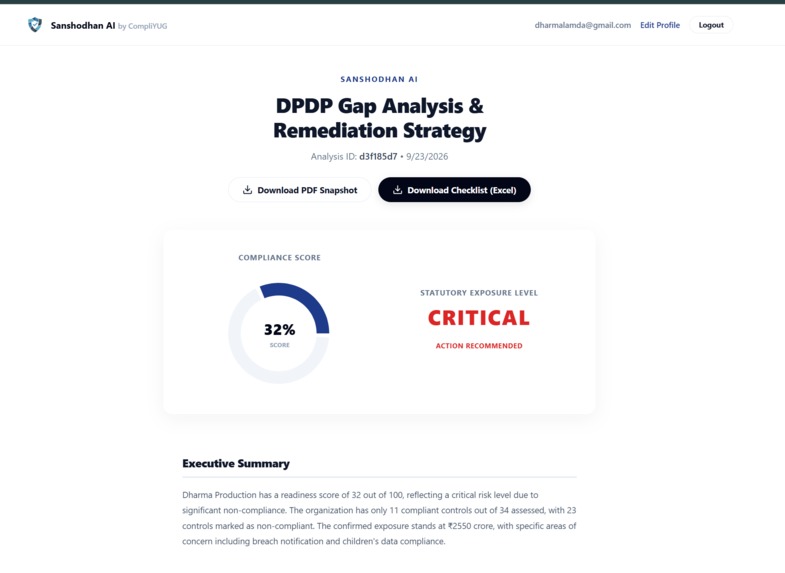
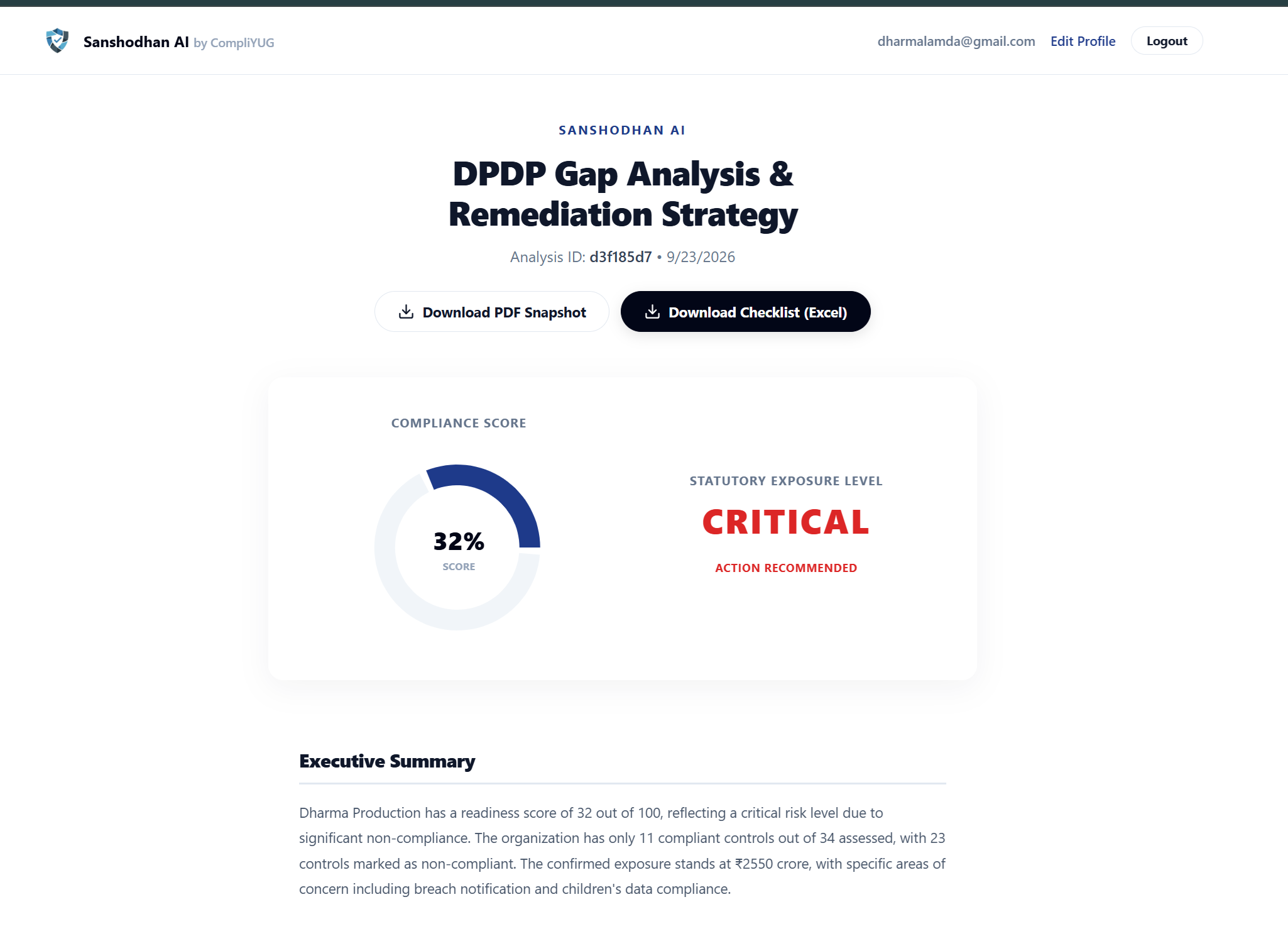
Final output.
-
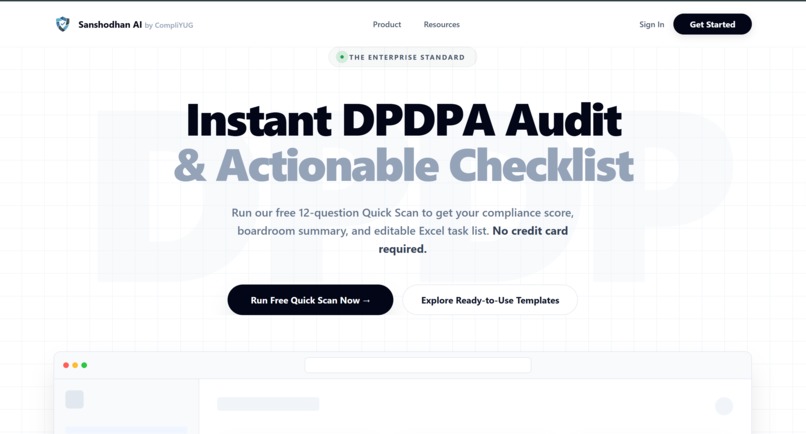
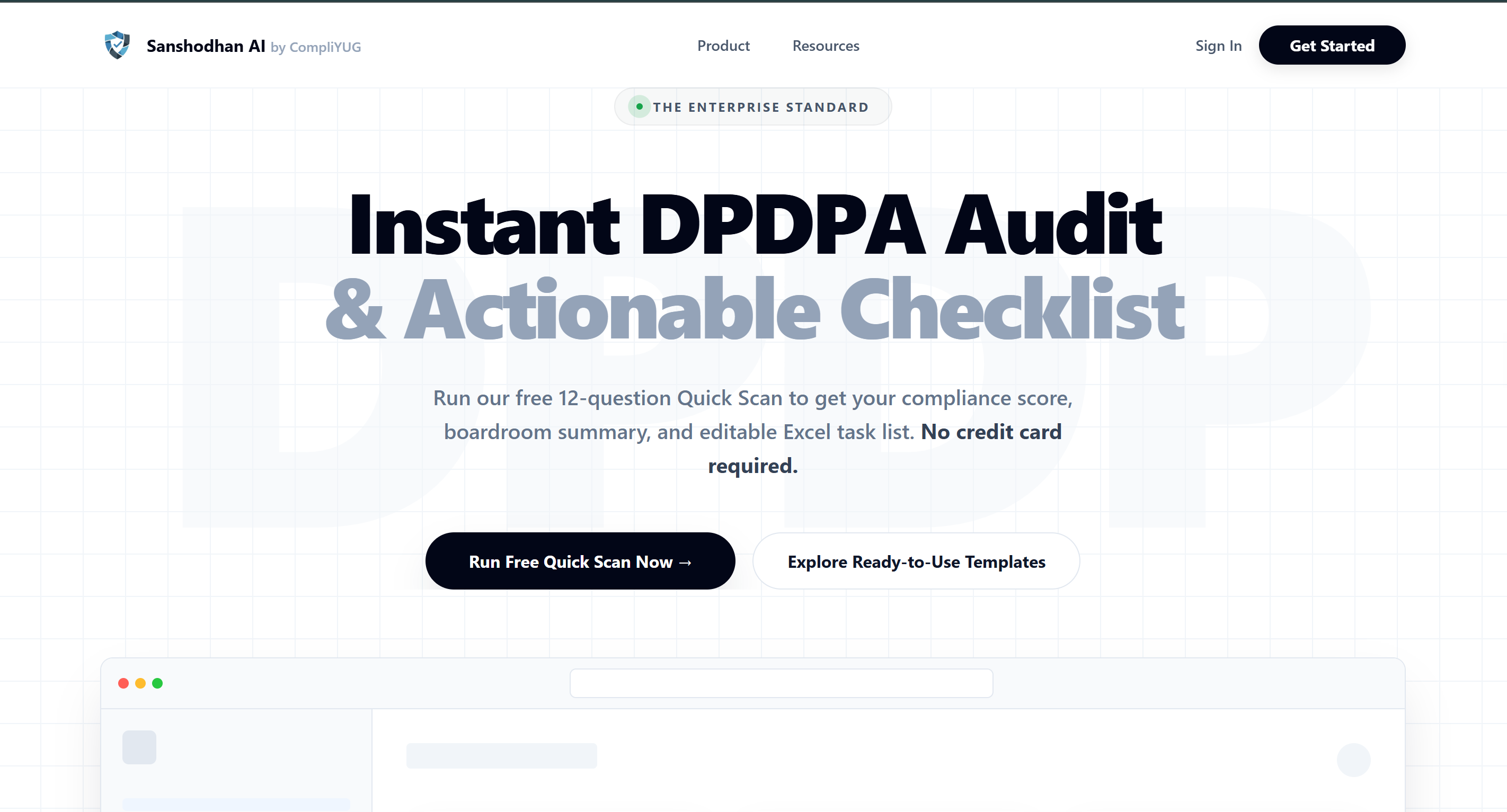
Landing page
-
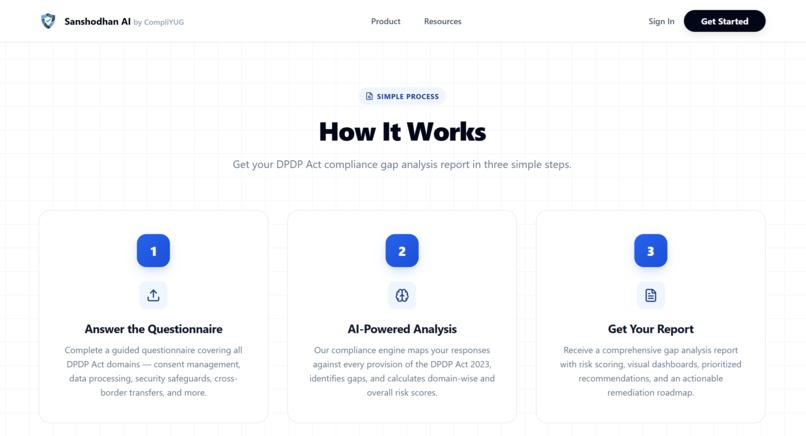
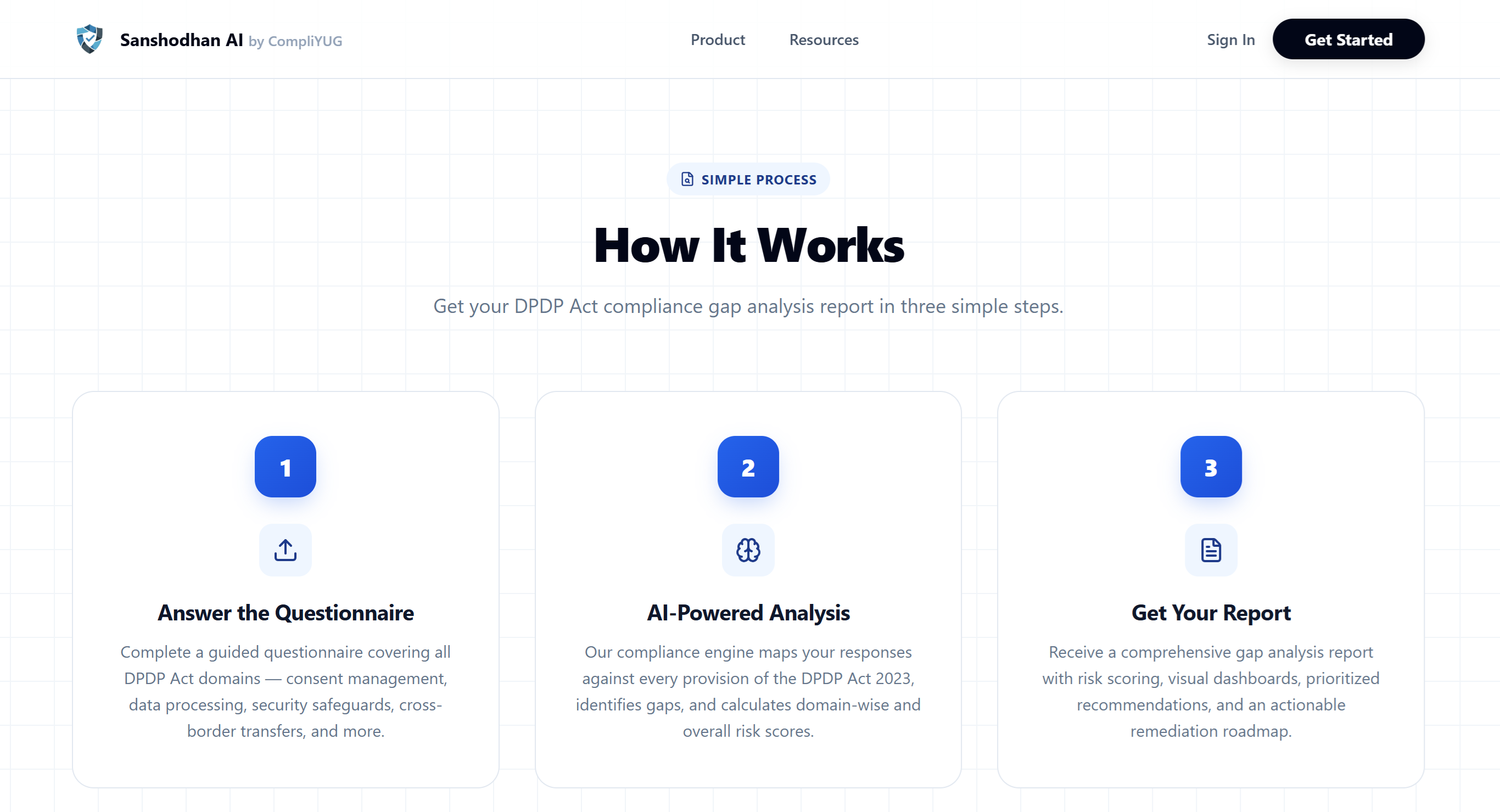
How it works
-
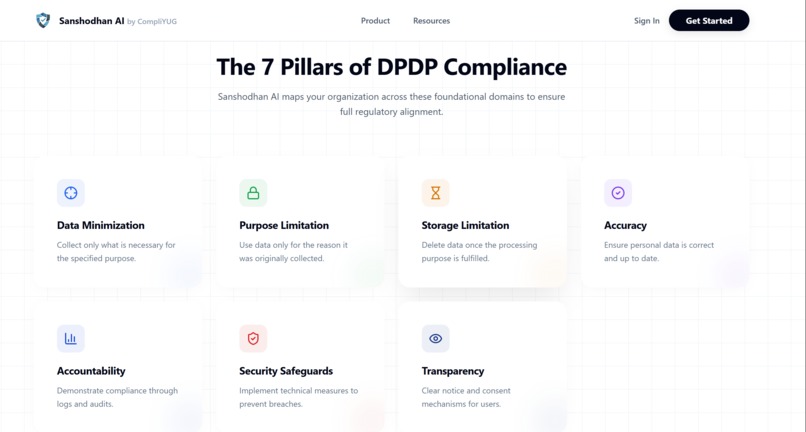
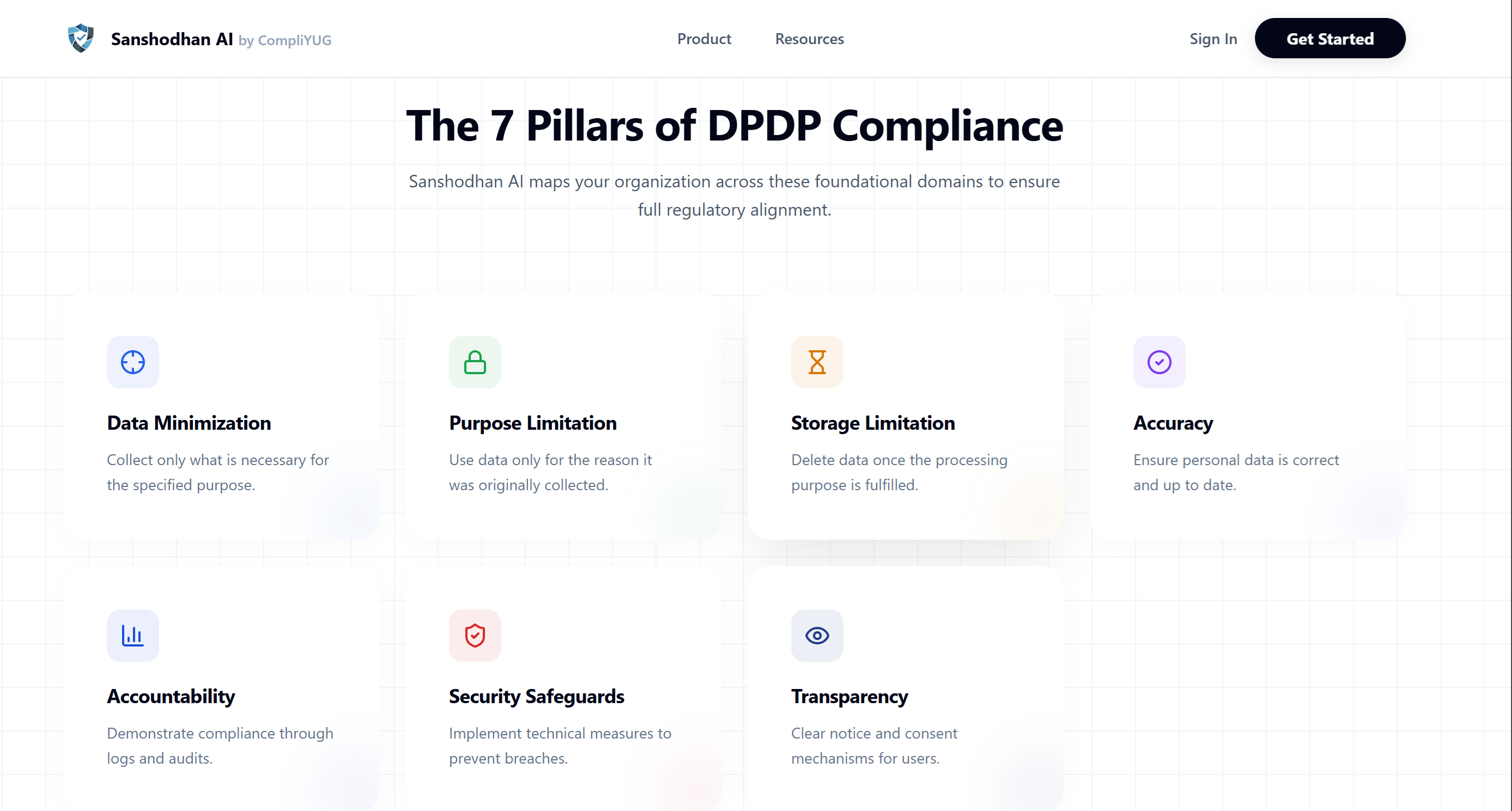
Seven pillars of DPDPA
-
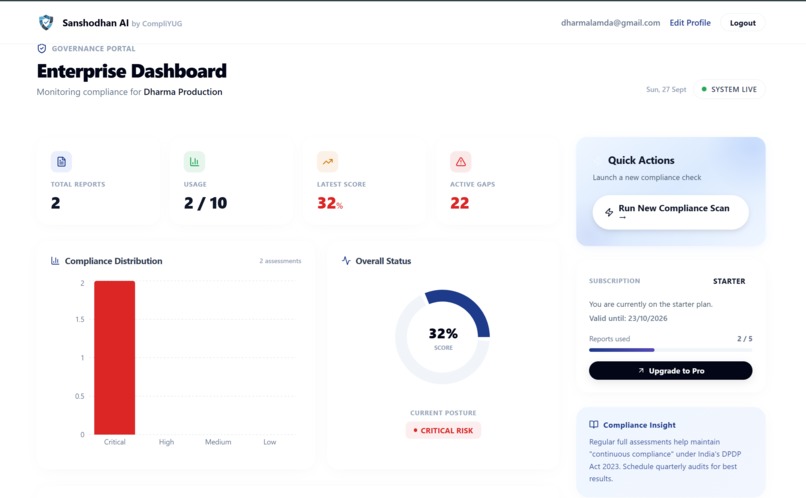
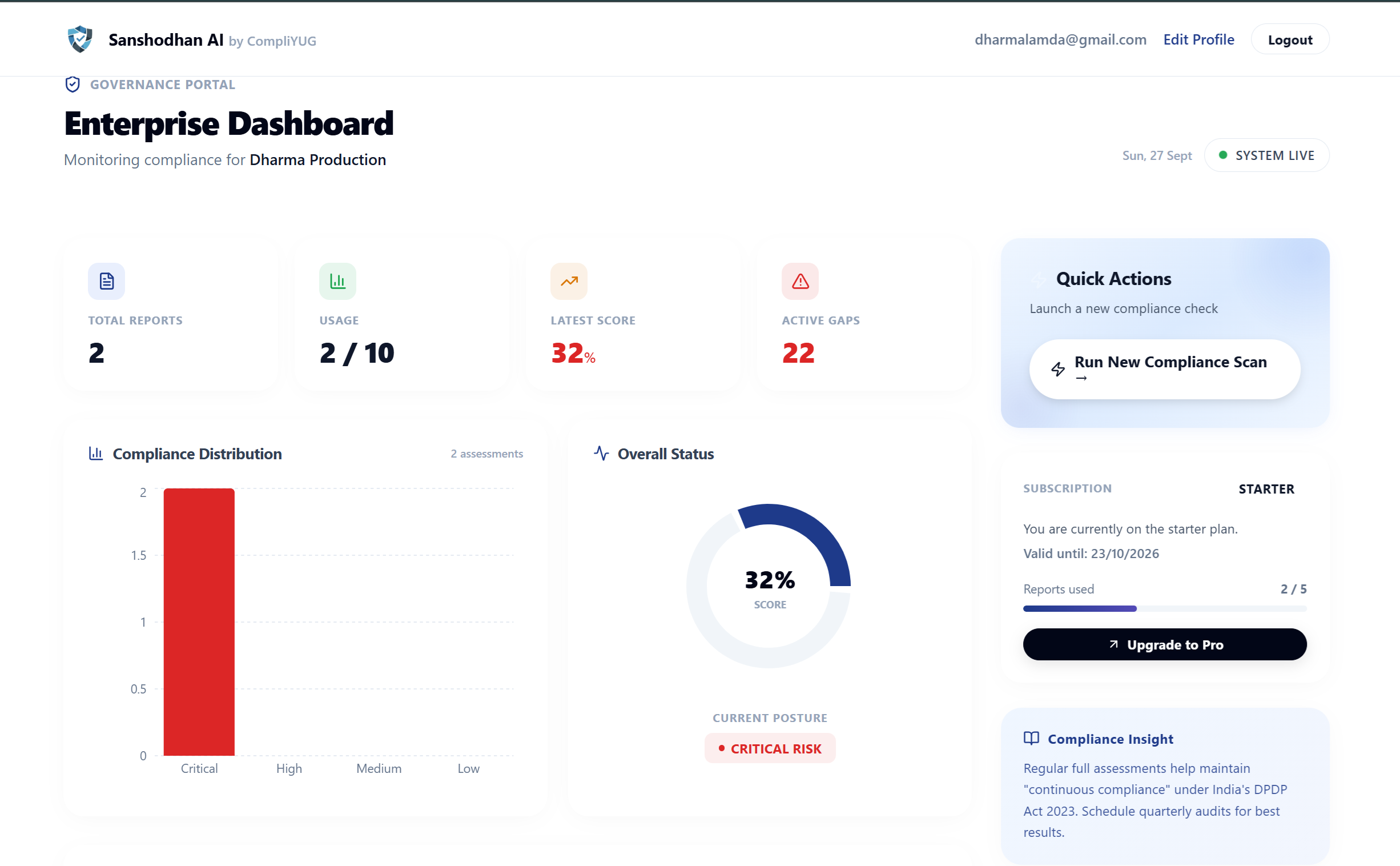
Dashboard
Inspiration
₹250 Crore.
That's the maximum penalty an organization faces under India's Digital Personal Data Protection Act, 2023 (DPDPA) for failing to implement reasonable security safeguards. And yet - almost no one understands the law.
We spoke to startup founders, CTOs, and compliance officers across India. The pattern was alarming:
- "We know we need to comply, but we don't even know where to start."
- "We Googled the DPDP Act and got 50 different interpretations."
- "Our lawyer quoted ₹8-15 Lakhs just for a gap assessment."
- "We asked ChatGPT about DPDPA - it hallucinated sections that don't even exist."
This was the moment that sparked Sanshodhan AI. The law exists. The penalties are real. But the gap between regulation and understanding is massive - and no one is bridging it affordably, accurately, or accessibly.
Every organization in India that handles personal data - from a 5-person startup to a 50,000-employee enterprise - must comply with DPDPA. But the legal language is dense, the rules are nuanced, and generic AI tools hallucinate legal citations that could lead to catastrophic compliance failures.
We asked ourselves: What if we could make DPDPA compliance as simple as answering a questionnaire - and as reliable as reading the law itself?
What it does
Sanshodhan AI is a comprehensive DPDP Act compliance platform that transforms how organizations understand and achieve data privacy compliance.
AI-Powered Gap Assessment - Users complete a dynamic, industry-personalized questionnaire (Quick 12-question scan or Full Compliance deep-dive). The AI engine analyzes responses and generates a boardroom-grade compliance report with risk scores, categorized gaps (Critical / High / Medium / Low), and an actionable compliance roadmap.
RAG Model Trained Exclusively on Official DPDPA Documents - Our Retrieval-Augmented Generation model is grounded only on the official DPDP Act 2023 text and DPDP Rules. No internet scraping. No third-party opinions. No hallucination. Every recommendation traces back to a specific legal provision.
Dynamic Industry Personalization - The platform doesn't use a one-size-fits-all approach. It reads the organization's domain (FinTech, HealthTech, E-commerce, EdTech, etc.) and dynamically personalizes the language, questions, follow-ups, and legal context - making every assessment feel tailor-made for the user's sector.
Evidence Tracking & Remediation Engine - Post-assessment, organizations use the dashboard to manage compliance evidence collection, assign remediation tasks, and track progress against identified gaps - with contextual UI hints guiding users on what evidence to gather.
Vendor & Sub-Processor Risk Management - Track third-party data processors, monitor cross-border data sharing, evaluate contract statuses, and generate vendor risk scores - because your compliance is only as strong as your weakest data partner.
Automated CRM Integration - Lifecycle webhooks sync events like assessment_started and assessment_completed to external CRM systems for seamless organizational tracking.
How we built it
The Foundation: Getting the Data Right
We started where it matters most - the source of truth. We digitized, parsed, and structured the complete text of the DPDP Act 2023 and the DPDP Rules into a retrieval-optimized knowledge base. Every chunk is tagged with section numbers, clause references, and penalty mappings.
The AI Engine: RAG Over Fine-Tuning
We deliberately chose Retrieval-Augmented Generation (RAG) over fine-tuning. Why?
- Fine-tuning bakes knowledge into model weights - it can drift, hallucinate, and can't be easily updated when rules change.
- RAG retrieves the exact relevant legal text at query time and uses it as grounded context - ensuring every response is traceable, auditable, and hallucination-free.
This architectural decision is critical for a legal compliance tool where a single hallucinated clause could expose an organization to ₹250 Crore in penalties.
The Assessment Engine: Dynamic & Personalized
We built the questionnaire system to be adaptive, not static:
- Follow-up questions appear dynamically based on prior answers
- "Don't Know" responses are intelligently flagged as "Unable to Determine" and factored into risk calculations
- The
industry_contextengine reads the organization's domain and injects sector-specific terminology and obligations into the question schema on the fly
The Platform: Full-Stack SaaS
- Authentication: Custom JWT-based auth with OTP email verification for enterprise-grade security
- Payments: Razorpay integration with a transparent three-tier pricing model (Free / Starter / Pro)
- Reports: AI-generated PDF compliance reports with legal citations, risk visualizations, and a prioritized remediation roadmap
- CRM: n8n webhook automations for lifecycle event tracking
Challenges we ran into
1. Preventing Hallucination in Legal Context This was our hardest challenge. Generic LLMs confidently fabricate legal sections, penalties, and compliance requirements that simply don't exist. We solved this by constraining the RAG retrieval scope exclusively to verified DPDPA documents and implementing a citation-verification layer that cross-references every AI output against the source knowledge base.
2. Making Legal Language Accessible Without Losing Accuracy There's a tension between simplification and precision. "Plain language" that's too simplified can misrepresent legal obligations. We addressed this by generating two layers in every report: a plain-language executive summary for decision-makers, and detailed legal citations for legal/compliance teams.
3. Industry Personalization at Scale Every industry has different data processing patterns, consent requirements, and risk profiles under DPDPA. Building a dynamic personalization engine that accurately adapts across FinTech, HealthTech, E-commerce, EdTech, and more - without maintaining separate question banks for each - required careful abstraction of industry context injection.
4. Building Trust in AI-Generated Compliance Advice Users are rightfully skeptical of AI giving legal guidance. We addressed this through transparency: every recommendation shows its confidence level, source section, and the exact DPDPA provision it references. The AI positions itself as a compliance co-pilot, not an autonomous legal authority.
Accomplishments that we're proud of
- Zero hallucination architecture - Every output is grounded in official DPDPA text with traceable citations
- True industry personalization - Not generic templates, but dynamically adapted assessments per sector
- Boardroom-grade reports - Compliance scores, risk matrices, gap categorization, and remediation roadmaps that a CISO can present directly to the Board of Directors
- Minutes, not months - What traditionally takes 3+ months and ₹8-15L+ in legal consulting fees, Sanshodhan AI delivers in minutes
- Production-ready SaaS - Not a hackathon prototype. Full authentication, payments, CRM integrations, and multi-tier pricing. This is a live, working platform.
What we learned
- Legal AI demands a fundamentally different approach than general-purpose AI. RAG with constrained retrieval isn't just a technical preference - it's an ethical necessity when people's compliance decisions (and ₹250 Crore penalties) depend on your output.
- The biggest barrier to compliance isn't willingness - it's accessibility. Organizations want to comply. They just can't navigate 50+ pages of dense legal text without expert help they can't afford.
- Personalization isn't optional for compliance tools. A FinTech company and a HealthTech company have fundamentally different DPDPA obligations. One-size-fits-all assessments create a false sense of security.
- Trust in AI is earned through transparency. Showing confidence scores, source citations, and human-in-the-loop confirmations isn't just good UX - it's the only way to build credibility in regulated domains.
What's next for Sanshodhan AI
- DPDPA Breach Incident Command Center - Automated 72-hour breach response workflows with CERT-In notification templates and Data Protection Board reporting
- 22 Indian Language Consent Manager - Multi-language consent architecture supporting all scheduled Indian languages for legally valid consent under Section 6 of DPDPA
- Data Subject Request (DSR) Portal - Self-service portal for data principals to exercise their rights (access, correction, erasure, grievance) with automated workflow routing
- Continuous Compliance Monitoring - Always-on scanning that detects compliance drift and alerts organizations before gaps become violations
- Multi-Entity & Group Company Support - Consolidated compliance dashboards for enterprise groups managing multiple subsidiaries
Built With
- ai
- api
- javascript
- jwt
- learning
- llm
- machine
- n8n
- natural-language-processing
- node.js
- python
- rag
- razorpay
- react
- rest


Log in or sign up for Devpost to join the conversation.