Inspiration
A room can be quiet without everyone being clear.
One speaker can address hundreds of people, yet hear from only a handful. One listener needs another example. Another has a question they are uncomfortable asking publicly. Someone else is still processing the previous idea. They share a presentation, but experience it differently.
The speaker has to decide whether to move on with very little information about those differences.
AI has made personalized information increasingly accessible. We wanted to bring that possibility into the conversations people share: conferences, workshops, classrooms, training sessions, and public forums.
Bee gave us the starting point: continuous context about what was actually said. We saw an opportunity to connect that context with audience participation, so people could express what they needed while the speaker still had an opportunity to respond.
That became SansCue.
What it does
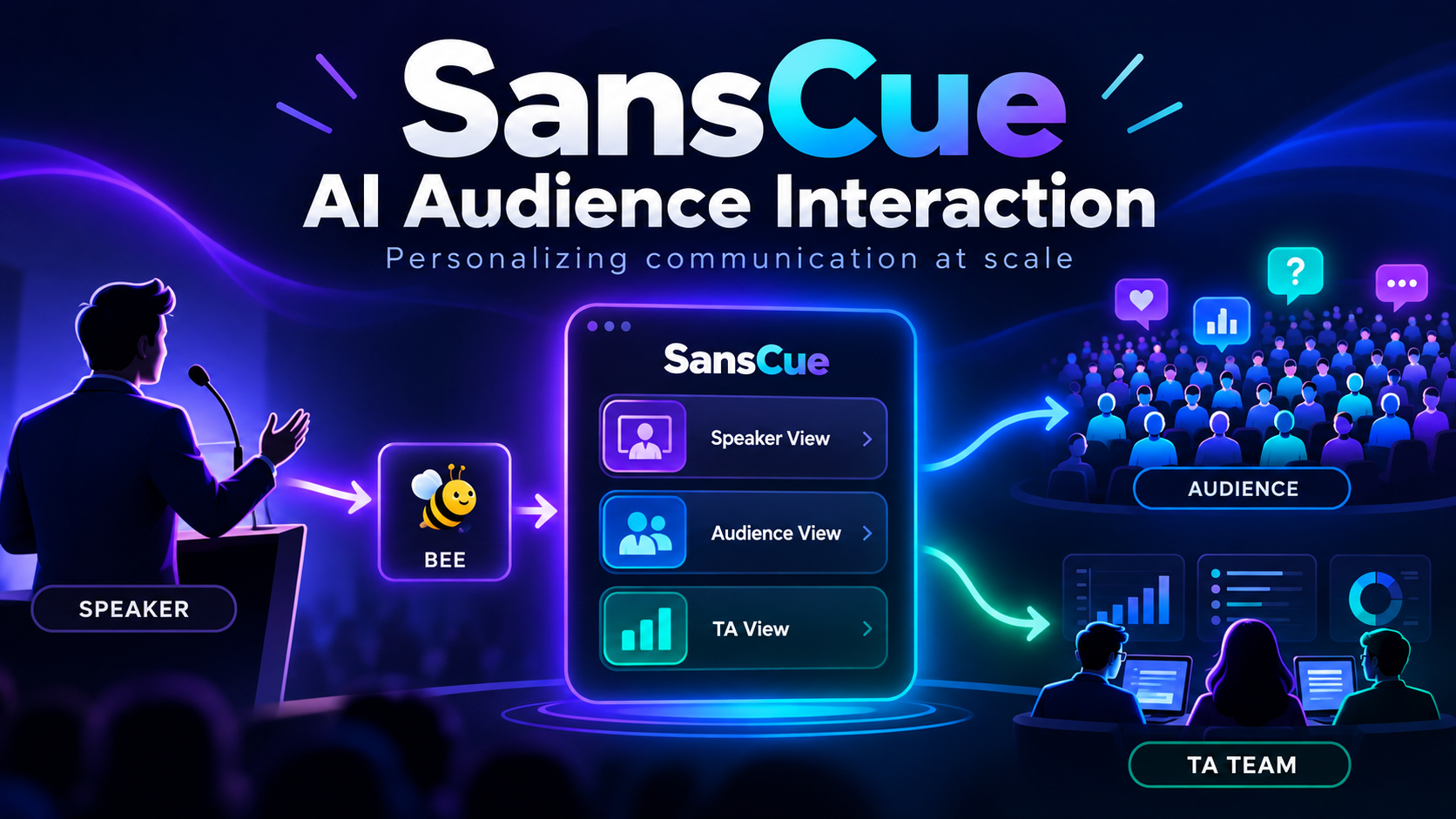
SansCue connects spoken context, audience feedback, and individual support in one shared session.
The speaker creates a room and connects the intended Bee recording. Listeners join through a browser link or QR code without needing their own Bee account. SansCue uses the transcript to generate short clarity check-ins tied to the discussion.
Imagine a speaker explaining cache expiration. A check-in asks, “How clear is cache expiration?” A listener understands the basic idea but is unsure what happens when the original data changes. They can select Partly clear and privately ask their specific question. A moderator can reply while the speaker continues. Meanwhile, the speaker sees which topics respondents find confusing and can decide whether to revisit the explanation.
Three connected views support that experience:
- Speaker: topic feedback, response counts, transcript context, generated questions, and audience Q&A.
- Audience: Clear, Partly clear, or Need help responses, plus private written questions and replies.
- TA / moderator: question review and publication controls, audience feedback, and private replies.
The smallest useful interaction can be one tap that says, “I need another explanation.” Written questions provide room for the details that one tap cannot capture.
How we built it
Bee supplies the conversational context through its command-line integration. SansCue associates the selected recording with a particular room, then builds a bounded window of recent speech for question generation.
Amazon Bedrock Nova Micro generates clarity check-ins with supporting transcript quotes. The service checks those quotes against the transcript, and uses context checks, generation intervals, and recent-question history to reduce incomplete or repetitive suggestions.
We built three Rust services for Bee ingestion, question generation, and room interactions. Each owns a PostgreSQL database. Keeping model processing separate from audience participation means a slow generation request does not have to hold up votes or private Q&A.
The interface uses Preact, TypeScript, and Vite. The hosted application runs on Amazon EC2 with Docker Compose and Caddy HTTPS. Persistent delivery queues, duplicate handling, and browser updates connect the services and views.
We also built an EC2 development environment where OpenClaw coordinated Cursor coding agents through scoped tasks and isolated Git worktrees. We combined agent-assisted implementation with our own product decisions, integration work, device testing, deployment, and review.
Challenges we ran into
Finding the right moment to ask. Continuous speech includes pauses, unfinished explanations, and repeated ideas. We needed enough context for a useful check-in without turning every utterance into an interruption. Context windows, freshness checks, question history, and generation cadence became core product decisions.
Keeping context attached to the right interaction. A transcript belongs to a particular recording and room. A response belongs to a particular topic. A private question belongs to its author and authorized staff. Preserving these relationships mattered as much as generating the question itself.
Working across device and cloud boundaries. Hardware availability and model quotas affected development. We used transcript replay to exercise the service pipeline, tested actual Apple Watch delivery separately, and verified hosted Nova generation with controlled inputs. That helped us identify which part of an integration was working and where more evidence was needed.
Making agent collaboration dependable. Delegation, permissions, context, and review needed their own engineering. We verified small tasks through the complete workflow before expanding the agents’ responsibilities.
Accomplishments that we're proud of
We built the core communication loop: Bee ingestion, context-based question generation, three participant roles, private Q&A, live responses, and topic-level speaker feedback.
We connected actual Apple Watch speech to transcript ingestion, exercised hosted Nova generation through audience feedback with controlled synthetic transcript inputs, and tested role boundaries, private replies, duplicate handling, and recovery from database outages.
Most importantly, the product gives both a group signal and an individual channel: a speaker can see a topic needs attention, while a moderator helps someone with a specific question.
What we learned
A clarity response is a person’s report of their experience. Its value depends on giving the speaker enough context to interpret it. Response counts and topic association matter alongside the chart.
We also learned that personalization can happen within a shared conversation. People do not need separate presentations to benefit from having their different needs heard.
AI creates opportunities to participate. Speakers and moderators decide how to respond.
What's next for SansCue
Our immediate priorities are a complete live hosted rehearsal and a small pilot with real speakers and audiences. We want to measure question usefulness, timing, participation, and whether the feedback helps speakers make better decisions.
We also want to improve moderator prioritization and the connection between written questions and spoken context. Consent, data retention, deletion, and realistic audience capacity need further work as we move toward broader use.
We want a question that would have stayed unasked to help shape the next explanation.
Built With
- bee


Log in or sign up for Devpost to join the conversation.