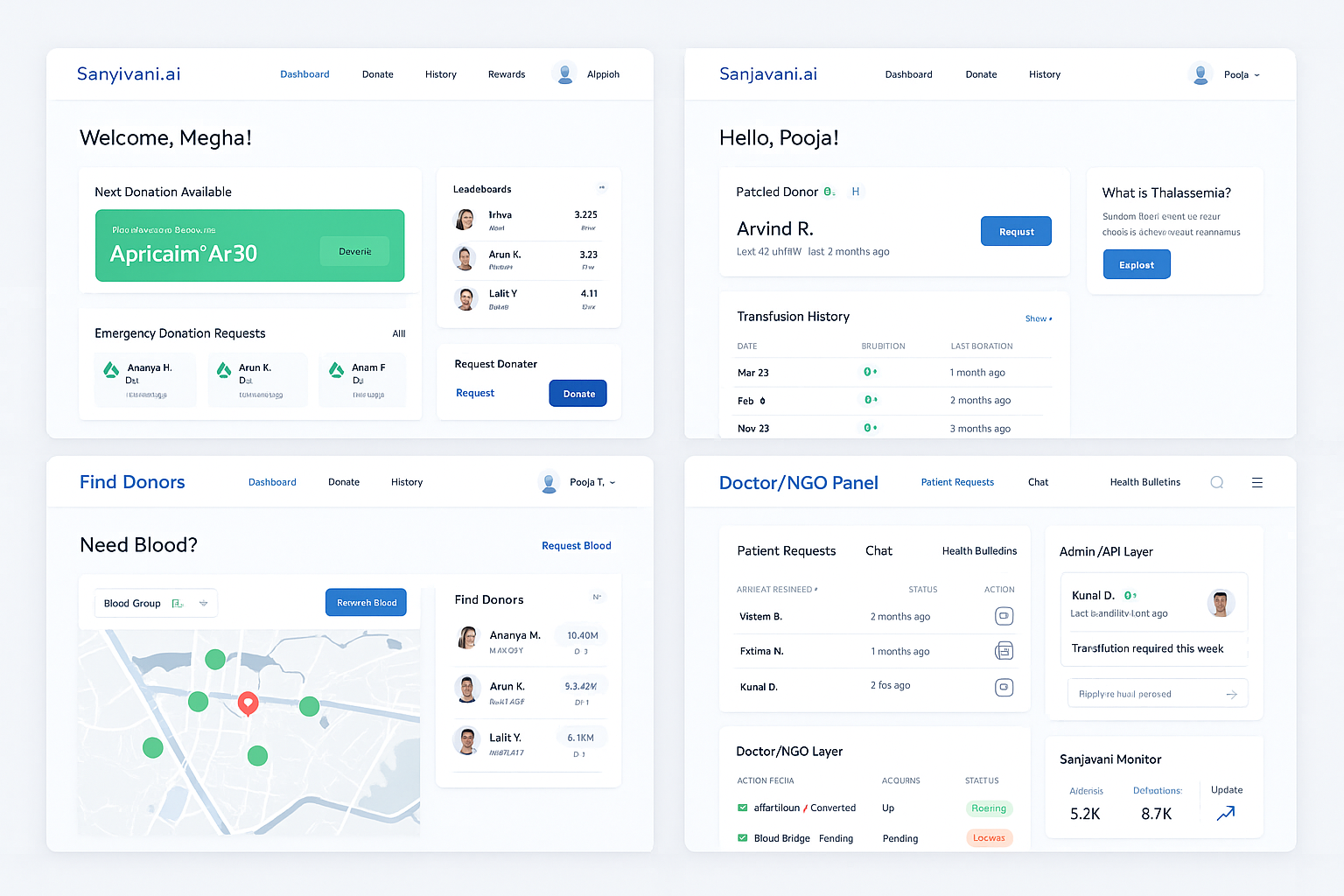
Inspiration Thalassemia patients often rely on frequent blood transfusions to survive. While blood donors exist, the process of matching a patient with a suitable donor is still largely manual, time-consuming, and unreliable—especially during emergencies. We were inspired to solve this life-threatening inefficiency using AI. We wanted to build a platform that not only connects people but also predicts, learns, and supports patients, caregivers, and healthcare providers. This led to the idea of Sanjivani.ai—a digital life-saving companion named after the mythical healing herb.
What it does Sanjivani.ai is an AI-powered platform that improves the blood donation ecosystem for Thalassemia patients. It:
Predicts donor availability based on historical behavior and patterns
Matches donors to patients using location, blood type, and donation frequency
Notifies donors when they are needed most
Encourages regular donations through gamified features
Provides a multilingual education dashboard for patients
Supports real-time chat between patients, doctors, and NGOs
Integrates with platforms like e-RaktKosh and Blood Bridge
How we built it We used React.js and Flutter for the web and mobile frontends, and Node.js with Express for our backend. MongoDB was used for flexible, schema-less data storage. For real-time messaging and donor alerts, we integrated Firebase Cloud Messaging and WebSockets. The AI model was built using Python (pandas and scikit-learn) to predict donor availability. We used OAuth2 for authentication and added biometric login for mobile users. Government API integrations, data encryption, and multilingual tools were layered in to ensure scalability, privacy, and accessibility.
Challenges we ran into Access to complete and clean historical donor data was limited, so we used a bootstrapped dataset for training and refined the model over time.
Integrating government APIs like e-RaktKosh required time due to documentation and sandbox limitations.
Balancing real-time performance with data privacy and encryption.
Making the platform multilingual and inclusive for a wide audience across India.
Designing a user experience that worked equally well for donors, patients, and NGOs.
Accomplishments that we're proud of Built a working prototype that can predict donor availability using real data patterns.
Designed a multi-role platform that brings together patients, donors, doctors, and NGOs in a single ecosystem.
Seamlessly integrated chat, alerts, and gamification to enhance engagement and trust.
Ensured privacy-first design with consent-driven data sharing and AES encryption.
Created a modular API structure that can be expanded across regions and scaled easily.
What we learned We learned the real impact of technology when it serves urgent, human-centered needs. From AI modeling to privacy protocols, this project pushed us to think critically about both performance and compassion. We explored healthcare regulations, API security, and multilingual UI design, gaining cross-domain knowledge in a short time. Most importantly, we understood the importance of designing with empathy—for users who are often in distress.
What's next for Sanjivani.ai Expand testing and deployment to more cities, starting with urban areas.
Partner with hospitals, blood banks, and NGOs for pilot programs.
Integrate more regional languages and voice-based assistance.
Improve AI accuracy using deep learning and real-time health data.
Launch a campaign to onboard verified donors and build community trust.
Open-source parts of the platform for wider adoption and collaboration.

Log in or sign up for Devpost to join the conversation.