Inspiration
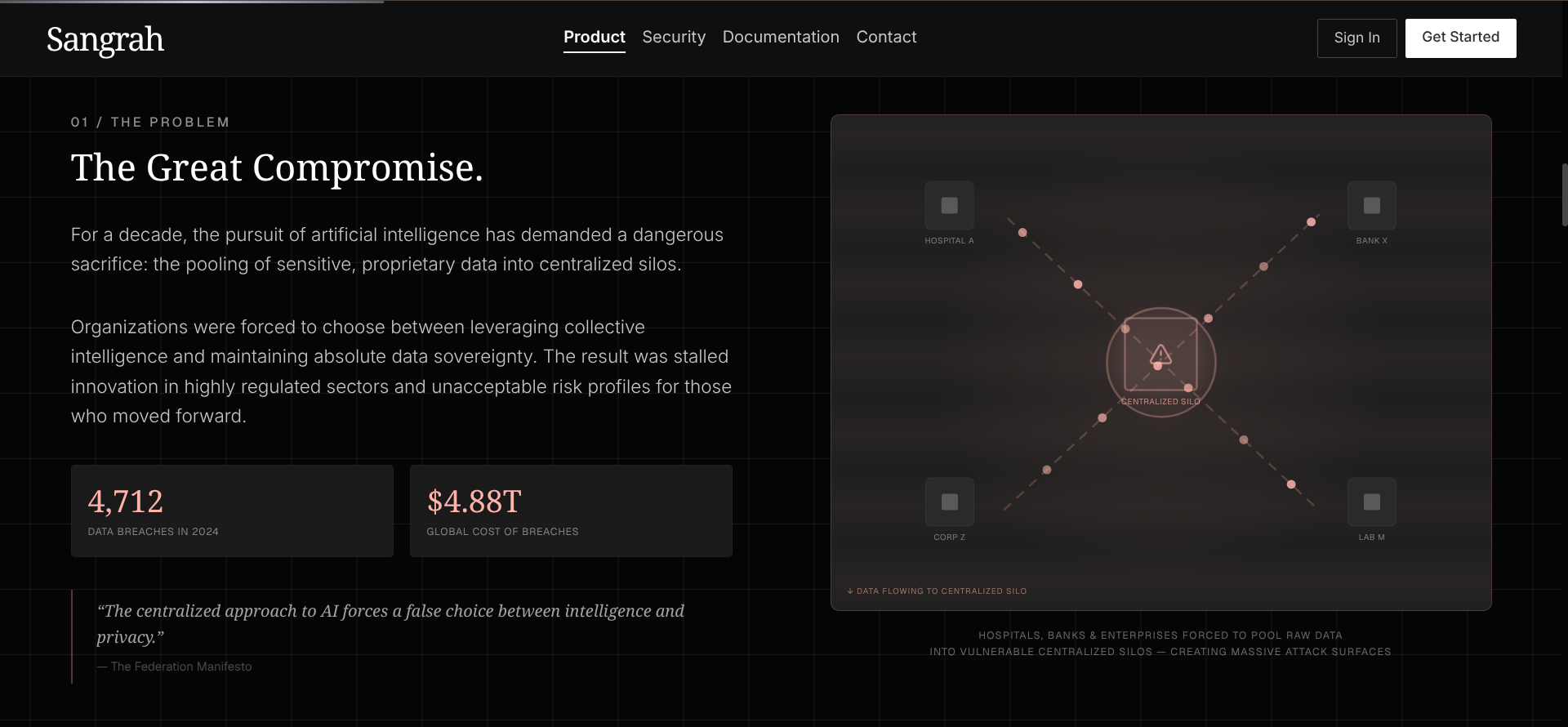
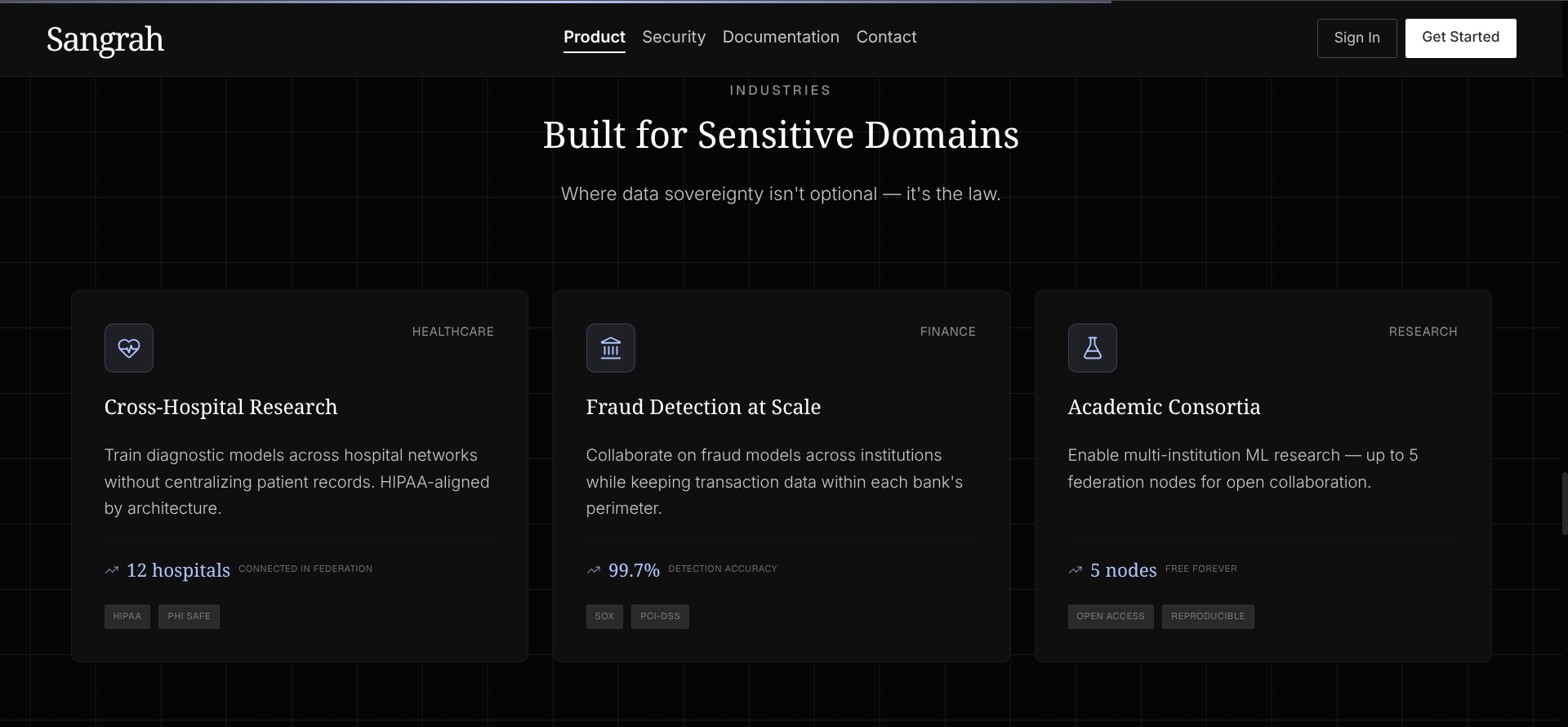
Artificial Intelligence is only as good as the data it learns from. Unfortunately, the world's most valuable datasets are locked inside hospitals, banks, insurance companies, research institutions, and government organizations. Regulations such as GDPR, HIPAA, and DPDP rightly prevent these organizations from sharing sensitive information, creating isolated data silos that limit the potential of AI.
Existing Federated Learning frameworks promise collaborative AI without data sharing, but most are research-oriented and difficult to deploy in real enterprise environments. They often overlook challenges such as identity management, auditability, security, and operational scalability.
We created Sangrah to bridge this gap. Our vision was simple: enable organizations to collaboratively train AI models without ever exposing their raw data while providing the security, transparency, and operational capabilities required for enterprise adoption.
What It Does
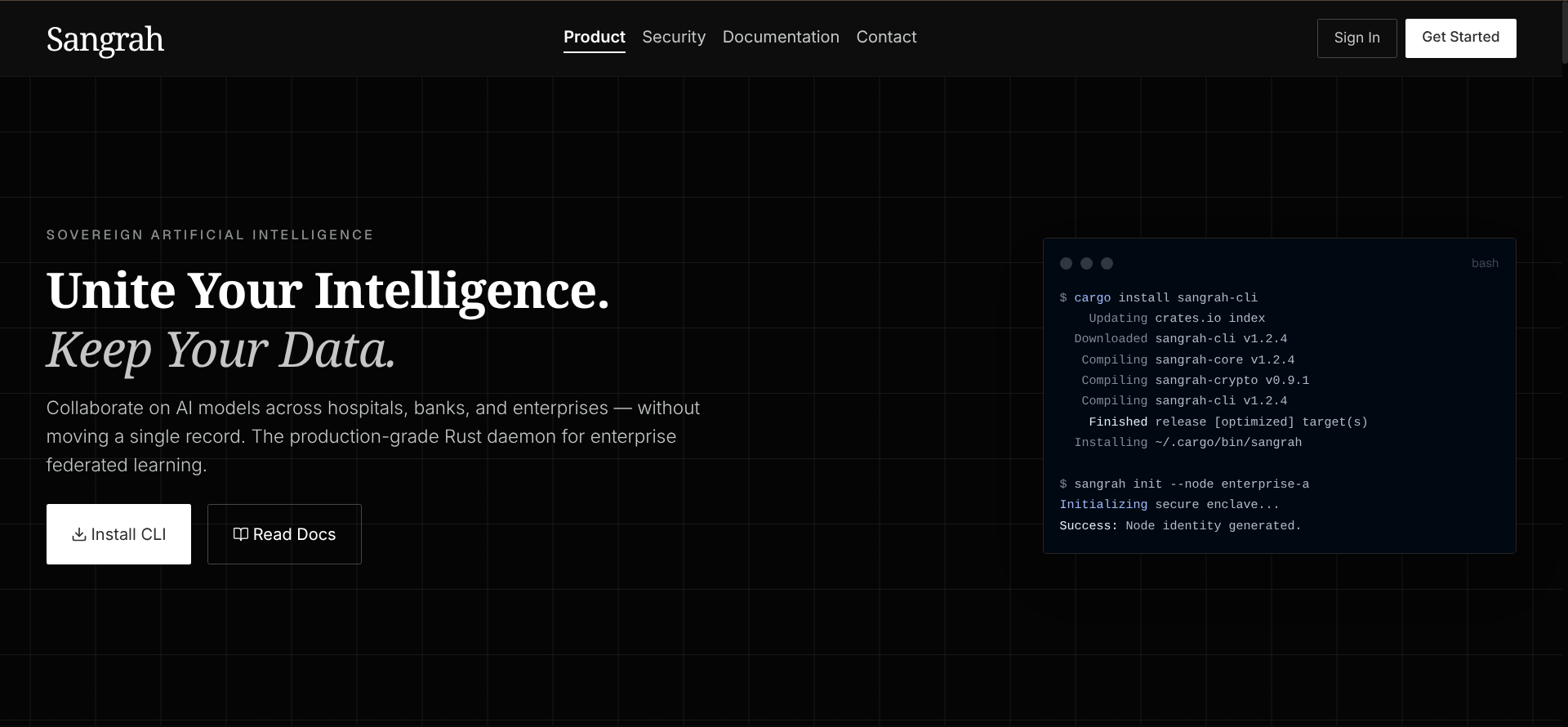
Sangrah is a production-oriented federated learning platform that enables multiple organizations to collaboratively train machine learning models while keeping all sensitive data within their own infrastructure.
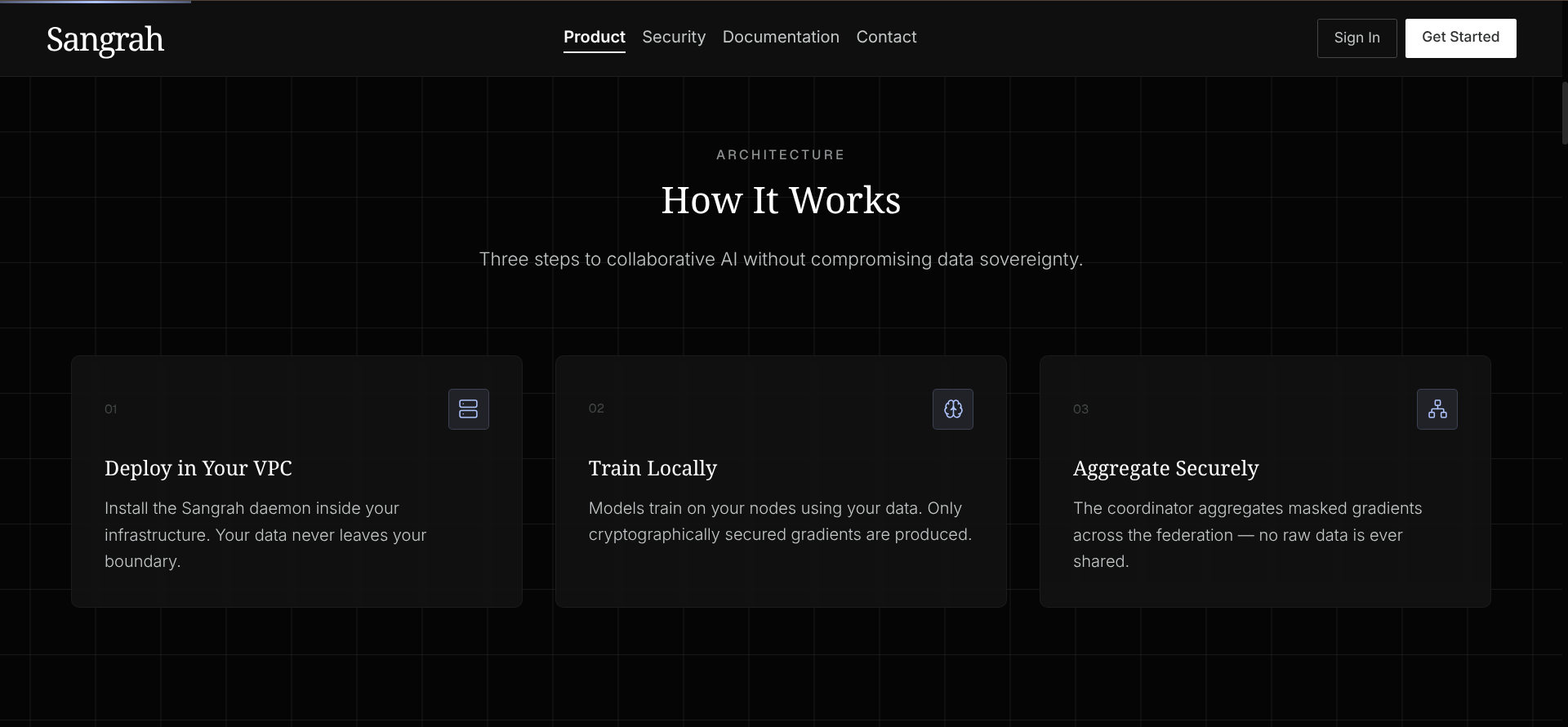
Each organization runs a lightweight Rust daemon that performs local model training, applies privacy-preserving techniques, and securely communicates with a centralized coordinator. Instead of transferring datasets, only protected model updates are exchanged.
The platform combines Federated Learning, FedProx, Differential Privacy, Secure Aggregation, and Byzantine-resilient aggregation (Multi-Krum) to ensure privacy, security, and robustness throughout the training lifecycle.
A modern Next.js enterprise dashboard provides complete visibility into federation health, participating organizations, training rounds, model versions, audit logs, drift monitoring, privacy budgets, and operational metrics, giving administrators complete control over the federated learning process.
How We Built It
We designed Sangrah as a complete enterprise platform rather than just another machine learning demonstration.
At the edge, every participating organization runs a memory-safe Rust daemon responsible for local dataset processing, model training, Differential Privacy, Secure Aggregation, and encrypted communication with the cloud coordinator. Because training happens entirely on-premise, sensitive datasets never leave the organization's infrastructure.
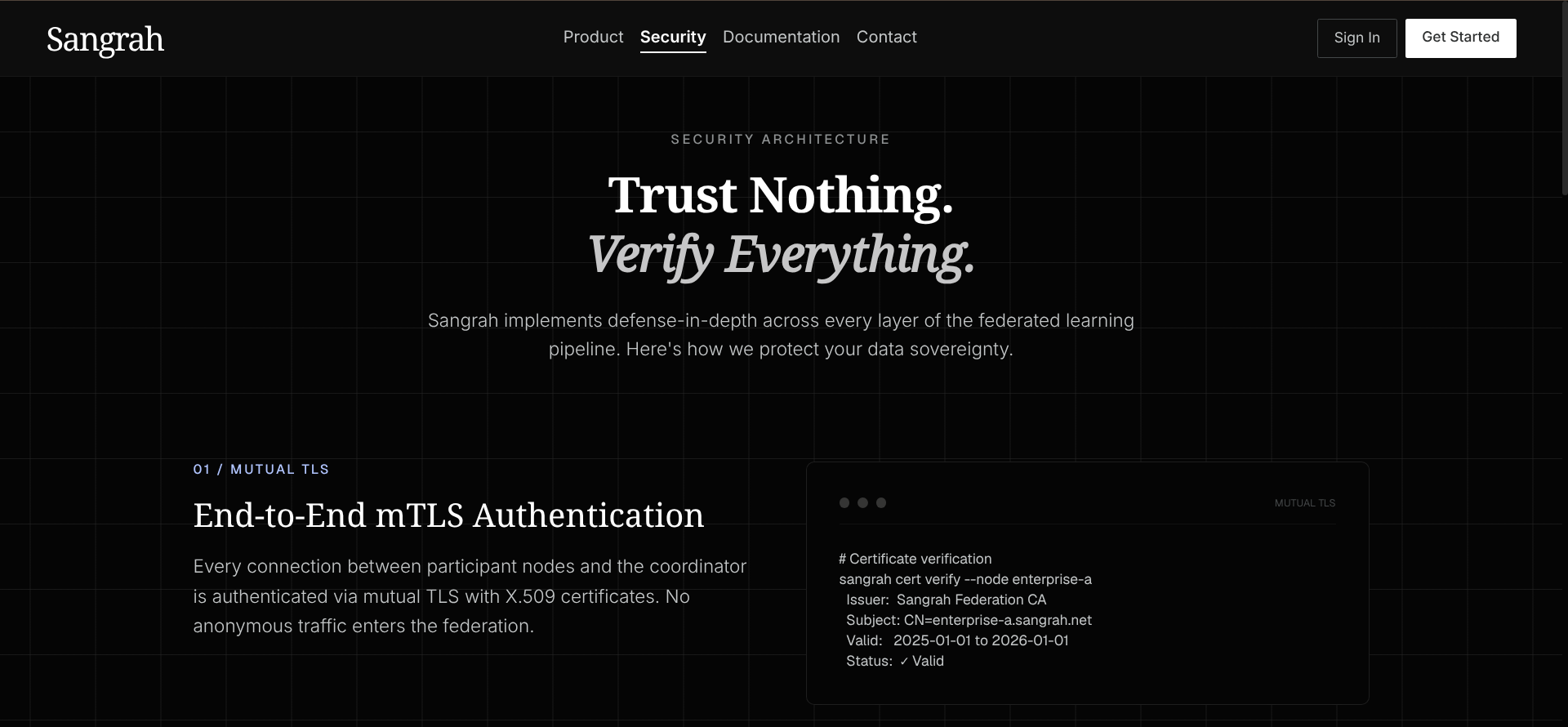
Our cloud infrastructure is built entirely on AWS. Amazon API Gateway, secured using Mutual TLS (mTLS), authenticates every participating organization before requests reach the backend. The AWS Lambda Federation Coordinator manages participant authentication, training epochs, model distribution, and aggregation orchestration. Amazon S3 stores encrypted model artifacts and checkpoints, while Amazon DynamoDB maintains organization metadata, training epochs, participant information, audit logs, and model registry data. Compute-intensive aggregation is performed using Amazon ECS Fargate, where FedProx and Multi-Krum generate robust global models while defending against malicious or abnormal updates.
To simplify enterprise adoption, we developed a modern Next.js dashboard using a Backend-for-Frontend (BFF) architecture. This allows administrators to securely manage federations, monitor training progress, inspect audit logs, and deploy new model versions without exposing client certificates directly to browsers.
Challenges We Ran Into
Building a production-ready federated learning platform required solving much more than machine learning.
One of our biggest challenges was balancing privacy, security, and performance. We initially explored Fully Homomorphic Encryption (FHE) for secure aggregation but found that its computational overhead made it impractical for large-scale enterprise deployments. We redesigned our architecture around Differential Privacy, Secure Aggregation, and Multi-Krum, achieving a far more practical balance between privacy, scalability, and performance.
Another challenge was enterprise authentication. While Mutual TLS (mTLS) is ideal for machine-to-machine communication, browsers cannot securely manage client certificates. We solved this by introducing a Backend-for-Frontend (BFF) layer that separates user authentication from organization identity while preserving end-to-end security.
We also had to design an architecture capable of supporting heterogeneous datasets across organizations. By adopting FedProx, we significantly improved convergence and stability compared to traditional Federated Averaging, making the platform better suited for real-world enterprise deployments.
Accomplishments We're Proud Of
- Built a complete end-to-end federated learning platform instead of an isolated proof of concept.
- Successfully integrated Rust, AWS cloud infrastructure, enterprise security, and a modern management dashboard.
- Designed a zero-trust architecture where raw data never leaves participating organizations.
- Implemented secure federated training using Differential Privacy, Secure Aggregation, FedProx, and Multi-Krum.
- Created an intuitive enterprise dashboard that transforms complex distributed AI workflows into an accessible operational platform.
- Designed the platform with extensibility in mind, making it ready for future governance, compliance, and enterprise-scale deployments.
What We Learned
This project taught us that production AI is far more than model training. Identity management, infrastructure, compliance, monitoring, security, and operational visibility are just as important as machine learning algorithms.
We also learned how cloud-native AWS services, privacy-preserving AI, cryptography, and distributed systems can work together to enable collaborative intelligence while preserving complete data ownership.
Perhaps the biggest lesson was that production federated learning is fundamentally a distributed systems problem, where scalability, reliability, observability, and security are just as critical as model accuracy.
What's Next
Our vision extends well beyond this hackathon.
Future development will focus on making Sangrah an even more secure, trustworthy, and enterprise-ready federated AI platform. Planned enhancements include:
- Trusted Execution Environments (TEE) for confidential computing
- Zero-Knowledge Proofs (ZKP) for verifiable model contributions
- Enterprise SSO and fine-grained Role-Based Access Control (RBAC)
- Advanced participant reputation and contribution scoring
- Cross-cloud federation across AWS, Azure, and Google Cloud
- Automated model approval, rollback, and lifecycle management
- MLOps integration with MLflow and CI/CD pipelines
- Real-time model drift detection and adaptive retraining
- Multi-region disaster recovery and high availability
- Hyperledger Fabric integration for decentralized governance, immutable audit trails, participant identity management, and compliance-ready model provenance
We believe the future of enterprise AI is not centralized intelligence, but shared intelligence with sovereign data ownership. Sangrah is our step toward making that future practical.
Built With
- amazon-web-services
- aws-api-gateway
- aws-cloudwatch
- aws-dynamodb
- aws-ecr
- aws-ecs-fargate
- aws-lambda
- aws-sam
- cloudformation
- differential-privacy
- docker
- ecdh
- ed25519
- ed25519-dalek
- fedprox
- hyperledger-fabric
- multi-krum
- next.js-14
- nextauth.js
- numpy
- pkcs#11
- python
- react
- reqwest
- resend
- ring
- rust
- rustls
- secure-aggregation
- serde
- sha-256
- tailwind-css
- tokio
- tpm-2.0
- typescript
- x.509-mtls
- zeroize


Log in or sign up for Devpost to join the conversation.