Inspiration
SaneSpace was inspired by my own experience as a natural overthinker. When things don’t go as planned, I tend to overanalyze everything, get overwhelmed, and struggle to organize my thoughts clearly in the moment.
Like many people, I often turned to ChatGPT as a confidant to process what I was feeling. While it helped, I realized it still has limitations — it doesn’t retain full context over time, and it doesn’t always fully understand the cultural and emotional context of being a Nigerian user navigating stress, expectations, and uncertainty.
At the same time, I’ve always been interested in mental health awareness. I didn’t just want to talk about change — I wanted to be part of it. That’s what led me and my teammate to build SaneSpace.
Our goal was to create a starting point for students and young professionals like us to unpack their thoughts, manage stress, and gain clarity.
We want to build a space where users feel heard and understood, free from stigma, and more accessible than traditional therapy, which can often feel expensive or out of reach. For severe cases, the system encourages seeking professional therapy support, while ensuring the user remains in full control of their experience and decisions.
What it does
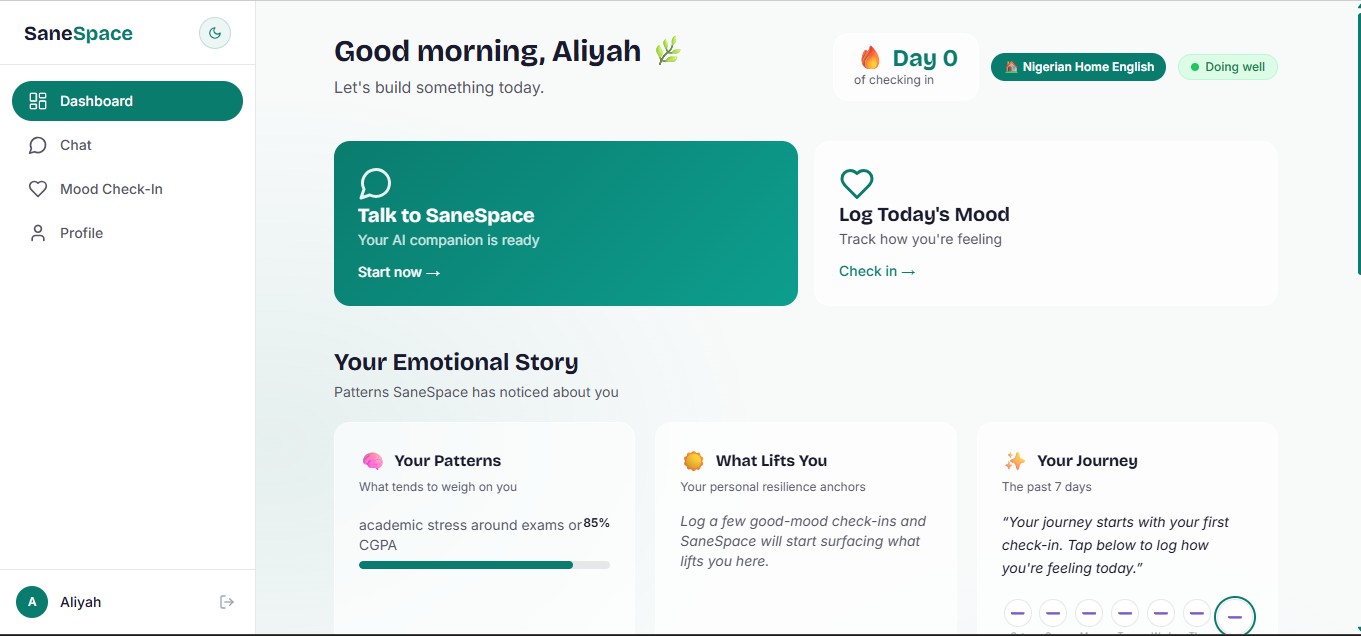
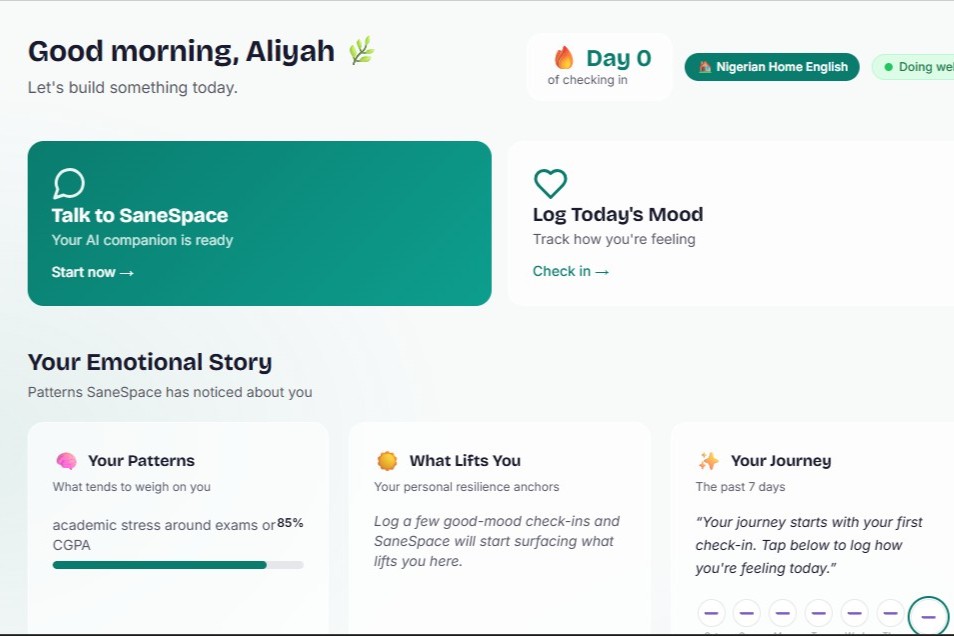
SaneSpace is an AI-powered reflection space that helps users turn unstructured thoughts into clarity. Users input what they are feeling or thinking, and the system responds with structured, calm, and supportive outputs that help them understand their situation better and decide their next step.
Instead of replacing human judgment, SaneSpace acts as a reflective companion that helps users organize emotional or mental noise into clearer thinking while keeping them in full control of their decisions.
How we built it
SaneSpace was built in one week by a two-person team — Aliyah handling frontend and Mustakheem leading backend and AI integration.
We started by designing the full product architecture: a layered AI system where every response is shaped by four stacked context blocks — a core identity layer, a specialisation block (Therapy/Coaching/Student etc.), a Nigerian language profile block, and an emotional memory block built from prior sessions.
The frontend was built with Next.js 14 (App Router) and Tailwind CSS, with Framer Motion powering all animations including the immersive 3D voice interface and scroll-triggered reveals. Clerk handled authentication so we could focus entirely on the product experience.
The AI layer uses Groq's Llama 3.3 70B for sub-500ms chat responses, with a dynamic prompt builder that assembles the full system prompt on every request. We built a crisis detection engine that runs before every AI response as a pre-flight safety check across three escalation tiers. An emotional memory graph extracts patterns from conversations and updates confidence scores silently in the background.
The voice interface uses the Web Audio API for real-time amplitude detection, making the breathing orb respond to the user's actual voice activity. OpenAI Whisper was integrated for Nigerian-English-primed transcription — the first time we'd seen Pidgin handled accurately by an STT model.
Claude Code in VS Code was our primary AI-assisted development tool, enabling us to build and iterate across 12 pages and 40+ components in under 7 days. Challenges We Ran Into
Our biggest challenge was the Nigerian language layer. Getting an LLM to genuinely understand Pidgin expressions — not just translate them, but respond with cultural warmth and accuracy — required extensive prompt engineering. We built a glossary of emotional signal phrases (e.g. "e don do me" = at breaking point, "I dey manage" = coping but struggling) and embedded them into the language profile blocks.
The second major challenge was the voice interface. Browser-based audio recording, real-time amplitude detection via Web Audio API, and streaming text-to-speech all had to work together without perceptible latency. We went through three architectures before landing on a streaming approach where audio playback begins before generation completes.
Responsible AI was harder than expected. Defining precise escalation thresholds for crisis detection — knowing when to shift to Care mode vs when to hard-stop the AI entirely and only show human resources — required careful thinking about edge cases and cultural context. Nigerians often express distress indirectly, so our crisis signals had to account for coded language and understatement.
Finally, deploying a Next.js app nested inside a monorepo to Vercel with Clerk authentication and environment variables across multiple services was a significant DevOps challenge that cost us several hours close to submission.
Challenges we ran into
We're most proud of building something that actually works for Nigerians — not a Western wellness app with a Nigerian flag pasted on it.
When you type "Abeg I just dey stress, e don do me today" and SaneSpace responds in warm, culturally accurate Pidgin without hesitation — that moment is what we set out to build. No other wellness application on the continent does this.
We're proud of the Emotional Memory Graph — a system that extracts psychological patterns from conversations, builds confidence scores over time, and injects the top patterns into every subsequent session. It makes SaneSpace feel like it genuinely knows you, not like it's meeting you for the first time every session.
The three-tier crisis escalation system is something we're proud of from a responsible AI standpoint. It's not a single keyword trigger — it's a nuanced, tiered response system that distinguishes between monitoring, escalating, and hard-stopping, with Nigerian crisis resources (MANI, She Writes Woman, NIMH Lagos) surfaced at the right moments.
And we're proud of shipping a full-stack AI product — 12 pages, 40+ components, voice interface, live AI chat, emotional dashboard — in under 7 days as a two-person student team.
Accomplishments that we're proud of
We're proud that we chose to solve an overlooked issue in our country and not just talk about it
What we learned
We learned that cultural intelligence is an engineering problem, not just a design one. Making AI understand Nigerian Pidgin required building a structured language profile system, a phrase glossary, and a live detection layer — not just changing the UI language.
We learned that responsible AI design has to be baked into the architecture from day one, not added as a feature at the end. The crisis detection system works well because we designed the entire message pipeline with safety checks as a first-class concern, not an afterthought.
We learned how to orchestrate multiple AI services — Groq for speed, OpenAI Whisper for Nigerian-accented speech recognition — in a hybrid architecture that routes different tasks to the right model based on latency requirements.
We learned that the most important UX decision in a wellness app is the first 30 seconds. The conversational onboarding — where the AI greets you, asks how you're feeling, and adapts its entire personality to your answers — is what makes SaneSpace feel like a safe space rather than a product.
Most importantly, we learned that there is a real, urgent, underserved need for culturally intelligent mental health support in Nigeria. SaneSpace is our answer to that — and we intend to keep building it beyond this hackathon
What's next for SaneSpace
SaneSpace currently already includes personalization, voice input, and a privacy-focused design that ensures user conversations remain private and secure.
Moving forward, we aim to further enhance personalization by making the system better at adapting to individual user patterns over time, while still maintaining strict privacy and user control.
We also plan to improve the voice experience to make interactions feel even more natural and expressive, and explore additional accessibility features such as multilingual support to reach a wider audience.
In the future, we may also introduce optional journaling and progress tracking features to help users reflect on their thoughts and emotional patterns over time in a more structured way.


Log in or sign up for Devpost to join the conversation.