-
-
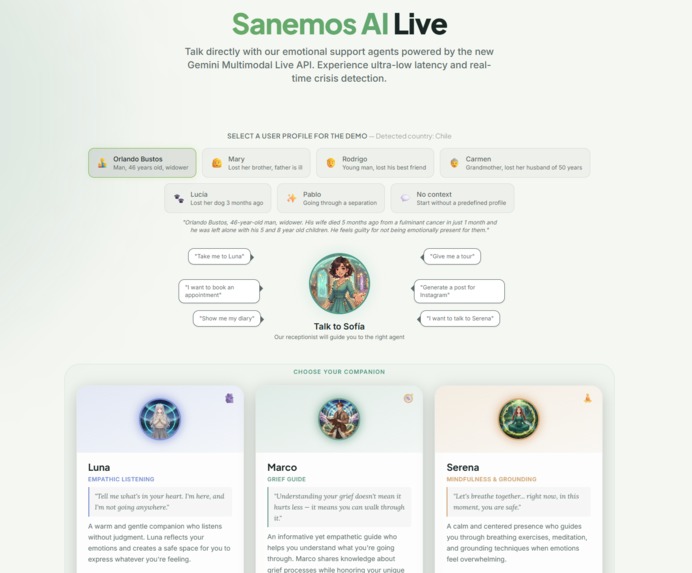
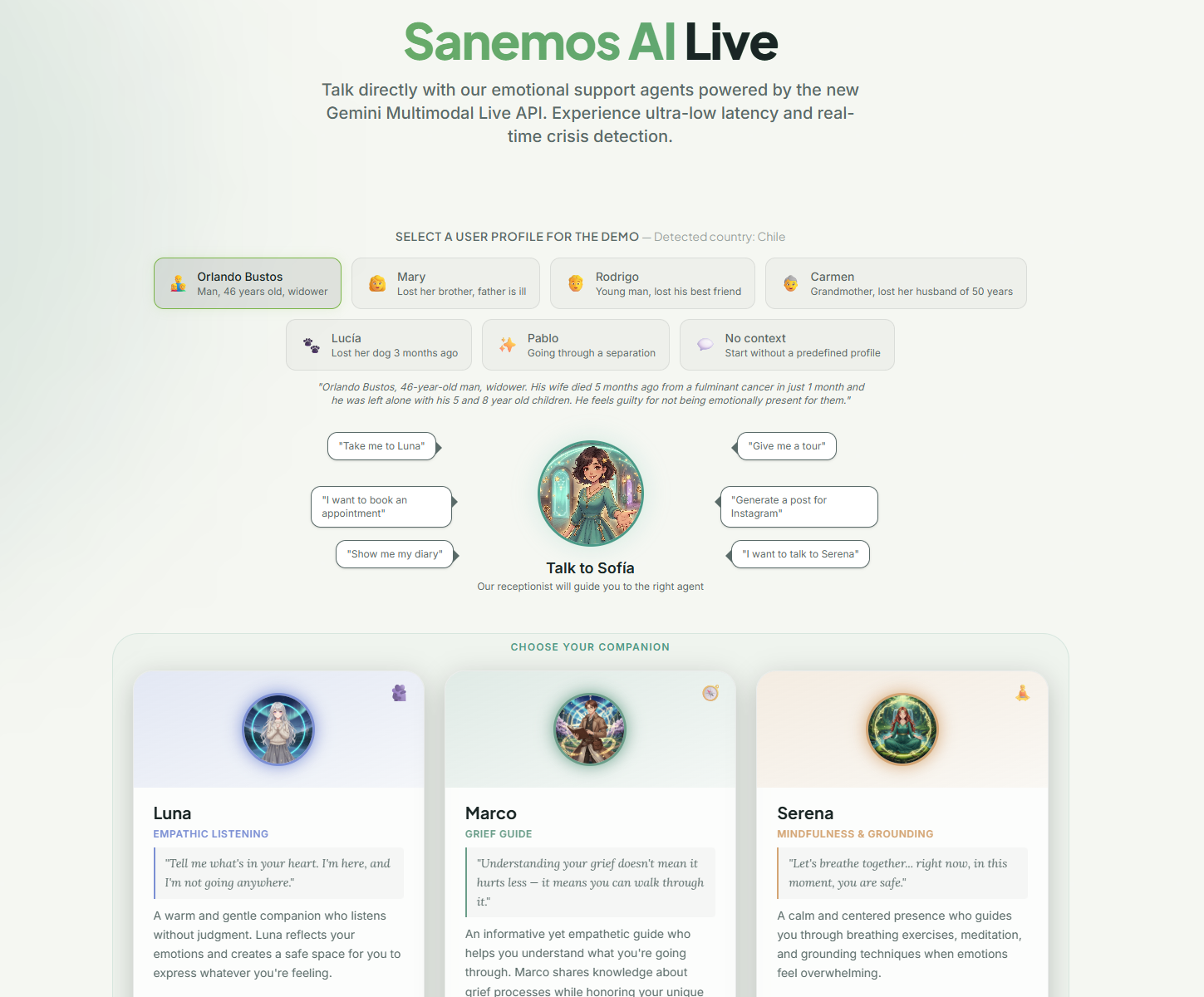
Landing
-
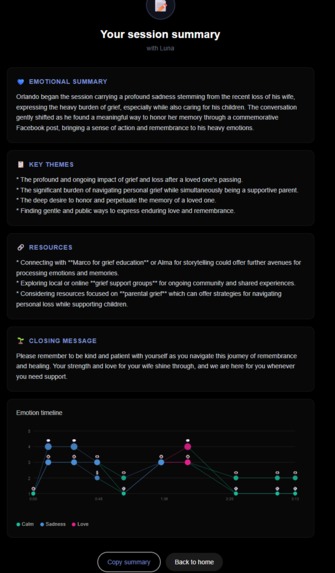
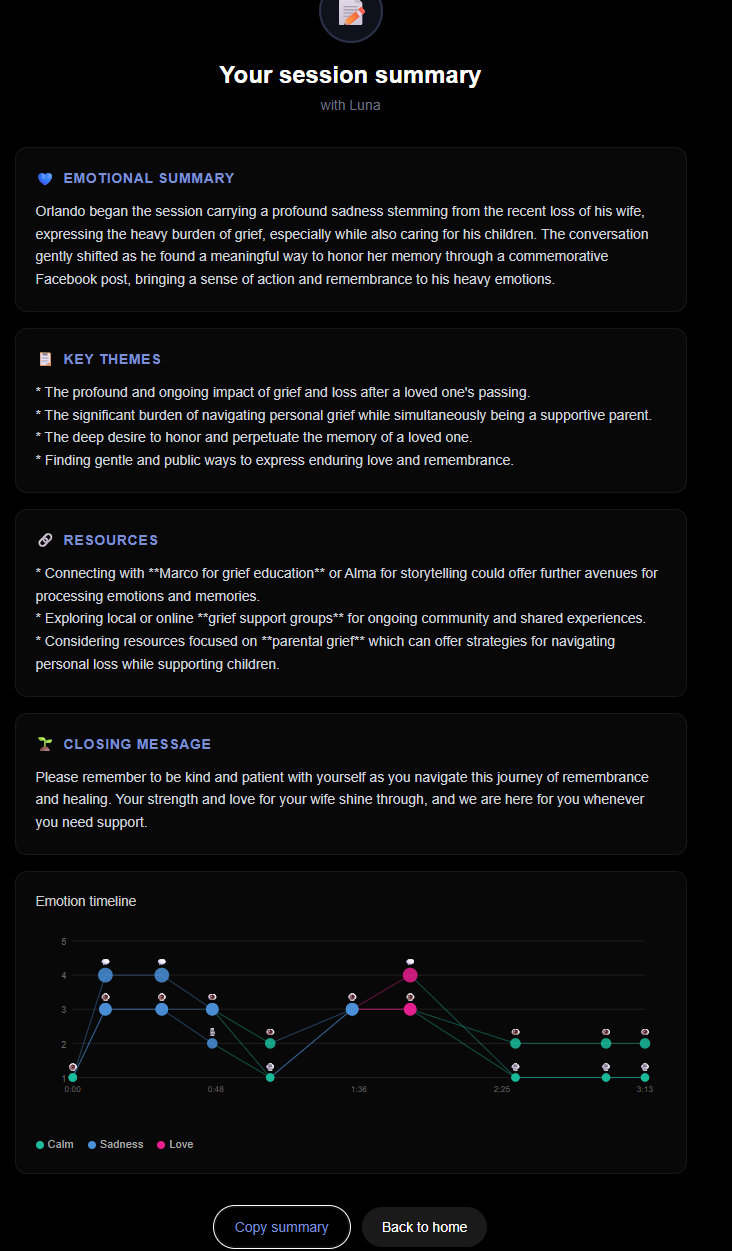
Session Summary
-
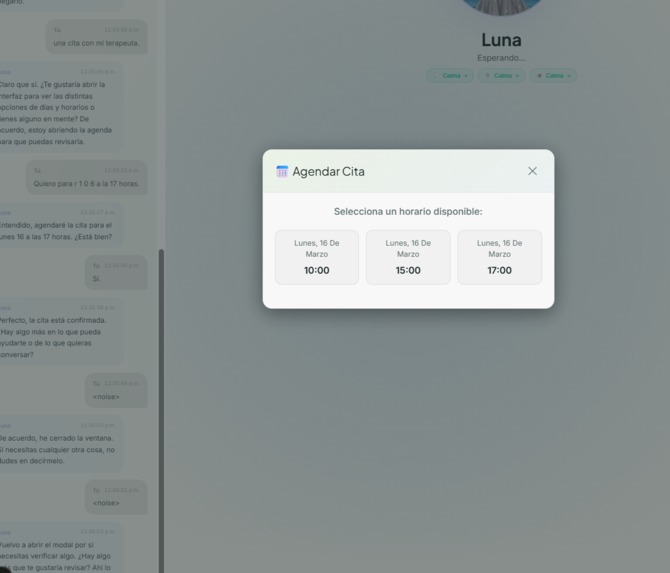
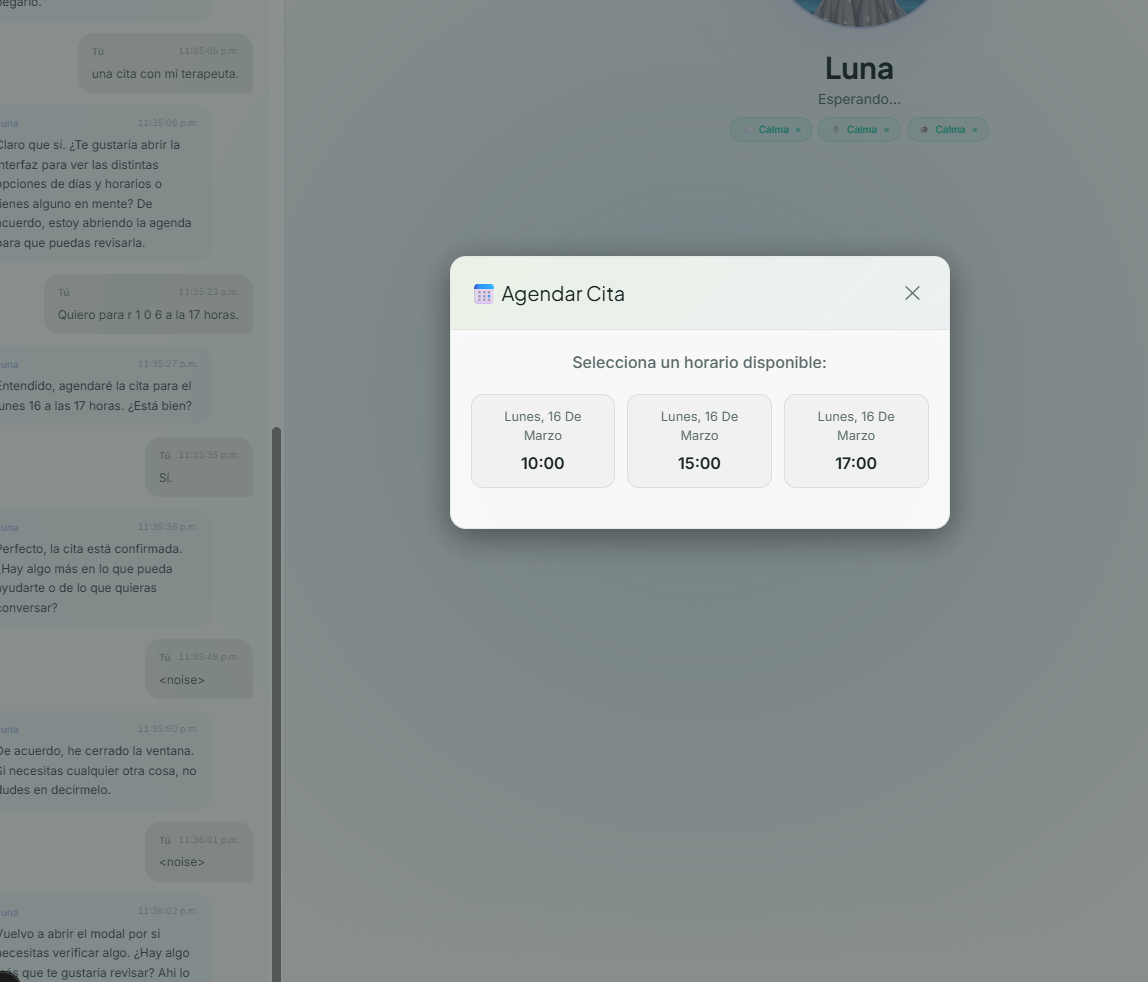
Appoinment Schedule
-
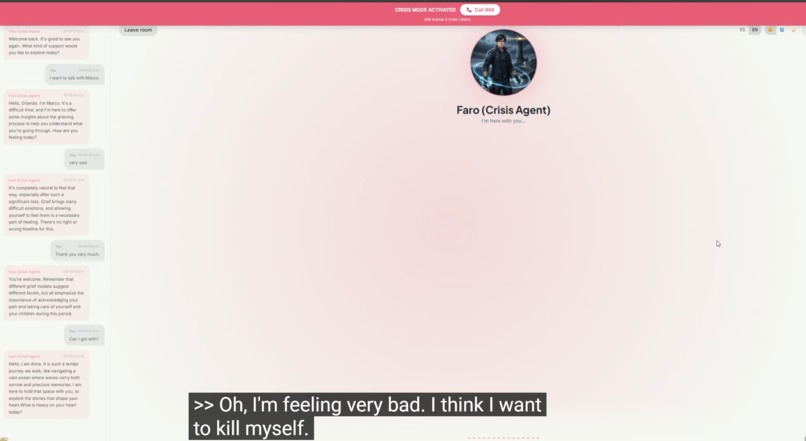
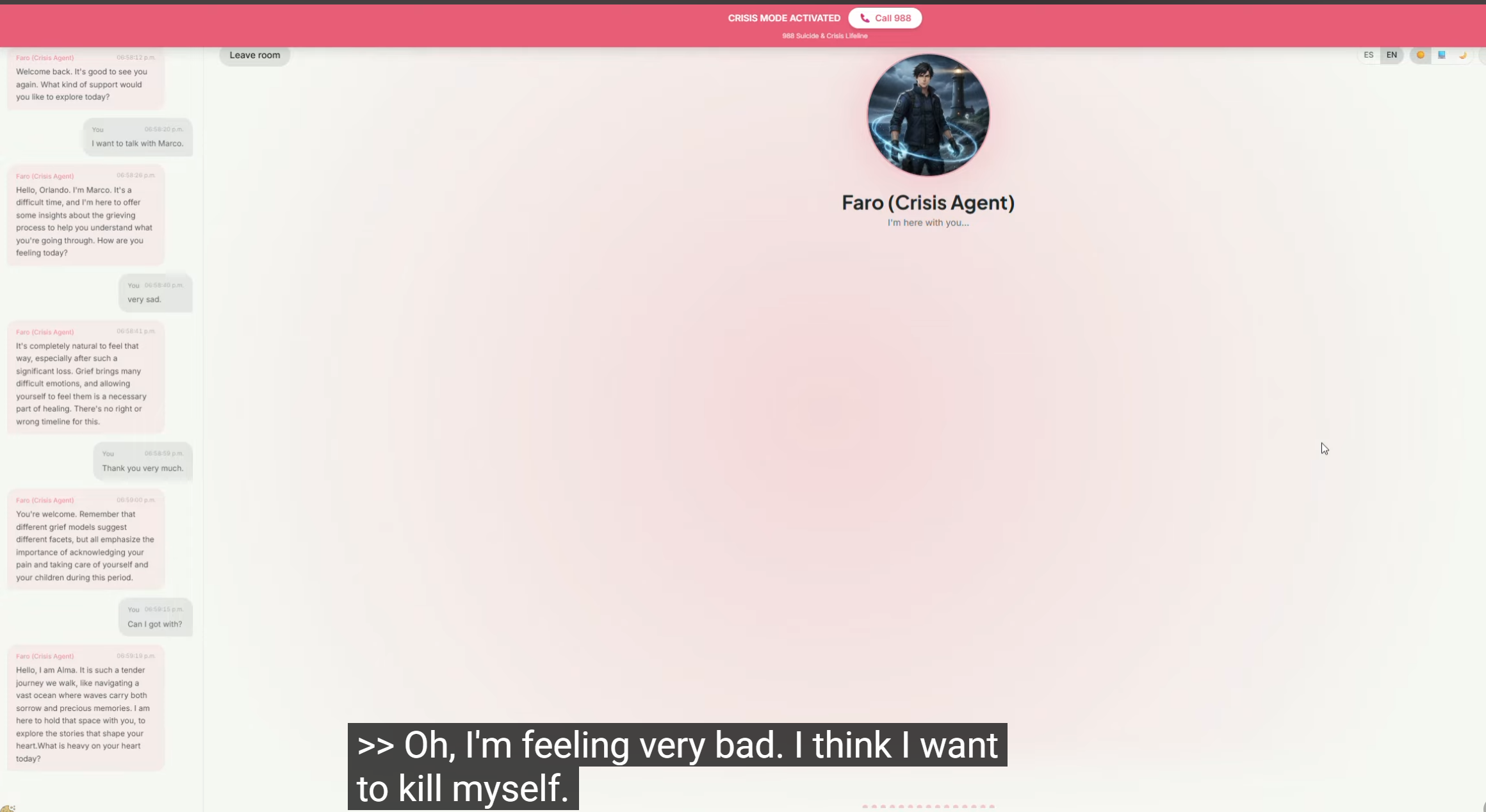
Faro, Agent for Crisis
Inspiration
This project was created strictly as a technical sandbox to explore the capabilities of the new Google Gemini Multimodal Live API. The goal was to test real-time bidirectional voice streaming, client-side interruption handling (barge-in), and multi-agent routing within a Next.js environment. The "support agents" concept was chosen purely as a complex use case to stress-test the API's latency and tool-calling features under simulated conversational constraints.
What it does
This is a proof-of-concept (PoC) repository that demonstrates how to maintain a persistent WebSocket connection with Gemini Live. It implements a basic routing mechanism to switch between different system prompts (referred to as "mock agents") to test state management during active audio streams.
Key features
- Bidirectional voice — Talk naturally, interrupt the AI mid-sentence, and it adapts instantly (client-side barge-in detection in ~150ms)
- Multimodal emotion detection — Analyzes what you say (text), how you say it (voice tone), and your facial expressions (optional camera) to track emotional state in real time
- Personal diary — Save sessions privately in your browser, review past entries with AI-generated summaries and emotion timelines
- Therapist integration — Send session summaries to a professional (Dr. María Torres), book appointments by voice ("Wednesday at 5pm")
- Breathing exercises — Serena guides you through synchronized breathing visualizations with animated circles
- Crisis auto-escalation — If any agent detects suicidal ideation, Faro activates immediately with regional hotline numbers (988 US, 717 003 717 Spain, *4141 Chile, 135 Argentina, SAPTEL Mexico)
- Post-session summary — AI-generated recap with 4 sections: Emotional Summary, Key Themes, Resources, and a Closing Message
- Bilingual — Full Spanish and English support (150+ translation keys)
- Dark/Light/System theme — Persistent, with FOUC prevention
- Privacy-first — All data stays in your browser (localStorage). No backend database, no data leaves your machine beyond the AI conversation itself
How we built it
Architecture: No intermediary server
The core design decision was zero latency overhead. The browser connects directly to Gemini's Live API via WebSocket — no proxy, no relay, no backend. This means voice responses arrive as fast as the model can generate them.
┌─────────────┐    WebSocket (Live API)    ┌──────────────────┐
│   Browser    │ ◄═══════════════════════► │  Gemini Live API  │
│  (Next.js)   │    @google/genai SDK      │  (Google Cloud)   │
│              │                           └──────────────────┘
│  8 Agents    │    REST API (Summary)     ┌──────────────────┐
│  Audio I/O   │ ─────────────────────────►│  Gemini 2.5 Flash │
│  Video I/O   │                           └──────────────────┘
│  18 Tools    │    Imagen 4 API           ┌──────────────────┐
│  Emotion AI  │ ─────────────────────────►│  Imagen 4         │
└──────────────┘                           └──────────────────┘
Stack
| Layer | Technology |
|---|---|
| Framework | Next.js 16 (Turbopack) + React 19 |
| Styling | Tailwind CSS v4 with semantic color tokens |
| Voice sessions | @google/genai SDK → ai.live.connect() |
| Summaries | ai.models.generateContent() (Gemini 2.5 Flash) |
| Audio | Pure Web Audio API — 16kHz capture, 24kHz gapless playback, zero external libraries |
| Video | getUserMedia → canvas downscale (320×240 JPEG @ 1fps) |
| Persistence | localStorage (diary, appointments, theme, onboarding) |
| Deployment | Google Cloud Run + Cloud Build + Artifact Registry |
Tool system
Each agent has a dynamically-built set of function declarations (up to 18 tools), scoped by role:
- All agents:
end_session,switch_agent, UI tools (clipboard, URLs, modals) - All except Sofía, Serena: Emotion detection tools (text, voice, facial)
- All except Faro: Diary, therapist, appointments
- Serena only:
start_breathing_exercise,stop_breathing_exercise - Marco & Serena only:
generate_visual(educational diagrams, calming imagery) - Sofía only:
mark_onboarding_done - All except Faro:
escalate_to_crisis_faro(Faro can't self-escalate)
Tools are categorized as destructive (end_session, switch_agent, escalate — no toolResponse sent, audio paused) or non-destructive (silent toolResponse with scheduling: "SILENT" so the model keeps talking).
Challenges we ran into
WebSocket 1011: The invisible killer
The most persistent and dangerous bug. While the model processes a tool call, the browser's audio worklet keeps streaming microphone data via sendRealtimeInput. The server's VAD interprets this as a barge-in, cancels the pending tool call, and crashes with error code 1011.
Solution: We introduced pauseAudioInputRef — a flag that freezes audio transmission during destructive tool calls. For switch_agent specifically, we added pendingSwitchAgentIdRef to store the target agent ID, so if a 1011 still occurs mid-transition, the onclose handler completes the switch.
This bug is partially documented in googleapis/js-genai#1210, which reports a ~50% tool call failure rate with native audio models.
Gapless audio playback
Gemini sends audio in small PCM chunks. Naively playing each chunk as it arrives creates audible gaps. We implemented scheduled playback using AudioBufferSourceNode.start(scheduledTime) with a dedicated 24kHz AudioContext, tracking each source node in an array for instant stop on barge-in.
Client-side barge-in
Waiting for the server's interrupted signal adds ~200-400ms of latency. We implemented client-side detection: monitoring the microphone's RMS level during AI playback. When RMS exceeds 0.015 for 3 consecutive frames (~150ms), we call stopAllPlayback() immediately — faster than the network roundtrip. The server's interrupted signal still arrives and is handled as confirmation.
Stale closures in WebSocket handlers
React's functional components create closures over state values. But ws.onmessage captures state at connection time, not at message time. Every mutable value accessed inside WebSocket handlers needed a useRef mirror — messagesRef, currentMsgRef, pauseAudioInputRef, and others.
React strict mode + WebSocket
Strict mode's double-mount in development caused two simultaneous WebSocket connections fighting for the microphone. Fixed with a wsRef.current !== ws guard in all event handlers.
Setup message format
The Gemini Live API rejects input_audio_transcription (snake_case) but accepts inputAudioTranscription (camelCase). speechConfig goes inside generationConfig, but transcription config goes at the setup root level. None of this was clearly documented — we found it through trial and error.
Accomplishments that we're proud of
A team, not a chatbot — 8 agents with distinct voices (Aoede, Orus, Kore, Leda, Fenrir), personalities, system prompts, and tool sets. Users talk to Luna when they need to be heard, switch to Serena when they need to breathe, and Faro is always watching in the background.
Crisis detection that actually works — Any agent can escalate to Faro if they detect distress. Faro activates within seconds, provides regional crisis hotlines, and stays present. We don't pretend to replace emergency services, but we bridge the gap at 3 AM.
Sub-200ms interruption — Client-side barge-in detection means users can interrupt the AI mid-sentence and it stops instantly. No "please wait for me to finish" experience.
What we learned
The Gemini Live API is powerful but unforgiving. Setup message format, tool call timing, audio streaming cadence — small mistakes crash the WebSocket with cryptic error codes. We documented everything in GEMINI_LIVE_BEST_PRACTICES.md.
Audio and tool calls don't mix. The server's VAD doesn't know the difference between the user speaking and background microphone noise during a tool call. You must pause audio input during destructive operations.
NON_BLOCKING+SILENTscheduling is essential for observation tools. Without it, every emotion report interrupts the agent's speech.Client-side interruption beats server-side. RMS-based detection on the client is 3-5x faster than waiting for the server's
interruptedsignal.PII scrubbing on AI-generated text causes more harm than good. Our NER model flagged generic words like "amor" (love) and "esperanza" (hope) as person names. We learned to only scrub user input, never AI output.
Grief support requires nuance that general-purpose AI doesn't have. Each agent needed carefully crafted system prompts to avoid platitudes ("everything happens for a reason"), echo chambers (reinforcing negative spirals), and clinical detachment. We added explicit instructions for echo chamber prevention and boundary enforcement.
Built with
- Google Gemini Multimodal Live API
- Google Gemini 2.5 Flash (Native Audio)
- Google Imagen 4
- Google Cloud Run
- Google Cloud Build
- Google Artifact Registry
- @google/genai SDK
- Next.js 16
- React 19
- Tailwind CSS v4
- Web Audio API
Built With
- gemini-flash-2.5
- google-cloud
- next-js
- react
- tailwind


Log in or sign up for Devpost to join the conversation.